Since so much information we decided to make it Monday and Tuesday!
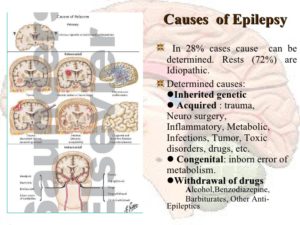
Than their is the epilepsy that is diagnosed with a IDIOPATHIC cause – meaning unknown cause and the patient could grow out of it in childhood depending on the type of seizure disorder or not–in where the condition becomes chronic (for life).
Although heredity has been known since antiquity to cause epilepsy, the progress to date in identifying the genetic basis of epilepsy has been limited primarily to the discovery of single gene mutations that cause epilepsy in relatively rare families. For the more common types of epilepsy, heredity plays a subtler role, and it is thought that a combination of mutations in multiple genes likely determine an individual’s susceptibility to seizures, as well as the responsiveness to antiepileptic medications.
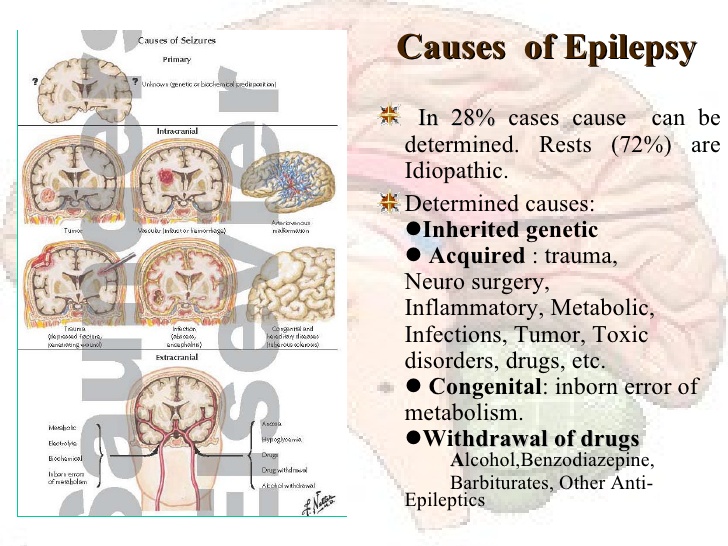
Epilepsy can be caused by genetic factors (inherited) or acquired (a etiology—cause) , although in most cases it arises in part from both. The neurology and neurological sciences of Stanford Epilepsy Center Dr. Robert S. Fischer Ph D. presents in the article Genetic Causes of Epilepsy.
He also presents in this article our genes are the instruction set for building the human body. Genes reside on chromosomes.
Going to the basics is every person has 46 chromosomes, carrying a total of about 30,000 genes. We get half our chromosomes from our mother and half from our father. While genes determine the structure of our body, they also control the excitability of our brain cells. Defective genes can make hyperexcitable brain cells, which are prone to seizures.
In recent years, several epilepsy conditions have been linked to mutations in genes, but the matter is complicated by the fact that different genes may be involved in different circumstances.
In general, the most common epilepsy conditions, including partial seizures, seem to be more acquired than genetic.
Gene testing will soon be able to identify predispositions to epilepsy, allowing doctors to help a patient get treatment and to assist with family counseling. One day, doctors may simply be able to swap a patient’s cheek, test his or her genes, and predict response to various epilepsy medicines, eliminating much of the trial and error in medication choice that goes on today. Eventually, we may even be able to repair or replace defective genes that predispose a person to epilepsy, a process called gene therapy.
Lastly, Dr. Robert Fischer Ph D presented in his article, that I found very interesting, the general population has about a 1% risk of developing epilepsy. Meanwhile, children of mothers with epilepsy have a 3 to 9% risk of inheriting this disease, while children of fathers have a 1.5 to 3% risk of inheritence. Still, the actual risk is upon the specific type of epilepsy. For example, partial seizures are less likely to run in families than are generalized seizures. In any event, with the usual forms of epilepsy, even if a parent does have the condition, there is more than a 90% chance that their child will not. So most epilepsies are acquired than inherited.
Clearly, genes determine a great deal of who we are, including our possible risk for epilepsy but slim versus a actual cause. But what happens to us in life and what we do is still the larger part of the risk for epilepsy.
A person given this diagnosis in the 1970’s, or before and even up to the early 1990’s was quiet about ever letting people know about this since in the 1970’s and back with lack of knowledge, information to the public and definitely technology than versus now. Epilepsy is much more an accepted disease in the overall community compared to 20-25 years ago and back. Heck in the 1970’s and back these patients when having a seizure episode were characterized as “Freaks”. This was due to ignorance and lack of information but due to the past 20 to 25 years with the computer used more as a must in our lives with media, television and even our government they all have made it possible for society everywhere in the world to learn and understand diseases with acceptance in wanting to help those, particularly the US, but we still need a healthier America. It will take time to get there with the many multicultural lives that all live in the U.S. which practice differently on how important or where a healthy diet with exercise balanced with rest and stress well controlled is on their priority list in living.
For a person diagnosed with or without a cause of epilepsy these steps in learning about the disease with higher technology and continuous research with medications over the years has allowed them to be able to live a completely healthy life doing the same things other people do without the disease but only if the patient is UNDER COMPLETE CONTROL which includes being COMPLIANT; this does exist in America.
Compliant meaning taking their medications everyday as ordered by their neurologist with yearly or sooner follow-up visits with blood levels of the anti-seizure medications there on. This is the only way one with chronic epilepsy is guaranteed that living this way MAY stop the seizures from occurring (inactive epilepsy you can call it — meaning you’ll always have the disease but can put the seizure activity in a remission by medications preventing the seizure.)
The purpose for (follow up) F/U visits is for the neurologist to see how good of a therapeutic drug level your anti-seizure med is in (you get the blood test before the F/U visit). Possible do a EEG (electroencephalogram); the only test to decipher if you have spikes in your brain waves indicating you had a seizure (a 26 lead to wires on the brain, which is painless). Go to the expert for keeping you on the right track. Its just like based on the principle why a person gets a check up on there car by seeing the mechanic (the car’s doctor).
Types of seizures whether with a etiology or unknown:
I-Partial seizures (seizures beginning local)
1-Simple partial seizures-(the person is conscious and not impaired). With motor symptoms, autonomic symptoms and even psychic symptoms.
2.)-Complex partial seizures-(the person is with impairment of consciousness)
II-Generalized seizures-(bilaterally symmetrical and without local onset).
3.) Tonic clonic seizures – Grand Mal
To make your life one without seizures occurring without putting your life on HOLD you need to TAKE CARE OF YOURSELF! Doing this gives you higher odds less chance of seizures occurring in most people having seizures. That is all up to you-the patient diagnosed with it.