To all have a Happy Easter and safe one!


To all have a Happy Easter and safe one!
“Phytotherapy was introduced into scientific medicine by a french physician Henri Leclerc (1877-1955). Phytotherapy is a method of treating, alleviating, and preventing disease and ailments by using whole or parts (flowers, leaves, roots) of medicinal plants. This ranges from capsules, tinctures, teas, ointments, actual chemo meds and other medicines. Phytotherapy is not an alternative to medicine but a part of scientific medicine. Besides treating medical problems the keep the human body healthy and restore harmony and balance to the human body. When used therapeutically and as prescribed they are not addictive and usually do not have side effects.”
Danijela Grizelj MD; PhD
(https://martifarm.com/the-importance-of-plants-in-the-pharmaceutical-industry/ )
“Multiple studies have found that plants in your workplace increases both productivity and creativity. In the past as far back as 2004 researchers have challenged people to make creative word associations and found they worked better with plants in the room with them. Another study as far back as 2007 showed people with plants in their work place at their job took fewer sick days and were more productive on the job. Medical clinics in Manchester, England are now prescribing to certain patients with anxiety and depression.”
“Diseases of the circulatory system and cancer remain the two leading causes of death in most countries.”
Center for Disease Control and Prevention – CDC (https://www.cdc.gov/nchs/fastats/leading-causes-of-death.htm)
“The main causes of death in the United States are typically heart disease, cancer, & unintentional injury. (keep in mind cancer covers a vast amount of areas affecting the body with this diagnosis cancer).
Heart disease is the leading cause of death for both men and women. This is the case in the U.S. and worldwide. More than half of all people who die due to heart disease are men.
Medical professionals use the term heart disease to describe several conditions. Many of these conditions relate to plaque buildup in the arteries’ walls that can create further problems.
As the plaque develops, the arteries narrow. This makes it difficult for blood to flow around the body that limits oxygen to certain organs & increases the risk of MI or stroke. It can also give rise to angina, arrhythmias, and heart failure.”
MedicalNewsToday (https://www.medicalnewstoday.com/articles/282929)
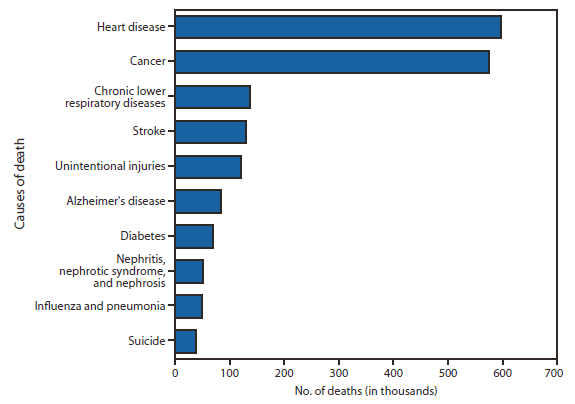
Source: Mortality in the United States, 2020, data table for figure 4
As of 2019:
For more than a decade, heart disease and cancer have claimed the first and second spots respectively as the leading causes of deaths in America. Together, the two causes are responsible for over 45 percent of deaths in the United States.
For more than 30 years, the Centers for Disease Control and Prevention (CDC) has been collecting and examining causes of death. This information helps researchers and doctors understand if they need to address growing epidemics in healthcare.
The numbers also help them understand how preventive measures may help people live longer and healthier lives.
The top 12 causes of death in the United States account for more than 75 percent of all deaths. Learn about each of the main causes and what can be done to prevent them.
Number of deaths per year: 635,260
Percent of total deaths: 23.1 percent
More common among:
Heart disease is a term used to describe a range of conditions that affect your heart and blood vessels. These conditions include:
Lifestyle changes can prevent many cases of heart disease, such as the following:
Number of deaths per year: 598,038
Percent of total deaths: 21.7 percent
More common among: Each type of cancer has a specific set of risk factors, but several risk factors are common among multiple types. These risk factors include:
Cancer is the result of rapid and uncontrolled cell growth in your body. A normal cell multiplies and divides in a controlled manner. Sometimes, those instructions become scrambled. When this happens, the cells begin to divide at an uncontrolled rate. This can develop into cancer.
There’s no clear way to avoid cancer. But certain behaviors have been linked to increased cancer risk, like smoking. Avoiding those behaviors may help you cut your risk. Good changes to your behaviors include things like:
Number of deaths per year: 154,596
Percent of total deaths: 5.6 percent
More common among:
This group of diseases includes:
Each of these conditions or diseases prevents your lungs from working properly. They can also cause scarring and damage to the lung’s tissues.
Tobacco use and secondhand smoke exposure are the primary factors in the development of these diseases. Quit smoking. Limit your exposure to other people’s smoke to reduce your risks.
Number of deaths per year: 142,142
Percent of total deaths: 5.18 percent
More common among:
A stroke occurs when the blood flow to your brain is cut off. Without oxygen-rich blood flowing to your brain, your brain cells begin to die in a matter of minutes.
The blood flow can be stopped because of a blocked artery or bleeding in the brain. This bleeding may be from an aneurysm or a broken blood vessel.
Many of the same lifestyle changes that can reduce your risk for heart disease can also reduce your risk for stroke:
Number of deaths per year: 161,374
Percent of total deaths: 5.9 percent
More common among:
Accidents lead to more than 28 million emergency room visits each year.
The three leading causes of accident-related death are:
Unintentional injuries may be the result of carelessness or a lack of careful action. Be aware of your surroundings. Take all proper precautions to prevent accidents or injuries.
If you hurt yourself, seek emergency medical treatment to prevent serious complications.
“Diet and exercise are the two most important changes you can make. Even if you’ve never been active, it’s never too late to get started. A healthy diet and physical activity are good at any age. As you age, these healthy habits strengthen muscles and bones. Strong muscles and bones reduce serious injuries related to falls. When your muscles are strong, activities like getting up from a chair or opening a door are easier. When lifting weights, start with a 1-pound or 5-pound weight. If you don’t have weights, use a can of soup, a book, or a full bottle of water. Keep your weights in the same room as your television.”
familydoctor.org (https://familydoctor.org/healthy-habits-at-age-60-and-beyond/)
“Most people with MS experience their first symptoms and are diagnosed between the ages of 15 and 50, although individuals of any age may be diagnosed with MS. More women are diagnosed with MS than men, and the area where someone lives, as well as race and ethnic background, also helps to determine his or her risk of developing the disease.
Nearly one million individuals are living with MS in the United States. This new prevalence figure was published in 2019 and is more than double the previous estimate of 400,000 affected people in the United States.”
MS Association of America (https://mymsaa.org/ms-information/overview/who-gets-ms/)
“Multiple sclerosis (MS) happens when your immune system attacks myelin, the sheath around your nerve cells. Without this outer shell, your nerves become damaged and cause communication problems between your brain and the rest of your body.
MS is a chronic, or long-lasting, disease that can affect your brain, spinal cord, and the optic nerves in your eyes. It can cause problems with vision, balance, muscle control, and other basic body functions.
The effects of MS vary from person to person. Some people have mild symptoms and don’t need treatment, while others have trouble getting around and doing daily tasks.”
WebMD (https://www.webmd.com/multiple-sclerosis/what-is-multiple-sclerosis)
“Our nervous system is divided in two components: the central nervous system (CNS), which includes the brain and spinal cord, and the peripheral nervous system (PNS), which encompasses nerves outside the brain and spinal cord. These two components cooperate at all times to ensure our lively functions: we are nothing without our nervous system!
Unlike the brain and the spinal cord of the central nervous system that are protected by the vertebrae and the skull, the nerves and cells of the peripheral nervous system are not enclosed by bones, and therefore are more susceptible to trauma.
If we consider the entire nervous system as an electric grid, the central nervous system would represent the powerhouse, whereas the peripheral nervous system would represent long cables that connect the powerhouse to the outlying cities (limbs, glands and organs) to bring them electricity and send information back about their status.”
University of Queensland (https://qbi.uq.edu.au/brain/brain-anatomy/peripheral-nervous-system)
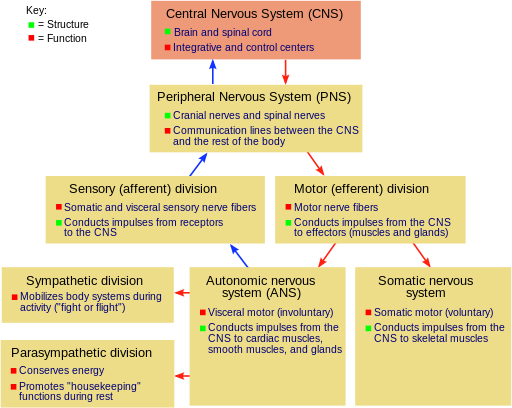
1 – Central nervous system (CNS): Your brain and spinal cord make up your CNS. Your brain reads signals from your nerves to regulate how you think, move and feel.
2 – Peripheral nervous system (PNS): Your PNS is made up of a network of nerves. The nerves branch out from your spinal cord. This system relays information from your brain and spinal cord to your organs, arms, legs, fingers and toes.
Your peripheral nervous system (PNS) is that part of your nervous system that lies outside your brain and spinal cord. It plays key role in both sending information from different areas of your body back to your brain, as well as carrying out commands from your brain to various parts of your body.
Some of those signals, like the ones to your heart and gut, are automatic. Others, like the ones that control movement, are under your control.
Your nervous system consists of two main parts: your central nervous system and your peripheral nervous system.
Your central nervous system includes two organs, your brain and spinal cord.
Your peripheral nervous system is everything else and includes nerves that travel from your spinal cord and brain to supply your face and the rest of your body. The term “peripheral” is from the Greek word that means around or outside the center.
There are two parts to your peripheral nervous system:
Your somatic nervous system is a subdivision of your peripheral nervous system, which is all of your nervous system except your brain and spinal cord. Your somatic nervous system allows you to move and control muscles throughout your body. It also feeds information from four of your senses — smell, sound, taste and touch — into your brain.
Your autonomic nervous system is a network of nerves throughout your body that control unconscious processes. These are things that happen without you thinking about them, such as breathing and your heart beating. Your autonomic nervous system is always active, even when you’re asleep, and it’s key to your continued survival.
Your autonomic nervous system is a part of your overall nervous system that controls the automatic functions of your body that you need to survive. These are processes you don’t think about and that your brain manages while you’re awake or asleep.
Nerve cells (neurons) are the basis of your nervous system. There are 100 billion neurons in your brain. These cells connect throughout your entire body.
Imagine your nervous system as a tree. Your central nervous system is the trunk of the tree that contains your brain and spinal cord. The tree branches are your peripheral nervous system (nerves). The branches extend from the truck (brain and spinal cord) to reach all parts of your body.
Signs and symptoms of nervous system conditions vary by type but may include:
Some conditions, like a stroke, are medical emergencies that need treatment quickly. If you notice the following symptoms, contact 911 or your local emergency services number: