Archive | February 2025

QUOTE FOR THURSDAY:

“For American Heart Month here are Heart Disease Quick Facts to know:

  • Heart disease is very common. In the United States, heart disease is the leading cause of death for men, women, and people of most racial and ethnic groups.1 In 2022, 1 in every 5 deaths in the United States was caused by heart disease.12
  • High blood pressure is a leading cause of heart disease. Nearly half of U.S. adults have high blood pressure, which puts them at risk for heart disease and stroke. And just 1 in 4 people with high blood pressure has it under control.3
  • Heart disease is costly. The cost of health care services, medications, and lost productivity from heart disease amounted to $252.2 billion between 2019 and 2020.”

Centers for Disease Control and Prevention-CDC (American Heart Month Communications Toolkit | Heart Disease | CDC)

QUOTE FOR WEDNESDAY:

“Wear Red this month to help raise awareness of the No. 1 killer of people in the U.S.; cardiovascular disease!  American Heart Month, observed in February, is a time to focus on heart health awareness. It aims to educate beginners about preventing heart disease through healthy lifestyle CHOICES!  National Wear Red Day is Friday 2/07.”

American Heart Association (American Heart Month | American Heart Association)


QUOTE FOE TUESDAY:

“February is National Cancer Prevention Awareness Month, a time to reflect on the steps we can take to reduce our risk of cancer.  Know this 40% of cancer cases and 44% of cancer-related deaths are linked to preventable lifestyle choices. By making informed decisions about what we eat, drink, and expose ourselves to, we can significantly lower our cancer risk.

5 things you should know about cancer prevention month:

1-Everyone knows, smoking remains the #1 most significant preventable cause of cancer, accounting for about 19.3% of cancer cases and 28.5% of cancer deaths.

2-Alcohol, in any amount, is detrimental to our health. Alcohol consumption contributes to 5.4% of cancer cases. It increases the risk of cancers in the oral cavity, pharynx, esophagus, colorectum, liver, larynx, and breast. CRI Clinical Innovator Marina Baretti, MD (Johns Hopkins University School of Medicine), recently highlighted the importance of controlling alcohol intake. “The recommendation is really to either stay away or (have) no more than two drinks per day for a man (and) no more than one drink per day for a woman,” she advised.

3-Our dietary habits can make a real difference towards our cancer risk.  Consumption of red meat (beef, pork, veal, lamb, etc) and processed meats (smoked and cured meats, cold cuts, sausages, etc) have been shown to increase a person’s risk for colorectal cancer. In addition, excess body weight is also a significant and preventable risk factor for cancer. Research has shown that high BMI is associated with an increased risk of developing 13 to 18 types of cancer.

4-Ultra Violet (UV) radiation from the sun and tanning beds contributes to 4.6% of cancer cases. In fact, it’s the primary cause of melanoma, the deadliest form of skin cancer. Over five million annual global cases of skin cancer due to direct exposure of UV rays.

5-It may come as a surprise, but infections caused by viruses and certain bacteria play a significant role in cancer development. In fact, they account for approximately 13% of cancer cases globally.”

CRI – Cancer Research Institute (Five Things You Need to Know for National Cancer Prevention Month – Cancer Research Institute)

QUOTE FOR MONDAY:

“As we age, we are more likely to develop systemic health problems like high blood pressure, heart disease or diabetes. It’s important to remember that these diseases can seriously damage your eyes as well. One warning sign of both high blood pressure and diabetes: frequent changes in vision (such as blurriness).

Always tell your ophthalmologist about your health conditions and what medications and nutritional supplements you take. They will also want to know about your eating, sleeping, exercise and other lifestyle choices. Remember: you and your ophthalmologist are partners in caring for your vision.”

American Academy of Ophthalmology (Tips for Eye Health in Adults Over 65 – American Academy of Ophthalmology)

Eye health tips for those at age 60 and over!

Eyes over 601Eyesover602

Women-Higher Risk for Some Eye Diseases

Women are more likely than men to have glaucoma and women are also more likely to be visually impaired or blind due to glaucoma. Also, women are 24 percent less likely to be treated for glaucoma. Cataract is somewhat more common in women, as well. Women should be sure to follow the Academy’s screening guidelines and adhere to their Eye M.D.’s follow-up appointment recommendations and treatment plans.

Low Vision

The term low vision describes vision loss that makes daily tasks difficult. Normal aging of the eye does not lead to low vision; it is a result of eye diseases, injuries or both. Low vision symptoms nclude loss of central and/or peripheral (side) vision, blurred or hazy vision or night blindness. A person may have trouble recognizing faces, reading, driving and shopping. If you experience any of these problems, it is important to see your Eye M.D., who will check for and treat any underlying conditions and advise on low vision resources and low vision aids and devices to help with reading and other daily tasks. Most people with low vision need brighter lighting in their living areas.

Avoid Falls and Related Eye Injuries

About half of all eye injuries occur in or around the home, most often during improvement projects (44 percent). The good news is that nearly all eye injuries can be prevented by using protective eyewear, so every household needs to have at least one pair of certified safety glasses on hand.

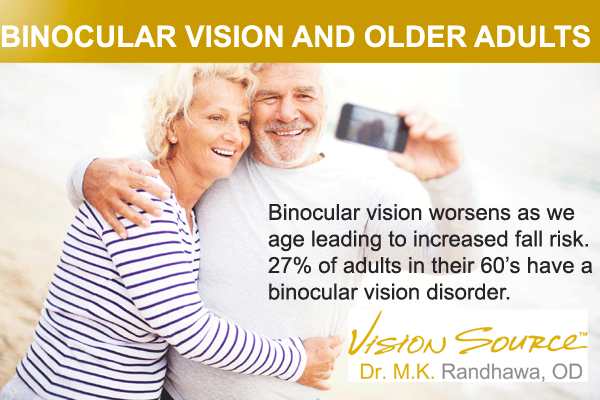
It’s also important to reduce the risk of falls, which become more likely as we age, due to changes in vision and balance. Consider taking these safety steps around the home to diminish the risks of injuring your eyes:

  • Make sure that rugs and shower/bath/tub mats are slip-proof.
  • Secure railings so that they are not loose.
  • Cushion sharp corners and edges of furnishings and home fixtures.

Systemic health problems to avoid

Systemic health problems like high blood pressure and diabetes that may be diagnosed or become more problematic in midlife can also affect eye health. One warning sign of both high blood pressure and diabetes is when the ability to see clearly changes frequently. Be sure to keep your Eye M.D. informed about your health conditions and use of medications and nutritional supplements, as well as your exercise, eating, sleeping and other lifestyle choices.

Exercise a great tip to help eyes

Our eyes need good blood circulation and oxygen intake, and both are stimulated by regular exercise. Regular exercise also helps keep our weight in the normal range, which reduces the risk of diabetes and of diabetic retinopathy. Gentler exercise, including walking, yoga, tai chi, or stretching and breathing, can also be effective ways to keep healthy. Remember to use sun safety and protective eyewear when enjoying sports and recreation.

Sleep are great also with exercise

As we sleep, our eyes enjoy continuous lubrication. Also during sleep the eyes clear out irritants such as dust, allergens, or smoke that may have accumulated during the day.

Some research suggests that light-sensitive cells in the eye are important to our ability to regulate our wake-sleep cycles. This becomes more crucial as we age, when more people have problems with insomnia. While it’s important that we protect our eyes from over-exposure to UV light, our eyes also need exposure to some natural light every day to help maintain normal sleep-wake cycles.

QUOTE FOR THE WEEKEND:

“Millions of people in the United States are living with a visual impairment. A visual impairment can make it hard to do everyday activities, like getting around, reading, or cooking. And it can’t be fixed with glasses, contacts, or other standard treatments, like medicine or surgery.
The good news is that vision rehabilitation services can help people with a visual impairment make the most of the vision they have — and keep doing the things they love. Take some time this Low Vision Awareness Month to learn about vision rehabilitation and spread the word!”

AMD/Low Vision Awareness Month

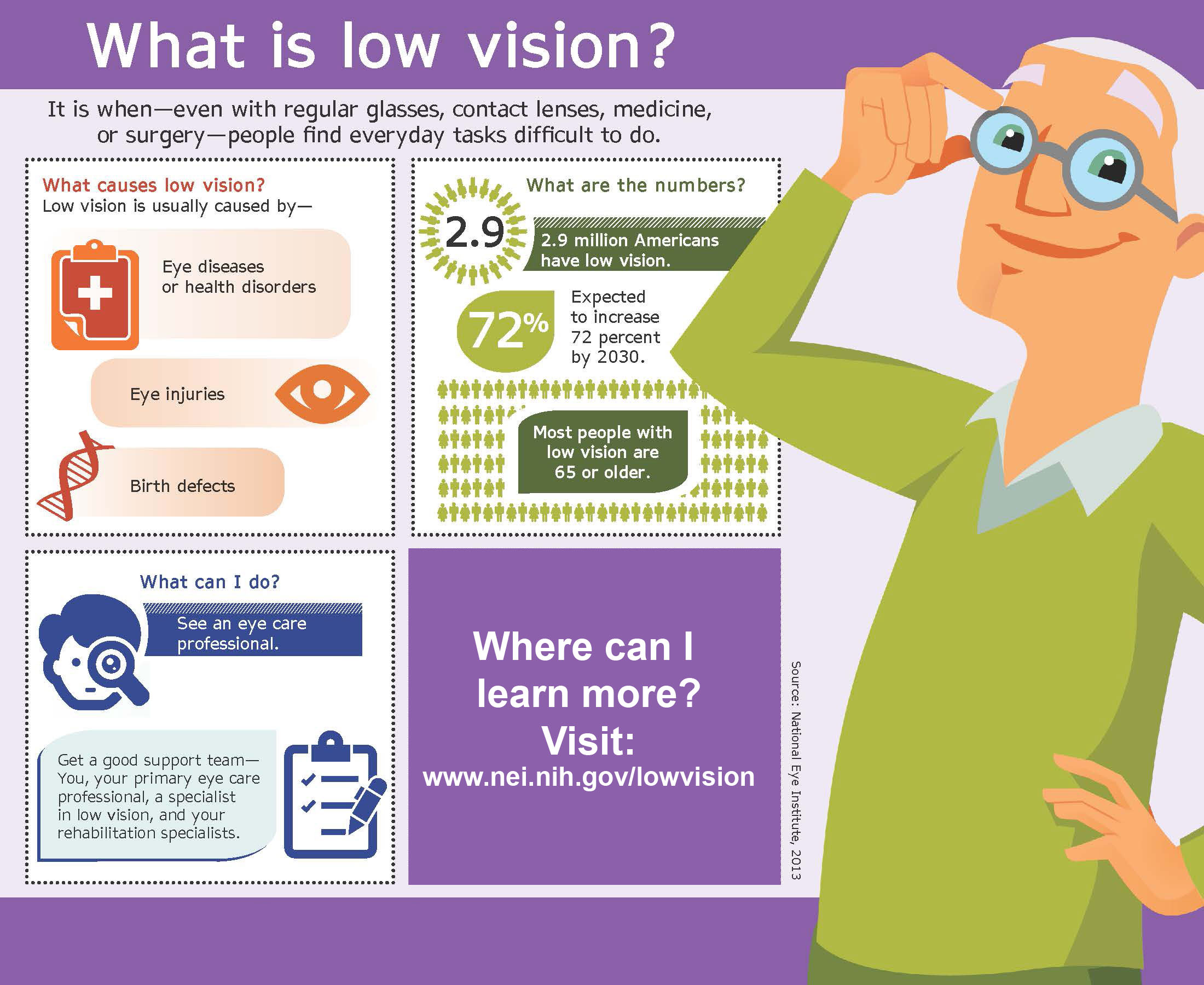
Prevent Blindness has declared February as Age-related Macular Degeneration (AMD) and Low Vision Awareness Month. According to the American Academy of Ophthalmology, AMD is a leading cause of vision loss in people 50 years or older, and more than 2.9 million Americans age 40 and older have low vision. Low vision is defined as a visual impairment that is not correctable through surgery, medicine, eye glasses or contact lenses.

According to the National Eye Institute, currently 4.2 million Americans ages 40 and older are visually impaired. Of these, 3 million have low vision. By 2030, when the last baby boomers turn 65, the number of Americans who have visual impairments is projected to reach 7.2 million, with 5 million having low vision.

For the millions of people who currently live or will live with low vision, the good news is that there is help.

But first, what is low vision? Low vision is when even with regular glasses, contact lenses, medicine, or surgery, people have difficulty seeing, which makes everyday tasks difficult to do. Activities that used to be simple like reading the mail, shopping, cooking, and writing can become challenging.

Most people with low vision are age 65 or older. The leading causes of vision loss in older adults are age-related macular degeneration, diabetic retinopathy, cataract, and glaucoma. Among younger people, vision loss is most often caused by inherited eye conditions, infectious and autoimmune eye diseases, or trauma. For people with low vision, maximizing their remaining sight is key to helping them continue to live safe, productive, and rewarding lives.

The first step is to seek help.

What is a low vision specialist? A low vision specialist is an ophthalmologist or optometrist who works with people who have low vision. A low vision specialist can develop a vision rehabilitation plan that identifies strategies and assistive devices appropriate for the person’s particular needs.

A low vision examination is quite different from the basic examination routinely performed by primary care optometrists and ophthalmologists.

A low vision examination includes a review of your visual and medical history, and places an emphasis on the vision needed to read, cook, work, study, travel, and perform and enjoy other common activities. The goals of a low vision exam include assessing the functional needs, capabilities, and limitations of your vision, assessing ocular and systemic diseases, and evaluating and prescribing low vision therapies.

Education and counseling of family and other care providers; providing an understanding of your visual functioning to aid educators, vocational counselors, employers and care givers; directing further evaluations and treatments by other vision rehabilitation professionals; and making appropriate referrals for medical intervention are all a part of a low vision evaluation.

Vision rehabilitation can include the following:

  • Training to use magnifying and adaptive devices
  • Teaching new daily living skills to remain safe and live independently
  • Developing strategies to navigate around the home and in public
  • Providing resources and support

The good news is that vision rehabilitation services can help people with vision impairment learn how to stay independent and make the most of their sight. Low Vision Awareness Month is a great time to spread the word about vision rehabilitation — and make sure that people with vision impairment know about the services available to them.

Magnification devices, electronic devices, computer-access software, and other access and mainstream technologies are used to help people with low vision maximize their remaining vision or learn alternative ways to do things, such as using their sense of touch or their sense of hearing.