Archive | February 2025

QUOTE FOR FRIDAY:

“Organ Donor Day is celebrated on February 14 annually as a nod to one of the greatest gestures of love. Valentine’s Day celebrates love and what better way to celebrate ultimate love than receiving an organ donation? It is a day to celebrate people who have saved lives in countless ways by donating blood marrow, blood, and organs. Families also remember people who have donated their organs or blood to save their loved ones in their times of need. If you can, donate your blood or tissue today.

Legally, an organ can be taken and transplanted from a donor, either while the donor is still alive or after their death, with the approval of the donor’s family members. Donations can be made to further scientific knowledge or, more typically, healthy organs and tissues might be donated to be transplanted into another person.

It is not uncommon for people to be given organ transplants for a wide range of reasons. A kidney or part of the liver, part of the pancreas, part of the lungs, or intestines can be donated by a living donor, but most organ and tissue donations are made after the donor has died.”

National Today (ORGAN DONOR DAY – February 14, 2025 – National Today)

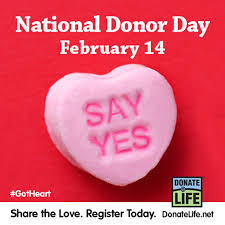
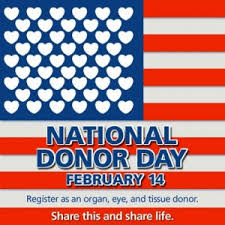
National Donor Day!

HISTORY

National Donor Day was started in 1998 by the Saturn Corporation and its United Auto Workers partners, with the support of the U.S. Department of Health and Human Services and many nonprofit health organizations.

There are over 1,500 national days. Don’t miss a single one. Celebrate Every Day with National Day Calendar!

February 14th is National Donor Day, which aims to raise awareness of the lifesaving benefits of organ, eye and tissue donation while reminding of the importance of discussing the topic with your loved ones. We encourage you to use National Donor Day to discuss organ, eye and tissue donation with those closest to you.

  • What does it mean to sign-up as a donor?

Signing up as an organ, eye and tissue donor means you have made the decision to donate your organs, eyes and tissues at the time of your death. .

  • Start the Conversation

Sometimes starting the conversation can be difficult. Learn a few easy ways to “start the conversation here” on the internet.   It is important to discuss your decision with your family as that will take priority over your family’s preferences. Making the decision for yourself in advance makes it easier for your family during a very difficult time. Discussing donation with loved ones will help them feel confident and prepared when they are presented with information about the donation process.

So #StartTheConversation today and celebrate your heroic choice to save and heal lives with your family!  You can share the love this National Donor Day by starting the conversation with those closest to you.

Let your loved ones know that just one donor can save up to eight lives through organ donation and save and heal more than 75 lives through eye and tissue donation. Learn more about the need for donation and about how individuals can take action by signing up anytime online at DonateLifeColorado.org or DonateLifeWyoming.org.

Want to join in on social media? Share with your loved ones that you signed up to be an organ, eye and tissue donor and why it’s important to you. Be sure to use the hashtag

#StartTheConversation. Help us spread awareness for organ, eye and tissue donation. Signing up gives hope to the 2,000 people right here in our local region who are waiting for a lifesaving organ transplant.

Just one donor can save up to eight lives through organ donation and save and heal up to 75 lives through tissue donation. There are nearly 2,000 awaiting a lifesaving organ transplant in our local region. Learn the facts of donation and share with your loved ones.

Many of those waiting may never get a second chance at life as it is estimated that every day in the U.S. 22 patients die because of the lack of donor organs. Many people who have never considered organ donation or have delayed registering to become a donor do so because of inaccurate information or assumptions about organ donation and transplantation.

One of the post common myths about organ donation is that there is an additional cost the organ and tissue donor’s family or their estate. However, there is in fact no cost to the donor’s family for organ, eye and tissue donation. The local, federally-designated organ procurement organization assumes all costs associated with recovering and processing organs and tissues for transplants once death has been declared and authorization is confirmed through either the donor registry, or from the family in lieu of registration. These costs are never passed on to the donor family. Donor Alliance’s culture and values are built on respecting and appreciating the gift of donation, which we have found is a comfort to both donor families and transplant recipients.

Eventually, the costs are reimbursed by transplant centers. Once a transplant is completed, the transplant center will bill private and public insurance plans. Hospital expenses incurred before the donation of organs or tissue and funeral expenses remain the responsibility of the donor’s family.


QUOTE FOR THURSDAY:

Treat your sweetheart tomorrow including a friend, family member, or yourself if you want to a present that cultivates cardiovascular health; it still is heart month.

“5 heartfelt gift ideas for Valentine’s Day – Harvard Health

1-Making home-cooked meals is one of the best things you can do for your cardiovascular health. Research suggests that people who eat more meals made at home tend to weigh less and have healthier cholesterol and blood sugar values compared with people who eat out frequently. “You can control the amount of saturated fat, salt, and sugar in food you make yourself. You’ll also avoid the preservatives, additives, and dyes found in convenience foods like frozen dinners and other processed foods,” says Dr. Frates.

2-Both strawberries and dark chocolate contain beneficial plant compounds called flavonoids, which are thought to improve cardiovascular health by relaxing blood vessels, improving blood sugar and cholesterol levels, and discouraging blood clots. Studies have linked diets rich in flavonoids to a lower risk of heart attacks and related problems.

3-Custom fit sneakers-If people walk, jog, or hike in shoes that don’t fit properly, they can run into problems, says Dr. Frates. For example, ill-fitting shoes can cause blisters, put pressure on bunions, or leave you vulnerable to plantar fasciitis (inflammation of the fibrous band of tissue on the bottom of the foot) and Achilles tendinitis (inflammation of the tendon connecting the calf muscle to the heel). Some experts recommend replacing your walking shoes at least every 300 to 500 miles, which translates to a new pair every six to 12 months if you regularly walk about three miles per day.

4-Luxury Sleep Products-Getting at least seven hours of sleep each night is vital for cardiovascular health, says Dr. Frates. Insufficient sleep can raise your risk for weight gain, diabetes, high blood pressure, and heart disease. Creating a sleep sanctuary that’s quiet, dark, and comfortable can make it easier to fall and stay asleep.

5-A subscription to a meditation app.-Meditation and mindfulness have been shown to lower blood pressure, decrease levels of the stress hormone cortisol, and increase heart rate variability (microsecond time differences from one heartbeat to the next), all of which are linked to better heart health. “A regular meditation practice can help you to better manage stress, which is an unavoidable part of life,” says Dr. Frates.

By , Executive Editor, Harvard Heart Letter

Have a healthy and happy Valentine’s day tomorrow!

QUOTE FOR WEDNESDAY:

“February is National Children’s Dental Health Month (NCDHM)
A national health observance to promote the benefits of good oral health, brought to you by the ADA.

National Children’s Dental Health Month observances began with a one-day event in Cleveland and a one-week celebration in Akron, Ohio, in February 1941.

Since then, the concept has snowballed into a nationwide program, bringing together thousands of dedicated professionals, health care providers and educators to promote the benefits of good oral health to children, their caregivers, teachers and many others.

The theme this year is “Healthy Habits for Healthy Smiles!”

The ADA held the first national observance of Children’s Dental Health Day on Feb. 8, 1949. The one-day event became a weeklong event in 1955, and in 1981 the program was extended to a monthlong celebration known today as National Children’s Dental Health Month.

“I am passionate about increasing access and advocating for improving the oral health of all Americans, and I believe there’s no better or easier place to start than with improving the oral health for our nation’s children,” said Elizabeth Simpson, D.M.D., chair of the ADA Council on Advocacy for Access and Prevention. “When we can get all children to the dentist, create positive experiences at the dental office for them and start then early with prevention and oral health education, it’s fair to hope that those patterns started in childhood can last a lifetime. I hope that people will find a way in whatever practice modality they practice to celebrate National Children’s Dental Health Month.”

The NCDHM Program Planning Guide provides program coordinators, dental societies, teachers and parents with resources to promote the benefits of good oral health to children. The guide includes easy-to-do activities, program planning timetable tips, a sample NCDHM proclamation and more.

The planning guide is an accompaniment to the annual postcard and poster program run by the ADA. This year, the Association received orders for 151,010 posters and postcards, which exceeds last year’s total amount of 115,000.

“Whether you hold a Give Kids A Smile event or volunteer in an elementary school and teach children about the dental profession and oral health, no action is too small, and all actions are needed as pieces of the puzzle to improve oral health outcomes for our children,” Dr. Simpson said.

Give Kids A Smile, which traditionally kick offs each February, is the signature access-to-care program of the ADA Foundation. Each year, about 65,500 dentists and 20,000 dental team members volunteer at local Give Kids A Smile events across the country to provide free oral health education, screenings, preventive, and restorative treatment to about 300,000 children. More than 7 million underserved children have received free oral health services since its inception more than two decades ago.”

ADA News (National Children’s Dental Health Month kicks off across country in February | American Dental Association)
QUOTE FOR TUESDAY:

“February is Teen Dating Violence Awareness Month (TDVAM), and the 2025 theme, “Respect That,” focuses on the importance of respect in all relationships.

Dating violence is more common than many realize—about 1 in 3 teens in the U.S. experiences some form of abuse from a dating partner. It can happen to anyone, regardless of gender, and may take place in person or online.

Teen dating violence includes physical, emotional, verbal, or digital abuse. As a parent or caregiver, you play a key role in educating your teen about what a healthy relationship looks like and how to recognize unhealthy behaviors.

Teen dating violence is any action by a partner meant to harm, manipulate, or control the other person. It can include:

  • Physical violence: Actions like hitting, pushing, or restraining.
  • Emotional abuse: Manipulation, humiliation, or constant criticism.
  • Sexual violence: Coercion or forcing unwanted physical acts.
  • Verbal abuse: Name-calling, yelling, or making threats.
  • Digital abuse: Monitoring social media accounts, excessive texting, or sharing private images without consent.”

Pillars Community Health (Talking to Your Teen About Safe Relationships | Pillars Community Health)

QUOTE FOR MONDAY:

“According to the infographic—which sources information from the American Veterinary Medical Association (AVMA) and the American Society for the Prevention of Cruelty to Animals, among others—there are a number of items that responsible pet parents need to be aware of, including:

  • Finances: It is important that pet parents understand the financial cost of properly caring for a cat or dog—which when considering routine veterinary care, food, toys, training, grooming, and other expenses—can costs hundreds of dollars a year.
  • Vaccines: In addition to regular care, pet parents should consult with their veterinarian about vaccinations, heartworm prevention, and other preventive measures that can protect cats and dogs from a range of potentially deadly diseases.
  • Protection: According to the AVMA, more than 10 million cats and dogs are lost or stolen every year, and one-third of pets will become lost at some point in their life. Microchipping your pet greatly increases the chances that they will be recovered if lost or stolen.

“Now more than ever, we consider our pets to be members of the family, so it is essential that people understand all that goes into being a responsible pet parent,” said Fran Dirksmeier, President, Henry Schein Animal Health, North America. “We encourage veterinarians to download this infographic and share it with their clients so they can be the best pet parents possible. Through regular veterinary visits, a healthy diet, and lots of exercise, we can ensure our pets live long, healthy, and happy lives.”

Henry Schein/solutions for health care professionals (Henry Schein Recognizes Responsible Pet Owners Month By Reminding Pet Parents To Take Their Pets To The Vet – Henry Schein)

QUOTE FOR THE WEEKEND:

“Many of us assume that the indoor air quality in our homes is much safer than the air outdoors. However, the Environmental Protection Agency has found that indoor air pollution is one of the most hazardous environmental threats to humans! If you’re like the average individual, you probably spend a good amount of time indoors, so it’s important to educate yourself regarding indoor air quality.

Your windows may be spotless and your floors may sparkle, but for millions of adults and children with allergies, asthma, and other respiratory conditions, a house is only as clean as its air.

Though it might be hard to believe, ­indoor air can be five times dirtier than what we breathe outside, exposing us to carcinogens, including radon and formaldehyde, as well as quotidian lung-gunking impurities, such as pollen, dust mites, pet dander, and a variety of particulate matter created when we burn candles or cook.

Judging from the skyward trend in sales figures, Americans are turning to portable air purifiers in increasing numbers, paying hundreds or even thousands of dollars to reduce indoor air pollutants and the sniffles, sneezes, coughs, and asthma attacks they can trigger.

The Environmental Protection Agency evaluates the energy consumption of air purifiers for its Energy Star program but is careful to issue a disclaimer about their health benefits: “While some home air cleaning devices may be useful in some circumstances, EPA makes no broad endorsement of their use.” According to the agency, the best way to avoid health problems caused by indoor air pollution is to control or eliminate the sources of pollutants (by banning smoking in the house, for instance) and to ventilate the home with clean outdoor air.

Though the benefits of portable air purifiers are still being debated by the scientific community, recent research suggests that they could protect against the ill effects of air pollution under certain conditions. A small, well-designed study, funded in part by China’s National Health and Family Planning Commission and conducted at a Shanghai university, found that the use of filter-based air purifiers was associated with reducing the adverse health effects caused by polluted air. Another study, conducted by Canada’s British Columbia Centre for Disease Control and other Canadian governmental and academic groups, concluded that the use of portable air purifiers can lower indoor levels of particulate matter caused by smoke pollution and, in doing so, benefit respiratory and cardiovascular health.

Energy Star. Models that carry this familiar blue logo are 40 percent more energy efficient than non-Energy Star models. That’s an important consideration for an appliance that CR suggests people run 24 hours a day.”

Consumer Reports (https://www.consumerreports.org/appliances/indoor-air-quality/how-to-improve-indoor-air-quality-a7861970027/?EXTKEY=SM72CR0D&gclsrc=3p.ds&&gclid=ce189d340a06186a625cfaa)

QUOTE FOR THE WEEKEND:

“Valvular heart disease (VHD) is a major cause of morbidity and premature death from cardiovascular diseases, making it an important clinical entity. Despite a dramatic decline in the incidence of rheumatic heart disease in industrialized countries, VHD remains highly prevalent. Although many VHDs are acquired during adult life, familial clustering and heritability have been noted for common heart valve defects.”

American Heart Association Journal (ahajournal.org)

QUOTE FOR FRIDAY:

“Using marijuana as little as once per month is associated with a higher risk of both heart attack and stroke, according to a large study published Wednesday by researchers from Massachusetts General Hospital. The risks rose sharply the more frequently marijuana was used.

The paper, which was published in the Journal of the American Heart Association, adds to the growing body of evidence suggesting marijuana may be harmful to the cardiovascular system.

Scientists analyzed data on nearly 435,000 patients, ages 18 to 74, to see whether there was a link between marijuana use and a higher risk of heart disease, stroke or heart attack. The data came from a behavioral risk factor survey collected from 2016 to 2020 by the Centers for Disease Control and Prevention.

Compared with people who had never used marijuana, daily cannabis users had 25% higher likelihood of heart attacks and 42% higher risk of strokes. People who used marijuana just once a week had a 3% increased likelihood of a heart attacks and 5% higher risk of strokes during the study time frame.”

NBC News (Marijuana use as little as once per month linked to heart attack and stroke risk in new study)

February is Heart Month – Stages of Heart Failure and more!


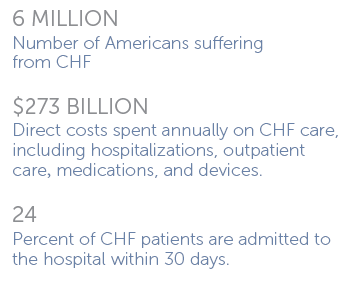
Heart failure (HF) is a syndrome characterized by high prevalence in society, frequent hospitalization, reduced quality of life and high mortality (overall,50% of patients are dead at an interval of 4 years [1], annual mortality varying from 5% to 75%). Outcomes in heart failure are highly variable, prognosis of individual patients differs considerably and trial data, though valuable, does not often give an adequate direction. Taking into account the high prevalence of heart failure in society and its complexity physicians need a model to predict the risk of death, to estimate the survival of heart failure patients. A key element of interest in this area is the survival function, usually noted by S and defined as S(t)=exp(–H0(t)eaTx)=e–H0(t)eaTx

Heart failure–Definition

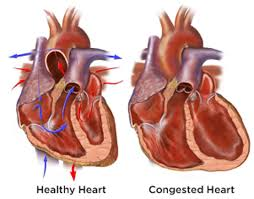
Heart failure is a syndrome in which structural or functional cardiac conditions impair heart’s ability to supply sufficient blood flow in order to meet the body’s needs, or to do that at an elevated diastolic pressure.

There are many definitions of this complex syndrome, but none is satisfactory, due to the lack of a universally agreed definition and challenges in definitive diagnosis. Until now, only some selective features of this extremely complex physiological state were highlighted in the definitions–oxygen consumption, cardiac pre-load and after-load, left ventricular remodeling and dysfunction, ventricular filling pressures, neuro-hormonal responses, exercise capacity, etc.

The new American and European guidelines and recommendations include new information and have the declared intention to simplify and clarify the previous recommendations.

Heart failure is a clinical syndrome in which patients have featured symptoms typical of heart failure (breathlessness at rest or on exercise, fatigue, tiredness, ankle swelling) and typical signs of heart failure (tachycardia, tachypnoea, pulmonary rales, pleural effusion, raised jugular venous pressure, peripheral edema, hepatomegaly) and objective evidence of a structural or functional abnormality of the heart at rest (cardiomegaly, third heart sound, cardiac murmurs,abnormality on the echocardiogram, raised natriuretic peptide concentration).

A clinical response to a pharmacological therapy directed to heart failure is not sufficient for the diagnosis of heart failure, although the usefulness/efficacy of the treatment may be established by the improvement in symptoms or signs (e.g. diuretic administration).

Heart failure may be classified by structural abnormality (ACC/AHA), or by symptoms relating to functional capacity (NYHA).

ACC/AHA stages of heart failure (based on structure and damage to heart muscle).

  • Stage A: At high risk for developing heart failure. No identified structural or functional abnormality; no signs or symptoms.
  • Stage B: Developed structural heart disease that is strongly associated with the development of heart failure, but without signs or symptoms.
  • Stage C: Symptomatic heart failure associated with underlying structural heart disease.
  • Stage D: Advanced structural heart disease and marked symptoms of heart failure at rest despite maximal medical therapy.

NYHA functional classification (severity based on symptoms and physical activity) (NYHA classification refers to stages C and D)

  • Class Ⅰ:No limitation of physical activity. Ordinary physical activity does not cause fatigue, palpitation, or dyspnoea.
  • Class Ⅱ: Slight limitation of physical activity. Comfortable at rest, but ordinary physical activity results in fatigue, palpitation, or dyspnoea.
  • Class Ⅲ: Marked limitation of physical activity. Comfortable at rest, but less than ordinary activity results in fatigue, palpitation, or dyspnoea.
  • Class Ⅳ: Unable to carry on any physical activity without discomfort. Symptoms at rest. If any physical activity is undertaken, discomfort is increased.