Archives

QUOTE FOR THE WEEKEND:

“You can do things to help manage COPD and its symptoms. For example: Ending line make your activities of living easier to do.
•Do activities slowly.
•Put items that you need often in one place that’s easy to reach.
•Find very simple ways to cook, clean, and do other chores.”
National Heart, Lung and Blood Institute

QUOTE FOR FRIDAY:

The term chronic in chronic obstructive pulmonary disease means that it lasts for a long time. While symptoms may vary from time to time, the lungs can still have disease, therefore, COPD is for life.”

AHA American Heart Association

QUOTE FOR THURSDAY:

Chronic lower respiratory disease, primarily COPD, was the third leading cause of death in the United States in 2011.  Fifteen million Americans report that they have been diagnosed with COPD.  More than 50% of adults with low pulmonary function were not aware that they had COPD; therefore the actual number may be higher.

CDC Center for disease control and prevention

QUOTE FOR WEDNESDAY:

“No matter how appropriate it is to leave a relationship, the loss of any significant relationship can feel like a death or is a acual death, You have to feel the sadness and grieve fully for what might have been, You can’t skip from, or otherwise hide from the pain if you’re to emerge at the next stage free to develop.”
Dr. Christiane Northrup,, author of Women’s Bodies, Women’s Wisdom and The Wisdom of Menopause.

Let bad memories move on in your life and learn how to make them tolerable to even forgotten!

Puppy TJTO CSC_0626 TO  CSC_0605

The Loss of a Loved Pet.             The loss of a loved ones            Loss of relationships that went sour.

Let bad memories move on in your life (bad relationships to death)!

How do we do that?

First get through the bad experience. You can do that through the steps of dying through Erickson, which in my eyes pertains not just to death.

Your first step is to go through anger.

Anger egarding the bad experience or memory that has happened embrace that bad memory feel it. Shout, pound on the floor or cry if you have to (Guys, it’s OK to let your emotions loose and cry if something really hurts deeply–not for a little scratch…). Just let the feeling into your conscious mind. Soak it up, absorb your grief or sorrow. Think about it. Recall the memory and try to think it through.

Then the step of denial.

A step of grieving is denial which is a feeling like you may sometimes wonder whether a past event actually happened or not. Stop wishing that is didn’t happen which is a form of denial. Don’t get distracted from this difficult realization or memory of pain you’re going through. You need to keep embracing this memory for awhile to make it through acceptance.

The next step would bargain

Here for example if you let me live God I promise to be a better person or it could be if you allow me to work things out with my significant other for whatever the reason might be I promise to do… but be strong and do what it takes to make this commitment stick and go through.  You could have down falls but pick up and make it through.  For if you do you feel a lot better inside about the situation and yourself!

The next step would be acceptance.

Muster your strength so that you can mentally say (or out loud for emphasis), “This is the feeling that I dreaded. I’ve felt it and faced it completely. Now I have to let the feeling go, and not fight it anymore.” Sigh, take a couple deep breaths, and just let that feeling go–let it be accepted. Examine your feelings. Now, that you did that, or worse if you couldn’t do it, that shows that you haven’t truly let the feeling be known. The only way to conquer it is to face it and all of the feelings (like being out of control for example). Repeat the process if it was unsuccessful, you have to make it through all the steps not just one to be a complete success.

Lastly you go through depression.

During this time you may have had a bad accident with having limitations; with knowing the limitations which may be permanent you work on what capabilities you still have and make them stonger leading to your optimal level of function.   It isn’t easy but it can pay off in the end; if you make yourself a stronger person with seeing new and other strong points about your character that you weren’t aware of it is higher probability you will continue going through the process. This could have been hidden when you had no limitations that allowed you to do activities you may not be able to do now with these limitations in the way back then when you didn’t do this process or just began it. Use your time effectively and wisely. During this stage of depression   Forgive others and yourself for whatever happened. Get over the frustration. Get over the memory of the horror or humiliation that you felt… Live positively despite that difficult past experience. If you hang this over someone and they repetitively act a way to make you offended than set limitations in seeing that one and if you say there always there than limit the amount of times with interaction (This is meaning someone not significant but a acquaintance or distant relative or even sister you interact with at family events, but if its your spouse than you both need to sit down and learn again how to love, respect, communicate and both parties wanting to renew or resolve long term negative interactions with each other where counseling may be necessary or even church–that is where you both decide (not one).

Hopefully, you have conquered the dreadful feeling–like fear. Let the memory stay inside you. Don’t block it out. Let it come when it comes and learn to shrug it off.   Say, “That was then, this is now.” I can overcome that bad past circumstance. I have the future. I can do everything that I need to do to get on with my life… Look at the pros of how your life now and if you see more cons than do what is needed to make it better.  If it is death you look at the positive memories this significant living creature from human to even pet brought to your life and think what you would have never had if this creature you never got to interact with.  Look at the 1/2 of glass of water like thank God I have a 1/2 of glass as opposed to only having a 1/2 of glass of water.   Things change.   You cannot possibly spend the rest of your life hurting the way you do now; human beings are dynamic and change is a part of life. The way you felt then and the way you feel now is not the way you will feel forever.

So every moment spent thinking that you will always be hurt by these bad memories is a moment wasted in your life!  Like a pet dying to a human dying or a relationship that went bad (friend to intimate to the work place), there must have been good in it for you to stay and if unhappy now ending line do what you have to in making it better.  Now if its death look at what the good memories where that you have in your life now as opposed to a dead person now and not having this relationship anymore available to you.  Also if you believe in after life think on it will be great to see you again in afterlife, like to some heaven!  It is all how you look at the situation and how you let drama take you over for days to weeks to years.  Is it worth it and would that dead person or pet want you to do that?  Obviously NO.  Cherish good relationship moments in your lives!  Look at the good it brought you back then and regarding death after of course getting through the shock than looking at the good that relationship did in making you a happier and even better person.


How to deal with bad memories in our mind:


Our body responds to the images in our mind and though the event happened maybe years ago; the negative experience you have today comes from the image in your mind.

It is possible to recondition your mind so that you interpret that memory from a new perspective and control the stress crated by that negative memory or dream.

To do that you need to develop a self image that is connected to the moment & not the past. It is possible to create a self image from your past experience that connects you to the Wisdom of your Body and that puts you in the moment. The fact is that in most people’s life they have had at least one positive experience and if your brain created it once it can create it again at will.

Our minds have developed a self image by the way people related to you in the past. That has created habits that formed who you think you are today. That does not create an accurate description of your real potential-but unfortunately you believe it to be you.

You have the power to develop a self image, based on the positive experiences of your life instead of how people related to you. It will take a little work to develop conscious habits of this character, but it will be worth your effort.

The quality of your life, how you deal with your health and how you express your heart depends on your own self image and the way you interpret what happens in your life. Change your own self image when necessary and you automatically change your interpretations.

If you strongly condition your new Positive Self image in your mind; your interpretations will begin to affect the old habits that create negative interpretations even in your sleep.

The bad memories that harm you are interpreted by a negative self image. After years of living with a negative self image, habits are created that effects your subconscious mind. Once you create a habit of your newly conditioned Positive Self, go back into that memory and view it from that perspective.

Seeing that same experience from a new perspective can eliminate the interpretation that makes that a bad memory. In Psychology that is called Re-dreaming and it can create an entirely different association to that memory or dream.

This is how you can clean up your mind and prepare to deal with your health crisis at your full potential; recondition the mind that distracts your attention from healing.

You may not be able to change the events of your past, but you can change your interpretations in the moment. In about 2 weeks of conscious work, (15 minutes twice a day and another ½ hour), you can create new habits that replace the old habit on the subconscious level.

QUOTE FOR TUESDAY:

“People who are physically active, eat a healthy diet, do not use tobacco, and practice other healthy behaviours reduce their risk for chronic diseases and have a much reduced rate of disability compared to others who don’t do this lifestyle.”

British Columbia Ministry of Healt

Aging in style, looking your age or looking even older; you make the choice!

aging in style3 aging and health2 aging in style4 aging in style2

I am enjoying my adulthood journey and wish I could say the same for many of our aging population. What I am observing as a RN, daughter and friend I must say it is a concern to me…why do people of age want to home in on talking about their illness (s) and making it their main topic of conversation? I can understand when a crisis happens, there is a new diagnosis that is heavy on their mind and that there stages they go through (shock, grieving, angry, bargaining, depression and acceptance) but I am not talking about this. I am talking about the need to focus on the aging process as a loss and a ‘giving up’ instead of looking at it for what it is… a time of a new stage in life from 40 and on some sooner where your process of mind and physical body goes through changes that can offer freedom, curiousity, and enjoyment. Let me give you some examples.

A family member of mine is in the last stage (I know I am not there but almost 30 years of care with geriatrics I have an idea how many live, some healthy with going about each day with a form of a work out or others closed in a box in their own world. There are conditions that slow us down but don’t cripple us and having a condition that isn’t curable many can be kept under controll. Though many like my family member give in or give up to the condition because or are set in their ways set to no change not paying attention to what they ate or stop exercise and the amount they eat. By doing this behavior what develops is weight gain and the signs started showing up of further health conditions like obesity, adult diabetes II (occurs 45 and up roughly), cardiac disease that would have never had occurred if the individual balance rest, a form of light exercise and good diet eating. On top of that from the immobility of sitting in the house or wherever you may sit all day gives you also sedentary lifestyle=less tone to the muscles with less muscle and more fat and stiffening of the muscle and joints that increases the risk of pulling a muscle or back which did to my family member, at first. Now over 6 years uses a cane and can barely walk with sciatica damage and the MRI and CatScan recently done only supposedly shows arthritis. Prevent this people just through a routine of balancing rest, exercise program (intense or slight work out = only 15 minutes a day), and good healthy dieting and high probability you will live longer with a better healthy tone body. The KEY to obtaining this is start YOUNG and you will get into this as a routine and it will feel like it’s a regular part of your life with you wanting to do it but if your elderly you can still do it. It maybe harder but go about it with your primrary MD’s approval with reviewing what is ok for a daily 15 minute exercise with proper dieting balancing this with rest. When he have a chance to correct obesity and prevent disease situations grab the opportunity before it is too late and unbearable to exercise, get out of the house, and now you sit in the house with few nearby to come and visit or even want to. Like many other family members and families in the world going through this that ill one limits the places they can go, limits independence (they have to be driven long distances 30 minutes away, have to do there shopping etc…). Where when they had there independence with having conversations with them other than there condition made you more out to look forward to visiting them. It’s just normal. Same example as if having a long term friend or sister you hung with for decades parting and gossiping and eating out and shopping together now moves into adulthood married with children. Than this sister depends on you for babysitting frequently, driving or picking the kids up frequently from school events, gossips about how bad the marriage is for 6 years now. Like anything else negativism all the time seen and heard you don’t want to be around. It is unfortunate but true. You on the other side feel obligated to do so for all the years of good life with that person but life good be better in the end if that family person doesn’t put themselves in that situation but it doesn’t always work that way. So make your life better and don’t but yourself in that situation. I am very much tryng to do so. One way of reaching it is through good diet (treats now and than), good exercise, and balance with good rest; doesn’t always work that way with work but I try to make up for it.     My family member by diet alone, could help the situation. One by making good diet decisions and don’t eat after 5pm or 6pm and good healthy food. Don’t have a dinner 9pm at night; or usually big meals after 6pm and make smaller meals.

I was very patient when I learned about the family member changes 6 years ago with no progress just the opposite to even activities of daily living capabilities and than what go me was that member getting use to it and being drawn in to live that way where it’s like a addition now. This can definitely end your life sooner so it is up to you.he had to change his eating habits, monitor his blood sugar, and learn to give himself insulin shots. I understood it would take him time to adjust, so his constant talking and yes, even complaining, was expected. As a friend, it was my job to help that loved individual go through this transition and give the needed support to ease all the changes that the family member would have to go through.

So, here’s his story now. That member is less than 81 years old and has had this condition for several years, continues to make this health issue the topic of conversation to me, family members, and friends even when things are going really well. The fact is, this condition for getting close to 10 years, my family member, has chosen to play the ‘poor me scenario’ at times it appears to come across as. The doctor and myself as a RN almost 30 years has provided excellent information and several resources to help with coping. In only took me 6 years with some family sibling help to have her agree it’s time to move out of the house I grew up in since 1966. No one else lives in that house.

It is taking a toll on my psychic energy. In other words, it sucks the life right out of me and, after visiting, I am tired after 14 hours working and so ready to take a nap.

I see this with other friends going through a similar situation with some family member also. They talk about their arthritic aches and pains plus stiffness in their joints as much as they do about the changes in the weather. These are chronic conditions, meaning they will experience this from time to time, and talking about it obsessively won’t change a thing.

At what point do people decide that the aging process means they need to constantly talk about their health issues? At what point do they stop engaging in healthier topics of conversation? What are the reasons for this shift in how they converse with people and, more importantly, do they even realize how depressing this whole routine is?

Again being a RN around geriatrics I understand. One reason may actually be major depression (also known as clinical depression) , which is a medical illness. It is a chemical imbalance in the brain and can appear in people regardless of age, race or economic status. The illness can appear after a triggering event or for no apparent reason at all or simple normal with being alone by yourself (possible spouse deceased, friends moving if not dying off as age progresses) but when will the stop? At this point I highly doubt it and for me writing with some exercise busy in work and a good love life all help out.

TO HELP YOU DETECT THIS EARLY OR EVEN POSSIBLY STOP IT,

Look for signs of:

  • Constant complaints of aches and pains (back, stomach, arms, legs, head, chest) , fatigue, slowed movements and speech, loss of appetite, inability to sleep, weight increase or decrease, blurred vision, dizziness, heart racing, anxiety. •An overall sadness or apathy, withdrawn; unable to find pleasure in anything or unable to have the need to get out to family gatherings or go to church anymore like previously it was considered a regular routine of that person’s life.
  • Also irritability, mood swings or constant complaining; nothing seems to make the person happy.
  • Talk of worthlessness, not being needed anymore, excessive and unwarranted guilt.
  • Frequent doctor visits without relief in symptoms; all tests come out negative.
  • Another reason is ‘doing as others do’. Meaning they mimic what other elders are doing. Again if that is what they see and hear from their associates, there is a strong chance they may get caught up in the same negative behavior.
  • Alcoholism can mask an underlying depression.
  • Another reason is the lack of stimulation, which will give them other things to talk about. Many times, elders find themselves alone with infrequent visitation from family and friends. They concentrate on familiar things like illnesses, chronic aches and pains, and the medications they take which become their major thing to talk about.

I, too, have minor health issues, however I chose to acknowledge that ‘it is what it is’. I have been dealt this hand and therefore I will do what I can to not let it slow me down. The other side to the coin is how you look at that ½ glass of water. It can be I have the worst condition and play “feel sorry for me scenario” not even realizing it since it it talked about all the time or like I look at life there are so many worse of then me with disease, no home, no family, no friends and just surviving possibly getting a meal each day, if that. As I said, I am an observer of people partly because I am an RN and it’s part of my job. I have made note that those individuals who are really struggling with major health issues many hardly complain at all. They keep a positive attitude and, in doing so, don’t let their condition stop them from enjoying life or start a negative domino effect that just keeps dropping on top of another till it crashes all of them and unfortunately when continues to have a life spreading to others with that effect you turn them away. Like everyone else we all have our headaches and on high probability in adulthood health issues with losses and aches & pains. You have to deal with them in a positive note. Meaning don’t blame the world or someone else for your health situation unless its real and lack of moving around (going out) even 10 minutes exercise a day or 2 to 3 times a week one hour exercise for elderly (just simply walking) with good dieting and rest will take you along way. Going the opposite way gives you a shorter life and highier odds a unhappier with lonely life. Along with keeping a positive attitude, you may also find things that attract your likes as opposed to dislikes which will keep you busier in life and people benefit from being around cheerful positive people that attracts them to have you back more.

Not to far away from being elder in about 15 to 20 years, I hope to stir the Pagan (polytheistic or open minded) community to take notice of how they choose to age. Are we aging with grace or are we just aging? Talk to the God and Goddess for help in modifying your way of thinking so you can handle life’s little ups and down. If you have family and / or friends who are displaying this type of behavior, show empathy and love by helping them comprehend the negative effects that persist when they chose to concentrate on their health issues in a pessimistic way. Sometimes it becomes a habit and they don’t even realize how often it occurs.

Behaviors can be changed, so make up your mind to age with GRACE and not just age.


Part I What is and what does a cardiac rhythm tell us?

atrial rhythms1atrial rhythms4afib RVR

First the engine to the human body is the heart; our car can’t work without a good working engine just like the body can’t work without a good working heart. In the heart we have a natural pacemaker of the heart which is called a Sinus Node. The sinus node conducts impulses from the top right chamber of the heart to the left chamber in the heart (called Atriums) and follows its way down to the bottom chambers (called ventricles) but for the conduction traveling originally from the right atrium to the left atrium the left side is slightly behind in conduction compared to the right when going down horizontally on each side due to the conduction having to cross over to the left top from the right top of the heart. Than the conduction continues on the atrio-ventricle valves (called AV valves) causing these valves to open and close completely allowing blood to drop in the ventricles from the atriums when open but without back up in the AV valves if the valve completely seals like any valve operating correctly by closing whether it be pipes, actual engine valves, or our veins/arteries or the actual heart in this case in the human body. Whatever valves used in our body or inanimate objects all pretty much play the same role.

The Rt. AV valve is the tricuspid valve the Lt. AV valve is the mitral valve. The conduction continues than to the bottom chambers-ventricles the conduction goes up and around the entire ventricles sensing up actually the purkinje fibers/papillary muscles to aid in contracting (depolarization) and relaxation (repolarization) of the ventricles. This allows the heart to go “Lub Dub” after from the SA node to the end process of conduction (described above) which gives a single beat or pulse. This allows our red blood cells that are more oxygenated than with carbon dioxide in them on the left side to go out the aorta to the bloodstream giving our tissues oxygen all over where needed when leaving the L side of the heart which after the 02 used up it will be returning to the right side when needing to refill with more oxygen and release the C02 from the red blood cells.   How do we get our red blood cells reoxygenated? The right side; when the Lt side is doing its function through this conduction process so is the right side. The Rt side allows the blood on the right side more carbon dioxide red blood cells that are carrying with some oxygen (but very little) so these red blood cells after going through the whole conduction process from the Rt. ventricle enter into the pulmonary artery to the lungs (a much shorter pathway than the Lt. side of the heart sends its RBCs-it goes from the aorta down the body up to the brain and back to the Rt. side of the heart needing more 02). This side is where the RBCs get reoxygenated than reentry to the left side of the heart going through that side out the aorta when those cells get into the Lt. through through our last process of the conduction system. This conduction system is so vital in our heart operating properly.  Since the Rt. and Lt. side have 2 completely different functions with our RBCs in dispensing 02 and C02 but both sides need to work correctly and are vital to keep us alive.

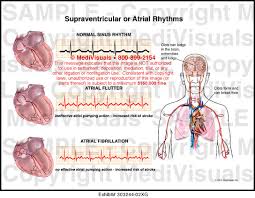
On a tele strip a sinus rhythm is made up of a P wave=Atriums contracting (atrial depolarization) than a straight line= atriums relaxing (atrial repolarization) than followed by a QRS wave=Ventricles contracting (ventricular depolarization) followed by a straight line than a T wave (ventricular depolarization) than in some a U wave. A U wave is on an electrocardiogram that is not always seen. It is typically small, and, by definition, follows the T wave. High probability you will see a U wave in normal sinus rhythm (NSR) or sinus bradycardia (SB). This is because the HR is slow enough to show a U wave on the rhythm you won’t see them in tachycardias. U waves are thought to represent repolarization of the papillary muscles or Purkinje fibers.

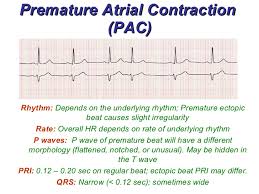
In most cases if the sinus node is working properly with the person taking care of their body staying in good shape, eating healthy and getting rest to balance stress and no cardiac disease or in some cases compliance with all above in taking cardiac meds it shows on the telemetry monitor sinus rhythm heart rate (HR) 80 – 100 but if HR over 100-150 the person has sinus tachycardia (fast pulse) or if HR less than 60 it is sinus bradycardia (slow pulse) which maybe normal for the person, like an athlete.  All these rhythms derive from the sinus node originally and have regular rhythms giving you a regular HR not irregular unless you have a premature contraction from the atriums causing a PAC (Premature atrial contraction) or a PVC premature ventricle contraction that pop up in your sinus regular rhythm (but remember simple stress or caffeine can cause this as well as heart disease of many types). These premature contractions pop on the telemetry reading with the ingredients that make up a atrial rhythm = p wave + a normal QRS + t wave unlikely for a u wave or other rhythms as well which we will get into. All these occasional or frequent premature contractions mean is the heart rhythm of the heart is getting irritable. The more irritable any rhythm gets the higher the probability the rhythm can go into a worse rhythm.

PVCs in the rhythm has the features that are the same as a atrial except no p wave with the QRS measuring wide because the contraction is in the Ventricle where the p wave is in the chamber above it (atriums). In the Ventricles where a premature contraction occurs will only have a wide QRS rather than a regular because of the chambers its in=Ventricles.

PVCs will be discussed with Ventricular Rhythms.

If the sinus node breaks down the heart works by having the next area of conduction take over by compensating having the natural pacing take over in the atriums where we have atrial rhythms which start at a HR over 150 unless controlled atrial fibrillation but we’ll get into that rhythm shortly.

The rhythms you see when the atrium is the natural pacemaker of the heart taking over for the SA node that doesn’t work with the heart now compensating with the atrium, they are atrial tachycardia or SVT supraventricular tachycardia, simple meaning above the ventricles. This is where the rhythm is over 150 to 250 showing a p wave and QRS and usually not a T wave but if the HR is slow enough it might show on the telemetry monitor but usually doesn’t. If it shows no PACs or PVCs it’s a regular rhythm.

Another atrial rhythm is atrial flutter or A- Flutter)=AFL which shows only QRSs with flutter waves. A regular rhythm but this rhythm needs to be changed or in time the heart will stress out and lead on to more dangerous rhythms. This has no p waves but flutter waves with QRS waves. You can have 2 flutter waves to every QRS wave or 3 to every QRS or 4 flutter waves to every QRS or even 5 but the it can even be a variable ratio of flutter waves to every QRS wave meaning the rhythm is getting more irregular and dangerous. If left untreated, the side effects of AFL can be potentially life threatening. AFL makes it harder for the heart to pump blood effectively. With the blood moving more slowly, it is more likely to form clots. If the clot is pumped out of the heart, it could travel to the brain and lead to a stroke or heart attack.

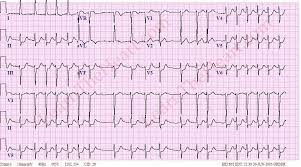
The treatment for aflutter and uncontrolled atrial fibrillation is a-fib with a HR over 100 but most important in both is the pt symptomatic vs. asymptomatic.  If the patient (pt.) has signs or symptoms of cardiopulmonary distress objective or subjective (pt. can only feel like chest pressure, chest pain with radiation particularly down the L arm-typical of angina or heart attack) it gets addressed STAT and if home call 911 and go to the nearest ER.  The treatment for both symptomatic or a HR over 100 to over 150 no symptoms or with symptoms (since the heart in time will give out from too much workout of the organ) is cardioversion using a defibrillator in sync mode so when the shock is given it lands with the R wave and avoiding the vulnerable T wave section which if the shock landed their could put this rhythm into V Tac or V fib. The other atrial rhythm is atrial fibrillation (afib) and if under 100 great for if its chronic afib it will be hard to change to NSR but if a new Dx. of afib higher odds with cardioversion it will shock it the rhythm back into NSR. Those who are chronic afib or new afib that can’t convert to NSR usually are given Coumadin and ASA aspirin to keep the blood from clotting in the heart and breaking free with the irregular rhythm. Also possibly used is Beta blockers that slow the conduction of impulses down being a beta blocker it blocks the beta stimulus especially lopressor or Metoprolol that is a selective beta 1 stimulus blocker which is in the heart to slow the HR down. Than there is calcium channel blockers possibly used to slow down the HR if needed by blocking cardiac cells sending impulse signals from the top to the bottom of the heart. Keeping afib under 100 of a pulse rate and more like 80 or less can live a completely normal life if compliant with meds, diet and exercise.

Part II tomorrow on types of heart blocks and ventricular rhythms.

QUOTE FOR MONDAY:

“People who are physically active, eat a healthy diet, do not use tobacco, and practice other healthy behaviours reduce their risk for chronic diseases and have a much reduced rate of disability compared to others who don’t do this lifestyle.”

British Columbia Ministry of Healt