Archives

QUOTE FOR FRIDAY:

“July is Juvenile Arthritis Awareness Month, and believe it or not, nearly 300,000 children have been diagnosed with some form of arthritis. Arthritis doesn’t affect just older people, but also affects children as little as six months old! Juvenile arthritis comes in a variety of forms with varying life spans and symptoms.”

Bone and Joint Center

QUOTE FOR THURSDAY:

“A cleft palate is an opening or split in the roof of the mouth that occurs when the tissue doesn’t fuse together during development in the womb. A cleft palate often includes a split (cleft) in the upper lip (cleft lip) but can occur without affecting the lip.”
 
MAYO CLINIC

QUOTE FOR WEDNESDAY:

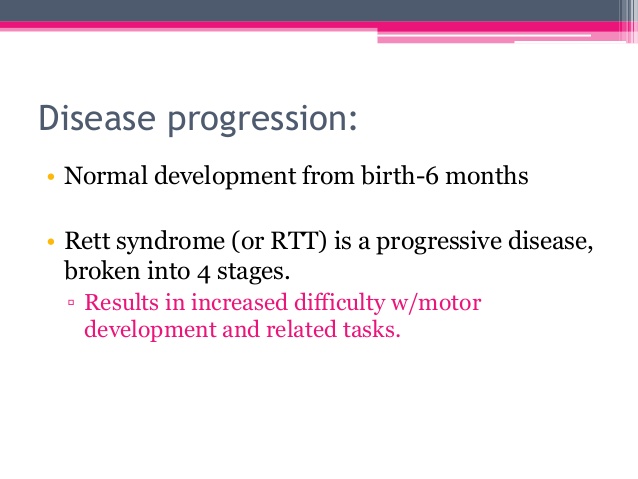
“Children with Rett syndrome often have normal development during the first 6 to 18 months of life. After this time, they have a period of regression (loss of skills) and they may lose speech and other developmental milestones. The symptoms can range from mild to severe. Almost all children with Rett syndrome are female.”
 
Boston Children’s Hospital

Part II Rett Syndrome Awareness Month

The spectrum of phenotypes in MECP2-related disorders includes the following:

  • Classic Rett syndrome

  • Variant Rett syndrome

  • Mild learning disabilities (females) or neonatal encephalopathy and syndromic or nonsyndromic intellectual disability (males)

Classic Rett syndrome. In 1988, well before the discovery of the genetic basis of Rett syndrome, clinical diagnostic criteria were developed. The following are limitations to clinical diagnosis of Rett syndrome using these criteria:

  • Clinical diagnosis may be considered tentative until the affected individual reaches age two to five years, by which point she has likely gone through several stages of the disease.
  • Atypical forms may be either milder or more severe than classic Rett syndrome:
    • In the more severe variant, no period of grossly normal development occurs; and early manifestations include congenital hypotonia and infantile spasms.
    • In the milder variant, girls have less dramatic regression and milder intellectual disability.
    • Other children experience an even more gradual regression that begins after the third year, lose purposeful hand use, and develop seizures; however, they retain some speech and the ability to walk.

Revised Diagnostic Criteria for Rett Syndrome

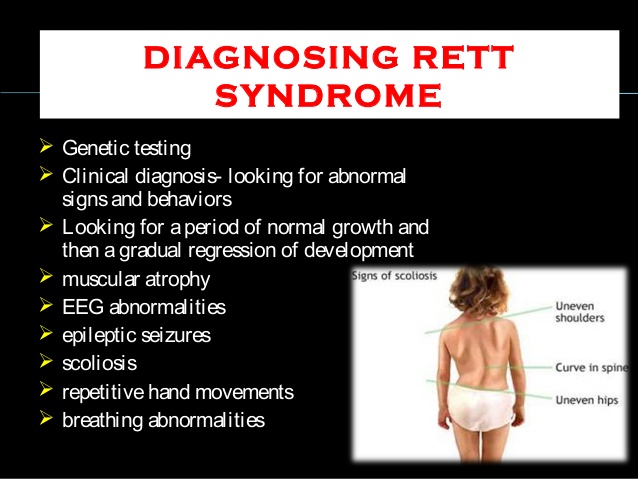
The diagnosis should be considered when there is postnatal deceleration of head growth observed. However, this is not mandatory.

Required for typical or classic Rett syndrome

  • A period of regression followed by recovery or stabilization
  • All of the main criteria and all of the exclusion criteria

Supportive criteria are not required, although often present in typical Rett syndrome.

Required for atypical or variant Rett syndrome

  • A period of regression followed by recovery or stabilization
  • Two of the four main criteria
  • Five of the 11 supportive criteria

Main criteria

  • Partial or complete loss of acquired purposeful hand skills
  • Partial or complete loss of acquired spoken language or language skill (e.g. babble).
  • Gait abnormalities: impaired (dyspraxic) or absence of ability
  • Stereotypic hand movements including hand wringing/squeezing, clapping/tapping, mouthing, and washing/rubbing automatisms

Exclusion criteria for typical Rett syndrome

  • Brain injury secondary to peri- or postnatal trauma, neurometabolic disease, or severe infection that causes neurologic problems
  • Grossly abnormal psychomotor development in the first six months of life, with early milestones not being met

Supportive criteria for atypical Rett syndrome (currently or at any time)*

  • Breathing disturbances when awake
  • Bruxism when awake, is excessive teeth grinding or jaw clenching
  • Impaired sleep pattern
  • Abnormal muscle tone
  • Peripheral vasomotor disturbances
  • Scoliosis/kyphosis
  • Growth retardation
  • Small cold hands and feet
  • Inappropriate laughing/screaming spells
  • Diminished response to pain
  • Intense eye communication – “eye pointing”

*Younger individuals may need to be reevaluated, as the development of many of these features is age dependent.

Molecular Genetic Testing

Gene. MECP2 is the only gene in which mutation is known to cause MECP2-related disorders.


QUOTE FOR TUESDAY:

“Rett syndrome is a genetic disorder that causes a loss of spoken language and motor skills, as well as behavioral and neurological problems. Children with Rett syndrome may also have a variety of other medical problems, including intestinal, breathing, orthopedic and heart complications.”
Boston Children’s Hospital.”


Part I Rett Syndrome Awareness Month

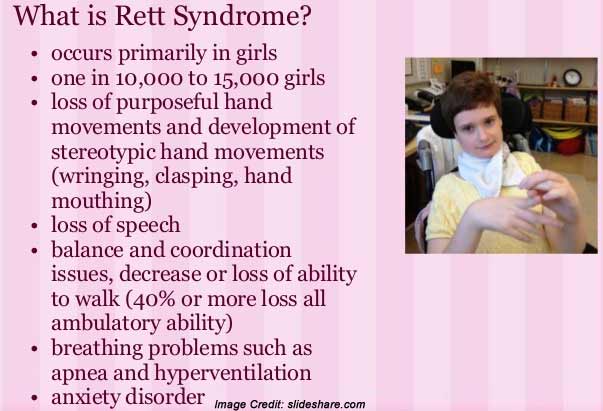
Rett syndrome is a rare non-inherited genetic postnatal neurological disorder that occurs almost exclusively in girls and leads to severe impairments, affecting nearly every aspect of the child’s life: their ability to speak, walk, eat, and even breathe easily. The hallmark of Rett syndrome is near constant repetitive hand movements while awake. Cognitive assessment in children with Rett syndrome is complicated, but we know that they understand far more than they can communicate to us, evidenced by their bright and attentive eyes, and their ability to express a wide spectrum of moods and emotions.

In 1954, Dr. Andreas Rett, a pediatrician in Vienna, Austria, first noticed two girls as they sat in his waiting room making the same repetitive hand-washing motions.  Brett syndrome is a unique postnatal neurological disorder that is first recognized in infancy and seen almost always in girls, but can be rarely seen in boys.

This neurological disorder is where there is a mutation in a single gene, the MECP2 gene.

The MECP2 gene provides instructions for making a protein called MeCP2. This protein helps regulate gene activity (expression) by modifying chromatin, the complex of DNA and protein that packages DNA into chromosomes. The function of DNA is the blueprint of biological guidelines that a living organism must follow to exist and remain functional. Medium of long-term, stable storage and transmission of genetic information.The MeCP2 protein is present in cells throughout the body, although it is particularly abundant in brain cells.

In the brain, the MeCP2 protein is important for the function of several types of cells, including nerve cells (neurons). The protein likely plays a role in maintaining connections (synapses) between neurons, where cell-to-cell communication occurs.

Many of the genes that are known to be regulated by the MeCP2 protein play a role in normal brain function, particularly the maintenance of synapses BUT the MeCP has a permanent alteration in it so if effects the DNA and there won’t be normal function.

 Affecting only children because this happens during fetal development when are DNA/RNA and genes are made up.  This won’t happen in adulthood, your RNA, DNA and genes won’t change at that age. 

It mostly affects girls rather than boys because the affected gene is located within the X chromosome. Chromosomes contain the set of instructions to create an organism. Men have one X chromosome and one Y chromosome, the latter being responsible for the characteristics that make men male, including the male sexual organs and the ability to produce sperm. In contrast, women have two copies of the X chromosome= XX. But, because the X chromosome carries a bigger instruction manual than the Y chromosome, biology’s solution is to largely inactivate one X chromosome in females, giving one functional copy of the X in both men and women.

Rett Syndrome is genetically based and is a very rare condition, but there is no known cure. This is a life-long condition. You can’t repair mutated genes or someone’s DNA/RNA.

Symptoms can be managed, and early detection is the key to making it easier on both the child affected and their families, but the patient will need constant care for the rest of their lives.

Often akin to the symptoms of severe autism, it is important to differentiate between the two diseases to get a correct diagnosis.

QUOTE FOR MONDAY:

“Helen’s ability to empathize with the individual citizen in need as well as her ability to work with world leaders to shape global policy on vision loss made her a supremely effective ambassador for disabled persons worldwide. Her active participation in this area began as early as 1915, when the Permanent Blind War Relief Fund, later called the American Braille Press, was founded. She was a member of its first board of directors.”

American Foundation for the Blind – AFB

QUOTE FOR THE WEEKEND:

“At the age of 19 months, Helen became deaf and blind as a result of an unknown illness, perhaps rubella or scarlet fever.  With the help of Anne Sullivan (her teacher) she made Helen learn to read & talk.  She made the signals have meaning in Helen’s mind.   Helen made it to a BSN, just as much her’s as Anne Sullivan’s. Helen’s ideals found their purest, most lasting expression in her work for the American Foundation for the Blind (AFB). Helen joined AFB in 1924 and worked for the organization for over 40 years. The foundation provided her with a global platform to advocate for the needs of people with vision loss and she wasted no opportunity. She met with world leaders such as Winston Churchill, Jawaharlal Nehru, and Golda Meir. In 1948, she was sent to Japan as America’s first Goodwill Ambassador by General Douglas MacArthur. Her visit was a huge success; up to two million Japanese came out to see her and her appearance drew considerable attention to the plight of Japan’s blind and disabled population. Wherever she traveled, she brought encouragement to millions of blind people, and many of the efforts to improve conditions for those with vision loss outside the United States can be traced directly to her visits.”

American Foundation for the Blind – AFB


QUOTE FOR FRIDAY:

“When significant memory loss occurs among older people, it is generally not due to aging but to organic disorders, brain injury, or neurological illness.  Studies have shown that you can help prevent cognitive decline and reduce the risk of dementia with some basic good health habits:  staying physically active, getting enough sleep, no smoking, having good social connections, limiting alcohol to no more than one drink a day, eating a Mediterranean style diet.”

Harvard Health Publishing/Harvard Medical School

HOW TO KEEP YOUR MEMORY SHARP WITH AGE.

There’s no denying that as we age chronologically, our body ages right along with us. But research is showing that you can increase your chances of maintaining a healthy brain well into your old age if you add these “smart” foods to your daily eating regimen.

Blueberries.

“Brainberries” is what Steven Pratt, MD, author of Superfoods Rx: Fourteen Foods Proven to Change Your Life, calls these tasty fruits. Pratt, who is also on staff at Scripps Memorial Hospital in La Jolla, Calif., says that in animal studies researchers have found that blueberries help protect the brain from oxidative stress and may reduce the effects of age-related conditions such as

Alzheimer‘s disease or dementia. Studies have also shown that diets rich in blueberries significantly improved both the learning capacity and motor skills of aging rats, making them mentally equivalent to much younger rats. Ann Kulze, MD, author of Dr. Ann’s 10-Step Diet: A Simple Plan for Permanent Weight Loss & Lifelong Vitality, recommends adding at least 1 cup of blueberries a day in any form — fresh, frozen, or freeze-dried.

Wild salmon.

Deep-water fish, such as salmon, are rich in omega-3 essential fatty acids, which are essential for brain function, says Kulze. Both she and Pratt recommend wild salmon for its “cleanliness” and the fact that it is in plentiful supply. Omega-3s also contain anti-inflammatory substances. Other oily fish that provide the benefits of omega-3s are sardines and herring, says Kulze; she recommends a 4-ounce serving, two to three times a week.

Nuts and seeds.

Nuts and seeds are good sources of vitamin E, says Pratt, explaining that higher levels of vitamin E correspond with less cognitive decline as you get older. Add an ounce a day of walnuts, hazelnuts, Brazil nuts, filberts, almonds, cashews, peanuts, sunflower seeds, sesame seeds, flax seed, and unhydrogenated nut butters such as peanut butter, almond butter, and tahini. Raw or roasted doesn’t matter, although if you’re on a sodium-restricted diet, buy unsalted nuts.

Avocados.

Avocados are almost as good as blueberries in promoting brain health, says Pratt. “I don’t think the avocado gets its due,” agrees Kulze. True, the avocado is a fatty fruit, but, says Kulze, it’s a monounsaturated fat, which contributes to healthy blood flow. “And healthy blood flow means a healthy brain,” she says. Avocados also lower blood pressure, says Pratt, and as hypertension is a risk factor for the decline in cognitive abilities, a lower blood pressure should promote brain health. Avocados are high in calories, however, so Kulze suggests adding just 1/4 to 1/2 of an avocado to one daily meal as a side dish.

Whole grains.

Whole grains, such as oatmeal, whole-grain breads, and brown rice can reduce the risk for heart disease. “Every organ in the body is dependent on blood flow,” says Pratt. “If you promote cardiovascular health, you’re promoting good flow to the organ system, which includes the brain.” While wheat germ is not technically a whole grain, it also goes on Kulze’s “superfoods” list because in addition to fiber, it has vitamin E and some omega-3s. Kulze suggests 1/2 cup of whole-grain cereal, 1 slice of bread two-thee times day, or 2 tablespoons of wheat germ a day.

Beans.

Beans are “under-recognized” and “economical,” says Kulze. They also stabilize glucose (blood sugar) levels. The brain is dependent on glucose for fuel, Kulze explains, and since it can’t store the glucose, it relies on a steady stream of energy — which beans can provide. Any beans will do, says Kulze, but she is especially partial to lentils and black beans and recommends 1/2 cup every day.

Pomegranate juice.

Pomegranate juice (you can eat the fruit itself but with its many tiny seeds, it’s not nearly as convenient) offers potent antioxidant benefits, says Kulze, which protect the brain from the damage of free radicals. “Probably no part of the body is more sensitive to the damage from free radicals as the brain,” says board-certified neurologist David Perlmutter, MD, author of The Better Brain Book. Citrus fruits and colorful vegetables are also high on Perlmutter’s list of “brainy” foods because of their antioxidant properties — “the more colorful the better,” he says. Because pomegranate juice has added sugar (to counteract its natural tartness), you don’t want to go overboard, says Kulze; she recommends approximately 2 ounces a day, diluted with spring water or seltzer.

Freshly brewed tea.

Two to three cups a day of freshly brewed tea — hot or iced — contains a modest amount of caffeine which, when used “judiciously,” says Kulze — can boost brain power by enhancing memory, focus, and mood. Tea also has potent antioxidants, especially the class known as catechines, which promotes healthy blood flow. Bottled or powdered teas don’t do the trick, however, says Kulze. “It has to be freshly brewed.” Tea bags do count, however.

Dark chocolate.

Let’s end with the good stuff and my favorite desert. Dark chocolate has powerful antioxidant properties, contains several natural stimulants, including caffeine, which enhance focus and concentration, and stimulates the production of endorphins, which helps improve mood. One-half ounce to 1 ounce a day will provide all the benefits you need, says Kulze. This is one “superfood” where more is not better. “You have to do this one in moderation,” says Kulze.

Lastly the prevention of diseases that can impact all organs including our brain.  With obesity comes the risk of heart disease, diabetes II, that can lead into further problems down the road with other systems of the human body.  To get on prevention check if your body mass index is in the range it should be and if your not sure check online BMI where it is for free.