March Awareness on Traumatic Brain Injuries


A Brain Injury is damage to the brain that results in a loss of function such as mobility or feeling.  Brain injury can also cause cognitive dysfunction.

Traumatic Brain Injuries can result from a closed head injury or a penetrating head injury.

There are two broad types of head injuries: Penetrating and non-penetrating.

  1. Penetrating Injury: A penetrating injury occurs when an object pierces the skull and enters brain tissue. As the first line of defense, the skull is particularly vulnerable to injury. Skull fractures occur when the bone of the skull cracks or breaks. A depressed skull fracture occurs when pieces of the broken skull press into the tissue of the brain. A penetrating skull fracture occurs when something pierces the skull, such as a bullet, leaving a distinct and localized injury to brain tissue. Skull fractures can cause cerebral contusion. Brain trauma occurs when a person has an injury to the brain, and can be mild or severe. When a person sustains trauma or injury to the brain, he or she may lose motor functions along with cognitive and physical abilities. Physicians use the Glasgow Coma Scale to determine the extent of brain trauma. This is a neurological scale that measures the level of a person’s consciousness.  A mild injury may cause temporary symptoms, like a concussion; while a severe injury could require years of rehabilitation, like a stoke or tumor.
  2. Closed Injury:  A closed injury occurs when the head suddenly and violently hits an object but the object does not break through the skull. It is caused by an external force strong enough to move the brain within the skull. Causes include falls, motor vehicle crashes, sports injuries, blast injury, or being struck by an object.

There are two most common types of brain trauma, which are:

1. traumatic brain injuries  2. acquired brain injuries.

1-Traumatic brain injury

This occurs from external force on the head or neck. These injuries can occur from blows to the head or aggressive twisting of the neck. Some ways this could happen include falls, motor vehicle accidents, sports, and vigorous shaking. In infants, Shaken Baby Syndrome is a type of traumatic brain injury.

2-Acquired brain injury

This means simply you got this injury after you were born and it was caused by a condition or illness after birth. This type of injury can result from several different causes like strokes, toxic poisoning or brain tumors. Degenerative diseases and lack of oxygen may also cause this type of brain trauma. Here are some examples of acquired brain injuries:

-Bleeding in the brain which can lead to brain injury. Blood Vessels in the brain can rupture resulting in an intra-cerebral hemmorage (one of the causes of a stroke). Symptoms may include headaches, loss of vision, weakness to one side of the body and eye pain to even garbled speech.

-Anoxia is another insult to the brain that can cause injury to it. Anoxia is a condition in which there is an absence of oxygen supply to an organ’s tissues, even if there is adequate blood flow to the tissue.  Common causes of anoxia are near drowning, choking, suffocation, strangulation, heart attacks, lung damage, or very low blood pressure.

Hypoxia refers to a decrease in oxygen supply rather than a complete absence of oxygen, and ischemia is inadequate blood supply, as is seen in cases in which the brain swells. In any of these cases, without adequate oxygen, a biochemical cascade called the ischemic cascade is unleashed, and the cells of the brain can die within several minutes. This type of injury is often seen in near-drowning victims, in heart attack patients, or in people who suffer significant blood loss from other injuries that decrease blood flow to the brain decreasing oxygen supply to the tissue.

-Toxemia, which is poisoning from chemical or biological factors that can damage the brain. Toxemia can be caused by drugs, chemicals of several types, gases or even toxic foods.

-Viruses or types of bacteria. An infection of the brain can be very damaging; here are some examples:

*Meningitis is a inflammation of the lining around the brain or spinal cord, usually due to infection; Neck stiffness, headache, fever, and confusion are common symptoms.

*Encephalitis (en-sef-uh-LIE-tis) is inflammation of the brain. Viral infections are the most common cause of the condition. Encephalitis can cause flu-like symptoms, such as a fever or severe headache. It can also cause confused thinking, seizures, or problems with senses or movement.

**HIV can lead to brain injury. HIV, can affect the brain in different ways. HIV-meningoencephalitis is infection of the brain and the lining of the brain by the HIV virus. It occurs shortly after the person is first infected with HIV and may cause headache, neck stiffness, drowsiness, confusion and/or seizures. HIV-encephalopathy (HIV-associated dementia) is the result of damage to the brain by longstanding HIV infection.  It is a form of dementia and occurs in advanced HIV infection. Mild Neurocognitive Disorder is problems with thinking and memory in HIV, however is not as severe as HIV-encephalopathy. Unlike HIV-encephalopathy it can occur early in HIV infection and is not a feature of Aquired Immune Deficiency Syndrome – AIDS.

*Lastly Herpes. There are two types of herpes simplex virus (HSV). Either type can cause encephalitis. HSV type 1 (HSV-1) is usually responsible for cold sores or fever blisters around your mouth, and HSV type 2 (HSV-2) commonly causes genital herpes. Encephalitis caused by HSV-1 is rare, but it has the potential to cause significant brain damage or death.

*Other herpes viruses. Other herpes viruses that may cause encephalitis include the Epstein-Barr virus, which commonly causes infectious mononucleosis, and the varicella-zoster virus, which commonly causes chickenpox and shingles.*Viral infections due to blood sucking insects like mosquitoes and ticks to animals with rabies a rapid progression to encephalitis once symptoms begin. Rabies is a rare cause of encephalitis in the U.S.

When a person is diagnosed with a brain trauma, doctors will decide if rehabilitation is needed. Rehabilitation programs may vary depending on the type of brain injury and estimated recovery time. Treatment usually consists of physical therapy and daily activities. In extreme cases, patients may need to learn how to read and write again.

Therapy for brain trauma typically takes place on an outpatient basis or through an assisted living facility. Therapy may last several weeks, months or even years, and sometimes the patient is not able to make a full recovery.

It may not always be obvious when a person has sustained a brain injury. The patient may have hit his or her head and not have symptoms until a few hours later. Some signs of a possible brain injury are headaches, confusion and loss of memory. If brain trauma is not treated, it could cause permanent damage or death.

Brain injuries can affect the patient and the patient’s family, with emotional and financial hardship. When problems arise with treatment or financial issues, a specialist or brain injury lawyer may need to intervene.


QUOTE FOR WEDNESDAY:

“The main treatment for severe hemophilia involves replacing the clotting factor you need through a tube in a vein.

This replacement therapy can be given to treat a bleeding episode in progress. It can also be given on a regular schedule at home to help prevent bleeding episodes. Some people receive continuous replacement therapy.

Replacement clotting factor can be made from donated blood. Similar products, called recombinant clotting factors, are made in a laboratory, not from human blood.”

MAYO CLINIC (Hemophilia – Diagnosis and treatment – Mayo Clinic)

QUOTE FOR TUESDAY:

“CDC states the following about hemophilia:

  • As many as 33,000 males are estimated to be living with hemophilia in the United States.
  • Hemophilia is associated with spontaneous (unexplained) bleeding and excessive bleeding after injury. This can include repeated bleeding within joints that can lead to chronic joint disease.
  • Bleeding symptoms in females with hemophilia are usually milder than symptoms in males with hemophilia. Nonetheless, females with hemophilia have been found to have reduced joint range of motion compared with females with no bleeding disorder.

Incidence and prevalence

    • The exact number of people living with hemophilia in the United States is not known. A CDC study that used data collected on patients receiving care in federally funded hemophilia treatment centers during the period 2012–2018 estimated that as many as 33,000 males in the United States are living with the disorder.
    • Hemophilia A (low levels of clotting factor VIII [8]) is three to four times as common as hemophilia B (low levels of clotting factor IX [9]).
    • Among all males with hemophilia, just over 4 in 10 have the severe form of the disorder.

Center for Disease Control and Prevention

(Data and Statistics on Hemophilia | Hemophilia | CDC)

QUOTE FOR MONDAY:

“ITP is an autoimmune condition, which means your immune system attacks and destroys its own cells.  In ITP, your immune system destroys healthy platelets in the spleen and/or liver. It also limits the production of new platelets in your bone marrow.

The impact of low platelets:

Platelets are important for blood clotting. Having fewer platelets can lead to bleeding symptoms.  Beyond low platelet counts and bleeding, the impact of ITP can extend to other areas of daily life!

When your immune system is overactive, it can cause inflammation throughout the body:

  • Scientists think inflammation may contribute to fatigue in ITP
  • Ongoing studies are looking closely at the role inflammation plays in fatigue and other symptoms of ITP.”

UnderstandingITP (www.understandingitp.com)

QUOTE FOR THE WEEKEND:

“Did you know that our special month for raising awareness about bleeding disorders has been around for almost 40 years? It all started back in 1986 when President Reagan set aside March as National Hemophilia Awareness Month. This happened during a really tough time when many in our hemophilia family were affected by contaminated blood products.

For about 30 years, the focus was mainly on hemophilia. But in 2016, something important changed – the month was officially renamed to “Bleeding Disorders Awareness Month.” This new name recognized that our community includes people with many different conditions – not just hemophilia, but also von Willebrand disease and other bleeding disorders.

According to the U.S. Centers for Disease Control, there are about 3 million people nationwide who are affected by bleeding disorders.

Between 30,000 and 33,000 people in the U.S. are thought to live with hemophilia. The most common bleeding disorder is von Willebrand disease (VWD), which affects about 1 in every 100 people.”

National Bleeding Disorders Foundation, formerly NHF

(Bleeding Disorders Awareness Month | National Bleeding Disorders Foundation)


QUOTE FOR FRIDAY:

“Williams syndrome (WS) is a genetic condition that is present at birth and can affect anyone. It is characterized by medical problems, including cardiovascular disease, developmental delays, and learning challenges. These often occur side by side with striking verbal abilities, highly social personalities, and an affinity for music. WS occurs equally in males and females and in all cultures worldwide.”

Williams Syndrome Association (What is Williams syndrome? | Williams Syndrome Association)

WILLIAMS SYNDROME

Williams Syndrome1 williams-syndrome-2

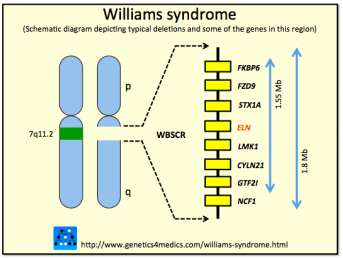
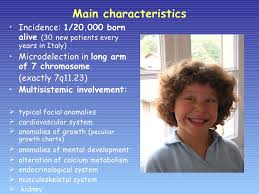
Williams syndrome (WS) is a genetic condition that is present at birth and can affect anyone.  It is characterized by medical problems, including cardiovascular disease, developmental delays, and learning disabilities.  The most significant medical problem associated with WS is the cardiovascular disease caused by the narrowed arteries. WS is also associated with elevated blood calcium levels in infancy. A random genetic mutation (deletion of a small piece of chromosome 7), rather than inheritance, most often causes the disorder. Williams syndrome is considered an autosomal dominant condition because one copy of the altered chromosome 7 in each cell is sufficient to cause the disorder. In a small percentage of cases, people with Williams syndrome inherit the chromosomal deletion from a parent with the condition.

Most cases of Williams syndrome are not inherited but occur as random events during the formation of reproductive cells (eggs or sperm) in a parent of an affected individual. These cases occur in people with no history of the disorder in their family.

However, individuals who have WS have a 50 percent chance of passing it on if they decide to have children. These often occur side by side with striking verbal abilities, highly social personalities and an affinity for music.

WS affects 1 in 7,500 – 10,000 people worldwide – an estimated 20,000 to 30,000 people in the United States. It is known to occur equally in both males and females and in every culture.

Unlike disorders that can make connecting with your child difficult, children with Williams syndrome tend to be social, friendly and endearing.  Parents often say the joy and perspective a child with WS brings into their lives had been unimaginable.

But there are major struggles as well.  Many babies have life-threatening cardiovascular problems.  Children with WS need costly and ongoing medical care and early interventions (such as speech or occupational therapy) that may not be covered by insurance or state funding.  As they grow, they struggle with things like spatial relations, numbers, and abstract reasoning, which can make daily tasks a challenge. As adults, most people with Williams syndrome will need supportive housing to live to their fullest potential.  Many adults with WS contribute to their communities as volunteers or paid employees; often working at assisted living homes for senior citizens, hospitals and libraries, or as store greeters or veterinary aides.

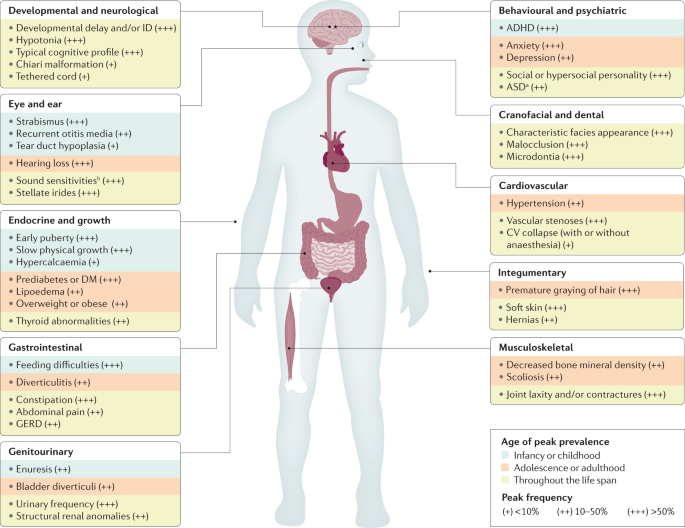
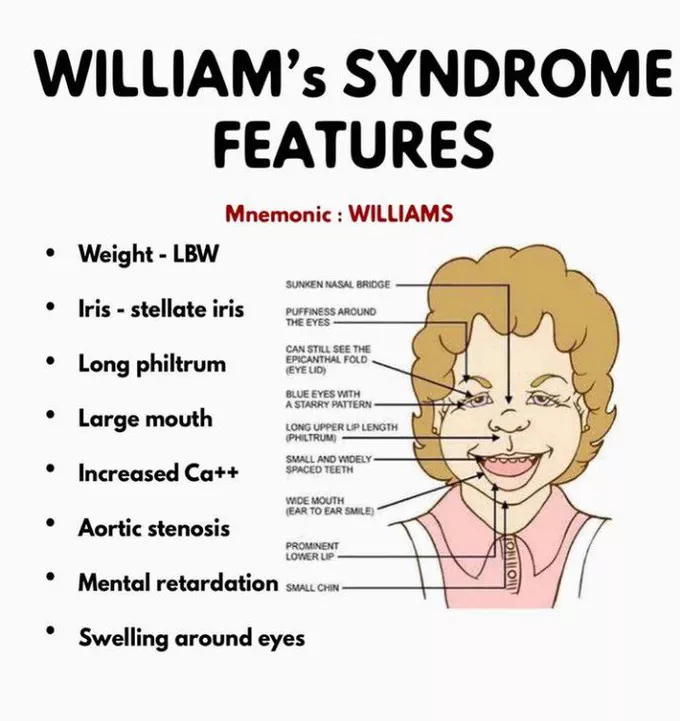
However, individuals who have WS have a 50 percent chance of passing it on if they decide to have children. The characteristic facial features of WS include puffiness around the eyes, a short nose with a broad nasal tip, wide mouth, full cheeks, full lips, and a small chin. People with WS are also likely to have a long neck, sloping shoulders, short stature, limited mobility in their joints, and curvature of the spine. Some individuals with WS have a star-like pattern in the iris of their eyes. Infants with WS are often irritable and colicky, with feeding problems that keep them from gaining weight. Chronic abdominal pain is common in adolescents and adults. By age 30, the majority of individuals with WS have diabetes or pre-diabetes and mild to moderate sensorineural hearing loss (a form of deafness due to disturbed function of the auditory nerve). For some people, hearing loss may begin as early as late childhood. WS also is associated with a characteristic “cognitive profile” of mental strengths and weaknesses composed of strengths in verbal short-term memory and language, combined with severe weakness in visuospatial construction (the skills used to copy patterns, draw, or write). Most older children and adults with WS speak fluently and use good grammar. More than 50% of children with WS have attention deficit disorders (ADD or ADHD), and about 50% have specific phobias, such as a fear of loud noises. The majority of individuals with WS worry excessively.

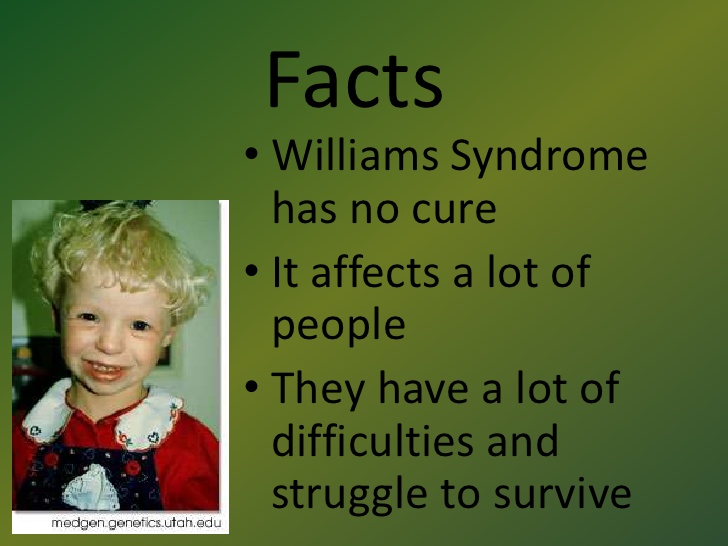
Unfortunately there is no cure for Williams syndrome, nor is there a standard course of treatment.

The prognosis for individuals with WS varies. Some degree of impaired intellect is found in most people with the disorder. Some adults are able to function independently, complete academic or vocational school, and live in supervised homes or on their own; most live with a caregiver.


Where you can find additional information about Williams syndrome:

You may find the following resources about Williams syndrome helpful. These materials are written for the general public.


QUOTE FOR THURSDAY:

“”Chronic kidney disease (CKD) affects more than 1 in 7 U.S. adults—an estimated 35.5 million Americans.1 For Americans with diabetes or high blood pressure—the two most common causes of kidney disease—the risk for CKD is even greater. About 1 in 3 people with diabetes and 1 in 5 people with high blood pressure have kidney disease.1 Other risk factors for developing kidney disease include heart disease and a family history of kidney failure.

Despite the prevalence of kidney disease in the United States, as many as 9 in 10 adults who have CKD are not aware they have the disease.1 Early-stage kidney disease usually has no symptoms, and many people don’t know they have CKD until it is very advanced. Kidney disease often gets worse over time and may lead to kidney failure and other health problems, such as stroke or heart attack. Approximately 2 in 1,000 Americans are living with end-stage kidney disease (ESKD)—kidney failure that is treated with a kidney transplant or dialysis.”

National Institute of Diabetes and Digestive and Kidney Disease NIH-NIDDK (https://www.niddk.nih.gov/health-information/health-statistics/kidney-disease)”

QUOTE FOR WEDNESDAY:

“Kidney failure is a condition in which one or both of your kidneys no longer work on their own. Causes include diabetes, high blood pressure and acute kidney injuries. Symptoms include fatigue, nausea and vomiting, swelling, changes in how often you go to the bathroom and brain fog. Treatment includes dialysis or a kidney transplant.”

Cleveland Clinic (Kidney Failure: Stages, ESRD, Causes, Symptoms & Treatment)

Part IIIA March is kidney month – Chronic Kidney Failure: When it happens, causes, the symptoms, how its diagnosed and treated!


Chronic Renal or Kidney Disease (CRF):

In giving a short and easily understandable definition Chronic kidney disease happens when your kidneys no longer filter your blood the way they should, so wastes (toxins, usually end products of an acid) build up in your blood. This has probably been going on for years, and it may keep getting worse over time. Just like a car engine damaged but still using the car without getting the engine repaired sooner or later in time the engine no longer functions the same with any organ of the body getting damaged by some long term condition. If your disease gets worse and worse over time, you could have kidney failure or some multi organ failure, depending on the condition causing this.

Regarding Chronic Kidney Failure the causes can be:

** Diabetes (uncontrolled diabetes (Type 1 or 2) for many years.

** High blood pressure for many years.

These are the top 2 causes of most chronic kidney disease. Controlling these diseases can help slow or stop the damage to the individual’s kidneys who has one of these, if not both.

Other common causes of chronic renal failure (CRF) include:

-recurring pyelonephritis (kidney infection)

-polycystic kidney disease (multiple cysts in the kidneys

-autoimmune disorders such as systemic lupus erythematosus.

-hardening of the arteries, which can damage blood vessels in the kidney.

-A narrowed or blocked renal artery. A renal artery carries blood to the kidneys. Know this for starters, each of your kidneys has about a million tiny filters, called nephrons. The nephron is the tiny filtering structure in your kidneys. Each of your kidneys contain more than a million tiny filtering nephrons that help clean your blood removing toxins dumping them into your urinary bladder so you can evacuate them though urine (urea, urine; get it). Your nephrons play a vital role to our essential daily living. If over a long time you have a renal artery blocked the nephrons stop their function and die.

Remember the nephrons help all humans do the following if there kidneys or one kidney is functioning properly:

-Remove excess water, wastes (like urea, ammonia, etc.) & other substances from your blood.

-Return substances like sodium, potassium or phosphorus to the body whenever any of these substances run llow in your body or do the opposite if they run high to evacuate them through voiding dumping the sodium or phosphorus or potassium in the urinary bladder through the tube from the kidneys to the urinary bladder called ureters.

**If nephrons are damaged by the high sugar content or high blood pressure in the kidneys, they stop working. For a while, healthy nephrons can take on the extra work or overload. But if the damage continues, more and more nephrons shut down. After a certain point, the nephrons that are left cannot filter your blood well enough to keep you’re blood filtered properly to keep you healthy. Just like running from a bear in the street chancing you. We can run only so long but sooner or later we will run out of energy and not be able to run anymore, same concept for the kidney nephrons when they run out of enough energy due to the kidneys not properly working.**

The symptoms can be:

Urinate less than normal.

Have swelling and weight gain from fluid buildup in your tissues. This is called edema.

Feel very tired or sleepy.

Not feel hungry, or you may lose weight without trying.

Often feel sick to your stomach (nauseated) or vomit.

Have trouble sleeping.

Have headaches or trouble thinking clearly.

So what will you do GO TO A DOCTOR OR CALL 911 AND GO TO THE ER:

Your doctor will do blood and urine tests to help find out how well your kidneys are working. These tests can show signs of kidney disease and anemia. (You can get anemia from having damaged kidneys.) You may have other tests to help rule out other problems that could cause your symptoms.

To diagnose chronic renal failure is pretty much the same tests that are listed above on acute renal failure plus:

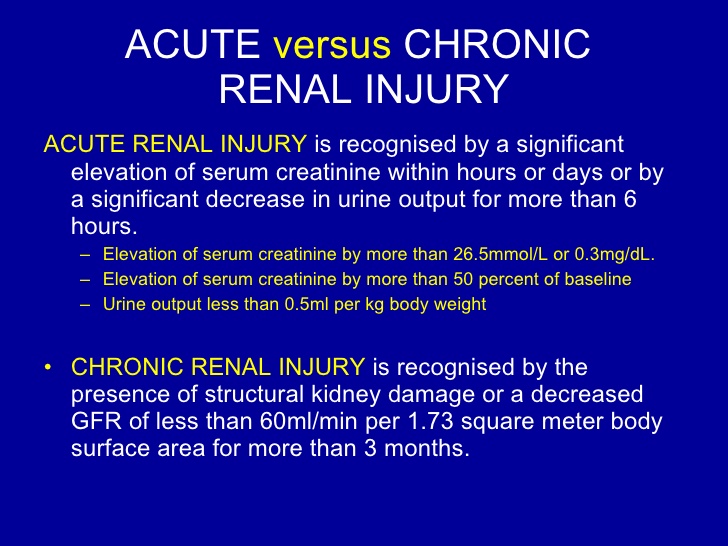
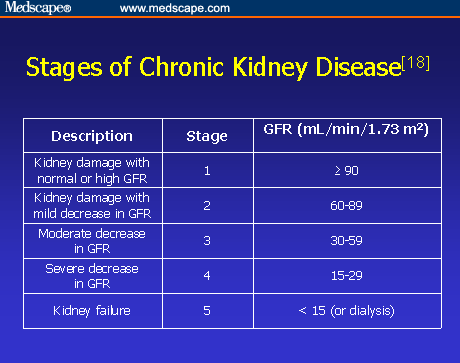
Chronic kidney disease is also called chronic renal failure or chronic renal insufficiency.There are five stages of kidney disease, from kidney damage with normal GFR to kidney failure.  So GFR will help the MD rule out acute versus chronic to give the MD direction on Rx.Your doctor will ask questions about any past kidney problems. He or she will also ask whether you have a family history of kidney disease and what medicines you take, both prescription and over-the-counter drugs.

Diagnosis & Treatment (Rx) for Chronic Kidney (Renal) Failure (CRF):

There are things you can do to slow or stop the damage to your kidneys. Taking medicines and making some lifestyle changes can help you manage your disease, prevent further damage to the kidneys, if their functioning at all and make you possibly feel better.

Kidney disease is a complex problem. You will probably need to take a number of medicines and have many tests. To stay as healthy as possible, take your medicines just the way your doctor says to and work closely with your doctor.

Go to all your appointments for the MD to see a increase in function or decrease in function of your kidney or kidneys you have still functioning to a level. To do that you can’t just go every 6 months especially when first diagnosed with it or with a collapse of an exacerbation of kidney failure in a worse level that brought on new symptoms that brought you to the ER.

Lifestyle changes are an important part of your treatment. Taking these steps can help slow down kidney disease and reduce your symptoms. These steps may also help with high blood pressure, diabetes, and other problems that make kidney disease worse or made the kidney disease happen with the secondary diagnosis you had originally for years (ex. Hypertension or Diabetes if not both especially is uncontrolled)

Very hard, never a complete 100 % resolution. It is like emphysema done by smokers the damage is done or like a heart attack the area of the infarction=damage is already done to the heart muscle.

Scared now, understandable but unfortunately the damage is done, so its get the organ to its optimal level of functioning or replace the damaged kidney (s) through a transplant of one.  You need to know this, do it if you want to live LONGER.  Remember fear is fear itself, the fear run it over and deal with what you have and make your life longer & better!  It’s all up to you.  HANDSOME I know you can do it , I am there for you as a good friend and professional RN and I would love you to last longer John!! XO

You may have a test done that lets your doctor look at a picture of your kidneys, such as an ultrasound or CT (Cat Scan of the kidneys). These tests can help your doctor measure the size of your kidneys, estimate blood flow to the kidneys, and see if urine flow is blocked. In some cases, your doctor may take a tiny sample of kidney tissue (biopsy) to help find out what caused your kidney disease.

Chronic kidney disease is caused by damage of the kidneys whether the cause of it be primary a Renal or Kidney problem or a secondary, another disease or disorder that affects the kidneys in doing their job, like hyperglycemia related to a individual with uncontrolled diabetes, for instance.

Chronic kidney disease may seem to have come on suddenly. But it has been happening bit by bit for many years as a result of damage to your kidneys.

One way to measure how well your kidneys are working is to figure out your glomelular filtration rate (GFR). The GFR is usually calculated using results from your blood creatinine test.

Then the stage of kidney disease is figured out using the GFR (glomelular filtration rate). There are five stages of kidney disease, from kidney damage with normal GFR to kidney failure.

Your doctor will do tests that measure the amount of urea (BUN) and creatinine in your blood. These tests can help measure how well your kidneys are filtering your blood. As your kidney function gets worse, the amount of nitrogen (shown by the BUN test) and creatinine in your blood increases. The level of creatinine in your blood is used to find out the glomerular filtration rate (GFR). The GFR is used to show how much kidney function you still have. The GFR is also used to find out the stage of your kidney disease your in if you have it and its to guide decisions about treatment. *