
QUOTE FOR TUESDAY:

“VA uses the term “military sexual trauma” (MST) to refer to sexual assault or threatening sexual harassment experienced during military service. MST includes any sexual activity during military service in which you are involved against your will or when unable to say no. People of all genders, ages, sexual orientations, racial and ethnic backgrounds, and branches of service have experienced MST. Like other types of trauma, being PTSD.  MST can negatively affect a person’s mental and physical health, even many years later. Examples include:

  • Being pressured or coerced into sexual activities, such as with threats of negative treatment if you refuse to cooperate or with promises of better treatment
  • Sexual contact or activities without your consent, including when you were asleep or intoxicated
  • Being overpowered or physically forced to have sex
  • Being touched or grabbed in a sexual way that made you uncomfortable, including during “hazing” experiences
  • Comments about your body or sexual activities that you found threatening
  • Unwanted sexual advances that you found threatening”

U.S. Dept of Veteran’s Affair (https://www.mentalhealth.va.gov/msthome/index.asp)

Part I What is Parkinson Disease (PD)?

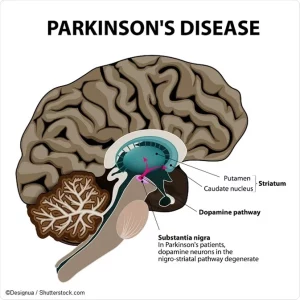
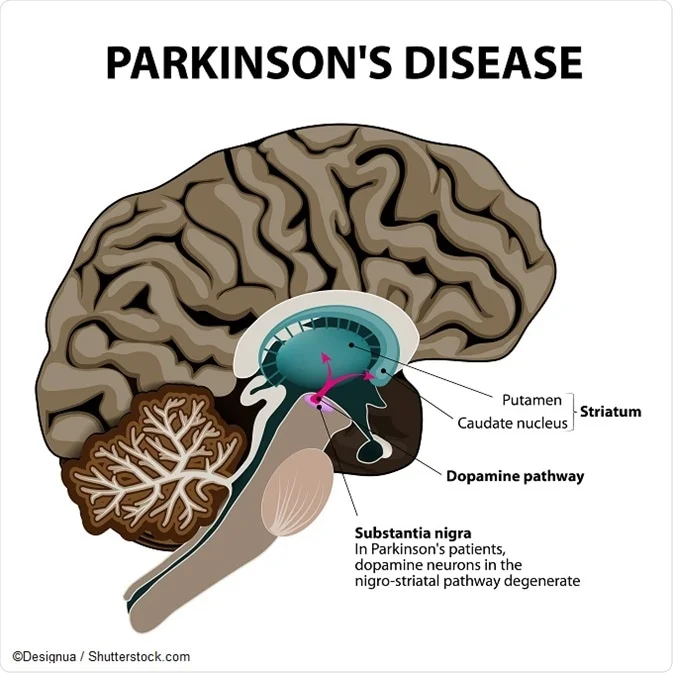
Parkinson's Disease1 

Parkinson Disease (PD) is a chronic and progressive movement disorder, meaning that symptoms continue and worsen over time. Nearly one million people in the US are living with Parkinson’s disease. The cause is unknown, and although there is presently no cure, there are treatment options such as medication and surgery to manage its symptoms.

Parkinson’s involves the malfunction and death of vital nerve cells in the brain, called neurons. Parkinson’s primarily affects neurons in an area of the brain called the substantia nigra. Some of these dying neurons produce dopamine, a chemical that sends messages to the part of the brain that controls movement and coordination. As PD progresses, the amount of dopamine produced in the brain decreases, leaving a person unable to control movement normally.

There are three types of Parkinson’s disease and they are grouped by age of onset: 

1-Adult-Onset Parkinson’s Disease – This is the most common type of Parkinson’s disease. The average age of onset is approximately 60 years old. The incidence of adult onset PD rises noticeably as people advance in age into their 70’s and 80’s.

2-Young-Onset Parkinson’s Disease – The age of onset is between 21-40 years old. Though the incidence of Young-Onset Parkinson’s Disease is very high in Japan (approximately 40% of cases diagnosed with Parkinson’s disease), it is still relatively uncommon in the U.S., with estimates ranging from 5-10% of cases diagnosed.

3-Juvenile Parkinson’s Disease – The age of onset is before the age of 21. The incidence of Juvenile Parkinson’s Disease is very rare.

Impact of the disease:

Parkinson’s disease can significantly impair quality of life not only for the patients but for their families as well, and especially for the primary caregivers. It is therefore important for caregivers and family members to educate themselves and become familiar with the course of Parkinson’s disease and the progression of symptoms so that they can be actively involved in communication with health care providers and in understanding all decisions regarding treatment of the patient.


According to the American Parkinson’s Disease Association, there are approximately an estimated 1 million Americans living with Parkinson’s disease and more than 10 million people worldwide.  That number is expected to rise as the general population in the U.S. ages. Onset of Parkinson’s disease before the age of 40 is rare. All races and ethnic groups are affected.


Knowledge is Critical when Dealing with a Life-Altering Condition such as Parkinson’s Disease and being able to make the changes to last longer and at your optimal level of functioning! First step is accept you have it!

If you or a loved one has been diagnosed with Parkinson’s disease, it’s critical to learn everything you possibly can about this condition so that you can make informed decisions about your treatment. That’s why we created the Medifocus Guidebook on Parkinson’s Disease, a comprehensive 170 page patient Guidebook that contains vital information about Parkinson’s disease that you won’t find anywhere in a single source.

The Medifocus Guidebook on Parkinson’s Disease starts out with a detailed overview of the condition and quickly imparts fundamentally important information about Parkinson’s disease, including:

Possible factors that could impact someone in being diagnosed with this disorder:

1-Genetic Factors

In some patients, genetic factors could be the primary cause; but in others, there could be something in the environment that led to the disease. Scientists have noted that aging is a key risk factor. There is a 2-4% risk for developing the disease for people over 60. That is compared to 1-2% risk in the general population.

2-Environmental Factors

Some scientists believe that PD can result from overexposure to environmental toxins, or injury. Research by epidemiologists has identified several factors that may be linked to PD. Some of these include living in rural areas, drinking well water, pesticides and manganese.

Some studies have indicated that long term exposure to some chemicals could cause a higher risk of PD. These include the insecticides permethrin and beta-hexachlorocyclohexane (beta-HCH), the herbicides paraquat and 2,4-dichlorophenoxyacetic acid and the fungicide maneb. In 2009, the US Veterans Affairs Department stated that PD could be caused by exposure to Agent Orange.

We should remember that simple exposure to a single toxin in the environment is probably not enough to cause PD. Most people who are exposed to such toxins do not develop PD but could be a risk.

The Parkinson’s Disease Foundation notes that even after decades of intense study, the causes of Parkinson’s disease are not really understood. However,they agree in saying that many experts believe that the disease is caused by several genetic and environmental factors, which can vary in each person.
QUOTE FOR WEDNESDAY:

“Not everyone has a work schedule that resembles the traditional nine-to-five day. In fact, more than 22 million Americans work evening, rotating, or on-call shifts. You face many challenges when working non-traditional hours. It can be hard to keep up with family and friends. You may feel disconnected from the people you care about the most. You may have trouble organizing your time and activities. You may be frustrated to realize that most things are planned around the schedule of the typical day worker. It may seem like no one has your needs in mind.  Your physical health may also suffer from shift work. It can be very hard to get the sleep you need to stay well rested. This can make you more likely to get sick. It also makes you at potential that the job is hard for you to stay alert on the job.  Being tired increases the chance that you could suffer a work-related injury. Even driving home from work is a risk when you are sleepy.  Studies show that sleepiness can have a negative effect on any of the following:

1. Attention 2. Concentration 3. Reaction time 4. Memory  5. Mood.

A main challenge of shift work is that it forces you to sleep against the clock. You have an internal body clock in your brain that produces circadian rhythms.  If you work at night, you must fight your body’s natural rhythms to try and stay awake. Then you have to try to sleep during the day when your body expects to be alert.

It is a good idea to take a nap just before reporting for a night shift. This makes you more alert on the job. A nap of about 90 minutes seems to be best. Naps during work hours may also help you stay awake and alert. You may also want to take a nap during the night shift “lunch hour.” This can make you more productive and more satisfied”

UCLS Health (https://www.uclahealth.org/medical-services/sleep-disorders/patient-resources/patient-education/coping-with-shift-work)

QUOTE FOR TUESDAY:

“National Foot Health Awareness Month is observed in April to raise critical awareness regarding our foot health. Understanding the value of healthy feet is essential. Below, our experts share important tips, tricks and fascinating facts on one of the most important parts of our body–our feet!

Step Into April On A Good Foot With These Tips and Tricks 

  • Inspect your feet regularly and pay attention to changes in color, texture or appearance.
  • Maintain good foot hygiene, including washing and drying between the toes.
  • Hydrate the skin. Southern California weather and open shoes can cause rapid loss of moisture from the skin and may result in cracking or the formation of fissures. It is helpful to replace the moisture content by using lotions or creams on a regular basis.
  • Don’t ignore foot pain. Symptoms that increase or do not resolve within a reasonable period of time need to be evaluated by your podiatric physician.”

Feet First Foot Care Specialists LLC-conservative and surgical foot care – posted: Mar. 31, 2023-Dr. A. Mucinska

(https://www.feetfirst-footcare.com/staff)

QUOTE FOR MONDAY:

“A good laugh has great short-term effects. When you start to laugh, it doesn’t just lighten your load mentally, it actually induces physical changes in your body.

Laughter or humor in short term changes it does this to the body:

  • Stimulate many organs. Laughter enhances your intake of oxygen-rich air, stimulates your heart, lungs and muscles, and increases the endorphins that are released by your brain.
  • Activate and relieve your stress response. A rollicking laugh fires up and then cools down your stress response, and it can increase and then decrease your heart rate and blood pressure. The result? A good, relaxed feeling.
  • Soothe tension.Laughter can also stimulate circulation and aid muscle relaxation, both of which can help reduce some of the physical symptoms of stress.

Laughter or humor in Long Term Effects it does this to the body:

  • Improve your immune system. Negative thoughts manifest into chemical reactions that can affect your body by bringing more stress into your system and decreasing your immunity. By contrast, positive thoughts can actually release neuropeptides that help fight stress and potentially more-serious illnesses.
  • Relieve pain. Laughter may ease pain by causing the body to produce its own natural painkillers.
  • Increase personal satisfaction. Laughter can also make it easier to cope with difficult situations. It also helps you connect with other people.
  • Improve your mood. Many people experience depression, sometimes due to chronic illnesses. Laughter can help lessen your stress, depression and anxiety and may make you feel happier. It can also improve your self-esteem.”

MAYO CLINIC (https://www.mayoclinic.org/healthy-lifestyle/stress-management/in-depth/stress-relief/art-20044456)

QUOTE FOR THE WEEKEND:

“You don’t have to face infertility alone. Find someone to talk to who understands through our support groups, online community, and HelpLine.  We can help you find reproductive endocrinologists, urologists, mental health therapists, and other family building professionals.We help you understand and advocate for insurance coverage and for legislation that improves access to all family building options.”

Resolve – The National Fertility Association (https://resolve.org/)

QUOTE FOR FRIDAY:

“Thrombocytopenia-absent radius (TAR) syndrome is a rare disorder that is present at birth (congenital). It is characterized by low levels of platelets in the blood (thrombocytopenia) and absence (aplasia) of the long, thin bones of the forearms (radii) but with presence of thumbs. Other abnormalities are often present including additional skeletal defects such as absence or underdevelopment of the other bone of the forearm (ulna), structural malformations of the heart (congenital heart defects) and kidney (renal) defects.”

NORD National Organization For Rare Diseases (https://rarediseases.org/rare-diseases/thrombocytopenia-absent-radius-syndrome/)

QUOTE FOR THURSDAY:

“Cotard’s syndrome is a relatively rare condition that was first described by Dr. Jules Cotard in 1882. Cotard’s syndrome comprises any one of a series of delusions that range from a belief that one has lost organs, blood, or body parts to insisting that one has lost one’s soul or is dead.”

NIH National Library of Medicine (https://www.ncbi.nlm.nih.gov/pmc/articles/PMC2695744/)

Cotard’s syndrome

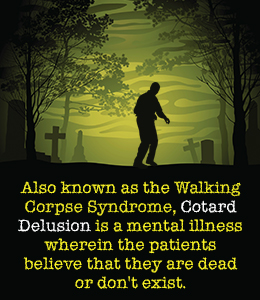
Cotard delusion, also known as or nihilistic delusion or walking corpse syndrome or Cotard’s syndrome , is a rare mental disorder in which the affected person holds the delusional belief that they are already dead, do not exist, are putrefying, or have lost their blood or internal organs.

Signs and Symptoms: 

One of the main symptoms of Cotard delusion is nihilism. Nihilism is the belief that nothing has any value or meaning. It can also include the belief that nothing really exists. People with Cotard delusion feel as if they’re dead or rotting away. In some cases, they might feel like they’ve never existed.

While some people feel this way about their entire body, others only feel it in regard to specific organs, limbs, or even their soul.

Depression is also closely related to Cotard delusion. A 2011 review of existing research about Cotard delusion notes that 89% of documented cases include depression as a symptom.

Other symptoms include:

  • anxiety
  • hallucinations
  • hypochondria
  • guilt
  • preoccupation with hurting yourself or death

Researchers aren’t sure what causes Cotard delusion, but there are a few possible risk factors. Several studies indicate that the average age of people with Cotard delusion is about 50. It can also occur in children and teenagers. People under the age of 25 with Cotard delusion tend to also have bipolar depression. Women also seem to be more likely to develop Cotard delusion.

In addition, Cotard delusion seems to occur more often in people who think their personal characteristics, rather than their environment, cause their behavior. People who believe that their environment causes their behavior are more likely to have a related condition called Capgras syndrome. This syndrome causes people to think their family and friends have been replaced by imposters. Cotard delusion and Capgras syndrome can also appear together.

Other mental health conditions that might increase someone’s risk of developing Cotard delusion include:

  • bipolar disorder
  • postpartum depression
  • catatonia
  • depersonalization disorder
  • dissociative disorder
  • psychotic depression
  • schizophrenia

Cotard delusion also seems to be associated with certain neurological conditions, including:

  • brain infections
  • brain tumors
  • dementia
  • epilepsy
  • migraines
  • multiple sclerosis
  • Parkinson’s disease
  • stroke
  • traumatic brain injuries

QUOTES FOR WEDNESDAY:

1-“Since 1996, evidence has been increasing for a causal relationship between the outbreak in Europe of a disease in cattle, called bovine spongiform encephalopathy (BSE, or “mad cow disease”), and a disease in humans, called “variant” Creutzfeldt-Jakob disease (vCJD).

Both disorders are invariably fatal brain diseases with unusually long incubation periods measured in years, and are caused by abnormally folded proteins in the brain called “prions” (pree-ons).  ”

Cattle affected by BSE experience progressive degeneration of the nervous system. Signs usually don’t appear until about 3–6 years after initial infection.

The highest quality beef comes from animals that are under 36 months of age. Old cows produce highly acceptable beef if properly fattened and processed but know there is testing cows for it before making it food on our table.

Know this BSE belongs to a family of diseases known as transmissible spongiform encephalopathies that includes, among others, scrapie in sheep and goats; chronic wasting disease in deer, elk, and moose; and classic and variant Creutzfeldt-Jakob disease in people.”

1-Centers for Disease Control and Prevention-CDC (https://www.cdc.gov/prions/index.html)

*****

2-CHICAGO (Reuters) states – On May 19,2023 they stated “The U.S. Department of Agriculture (USDA) announced on Friday an atypical case of Bovine Spongiform Encephalopathy (BSE), commonly called mad cow disease, in an older beef cow at a slaughter plant in South Carolina.

USDA stated “the animal never entered slaughter channels and the agency did not expect any trade impacts as a result.
It was the seventh detection of BSE in the United States since 2003 and all but one have been atypical”
Animal and Plant Health Inspection Service said in a statement “This finding of an atypical case will not change the negligible risk status of the United States and should not lead to any trade issues,”.
2-Reuters (https://www.reuters.com/world/us/us-reports-case-atypical-mad-cow-disease-2023-05-19/)

*****

3-“We know that the earliest point at which current tests can accurately detect BSE is 2-to-3 months before the animal begins to show symptoms. The time between initial infection and the appearance of symptoms is about 5 years. Since most cattle that go to slaughter in the United States are both young and clinically normal, testing all slaughter cattle for BSE might offer misleading assurances of safety to the public.

The carcasses from the tested animals are held and not allowed to enter the human food chain until test results show the samples are negative for Bovine spongiform encephalopathy (BSE or Mad Cow Disease).”

3-U.S.D.A  US Dept of Agriculture (https://www.usda.gov/topics/animals/bse-surveillance-information-center)

“Currently, there is no test to detect the disease in a live animal or in muscle meat products. BSE can only be confirmed by microscopic examination of brain tissue from the animal after its death using sophisticated laboratory techniques.”

3-U.S.D.A (https://ask.usda.gov/s/article/how-do-cattle-get-bovine-spongiform-encephalopathy)

Their is no standard testing before each cow including other wild life animals listed at the top that go on our plate sold in stores for food? Another thought, In the United States and the European Union, cows are typically slaughtered for beef between the ages of 18 months and 30 months. In the United States, most cows are slaughtered at around 24-30 months of age, although some may be slaughtered as young as 18 months; cows are about 5 yrs old when symptoms start showing. No regular testing on all cows used for meat for BSE no matter how low the incidence in US due to spreading can occur; really?  Quite interesting but know based on statistics you have a 1 in a million chance getting this & it seems by history you have more of a chance in the mid to mid west area of US.