Archive | May 2025

QUOTE FOR FRIDAY:

“Amyotrophic lateral sclerosis (ALS) is a progressive neurological disorder that affects motor neurons in the brain and spinal cord, leading to the degeneration and death of these crucial nerve cells [1]. This fatal condition, often referred to as Lou Gehrig’s disease, causes a gradual loss of voluntary muscle control, impacting essential functions such as walking, talking, chewing, and breathing [2]. ALS typically manifests between the ages of 40 and 70,

Notably, ALS does not typically affect cognitive function, sensory perception, or bladder control [2]. While the exact cause remains unknown for most cases, approximately 10% are attributed to genetic factors, classified as familial ALS. The remaining 90% are considered sporadic, occurring randomly without a clear hereditary link [3]. Despite ongoing research, there is currently no cure for ALS, and the average life expectancy after diagnosis ranges from 3 to 5 years, although some individuals may survive for a decade or more [1].”

ALS United Ohio (ttps://alsohio.org/als-vs-ms-amyotrophic-lateral-sclerosis-vs-multiple-sclerosis/)


Part II ALS Awareness Month-Stages of ALS

Once ALS starts, it almost always progresses, eventually taking away the ability to walk, dress, write, speak, swallow, and breathe, and shortening the life span. The onset of ALS often involves muscle weakness or stiffness as early symptoms. Progression of weakness, wasting, and paralysis of the muscles of the limbs and trunk, as well as those that control vital functions such as speech, swallowing, and breathing, generally follows.

How fast and in what order this occurs is very different from person to person. While the average survival time is three years, about 20 percent of people with ALS live five years, 10 percent will survive 10 years and 5 percent will live 20 years or longer.

End stages of ALS often include trouble swallowing and speaking. Weak and paralyzed vocal cords make speaking difficult and eventually impossible. Trouble swallowing occurs gradually in some patients, but can occur suddenly in others.

Stages of ALS

ALS is a relentlessly progressive disorder. The rate of progression between individuals is variable and the history generally reflects gradual and progressive worsening over time until death occurs.

Early stages:

Muscles

  • Muscles may be weak and soft, or they may be stiff, tight, and spastic. Muscle cramping and twitching (fasciculation) occurs, as does loss of muscle bulk (atrophy).
  • Symptoms may be limited to a single body region or mild symptoms may affect more than one region.

Physical effects

  • The person may experience fatigue, poor balance, slurred words, a weak grip, tripping when walking, or other minor symptoms.
  • Sometimes this stage occurs before a diagnosis is made.

Middle stages:

Muscles

  • Symptoms become more widespread.
  • Some muscles are paralyzed, while others are weakened or unaffected. Fasciculations may continue.

Physical effects

  • Unused muscles may cause contractures, in which the joints become rigid, painful, and sometimes deformed.
  • If a fall occurs, the person may not be able to stand back up alone.
  • Driving is relinquished.
  • Weakness in swallowing muscles may cause choking and greater difficulty eating and managing saliva.
  • Weakness in breathing muscles can cause respiratory insufficiency, especially when lying down.
  • Some people experience bouts of uncontrolled and inappropriate laughing or crying (pseudobulbar affect). Despite how it seems, the person usually doesn’t feel particularly sad or happy.

Late stages:

Muscles

  • Most voluntary muscles are paralyzed.
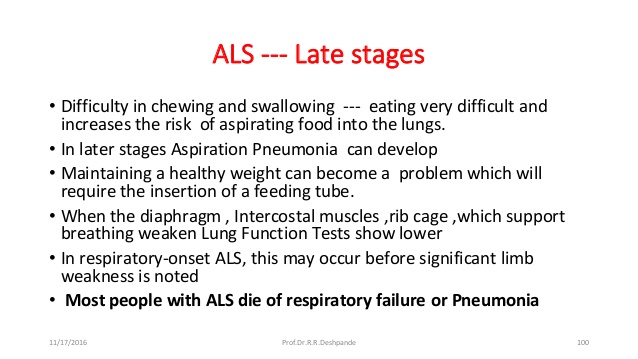
  • The muscles that help move air in and out of the lungs are severely compromised.

Physical effects

  • Mobility is extremely limited, and help is needed in caring for most personal needs.
  • Poor respiration may cause fatigue, fuzzy thinking, headaches, and susceptibility to pneumonia. (Respiratory insufficiency is a leading cause of death in ALS.)
  • Speech, or eating and drinking by mouth, may not be possible
  • Assistance needed if not needed in the previous stage yet; in the home care you would need:

    • Power wheelchair, hospital bed, mechanical lift, and switches that enable any moving body part to operate computers, environmental control units, and communication devices.
    • Assisted ventilation, either noninvasive or invasive (tracheostomy).
    • Feeding tube.
    • Possibly urinary catheters aren’t required but can make toileting easier.
    • The type of home assistance you need:

    1.) Caregivers should:

    • Find and train caregiving help.
    • Oversee 24-hour care operations.
    • Find ways to help the person with ALS stay socially and mentally active.
    • Get into a routine that supports themselves as well as the person with ALS.
    • Know that although this stage is all-consuming, surprisingly many caregivers report great stability and satisfaction in their daily lives at this later stage of the disease.

       2.) Visiting RN (Nurse) who basically follows up on the care and decline or no change in pt    with letting the attending M.D. in charge be kept informed on pt’s status who makes any change with orders on the pt’s care.  It’s a whole team effect to make sure the pt gets the best care!

  • Progression is not always a straight line in an individual, either. It is not uncommon to have periods lasting weeks to months where there is very little or no loss of function. There are even very rare examples in which there is significant improvement and recovery of lost function. These ALS “arrests” and “reversals” are, unfortunately, usually transient. Less than 1 percent of people with ALS will have significant improvement in function lasting 12 months or longer

End stage

  • The vast majority of deaths in ALS are the result of respiratory failure, a process that progresses slowly over months. Medications can relieve discomfort, anxiety, and fear caused by respiratory insufficiency.
  • Far less-common causes of death in ALS include malnutrition as a result of swallowing problems, pulmonary embolism (a blockage in one of the arteries of the lungs), abnormalities in the heart’s electrical pacing system called cardiac arrhythmias, and pneumonia as the result of aspiration (when food or fluid gets into the lungs).
  • Hospice care (in a facility or in the home) focuses on providing comfort and maintaining quality of life by supporting the physical, emotional, and spiritual needs of the individual with ALS and their family members. Families should contact hospice early on to see what in-home services are available even before the most advanced stage.
  • At MDA clinics, physicians work closely with palliative care teams to coordinate treatment with in-home hospice care providers, assisted living facilities, or inpatient hospice settings. Such cooperation helps ensure the person with ALS has the most peaceful and painless experience possible.


Part I ALS Awareness Month-What is it and what are the signs and symptoms?

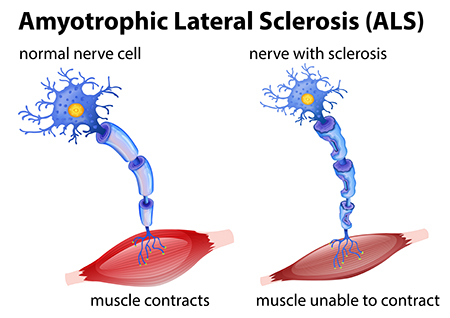
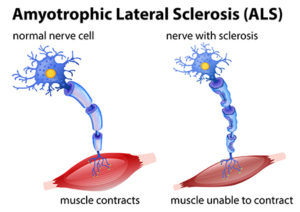
Amyotrophic lateral sclerosis concept illustration
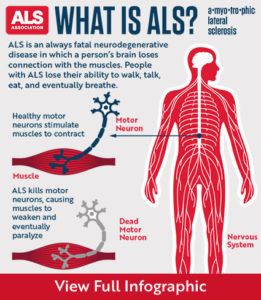
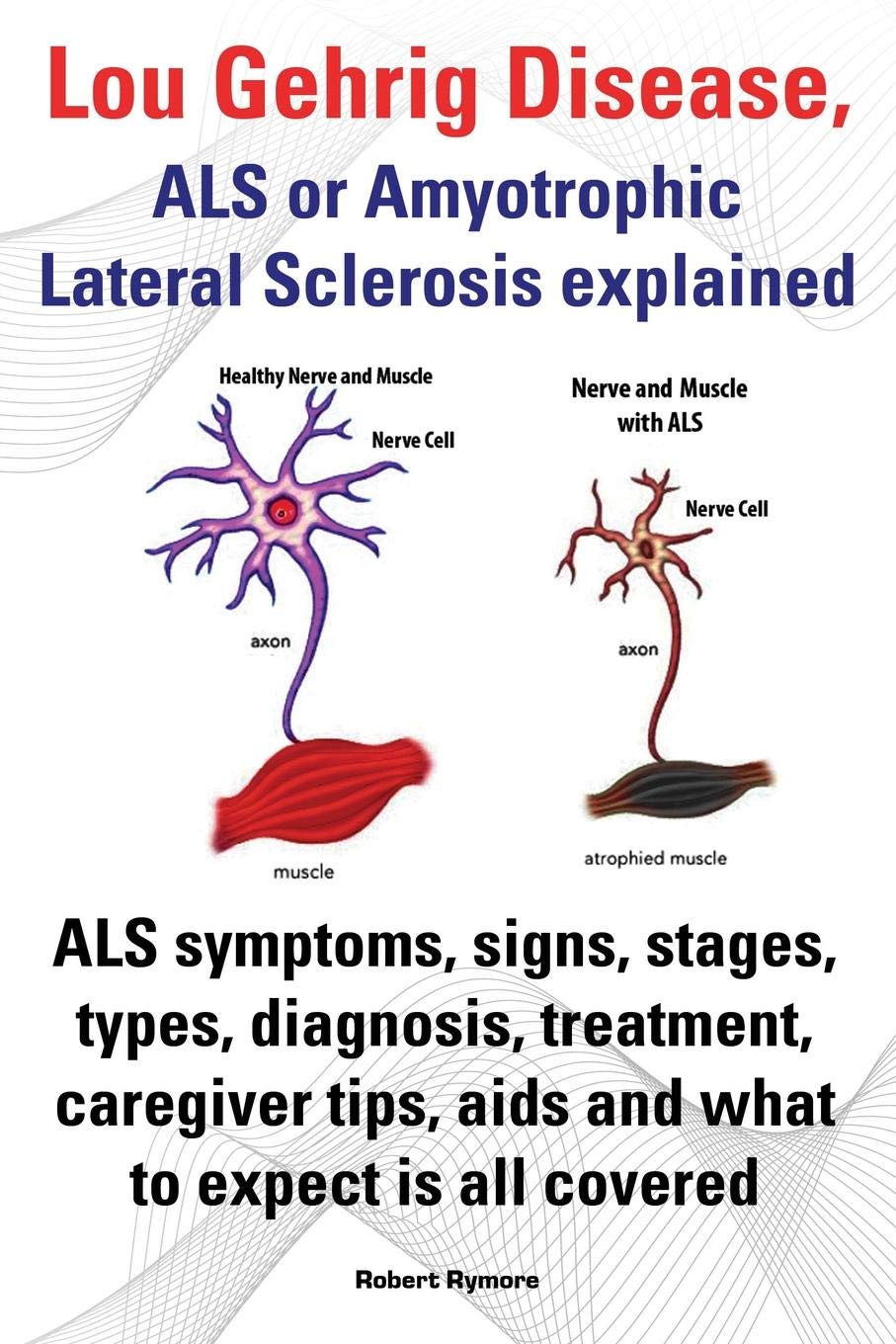
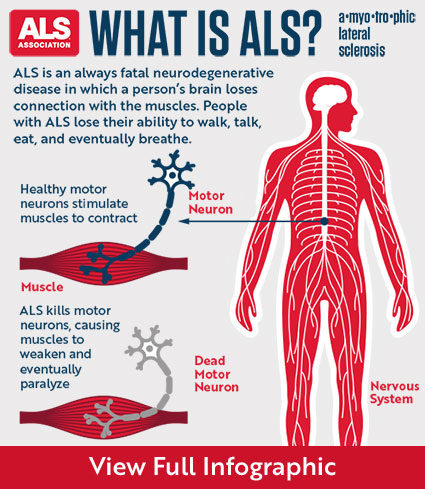
ALS amyotrophic lateral sclerosis is a rare neurological disease affecting nerve cells that control voluntary muscle movement.  Amyotrophic Lateral Sclerosis or ALS, more commonly known as Lou Gehrig’s disease, is a terminal and progressive motor neuron disease. ALS specifically targets and kills the motor neurons responsible for controlling the vast majority of skeletal muscles in the human body, which eventually leads to respiratory failure and death.

Individuals with ALS experience a degeneration of their motor neurons, which causes the muscles to stop receiving the signals needed to function. After a certain time, the brain completely loses its ability to control voluntary movements, hence, people with ALS are unable to walk, move, or even breathe properly.

ALS belongs to, and is perhaps the most common example of, a group of neurological disorders known as Motor Neuron Diseases.  These diseases affect the body by causing the death of millions of neurons found in the motor cortex of the brain as well as the spinal cord. These nerve cells are directly responsible for the regulation and control of skeletal muscle function.

How ALS is diagnosed:

Considering the damage ALS can do, it became essential to spread the message regarding the disease so that people could treat it at an early stage. Though there is no cure for ALS but early detection can help in improving the quality of life of those with the disease. 

The signs and symptoms of this diagnosis:

1-Fatigue

A positive diagnosis of ALS is based primarily on a patient’s symptomatology.  Unfortunately there is no test that can currently provide a more conclusive assessment.

There are many diseases whose symptoms resemble those observed in patients with ALS. Therefore, diseases such as cervical osteoarthritis, cervical hernias that compress the spinal cord, heavy metal poisoning, and some infectious diseases such as Lyme disease or syphilis, can delay a correct diagnosis of ALS immediately.

As such, when ALS is suspected, it is common practice to rule out other diseases through a variety of tests including but not limited to lumbar punctures, MRIs, and electromyographic studies. In some cases, it might be necessary to perform a biopsy of muscle tissue in order to assuage any remaining doubts.

Often, the earliest symptoms of ALS are ignored or outright dismissed. Therefore, better understand this disease’s signs and symptoms.

2-Loss of strength

Pt’s with ALS eventually lose the ability to control all voluntary movement. During the progression of the disease, which typically lasts for several years, patients will experience a cumulative loss of muscle strength.

In most cases, the first muscles affected by the disease are those of the arms and legs which results in patients experiencing awkwardness when walking or moving about, an increased propensity for stumbling or tripping, and difficulty performing everyday tasks especially fine motor tasks like texting on the phone, typing, and even tying shoe or sneaker laces.

3-Muscle Atrophy

This is when the muscle actually deteriorates and muscle is lost.  Leading to muscle dystrophy,in the specific case of ALS, it occurs due to a dramatic reduction in the connection between nerves and muscle fibers caused by the death of motor neurons.  It often culminates to paresthesia to partial or total paralysis.

4-Fasciculations

Fasciculations are slight and involuntary muscular contractions that occur underneath the skin, but that do not produce any observable limb movement. Fasciculations are visible to the naked eye and are sometimes described as looking like small worms are moving within the muscle. These contractions occur because of spontaneous nerve discharges that fire within clumps of skeletal muscle fibers.  They can occur due to damage present in the lower motor neurons. They could be considered an early warning sign of the possible onset of ALS.

5-Cramps

Muscle cramps are highly common in patients who have ALS, and their incidence increases as the disease progresses. These sustained involuntary contractions of the muscles are typically accompanied by palpable contractures, can last anywhere from 30 to 45 seconds, and tend to be extremely painful.  Spasticity could develop and may not allow certain movements as a consequence of cramps;  in which antagonistic muscle groups participate.

Other Symptoms include:

  • Tripping and falling
  • Hand weakness or clumsiness
  • Slurred speech or trouble swallowing
  • twitching in your arms, shoulders and tongue
  • Inappropriate crying, laughing or yawning
  • Cognitive and behavioral changes