Archives

Part I How music impacts our brain.

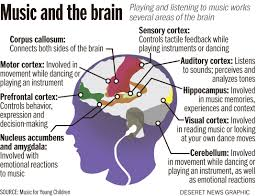
music and the brain   music and the brain

We can usually pick if a piece of music is particularly happy or sad, but this isn’t just a subjective idea that comes from how it makes us feel. In fact, our brains actually respond differently to happy and sad music. Even short pieces of happy or sad music can affect us.

When we hear a form of music we actually match the tone of the music with our mood or reaction to it. This means that sometimes we can understand the emotions of a piece of music without actually feeling them, which explains why some of us find listening to sad music to enjoyable, rather than depressing or sad to others.

We all like to pump up the tunes when we’re powering through our to-do lists, right? But when it comes to creative work, loud music may not be the best option.

It turns out that a moderate level of noises is the sweet level for creativity. Even more than low noise levels, ambient noise apparently gets our creative juices flowing, and doesn’t put us off the way high levels of noise does.

The way this works is that moderate noise levels increase processing difficulty which promotes abstract processing, leading to higher creativity. In other words, when we struggle (just enough) to process things as we normally would, we resort to more creative approaches.

In high noise levels, however, our creative thinking is impaired because we’re overwhelmed and struggle to process information efficiently.

This is very similar to how temperature and lighting can affect our productivity, where paradoxically a slightly more crowded place can be beneficial.

Of course, generalizing based on some studies is very hard. However looking at the science of introverts and extroverts, there is some clear overlap showing the following:

To break it down, here is the connection they has been found about people (again remember this is generally speaking):

  • Blues fans have high self-esteem, are creative, outgoing, gentle and at ease
  • Jazz fans have high self-esteem, are creative, outgoing and at ease
  • Classical music fans have high self-esteem, are creative, introvert and at ease
  • Rap fans have high self-esteem and are outgoing
  • Opera fans have high self-esteem, are creative and gentle
  • Country and western fans are hardworking and outgoing
  • Reggae fans have high self-esteem, are creative, not hardworking, outgoing, gentle and at ease
  • Dance fans are creative and outgoing but not gentle
  • Indie fans have low self-esteem, are creative, not hard working, and not gentle
  • Bollywood fans are creative and outgoing
  • Rock/heavy metal fans have low self-esteem, are creative, not hard-working, not outgoing, gentle, and at ease
  • Chart pop fans have high self-esteem, are hardworking, outgoing and gentle, but are not creative and not at ease
  • Soul fans have high self-esteem, are creative, outgoing, gentle, and at easePlaying music expands our thinking. We generally assume that learning a musical instrument can be beneficial for kids, but it’s actually useful in more ways than we might expect.   Studies have shown that children who had three years or more musical instrument training performed better than those who didn’t learn an instrument in auditory discrimination abilities and fine motor skills.
  • Instrument playing is a form of exercise that is great for your health as opposed to sitting watching t.v. where no creativity or imagining or brain concentrating takes place.
  • It seems that unfamiliar, or uninteresting, music is best for safe driving. Reason: Less Distracted.

Research on the effects of music during exercise has been done for years. In 1911, an American researcher, Leonard Ayres, found that cyclists pedaled faster while listening to music than they did in silence.

This happens because listening to music can drown out our brain’s cries of fatigue. As our body realizes we’re tired and wants to stop exercising, it sends signals to the brain to stop for a break. Listening to music competes for our brain’s attention, and can help us to override those signals of fatigue, though this is mostly beneficial for low- and moderate-intensity exercise. During high-intensity exercise, music isn’t as powerful at pulling our brain’s attention away from the pain of the workout.

Not only can we push through the pain to exercise longer and harder when we listen to music, but it can actually help us to use our energy more efficiently. A 2012 study showed that cyclists who listened to music required 7% less oxygen to do the same work as those who cycled in silence.

Some recent research has shown that there’s a ceiling effect on music at around 145 bpm, where anything higher doesn’t seem to add much motivation, so keep that in mind when choosing your workout playlist.

We all have a genre; for those wondering what is that actually it is a category of artistic, musical, or literary composition characterized by a particular style, form, or content

“The kind of music one listens to determines one’s reaction to it. No genre is harmful, but there is a preferable choice in different situations. For instance, studies have found that percussion stimulates the left side of the brain, so if one were solving Mathematics problems, or having to reach a logical conclusion, that music would be beneficial. Similarly, for an artiste, instrumental music or Soul would work better,” explains Khurana.

According to Dr Shaan Manohar, ENT specialist, Nanavati Hospital, “Japan has done a study on applying music to water as it freezes and check the patterns of crystals formed. It was concluded that loud drumbeats and music with violent poetry tend to have a destructive effect on the crystals versus Classical music, soft love tracks or devotional lyrics had an enhancing effect on the crystal formation. Loud drumbeats are also known to interfere with the pace of the heart in the very young and the elderly. It is a known fact that listening to Classical music enhances the mathematical ability of a growing child. Also, chanting helps release endorphins in the body creating a calm person, full of positive energy.”
QUOTE FOR THURSDAY:

“If you have a genetic predisposition to ovarian cancer, your doctor may recommend regular pelvic imaging and blood tests to screen for the disease.”

Dr. Edward Tanner (an assistant professor of gynecology and obstetrics at the Johns Hopkins University School of Medicine in Baltimore, Maryland).


QUOTE FOR WEDNESDAY:

“Each case of posttraumatic stress disorder (PTSD) has unique biological, psychological, and social determinants with differing treatment implications. Studies show that a number of medications are helpful in minimizing PTSD symptoms. Most of the time, medications do not entirely eliminate symptoms but provide symptom reduction and could be more effective when used in conjunction with an ongoing program of trauma specific psychotherapy for patients.”

The U.S. Dept. of Veteran Affairs

QUOTE FOR TUESDAY:

“PTSD was first brought to public attention in relation to war veterans, but it can result from a variety of traumatic incidents, such as mugging, rape, torture, being kidnapped or held captive, child abuse, car accidents, train wrecks, plane crashes, bombings, or natural disasters such as floods or earthquakes.”

National Institute of Mental Health (NIH)

QUOTE FOR MONDAY:

“Some risk factors, like a person’s age or race, can’t be changed. Others are linked to cancer-causing factors in the environment. Still others are related to personal behaviors, such as smoking, drinking, and diet.”

The American Cancer Society


PART II Breast Cancer

Breast Cancer Part IV

breast cancer 8


Is there a link between birth control pills and breast cancer?

A number of older studies suggested that birth control pills slightly increased the risk of breast cancer, especially among younger women. In these studies, however, 10 years after discontinuing birth control pills women’s risk of breast cancer returned to the same level as that of women who never used oral contraceptives. Current evidence does not support an increase in breast cancer with birth control pills.

Be vigilant about breast cancer detection. If you notice any changes in your breasts, such as a new lump or skin changes, consult your doctor. Also, ask your doctor when to begin mammograms and other screenings.

Once you’ve been diagnosed with breast cancer, your doctor works to find out the specifics of your tumor. Using a tissue sample from your breast biopsy or using your tumor if you’ve already undergone surgery, your medical team determines your breast cancer type. This information helps your doctor decide which treatment options are most appropriate for you.

Here’s what’s used to determine your breast cancer type.

Is your cancer invasive or noninvasive?

Whether your cancer is invasive or noninvasive helps your doctor determine whether your cancer may have spread beyond your breast, which treatments are more appropriate for you, and your risk of developing cancer in the same breast or your other breast.

  • Noninvasive (in situ) breast cancer. In situ breast cancer refers to cancer in which the cells have remained within their place of origin — they haven’t spread to breast tissue around the duct or lobule. One type of noninvasive cancer called ductal carcinoma in situ (DCIS) is considered a precancerous lesion. This means that if it were left in the body, DCIS could eventually develop into an invasive cancer. Another type of noninvasive cancer called lobular carcinoma in situ (LCIS) isn’t considered precancerous because it won’t eventually evolve into invasive cancer. LCIS does, however, increase the risk of cancer in both breasts.
  • Invasive breast cancer. Invasive (infiltrating) breast cancers spread outside the membrane that lines a duct or lobule, invading the surrounding tissues. The cancer cells can then travel to other parts of your body, such as the lymph nodes. If your breast cancer is stage I, II, III or IV, you have invasive breast cancer.

In what part of the breast did your cancer begin?

The type of tissue where your breast cancer arises determines how the cancer behaves and what treatments are most effective. Parts of the breast where cancer begins include:

  • Milk ducts. Ductal carcinoma is the most common type of breast cancer. This type of cancer forms in the lining of a milk duct within your breast. The ducts carry breast milk from the lobules, where it’s made, to the nipple.
  • Milk-producing lobules. Lobular carcinoma starts in the lobules of the breast, where breast milk is produced. The lobules are connected to the ducts, which carry breast milk to the nipple.
  • Connective tissues. Rarely breast cancer can begin in the connective tissue that’s made up of muscles, fat and blood vessels. Cancer that begins in the connective tissue is called sarcoma. Examples of sarcomas that can occur in the breast include phyllodes tumor and angiosarcoma.
  •  FYI a complication that can occur with advanced cancer that many of you may be unaware of. Bone metastasis occurs when cancer cells spread from their original site to a location in the bone. The most common types of cancer more likely to spread to bone include breast, prostate and lung cancers.Signs and symptoms of bone metastasis may include the following:
  • Bone metastasis can occur in any bone, but more commonly occurs in the pelvis and spine. Bone metastasis may be the first sign that you have cancer, or it may occur years after your cancer treatment is completed, ex. Hodgkins Disease.
  • Bone pain (back and pelvic pain are most common)
  • Unexplained broken bones
  • Loss of urine and/or bowel function
  • Weakness in the legs
  • High levels of calcium in the blood (hypercalcemia), which can cause nausea, vomiting and confusion
  • The most common problem with metastatic bone cancer is pain and fractures. Metastatic bone cancer usually can’t be cured, but instead the goal is to provide pain relief and control further spread.
  • Treatment can make a big difference and may include the following:
  • Medications to repair and build new bone — These medications are similar to those used by people with osteoporosis and can help in building and strengthening your bone.
  • Chemotherapy — Given as a pill or through a vein, used to control and treat cancer that has spread to the bone.
  • Traditional radiation therapy — Radiation is given as external beam therapy to treat the cancer in the bone.
  • Hormone therapy — Medications are used to block hormones (for breast and prostate cancers) that help control the spread of cancer to the bone.
  • Surgery — Used to fix a fracture and stabilize a break from the cancer in the bone.
  • Cryoablation — A special technique that freezes the cancer cells.
  • Radiofrequency ablation — A special technique that heats the cancer cells.
  • Chemoradiation — A form of internal radiation that is given through the vein and travels to the site of bone metastasis and targets the cancer cells.
  • Pain medications — Medications provided with the goal of relieving and controlling pain from bone metastasis.
  • Physical therapy — Exercises may be prescribed to assist in strengthening muscles and providing any assistive devices that may help you (cane, walker, crutches, etc.).If you’re living with metastatic bone cancer, you may find help and resources from a website called Bone Health in Focus. It was established with partners including BreastCancer.org, the National Lung Cancer Partnership and Us TOO International Prostate Cancer Education & Support Network to offer resources that help patients and caregivers understand more about cancer that has spread to the bone (find the site at www.bonehealthinfocus.com). Are you living with cancer that has spread to the bone? Feel free to share your experiences with each other on the this blog striveforgoodhealth.com or on TheMayoclinic.org.
  • REFERENCE: Mayoclinic.org
  • Mayo Clinic information on cancer that has spread to the bone can be found at http://www.mayoclinic.org/diseases-conditions/bone-metastasis/basics/definition/con-20035450.

QUOTE FOR FRIDAY:

“Staying at a healthy weight, being physically active, and limiting how much alcohol you drink can help reduce your risk of breast cancer.”

American Cancer Society

Part 1 Breast Cancer

breast cancer 9  Breast Cancer Part IV

Breast cancer is cancer that forms in the cells of the breasts.

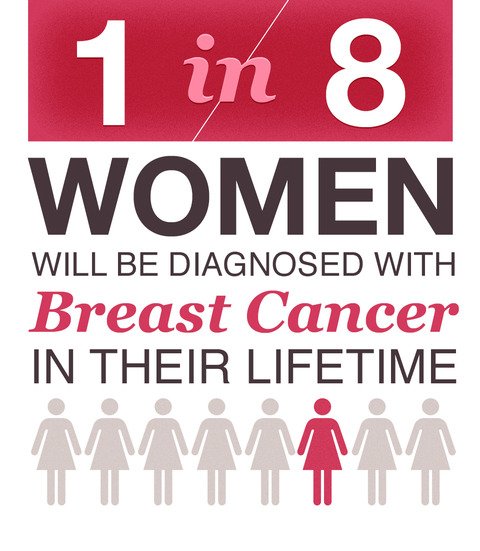
After skin cancer, breast cancer is the most common cancer diagnosed in women in the United States. Breast cancer can occur in both men and women, but it’s far more common in women.

Public support for breast cancer awareness and research funding has helped improve the diagnosis and treatment of breast cancer. Breast cancer survival rates have increased, and the number of deaths has been declining, thanks to a number of factors such as earlier detection, new treatments and a better understanding of the disease.

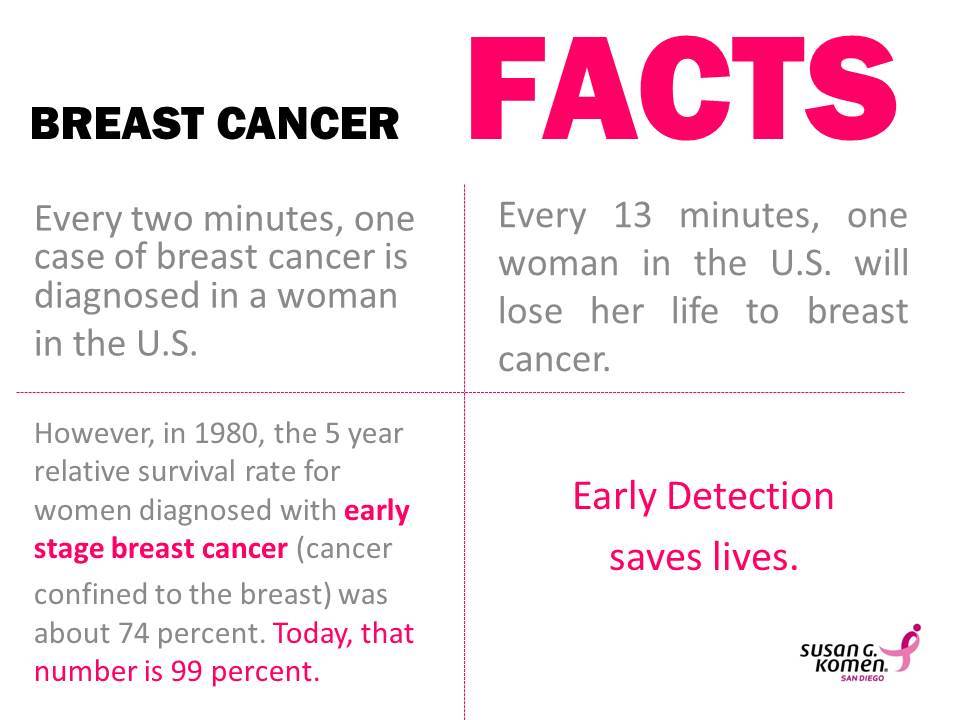
Breast Cancer affects everyone.  Every year, over 200,000 women are diagnosed with new cases of Breast Cancer in the United States, and over 39,000 women will lose their fight with this terrible disease.  Having experienced the effects that cancer has on both the victim and their loved ones support is so important by family and significant ones in our lives.

The Breast Cancer Awareness Month, marked in countries across the world every October, helps to increase attention and support for the awareness, early detection and treatment as well as palliative care of this disease.

There are about 1.38 million new cases and 458 000 deaths from breast cancer each year (IARC Globocan, 2008). Breast cancer is by far the most common cancer in women worldwide, both in the developed and developing countries. In low- and middle-income countries the incidence has been rising up steadily in the last years due to increase in life expectancy, increase urbanization and adoption of western lifestyles.

Currently there is not sufficient knowledge on the causes of breast cancer, therefore, early detection of the disease remains the cornerstone of breast cancer control. When breast cancer is detected early, and if adequate diagnosis and treatment are available, there is a good chance that breast cancer can be cured. If detected late, however, curative treatment is often no longer an option. In such cases, palliative care to relief the suffering of patients and their families is needed.

The majority of deaths (269 000) occur in low- and middle-income countries, where most women with breast cancer are diagnosed in late stages due mainly to lack of awareness on early detection and barriers to health services.

Here is another thing to help breast cancer patients National Breast Cancer Awareness Month is a chance to raise awareness about the importance of early detection of breast cancer. Make a difference! Spread the word about mammograms and encourage communities, organizations, families, and individuals to get involved.

In the first phases, the breast cancer has no evident signs and symptoms and it differ in folks from lumps to swelling and alterations in the pores and skin. A lump also modest which is felt does not cause any strange changes and it is unnoticed. Nevertheless, in a lot of circumstances visual appeal of new lump or a mass is the 1st indicator discovered. The lump may possibly be difficult to contact with uneven edges and they are painless. But there are cases the lump is really tender, spherical edged and soft. More lumps are painless. Breast Most cancers Signs and symptoms are: Swelling of element of the breast or all areas Pores and skin irritation in the breast. Nipple pain, Nipple begins to switch inward (inverted) slowly and gradually Breast pain.

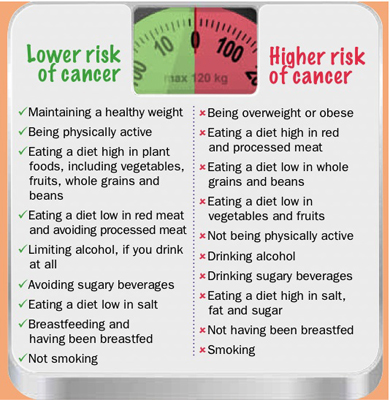
Breast cancer prevention starts with healthy habits — such as limiting alcohol and staying physically active. Understand what you can do to reduce your breast cancer risk.

If you’re concerned about breast cancer, you may be wondering if there are steps you can take toward breast cancer prevention. Some risk factors, such as family history, can’t be changed. However, there are lifestyle changes you can make to lower your risk.

What can I do to reduce my risk of breast cancer?

Lifestyle changes have been shown in studies to decrease breast cancer risk even in high-risk women.  The following are steps you can take to lower your risk:

  • Limit alcohol. The more alcohol you drink, the greater your risk of developing breast cancer. If you choose to drink alcohol — including beer, wine or liquor — limit yourself to no more than one drink a day.
  • Don’t smoke. Accumulating evidence suggests a link between smoking and breast cancer risk, particularly in premenopausal women. In addition, not smoking is one of the best things you can do for your overall health.
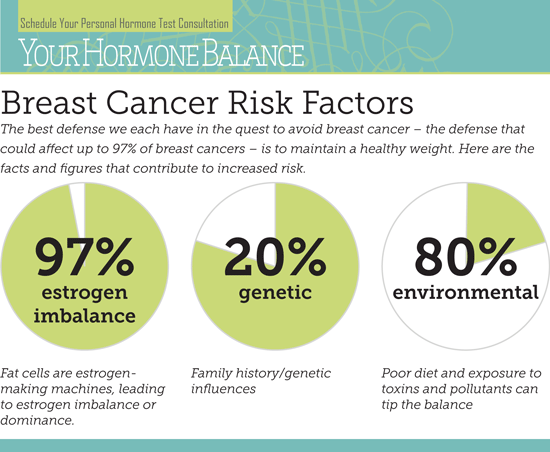
  • Control your weight. Being overweight or obese increases the risk of breast cancer. This is especially true if obesity occurs later in life, particularly after menopause.
  • Be physically active. Physical activity can help you maintain a healthy weight, which, in turn, helps prevent breast cancer. For most healthy adults, the Department of Health and Human Services recommends at least 150 minutes a week of moderate aerobic activity or 75 minutes of vigorous aerobic activity weekly, plus strength training at least twice a week.
  • Breast-feed. Breast-feeding may play a role in breast cancer prevention. The longer you breast-feed, the greater the protective effect.
  • Limit dose and duration of hormone therapy. Combination hormone therapy for more than three to five years increases the risk of breast cancer. If you’re taking hormone therapy for menopausal symptoms, ask your doctor about other options. You may be able to manage your symptoms with nonhormonal therapies, such as physical activity. If you decide that the benefits of short-term hormone therapy outweigh the risks, use the lowest dose that works for you.
  • Avoid exposure to radiation and environmental pollution. Medical-imaging methods, such as computerized tomography, use high doses of radiation, which have been linked with breast cancer risk. Reduce your exposure by having such tests only when absolutely necessary. While more studies are needed, some research suggests a link between breast cancer and exposure to the chemicals found in some workplaces, gasoline fumes and vehicle exhaust. Eating a diet rich in fruits and vegetables hasn’t been consistently shown to offer protection from breast cancer. In addition, a low-fat diet appears to offer only a slight reduction in the risk of breast cancer.  “Staying at a healthy weight, being physically active, and limiting how much alcohol you drink can help reduce your risk of breast cancer.”