“Every person has an idea of what the perfect holiday season looks like for them, but too often we push ourselves to reach this ideal and are disappointed when we fall short. The feeling of sadness, loneliness, anxiety or depression in and around the holiday season is known as “the holiday blues.”
After spending a wonderful holiday over the Christmas Eve, Christmas, New Years month of December some people feel blue and find that it’s difficult to function normally in their daily rhythm. As defined by the DSM IV, holiday blues, holiday depression, or post-Christmas blues, these commonly used terms depict the mental distress occurring after the winter holidays and festival season. This article is focused on experiencing the “blues” since this term suggests mild mental distress, a commonly occurring phenomenon when dealing with daily life stress and change.
Dr. David Miers is the Counseling and Program Development Manager for Mental Health Services at Bryan Medical Center in Lincoln, NE. In addition, he co-chairs the Nebraska State Suicide Prevention Coalition. He said, “During the holidays there’s an increased stress, demands that are placed on individuals.”
Whether that stress is financial or a full calendar of events, Dr. Miers said it can be hard to find a balance. “It’s important to set limits for yourself. It’s important to look at your exercise, that you’re exercising, that you’re eating a healthy diet and that you’re sleeping, that you’re getting an adequate amount of sleep.”
Besides the stress, the holidays can also be a lonely time or a time of grief. Larry Collins experienced one year recently loosing his mother.
“My mother’s passed away, but this was her favorite time of the year and every time this comes around I think of her.”
Dr. Miers said it’s important to set new traditions, while also remembering the old ones. He added, helping others during your own time of need, can also do yourself some good.
“Sometimes it’s somebody reaching out and volunteering, or spending some time at an event volunteering your time to help other people.”
The “Holiday Blues” aren’t uncommon and it’s important to recognize the signs and symptoms: -Becoming more isolative -Changing in eating and sleeping habits -Gaining or losing weight -Feeling more irritable
Dr. Miers said, “Depression is also one of the most treatable, and that seeking help is a sign of strength and there are treatments available.”
If you’re struggling this season seek for some for of counseling or help by a therapist or doctor. You can simple get involved with a community depression group. All you have to do is research on the internet.
POST HOLIDAY TIPS FOR THE BLUES AFTER THE PARTYING FROM THANKSGIVING TO 2017:
1.) EXPECT SOME LET DOWN AFTER THE HOLIDAYS:
The holiday season is both joyful and stressful at once. There is family to get along with, gifts to buy and return, people to visit, activities to throw yourself into, plenty of festive food to eat, sales to rush to, and parties to plan and attend. Topped off with the excitement of New Year’s Eve, your adrenaline has probably been pumping a lot of the time during the Christmas and New Year’s period. Returning to the usual routine and probably quieter workplace than normal can dampen your spirits just by the absence of exciting things to do and look forward to. Equally, if your Christmas and New Year’s Eve period wasn’t as enjoyable as you had hoped, you can be left feeling down about the lack of enjoyment you’d expected and this can sour your mood. Expecting to feel a little low is a way of telling yourself that this is a normal feeling and that it will soon pass once the routine re-establishes itself.
Look at your past experiences to enlighten you as to your normal post-holiday feelings. Do you always fall into a slump after the holiday season? If you have spent period after last two holidays in despair, then the chances of this post holiday period continuing in despair are high. Look carefully about what you did last time and what relaxed you. And realize that generally this is a phase that is easily fixed.
2.)CHOOSE TO SEE THE BENEFITS OF POST HOLIDAY SEASON:
The good side to the end of the holidays is that you’ve had a chance to rest, to relax, and to enjoy yourself. The craziness prior to Christmas has ended both at the workplace and in the home, and the restful time after Christmas and New Year’s Eve has hopefully given you the opportunity to do things that are different from your usual routine. And any break in the routine is good for the spirit, providing you with the chance to rejuvenate.
Take it easy when you’re settling back down into your usual routine. Your more rested self is a good thing and gives you an opportunity to take a renewed perspective on your work, routine, study, or home life pace.
Perhaps the break has given you perspective on your life, job, relationships etc. If so, this is a good time to consider making changes to improve your situation, especially because not making the changes can prolong your blues.
3.) BE GENTLE ON YOURSELF WITH RESPECT TO YOUR NEW YEAR’S RESOLUTION:
If you set the bar too high and you already feel as if you’re slipping, don’t berate yourself. Instead, look at your resolutions realistically and assess whether they need some tweaking to ensure that they’re achievable. Discard the resolutions that required you to be too harsh on yourself and reform them into ones that can be met now that the heady atmosphere of New Year’s Eve is behind you. Think of it as a double checking of the details, and simply fiddle with the fine print!
Ensure that any goals you’ve set are reasonable and most importantly achievable. Taking weight loss as an example, targeting for a size zero is unrealistic, but looking for 1 pound loss in a span of week seems to be more achievable.
4.) CONTINUE TO SPEND TIME AROUND PEOPLE; DON’T SEE PEOPLE ONCE A YEAR!
Some of the post-holiday season blues might be related to having been around many people over the Christmas break and then suddenly finding yourself surrounded by people you don’t know that well, or even not by many people at all. Lift your spirits by continuing to stay connected with friends and family (far away now there is always the phone0); also getting out and about to do activities where other people interact with you. Trust me your not the only one experience this if your going through the post blues.
5.) DO THINGS THAT GIVE YOU CAUSE TO LOOK FORWARD TO SOMETHING AFTER THE HOLIDAYS:
Do things that give you cause to look forward to something. Revive the excitement of anticipation by arranging fun activities, such as having dinner with friends, starting a new class for a hobby or interest, attending a sporting event regularly, going to the movies, etc. Choose activities that meet your budget and interests, and that you know will give you a thrill.
“Every person has an idea of what the perfect holiday season looks like for them, but too often we push ourselves to reach this ideal and are disappointed when we fall short. The feeling of sadness, loneliness, anxiety or depression in and around the holiday season is known as “the holiday blues.”
“Coffee does not help you get sober. If you’re plastered, you’re going to have to wait several hours for the alcohol to leave your system on its own. Drinking coffee won’t make your body metabolize alcohol faster. However, coffee can affect your drunken state by tricking your mind into thinking you’re close to sobriety. It turns out the caffeine in coffee is a stimulant, which can make you feel like you’re ready to handle certain potentially dangerous activities — like driving.”
“If not treated quickly, hypothermia can cause severe health problems, including death. Heart problems. Cold weather can increase your risk of a heart attack. When you’re outside in the cold, your heart works harder to keep you warm — leading to increased heart rate and blood pressure.”
Harvard Health Publishing (www.healthharvardeducation)
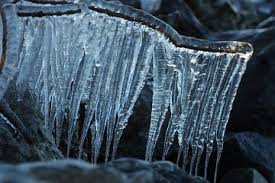
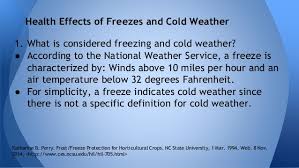
There are workers and people at home working around the house outside who are exposed to extreme cold or work in cold environments for a long period of time may be at risk of cold stress. Extreme cold weather is a dangerous situation that can bring on health emergencies in susceptible people, such as those without shelter, outdoor workers, and those who work in an area that is poorly insulated or without heat. What constitutes cold stress and its effects can vary across different areas of the country. In regions relatively unaccustomed to winter weather, near freezing temperatures are considered factors for “cold stress.” Whenever temperatures drop decidedly below normal and as wind speed increases, heat can more rapidly leave your body. These weather-related conditions may lead to serious health problems.
When exposed to cold temperatures, your body begins to lose heat faster than it can be produced. Prolonged exposure to cold will eventually use up your body’s stored energy. The result is hypothermia, or abnormally low body temperature. A body temperature that is too low affects the brain, making the victim unable to think clearly or move well. This makes hypothermia particularly dangerous because a person may not know it is happening and will not be able to do anything about it.
The symptoms you see with this hypothermia (body exposed to freezing temperatures) are: SHIVERING, LOSS OF COORDINATION, FATIGUE, CONFUSION OR DISORIENTATION.
When the hypothermia gets severe the symptoms go to NO SHIVERING, BLUE SKIN (CYANOTIC), DILATED PUPILS, SLOWED PULSE AND BREATHING, AND LOSS OF CONCIOUSNESS.
Another problem secondary to cold weather is cold water immersion creates a specific condition known as immersion hypothermia. It develops much more quickly than standard hypothermia because water conducts heat away from the body 25 times faster than air. Typically people in temperate climates don’t consider themselves at risk from hypothermia in the water, but hypothermia can occur in any water temperature below 70°F. Survival times can be lengthened by wearing proper clothing (wool and synthetics and not cotton), using a personal flotation device (PFD, life vest, immersion suit, dry suit), and having a means of both signaling rescuers (strobe lights, personal locator beacon, whistles, flares, waterproof radio) and having a means of being retrieved from the water. Below you will find links with information about cold water survival and cold water rescue.
NIOSH Commercial Fishing Safety Topic Page
Alaska Marine Safety Education Association
Minnesota Sea Grant
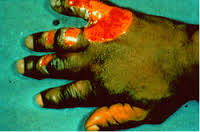
Another problem due to cold weather is frostbite is an injury to the body that is caused by freezing. Frostbite causes a loss of feeling and color in the affected areas. It most often affects the nose, ears, cheeks, chin, fingers, or toes. Frostbite can permanently damage body tissues, and severe cases can lead to amputation. In extremely cold temperatures, the risk of frostbite is increased in workers with reduced blood circulation and among workers who are not dressed properly. Signs or symptoms of frostbite are reduced blood flow to hands and feet (fingers or toes can freeze), Reduced blood flow to hands and feet (fingers or toes can freeze, numbness, tingling or stinging, aching, pale to blue and even waxy skin.
Another problem from long exposure to cold that can arise is trench foot, also known as immersion foot, is an injury of the feet resulting from prolonged exposure to wet and cold conditions. Trench foot can occur at temperatures as high as 60 degrees F if the feet are constantly wet. Injury occurs because wet feet lose heat 25-times faster than dry feet. Therefore, to prevent heat loss, the body constricts blood vessels to shut down circulation in the feet. Skin tissue begins to die because of lack of oxygen and nutrients and due to the buildup of toxic products.
Symptoms of trench foot include: Reddening of the skin, Numbness, Leg cramps, Swelling, Tingling pain, Blisters or ulcers, Bleeding under the skin, and Gangrene (the foot may turn dark purple, blue, or gray).
Ideas to try to prevent long exposure to cold problems from happening are:
Wear appropriate clothing. Tight clothing reduces blood circulation. Warm blood needs to be circulated to the extremities.
When choosing clothing, be aware that some clothing may restrict movement resulting in a hazardous situation.
Wear several layers of loose clothing. Layering provides better insulation.
Make sure to protect the ears, face, hands and feet in extremely cold weather. Wear a hat; it will keep your whole body warmer. (Hats reduce the amount of body heat that escapes from the head).
Boots should be waterproof and insulated.
Move into warm locations during work breaks; limit the amount of time outside on extremely cold days.
Carry cold weather gear, such as extra socks, gloves, hats, jacket, blankets, a change of clothes and a thermos of hot liquid.
Include a thermometer and chemical hot packs in your first aid kit.
Avoid touching cold metal surfaces with bare skin.
Monitor your physical condition whenever you go outside in the cold and prepare properly for that weather.
“Most of the time there are no obvious symptoms. Certain physical traits and lifestyle choices can put you at a greater risk for high blood pressure. When left untreated, the damage that high blood pressure does to your circulatory system is a significant contributing factor to heart attack, stroke and other health threats.”
“Hearing loss that occurs gradually as you age (presbycusis) is common. About 25 percent of people in the United States between the ages of 55 and 64 have some degree of hearing loss. For those older than 65, the number of people with some hearing loss is almost 1 in 2.”
“As chillier weather sets in across the country, certain illnesses rise to their peak and spread throughout schools and workplaces.Due to the evolution from hot to milder air and the piling of children back into schools, a mess of germs sparks the start of a new season of illnesses that sweep through every corner of the country. When the weather turns sharper with icy temperatures, colder air and darker skies in the winter, the threat of catching certain widespread illnesses turns greater.“