Archives

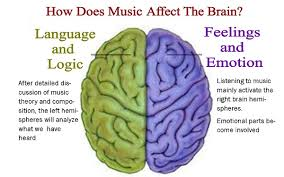
How music impacts the brain!


                  how music impacts the brain II


We can usually pick a piece of music, that is particularly happy or sad, but this isn’t just a subjective idea that comes from how it makes us feel. In fact, our brains actually respond differently to happy and sad music. Even short pieces of happy or sad music can affect us.

When we hear a form of music we actually match the tone of the music with our mood or reaction to it. This means that sometimes we can understand the emotions of a piece of music without actually feeling them, which explains why some of us find listening to sad music enjoyable, rather than depressing or sad to others.

We all like to pump up the tunes when we’re powering through our to-do lists, right? But when it comes to creative work, loud music may not be the best option.

It turns out that a moderate level of noises is the sweet level for creativity. Even more than low noise levels, ambient noise apparently gets our creative juices flowing, and doesn’t put us off the way high levels of noise does.

The way this works is that moderate noise levels increase processing difficulty which promotes abstract processing, leading to higher creativity. In other words, when we struggle (just enough) to process things as we normally would, we resort to more creative approaches.

In high noise levels, however, our creative thinking is impaired because we’re overwhelmed and struggle to process information efficiently.

This is very similar to how temperature and lighting can affect our productivity, where paradoxically a slightly more crowded place can be beneficial.

Of course, generalizing based on some studies is very hard. However looking at the science of introverts and extroverts, there is some clear overlap showing the following:

To break it down, here is the connection they has been found about people (again remember this is generally speaking):

  • Blues fans have high self-esteem, are creative, outgoing, gentle and at ease
  • Jazz fans have high self-esteem, are creative, outgoing and at ease
  • Classical music fans have high self-esteem, are creative, introvert and at ease
  • Rap fans have high self-esteem and are outgoing
  • Opera fans have high self-esteem, are creative and gentle
  • Country and western fans are hardworking and outgoing
  • Reggae fans have high self-esteem, are creative, not hardworking, outgoing, gentle and at ease
  • Dance fans are creative and outgoing but not gentle
  • Indie fans have low self-esteem, are creative, not hard working, and not gentle
  • Bollywood fans are creative and outgoing
  • Rock/heavy metal fans have low self-esteem, are creative, not hard-working, not outgoing, gentle, and at ease
  • Chart pop fans have high self-esteem, are hardworking, outgoing and gentle, but are not creative and not at ease
  • Soul fans have high self-esteem, are creative, outgoing, gentle, and at ease.  Playing music expands our thinking. We generally assume that learning a musical instrument can be beneficial for kids, but it’s actually useful in more ways than we might expect.  Studies have shown that children who had three years or more musical instrument training performed better than those who didn’t learn an instrument in auditory discrimination abilities and fine motor skills.
  • Instrument playing is a form of exercise that is great for your health as opposed to sitting watching t.v. where no creativity or imagining or brain concentrating takes place.
  • It seems that unfamiliar, or uninteresting, music is best for safe driving. Reason: Less Distracted.

Research on the effects of music during exercise has been done for years. In 1911, an American researcher, Leonard Ayres, found that cyclists pedaled faster while listening to music than they did in silence.

This happens because listening to music can drown out our brain’s cries of fatigue. As our body realizes we’re tired and wants to stop exercising, it sends signals to the brain to stop for a break. Listening to music competes for our brain’s attention, and can help us to override those signals of fatigue, though this is mostly beneficial for low- and moderate-intensity exercise. During high-intensity exercise, music isn’t as powerful at pulling our brain’s attention away from the pain of the workout.

Not only can we push through the pain to exercise longer and harder when we listen to music, but it can actually help us to use our energy more efficiently. A 2012 study showed that cyclists who listened to music required 7% less oxygen to do the same work as those who cycled in silence.

Some recent research has shown that there’s a ceiling effect on music at around 145 bpm, where anything higher doesn’t seem to add much motivation, so keep that in mind when choosing your workout playlist.

We all have a genre; for those wondering what is that actually it is a category of artistic, musical, or literary composition characterized by a particular style, form, or content

“The kind of music one listens to determines one’s reaction to it. No genre is harmful, but there is a preferable choice in different situations. For instance, studies have found that percussion stimulates the left side of the brain, so if one were solving Mathematics problems, or having to reach a logical conclusion, that music would be beneficial. Similarly, for an artiste, instrumental music or Soul would work better,” explains Khurana.

According to Dr Shaan Manohar, ENT specialist, Nanavati Hospital, “Japan has done a study on applying music to water as it freezes and check the patterns of crystals formed. It was concluded that loud drumbeats and music with violent poetry tend to have a destructive effect on the crystals versus Classical music, soft love tracks or devotional lyrics had an enhancing effect on the crystal formation. Loud drumbeats are also known to interfere with the pace of the heart in the very young and the elderly. It is a known fact that listening to Classical music enhances the mathematical ability of a growing child. Also, chanting helps release endorphins in the body creating a calm person, full of positive energy.”
QUOTE FOR FRIDAY:

“It takes more than a day to educate the American youth about the risks of getting stewed. April marks National Alcohol Awareness Month and is sponsored by the National Council on Alcoholism and Drug Dependence (NCADD) to educate the masses about America’s #1 health problem: alcohol dependence. Claiming the lives of more than 90,000 people every year, this month focuses on raising awareness about alcohol abuse and dependency before it is fatal.”

nationaltoday.com (“National Alcohol Awareness Month”)

QUOTE FOR FRIDAY:

“Suicide rates increased 30% between 2000–2018, and declined in 2019 and 2020. Suicide is a leading cause of death in the United States,3 with 45,979 deaths in 2020. The number of people who think about or attempt suicide is even higher. In 2020, suicide was among the top 9 leading causes of death for people ages 10-64. Suicide was the second leading cause of death for people ages 10-14 and 25-34.
In 2020 kidney disease is the tenth leading cause of death in America. Nephritis, nephrotic syndrome, & nephrosis are all disorders of the kidneys.
Chronic kidney disease is a condition in which the kidneys are damaged & cannot filter blood as well as healthy ones. This allows waste from the blood to remain in the body & may cause other health problems.”
Centers of Disease Control and Prevention (CDC)

QUOTE FOR THURSDAY:

“In 2020, life expectancy at birth was 77.0 years for the total U.S. population—a decrease of 1.8 years from 78.8 years in 2019 (Figure 1). For males, life expectancy decreased 2.1 years from 76.3 in 2019 to 74.2 in 2020. For females, life expectancy decreased 1.5 years from 81.4 in 2019 to 79.9 in 2020.

In 2020, the difference in life expectancy between females and males was 5.7 years, an increase of 0.6 year from 2019.
In 2020, life expectancy at age 65 for the total population was 18.5 years, a decrease of 1.1 years from 2019.
Centers for Disease Control and Prevention (CDC)

QUOTE FOR WEDNESDAY:

“The majority of deaths are caused by chronic conditions such as heart disease, cancer, stroke, diabetes, and
Alzheimer’s disease. During the 20 th century these chronic diseases replaced acute infections as the major causes of
death.”

Centers for Disease Control and Prevention (CDC)


QUOTE FOR TUESDAY:

“Suicide fell off the list of the 10 leading causes of death in the U.S. in 2020, amid a rise in deaths from chronic liver disease and cirrhosis and the emergence of COVID-19, the latter of which did make the list. Meanwhile, diabetes deaths topped 100,000 for the first time, while deaths from accidents – a category that includes unintentional drug overdoses – topped 200,000 for another record mark.

CDC researchers noted that death rates increased for six of the 10 leading causes of death in the U.S. in 2020, and decreased for only two: cancer and chronic lower respiratory diseases. The death rate for kidney disease stayed the same.”

US News (https://www.usnews.com)


QUOTE FOR MONDAY:

“Heart disease is the leading cause of deathTrusted Source for both men and women. This is the case in the U.S. and worldwide. More than half of all people who die due to heart disease are men.  Medical professionals use the term heart disease to describe several conditions. Many of these conditions relate to the buildup of plaque in the walls of the arteries.  As the plaque develops, the arteries narrow. This makes it difficult for blood to flow around the body and increases the risk of heart attack or stroke. It can also give rise to angina, arrythmias, and heart failure.  To reduce the risk of dying from heart disease, a person can protect their heart health by adopting a healthful diet and getting regular exercise.”

MedicalNewsToday (https://www.medicalnewstoday.com)

Part I Top Leading Diseases in America!

Over the years news has been filled with stories about Ebola, breast cancer and Methicillin Resistant Staph Aureus (MRSA) which all gets a lot of press today. Would it surprise you to know that neither makes the list of the 10 deadliest diseases in the USA? Even more surprising, perhaps, is that several of the deadliest diseases, including the number one killer in the world, are at least partially preventable.  It is right under are nose people but it doesn’t seem to be a topic of discussion in SCHOOL, you when young, taught at that grade level for the child to comprehend.  It is not even a standard topic in college to pass on health education which obviously our country needs based on the statistics of disease and Obesity alone which causes a lot of the diseases after being obese for a long period of time which could have been prevented but for millions of people it is not the priority over food.  Why?  It takes an individual to want to make change in their life either drastically or gradually depending on how much to you need to or desire to lose weight.  The people that surround you frequently and that are important to you helps if they are supporting that cause since it helps first you and all the people around you; like your children and even significant other to other family members (mom, close cousin, etc…) and even friends.  If we all made this a cause our health care system would end up being a lot more affordable for all but we the society make it difficult with too many staying unhealthy.  Wake up Americans take care of yourself to help yourself and all around you.   Where a person lives, having the access to preventive care, and the quality of healthcare provided in a community are all factors that can either benefit or put people in that community into the risk of obesity.

Surprising news is that we, due to not regarding our health as a priority in many areas of the USA show the following statistics:

Of all the causes of death in the US, the leading top 10 causes account for nearly 75% of all deaths and the top 3 causes account for over 50% of all deaths in the country, with the main culprits remaining relatively consistent for at least the last five years.

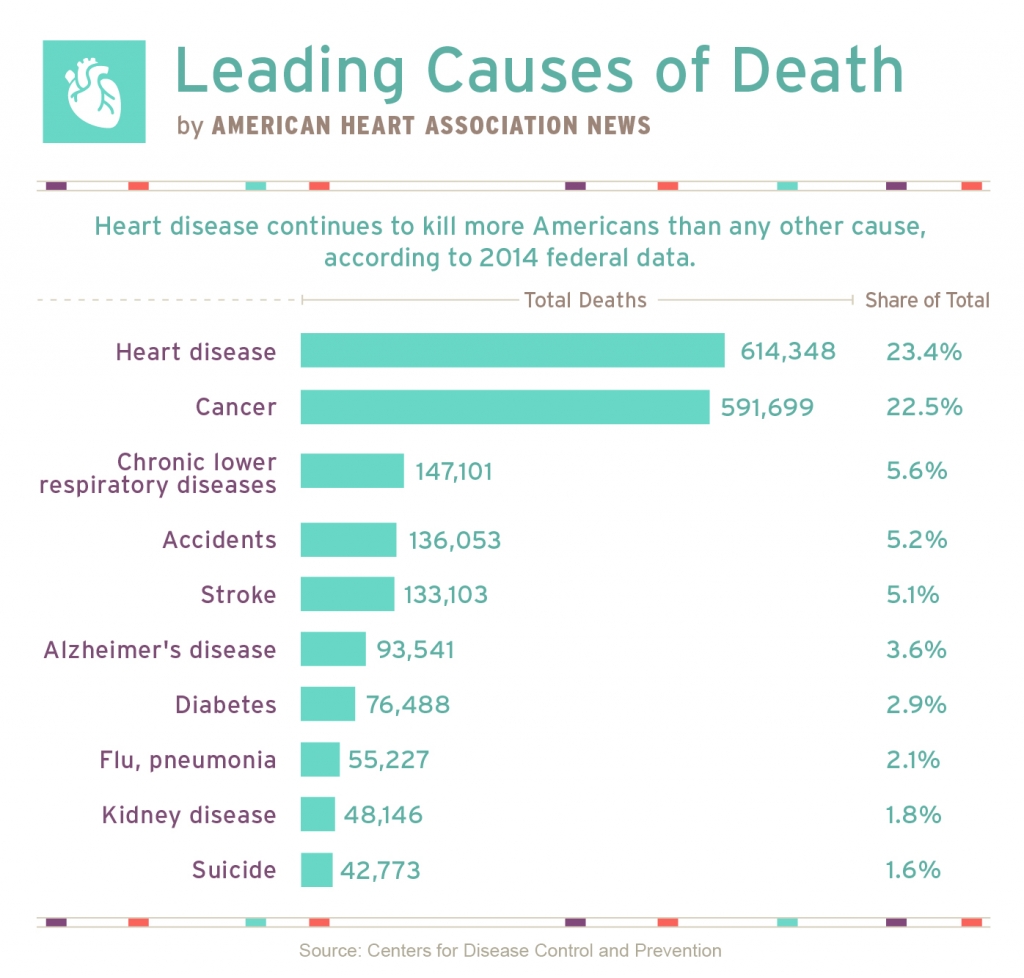
The top leading 10 causes  of death are:

  1. Heart disease (which can be prevented)
  2. Cancer (malignant neoplasms). Some cancers without question can be prevented (lung CA due to smoking)
  3. Chronic lower respiratory disease (same as above if we are referring to emphysema and its due to smoking)
  4. Stroke (cerebrovascular diseases) (this also in many cases can be prevented)  Check out Monday’s article.
  5. Accidents (unintentional injuries)
  6. Alzheimer’s disease
  7. Diabetes (diabetes mellitus) If its diabetes II; usually due to obesity and diet.
  8. Influenza and pneumonia
  9. Kidney disease (nephritis, nephrotic syndrome, and nephrosis)
  10. Suicide (intentional self-harm).

1.)Heart Disease shows:

The #1 leading disease in the US!

  • Deaths: 596,577
  • Males: 308,398
  • Females: 288,179
  • Rate: 191.5
  • Age-adjusted rate: 173.7
  • Percentage of total deaths: 23.71%.

Heart disease is the leading cause of death for both men and women in the US and also the leading cause of death worldwide. More than half of the deaths that occur as a result of heart disease are in men.

Coronary heart disease costs the US $108.9 billion each year and is the most common type of heart disease.3

Heart disease is a term used to describe several problems related to plaque buildup in the walls of the arteries.  Ending line clogging up the vessels closing up the pipelines our blood is carried through (vessels) to give oxygen to our blood tissues with taking carbon dioxide to the lungs for more 02 when its used up by our cells who carry oxygen to our tissues (02 is the fuel for our body to stay alive).

As the plaque builds up, the arteries narrow, making it more difficult for blood to flow and creating a risk for heart attack or stroke due to ischemia (Lack of oxygen to the tissues.  If its lack of 02 to the heart angina to an MI if its the brain a TIA-transient ischemic attack or worse a CVA-stroke).  Remember, prevention=protection is the first step so you don’t get this problem at all.  Ending line the better you take care of yourself the higher the odds you will not get this problem.

How can you take this step in PREVENTION;

 Protecting the heart

Lowering blood pressure and cholesterol can significantly lower heart disease risk.

  • Follow instructions on medication usage if your already on it
  • Make sure diet is low in salt, fat, saturated fat and cholesterol and high in fresh fruits and vegetables
  • It is recommended that exercise in the form of a brisk 10 minute walk takes place 3 times a day, 5 days a week
  • Avoid excessive alcohol use
  • Quit smoking
  • All steps listed above if you follow has even caused patients to stop medications completely because the changes listed above caused the problem in high statistics with the individual having no heredity.


QUOTE FOR THE WEEKEND:

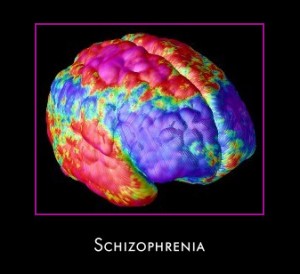
“Schizophrenia is a serious mental disorder in which people interpret reality abnormally. Schizophrenia may result in some combination of hallucinations, delusions, and extremely disordered thinking and behavior that impairs daily functioning, and can be disabling.

People with schizophrenia require lifelong treatment. Early treatment may help get symptoms under control before serious complications develop and may help improve the long-term outlook.”.

MAYO CLINIC


What is Schizophrenia?


Schizophrenia is a serious disorder which effects how a person thinks, feels and acts.  A individual with this diagnosis may have difficulty distinguishing between what is real and what is imaginary; may be unresponsive or withdrawn; and may have difficulty expressing normal emotions in social situations.  The person with schizophrenia may have difficulty expressing normal emotions in social situations.

Contrary to public perception, schizophrenia is not split personality or multiple ones.  The vast majority of people with schizophrenia are not violent and do not pose a danger to others; if anyone they could put a danger to is themselves without supervision around.  Schizophrenia is not caused by childhood experiences, poor parenting, lack of will power.  The signs and symptoms of the disease are not the same for each person.

The cause of schizophrenia is still not clear.  Some theories about the cause of this disease include:  genetics (heredity), biology (the imbalance in the brain’s chemistry); and/or possible viral infections and immune disorders.

Another cause can be genetics (heredity).  Scientists recognize that the disorder tends to run in families and a person inherits to develop the disease.  Schizophrenia may also be triggered by environmental events like viral infections or highly stressful situations or a combination of both.  Similar to some other genetically-related illnesses, schizophrenia appears when the body undergoes hormonal and physical changes, like those that occur during puberty in the teen and young adult years.

Substance use can be another cause. Some studies have suggested that taking mind-altering drugs during teen years and young adulthood can increase the risk of schizophrenia. A growing body of evidence indicates that smoking marijuana increases the risk of psychotic incidents and the risk of ongoing psychotic experiences. The younger and more frequent the use, the greater the risk. Another study has found that smoking marijuana led to earlier onset of schizophrenia and often preceded the manifestation of the illness.

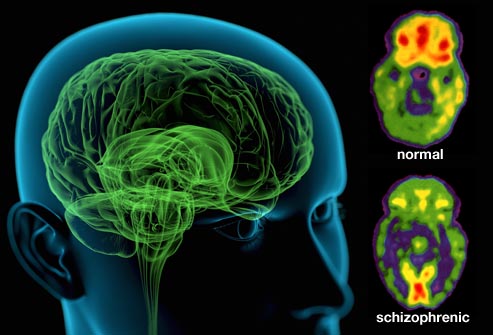
Another etiology deals with chemistry.  Genetics help to determine huw the brain uses certain chemicals.  People with schitzophrenia have a chemical imbalance of brain chemicals (serotonin and dopamine) which are neurotransmitters.  These neurotransmitters allow nerve cells in the brain that send messages to each nerve cell.  The brain is made up of nerve cells, called neurons, and chemicals, called neurotransmitters. An imbalance of one neurotransmitter, dopamine, is thought to cause the symptoms of schizophrenia. … The “dopamine hypothesis” has been the main theory regarding the cause of the symptoms of schizophrenia.  Dopamine is produced in the dopaminergic neurons in the ventral tegmental area (VTA) of the midbrain, the substantia nigra pars compacta, and the arcuate nucleus of the hypothalamus.  With the imbalance these chemicals affects the way a person’s brain reacts to stimuli—which explains why a person with schizophrenia may be overwhelmed by sensory information (Ex. loud music or bright lights) which other people can easily handle.  This problem in processing different sounds, sights, smells and tastes can also lead to hallucinations or delusions.

Looking for a moment at Dopamine in different areas of the brain in both low and high amounts see how it effects brain thinking to better understand schizophrenia.

Dopamine in cognition:

Dopamine in the frontal lobes of the brain controls the flow of information from other areas of the brain. Disorders of dopamine in this region lead to decline in neurocognitive functions, especially memory, attention, and problem-solving.

D1 receptors and D4 receptors are responsible for the cognitive-enhancing effects of dopamine. Some of the antipsychotic medications used in conditions like schizophrenia act as dopamine antagonists. Older, so-called “typical” antipsychotics most commonly act on D2 receptors, while the atypical drugs also act on D1, D3 and D4 receptors.

Dopamine in movement

A part of the brain called the basal ganglia regulates movement. Basal ganglia in turn depend on a certain amount of dopamine to function at peak efficiency. The action of dopamine occurs via dopamine receptors, D1-5.

Dopamine reduces the influence of the indirect pathway, and increases the actions of the direct pathway within the basal ganglia. When there is a deficiency in dopamine in the brain, movements may become delayed and uncoordinated. On the flip side, if there is an excess of dopamine, the brain causes the body to make unnecessary movements, such as repetitive tics.

Dopamine in pleasure reward seeking behavior

Dopamine is the chemical that mediates pleasure in the brain. It is released during pleasurable situations and stimulates one to seek out the pleasurable activity or occupation. This means food, sex, and several drugs of abuse are also stimulants of dopamine release in the brain, particularly in areas such as the nucleus accumbens and prefrontal cortex.

Dopamine and addiction

Cocaine and amphetamines inhibit the re-uptake of dopamine. Cocaine is a dopamine transporter blocker that competitively inhibits dopamine uptake to increase the presence of dopamine.

Amphetamine increases the concentration of dopamine in the synaptic gap, but by a different mechanism. Amphetamines are similar in structure to dopamine, and so can enter the presynaptic neuron via its dopamine transporters. By entering, amphetamines force dopamine molecules out of their storage vesicles. By increasing presence of dopamine both these lead to increased pleasurable feelings and addiction.

Dopamine in memory

Levels of dopamine in the brain, especially the prefrontal cortex, help in improved working memory. However, this is a delicate balance and as levels increase or decrease to abnormal levels, memory suffers.

Dopamine in attention

Dopamine helps in focus and attention. Vision helps a dopamine response in the brain and this in turn helps one to focus and direct their attention. Dopamine may be responsible for determining what stays in the short term memory based on an imagined response to certain information. Reduced dopamine concentrations in the prefrontal cortex are thought to contribute to attention deficit disorder.

Dopamine is affected in schizophrenia, just look at the functions of the chemical and the signs and symptoms of schizophrenia.

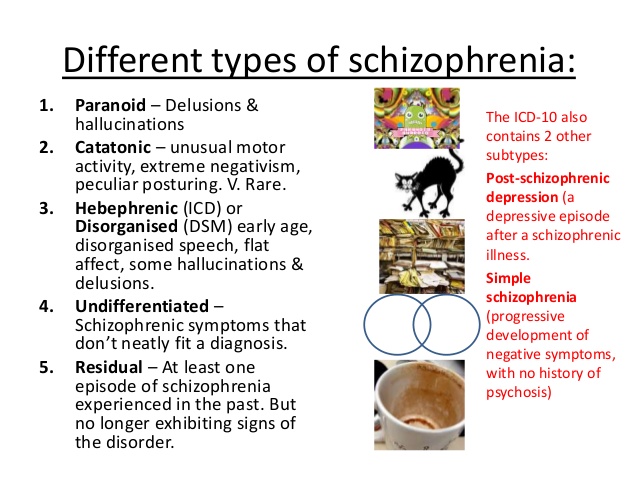
Signs and symptoms of schizophrenia:

Deficits in cognitive abilities are widely recognized as a core feature of this disease.  The deficits impacting the cognitive function are found in a large number of areas: working memory, long-term memory,verbaldeclarative memory, semantic processing, episodic memory, attention, learning (particularly verbal learning).  Deficits in verbal memory are the most pronounced in individuals with schizophrenia, and are not accounted for by deficit in attention. Verbal memory impairment has been linked to a decreased ability in individuals with schizophrenia to semantically encode (process information relating to meaning), which is cited as a cause for another known deficit in long-term memory.  When given a list of words, healthy individuals remember positive words more frequently (known as the Pollyanna principle); however, individuals with schizophrenia tend to remember all words equally regardless of their connotations, suggesting that the experience of anhedonia impairs the semantic encoding of the words.  These deficits have been found in individuals before the onset of the illness to some some extent and varying degrees.

-Delusions

-Hallucinations

-Disorganized speech

-Disorganized or catatonic behavior

TREATMENT FOR SCHIZOPHRENIA:

There is no cure for schizophrenia, but it can be treated and managed in several ways.

-Antipsychotic medications

-Psychotherapy, such as cognitive behavioral therapy and assertive community treatment and supportive therapy.

– Self-management strategies and education