The Center for Disease Control and Prevention states the following:
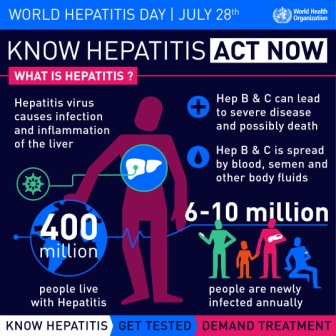
“Viral hepatitis affects nearly 300 million people globally, with approximately 1.3 million deaths each year from hepatitis B and hepatitis C. Despite effective vaccines, evidence-based prevention strategies and medications, deaths from viral hepatitis are increasing globally.
CDC and other organizations around the world recognize WHD by raising awareness about viral hepatitis, the burdens people with hepatitis face, ongoing work to combat viral hepatitis across the globe, and actions people can take to prevent future transmission.
WHD is recognized annually on July 28, the birthday of Dr. Baruch Blumberg, who discovered the hepatitis B virus in 1967. Two years later, he developed the first hepatitis B vaccine. Dr. Blumberg won the Nobel Prize in Physiology or Medicine in 1976.
CDC provides scientific and public health leadership in the United States and to countries around the world in advancing efforts to eliminate viral hepatitis as a public health threat. CDC helps countries build capacity for viral hepatitis surveillance, testing, care, and treatment and assists with development and implementation of national control and elimination programs.
CDC’s global viral hepatitis work protects the United States. Persons who were not born in the United States account for 3 out of 4 people with hepatitis B virus infections.
CDC’s global viral hepatitis work protects the United States. Persons who were not born in the United States account for 3 out of 4 people with hepatitis B virus infections. Simulation studies suggest that since 2000, progress in expanding global hepatitis B vaccination among all countries with people who immigrate to the United States could prevent almost 900,000 hepatitis B virus infections and over 67,000 hepatitis B-related deaths if global 2030 vaccination targets are achieved and sustained; this would save the United States $8.1 billion in estimated costs by 2070.
CDC’s support to other countries makes America stronger by fortifying international partnerships, advancing innovation, and using lessons from other countries to advance the elimination of hepatitis C in the United States. Notably, global work has provided examples of the usefulness for tests at point-of-care, such as a viral test for hepatitis C diagnosis that can be used to link people to care and curative treatment in real time. Evaluations of use of hepatitis C self-testing (i.e. for antibody to hepatitis C virus) has shown strong usability and acceptance in the country of Georgia providing lessons for potential use in other low- and middle-income countries to identify persons exposed to hepatitis C who do not typically access health care services.
CDC has supported the first national viral hepatitis serosurveys to estimate the burden of hepatitis B, hepatitis C, and hepatitis D in Georgia, the Kyrgyz Republic, Uzbekistan, Malawi, and Botswana, providing data that guide the development of national strategic plans, identify strategic priorities needed to achieve elimination of viral hepatitis, and measure progress toward the elimination of hepatitis B and hepatitis C.”