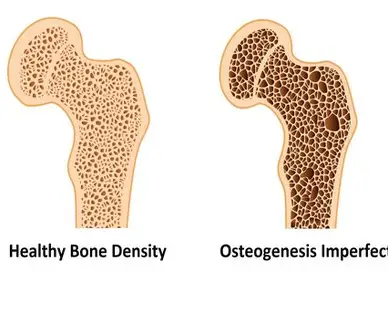
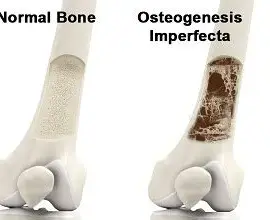
Osteogenesis imperfecta (OI) is an inherited (genetic) bone disorder that is present at birth. It is also known as brittle bone disease. A child born with OI may have soft bones that break (fracture) easily, bones that are not formed normally, and other problems. Signs and symptoms may range from mild to severe.
There are at least 8 different types of the disease. The types vary greatly, both within and between types. They are based on the type of inheritance (see below), and signs and symptoms. These include findings on X-rays and other imaging tests. The OI types are as follows:
- Type I. Mildest and most common type. About 50% of all affected children have this type. There are few fractures and deformities
- Type II. Most severe type. A baby has very short arms and legs, a small chest, and soft skull. He or she may be born with fractured bones. He or she may also have a low birth weight and lungs that are not well developed. A baby with type II OI usually dies within weeks of birth
- Type III. Most severe type in babies who don’t die as newborns. At birth, a baby may have slightly shorter arms and legs than normal and arm, leg, and rib fractures. A baby may also have a larger than normal head, a triangle-shaped face, a deformed chest and spine, and breathing and swallowing problems. These symptoms are different in each baby.
- Type IV. Symptoms are between mild and severe. A baby with type IV may be diagnosed at birth. He or she may not have any fractures until crawling or walking. The bones of the arms and legs may not be straight. He or she may not grow normally.
- Type V. Similar to type IV. Symptoms may be medium to severe. It is common to have enlarged thickened areas (hypertrophic calluses) in the areas where large bones are fractured
- Type VI. Very rare. Symptoms are medium. Similar to type IV.
- Type VII. May be like type IV or type II. It is common to have shorter than normal height. Also common to have shorter than normal upper arm and thighbones.
- Type VIII. Similar to types II and III. Very soft bones and severe growth problems.
What causes osteogenesis imperfecta in a child?
OI is passed on through the genes. The different types are passed on in different ways. The gene may be inherited from one or both parents. Or the gene can be passed on from an unexplained change (spontaneous mutation) of a gene.
Most babies with OI have a defect of one of two genes. These genes help in forming collagen. Collagen is a main part of connective tissue that connects and supports the whole body, including the bones. Because of the defect, there is not enough collagen. Or the collagen is abnormal.
What are the symptoms of osteogenesis imperfecta in a child?
The symptoms of OI vary greatly within and between types. Symptoms of OI include:
- Easily broken bones
- Bone deformities, such as bowing of the legs
- Discoloration of the white of the eye (sclera), may be blue or gray in color
- A barrel-shaped chest
- A curved spine
- A triangle-shaped face
- Loose joints
- Muscle weakness
- Skin that easily bruises
- Hearing loss in early adulthood
- Soft, discolored teeth
The symptoms of osteogenesis imperfecta may look like other medical conditions. Always see your child’s healthcare provider for a diagnosis.