Menopause and effects of it on women’s health

 Menopause4                        menopause2

menopause5          menopause2

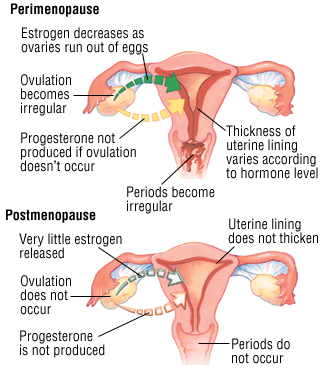
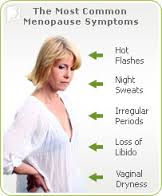
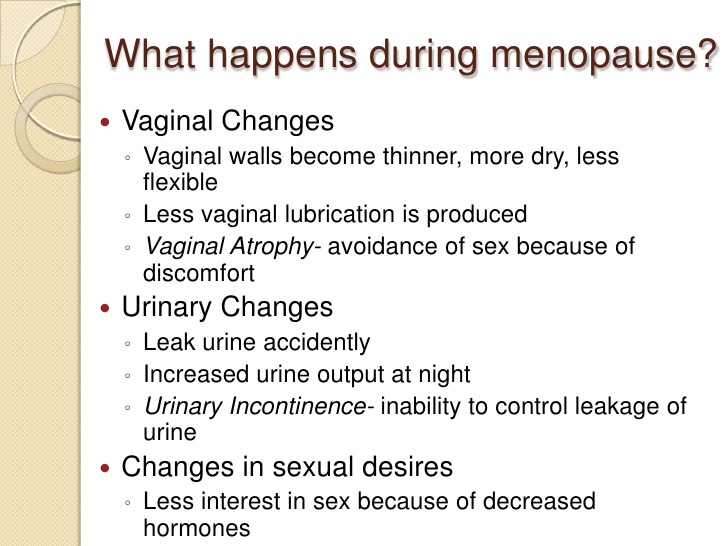
What is Menopause? Menopause is when the ovaries naturally stop producing 2 hormones called estrogen and progesterone.  Your ovaries are similar to what a car does in that over years it wears down, well so does the mechanism that regulates your hormones which is the ovaries. You go 12 consecutive months without having a period with no reasons to be explained for its occurrence, both biological or physical with it never returning.   If both ovaries are removed surgically the menopause kicks in immediately.   Menopause has signs and symptoms (s/s) that kick in which have varying intensities (it depends on the individual). You may experience mild to severe s/s.   Those s/s can be : 1- Hot Flashes 2-Irregular Periods 3- Breast Pains 4- Night Sweats 5- Mood Swings 6- Loss of Labido 7- Vaginal Dryness 8-Brittle Nails 9-Bloating 10-Irritability 11-Depression 12- Weight Gain 13- Osteoporosis-one of the worst symptoms of menopause.

According to U.S. Census data from 2000, there are about 37.5 million women reaching or currently at menopause (ages 40 to 59).

As women near menopause, they may have symptoms too from the changes their body is making. Some women may not have any other symptoms at all. Symptoms that some women experience near menopause include symptoms close to the actual menopause symptoms are like the hot flashes (getting warm in the face, neck, or chest), night sweats or sleeping problems that led to feeling tired, stressed or tense, vaginal changes (the vagina may become dry and thin and sex may be painful) and thinning of bones, which may lead to loss of height and bone breaks. If a woman would like to treat her symptoms, she should talk to her health care provider to discuss treatment options.

Did you know over 60% of adult Americans are considered obese or overweight?

Weight gain happens when a person increases their body mass, whether it is a result of fat deposits, additional muscle tissue, or excess fluid. However, weight gain associated with menopause typically involves increased amounts of fat around the abdomen. One of the most accurate ways to see if you are obese is to measure your body mass index which is free online, check out the internet. I do every so often.

Go to Free BMI Calculator – AICR.org‎

www.aicr.org/bmi calculator‎.

On average, a women gains about 12 to 15 pounds between the ages of 45 and 55, this is usually when menopause typically occurs. This extra weight generally does not evenly distribute itself throughout a woman’s body. The weight tends to accumulate around the abdomen instead and women often notice the shape of their bodies slowly losing their hour-glass figure.

What can resolve this issue? As years progress the metabolism slows down; setting the physiological stage for weight gain. As a woman’s hormones fluctuate prior to menopause and preparing for a permanently reduced hormonal level, it is likely to experience weight gain. I’m over 45 y/o and in menopause. I have found a way not effective for me to stay in my BMI therapeutically by increasing my metabolism and keeping it at a steady rate without any heavy workout at this time. If you too are experiencing this problem and would like guidance in how to fix this naturally with not being put on drugs than just eat vegetables and fruits with will power to staying it for 3 months. You should see a decrease in weight. Now if you can’t than go to healthyusa.tsfl.com. and learn how to use medifast (which I attempted but didn’t work for me due to GERD since its all high in protein but with the acid build up it killed my esophagus and throat.). If you don’t have GERD it may be a temporary idea for you. You could try Jenny Craig or Weight Watchers.    They all will show you how to increase your metabolism with you making the choices of what foods you want in your body. You will be able to treat yourself to foods high in fats or carbohydrates or sugars occasionally when you reach your therapeutic ratio of your body mass index. If you join Medifast you will also be able to get Dr. Anderson with his book “Dr. A’s healthy habits” and health coaches assisting you in doing what you need to know in understanding how the body works with foods and what foods (out of the 4 food groups is good for the body on a regular daily basis). I hope if you join any diet program company it works for you. Many people like myself who did found we were so happy with ourselves with the results, how it financially stayed within our budget or cheaper, and how it all paid off but remember you need to understand the concept of small meals not big 3 or 3 small meals a day. They both decrease your metabolism but if you reach your weight you need to follow with proper dieting and exercise if not everyday than at least every other day.   If you feel you can’t give that commitment than do 3 times a week doing a good workout or two times working yourself up to 3 or 4 hour workouts which is not the ideal way or recommended since I use to do this type of workout and was good in keeping my weight great. I recommend you go to your doctor and get the best workout for you recommended by him or her. Not one plan fits everybody so you have to put time into finding that plan. I have been a RN over a quarter of a century and have seen disease from cancer units to cardiac units to all types of med surg. & could go on with my experience. I have worked from sea to shining sea, NY to California. I saw what unhealthy habits have done to peoples bodies of all ages in the US and will try every attempt not to end up like that. I will try to be healthier in living my life with staying out of medical facilities. Come aboard in helping yourselves with others making a healthier USA we take that responsibility on as a citizen in America and to those around us (particularly the young; they should start early life so they don’t have to adapt to workout or dieting after 45 when pre-menopause or over 50 when menopause definitely starts). Having a healthy diet with occasional junk food or treats like ice cream joints for a sundae or shake are ideal.
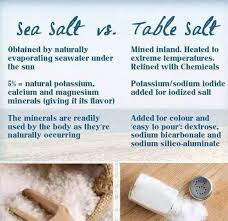
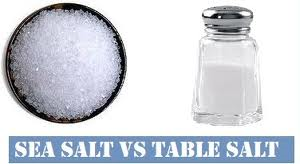
Sea Salt and Table Salt…Which is healthier?

SALT                 SALT4

The most notable differences between sea salt and table salt are in their taste, texture and processing

Sea salt is produced through evaporation of ocean water or water from saltwater lakes, usually with little processing. Depending on the water source, this leaves behind certain trace minerals and elements. The minerals add flavor and color to sea salt, which also comes in a variety of coarseness levels.

Table salt is typically mined from underground salt deposits. Table salt is more heavily processed to eliminate minerals and usually contains an additive to prevent clumping. Most table salt also has added iodine, an essential nutrient that helps maintain a healthy thyroid.

Sea salt and table salt have the same basic nutritional value, despite the fact that sea salt is often promoted as being healthier. Sea salt and table salt contain comparable amounts of sodium by weight.

Whichever type of salt you enjoy, do so in moderation. The Dietary Guidelines for Americans recommend limiting sodium to less than 2,300 milligrams a day — or 1,500 milligrams if you’re age 51 or older, or if you are black, or if you have high blood pressure, diabetes or chronic kidney disease Sea salt has boomed in popularity in restaurants and supermarket aisles. Many gourmet chefs say they prefer it over table salt for its coarse, crunchy texture and stronger flavor. Manufacturers are using it in potato chips and other snacks because it’s “all natural,” and less processed than table salt. And some health-conscious consumers choose it because it contains minerals like magnesium.

Each of the above-mentioned characteristics may set sea salt apart from table salt, but in one other very important respect there’s usually little difference between the two: sodium content.

How does the amount of sodium in sea salt compare to table salt?

In a survey conducted by the American Heart Association, 61 percent of respondents incorrectly agreed that sea salt is a low-sodium alternative to table salt. Table salt and most sea salts contain about 40 percent sodium by weight. Kosher salt and some sea salts may have larger crystal sizes than table salt, so they may have less sodium by volume (e.g., by teaspoon or tablespoon). A teaspoon of table salt has about 2,300 mg of sodium, but a teaspoon of sea salt or kosher salt may have less sodium because fewer crystals fit into the spoon.

Some varieties of sea salt may claim to have less sodium than table salt. You can check the Nutrition Facts label to compare how a given sea salt compares to table salt, which has about 575 mg sodium per ¼ teaspoon.

“It’s very important for people to be aware that sea salt often has as much sodium as table salt,” said Rachel K. Johnson, Ph.D., R.D., an American Heart Association spokeswoman and the Bickford Professor of Nutrition at the University of Vermont.

“One of the keys to maintaining a heart-healthy diet is to control your sodium intake,” she said. “If you’re consuming more sea salt than you otherwise would because you think it has less sodium, then you may be placing yourself at higher risk of developing high blood pressure, which raises your risk of heart disease.”

Lets review what’s the difference between the way sea salt and table salt are made.

Sea salt is obtained directly through the evaporation of seawater. It is usually not processed, or undergoes minimal processing, and therefore retains trace levels of minerals like magnesium, potassium, calcium and other nutrients.

Table salt, on the other hand, is mined from salt deposits and then processed to give it a fine texture so it’s easier to mix and use in recipes. Processing strips table salt of any minerals it may have contained, and additives are also usually added to prevent clumping or caking.

While these attributes may make sea salt more attractive from a marketing standpoint, Johnson says there are no real health advantages of most sea salts.

“The minute amounts of trace minerals found in sea salt are easily obtained from other healthy foods,” Johnson said. “Sea salt also generally contains less iodine than table salt. Iodine has been added to table salt since the 1920s to prevent the iodine-deficiency disease goiter.”

First off, sea salt is produced by evaporating water from the ocean or saltwater lakes, whereas table salt is usually mined from underground salt deposits. While the exact body of water or deposit can influence the concentration of certain minerals, it doesn’t affect sodium. However, the larger the salt crystals, the fewer that fit in a given volume—be it a pinch, teaspoon, or your entire salt cellar—which could influence how much you end up dishing out.

The next time you find yourself choosing between kosher salt, sea salt and table salt, remember that it’s probably mostly a matter of letting your taste buds decide.  But whichever option you choose, keep in mind that both usually contain the same amount of sodium.

As far as health goes, salt has a notoriously bad reputation. But is sea salt any better (or at least less bad) than run-of-the-mill table salt?

The expert: Pamela Peeke, MD, MPH, FACP, nutritionist at Elements Behavioral Health and author of The Hunger Fix

ADVERTISEMENT

The verdict: The answer isn’t as cut-and-dry as most chefs might like, but that’s because the path every salt (even if it’s the same “kind”) takes to reach your shaker varies.

Whether it’s mined from the earth or evaporated from the sea, unrefined salt is always the best option in terms of both flavor and health. However, since boxes nowadays tend to make everything look like a health food, read through the ingredients. If the only thing listed is sodium chloride, you know that the so-called healthy natural salt is just as refined as the table-side variety. (For help decoding those mystifying food labels, look no further.

References:

  1. Mayo Clinic
  2. American Heart Association
  3. FOX News

QUOTE FOR THURSDAY:

“Age-related macular degeneration (AMD) is a disease that causes the gradual loss of sight due to blurring or loss of central vision. This is often as a result of a deterioration of the macula, a yellow pigmented structure at the back of the eye that is responsible for our detailed color vision.”

FightingBlindness.com


Signs that could indicate kidney disease.

chronic-kidney-disease-image  kidney disease 3

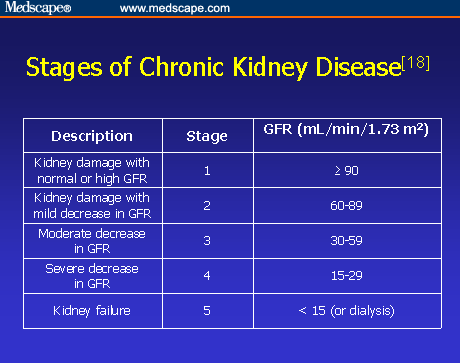
GFR = Glomerular Filtration Rate

                                  3260_KidneyPathologyCard-1


There are numerous causes of kidney failure, and treatment of the underlying disease may be the first step in correcting the kidney abnormality. Some causes of kidney failure are treatable and the kidney function may return to normal. Unfortunately, kidney failure may be progressive in other situations and may be irreversible.

1. Urination Changes

The kidneys are responsible for handling urine, so it makes sense that urine will start to change if the kidneys are failing. Some examples of urination changes include: • Urine comes out bubbly or foamy • Urine may have traces of blood • You may have the overwhelming urge to urinate during the night, waking up • Urination occurs more often and appears pale • Urination occurs less often and appears dark • You may have difficulty attempting to urinate

2. Fatigue

The kidneys are responsible for producing a specific hormone called erythropoietin (EPO). This hormone is responsible for instructing the body to produce red blood cells, which are meant to carry oxygen throughout the body. If the kidneys start to fail, they will make less EPO, which means fewer hormones are directing the body to produce the necessary amount of red blood cells. At the end of this cycle, you’re left feeling very tired and weakened throughout the day. Experiencing fatigue even when you seem to get enough sleep at night is one symptom that the kidneys are not producing enough hormones for your body.

3. Swelling

Because of the way the kidneys interact with the body and handle the process of urination, they also are largely responsible for removing the extra fluid within your body. Kidneys that are starting to fail won’t get rid of that fluid as well as they should be. As a result, it stays inside the body — and while it’s in the body, it has to go somewhere; the fluid starts filling in pocketed areas. You may experience swelling in one or both ankles, the legs, the face, hands, as well as feet. While the swelling can be mild, it can also swell to difficult stages; for instance, it might be hard to wear a regular shoe. This is edema.

4. Nausea

Healthy kidneys also take on the role of the body’s garbage men; that is, they’re responsible for getting rid of waste in the body. In the event of kidney problems or failure, waste won’t exit the body as efficiently as before, causing a buildup of excess waste in the bloodstream. This is known as uremia, and it can cause feelings of nausea or make you need to vomit. It should go without saying that your body doesn’t like being filled with waste, and it attempts to purge the waste by way of vomiting.

  1. Bad Taste in Mouth

When kidneys begin to fail and cause uremia, or a buildup of waste in the body, the body may react by producing the taste of metal in your mouth or causing bad breath. Overall, you might taste a rather poor flavor in your mouth that causes you not to taste food in the same way as you did before. In particular, this may make you less interested in eating meats. In addition, you might start to notice some weight loss as a result of not eating. This could be due to the taste issue or you may simply not feel hungry enough to eat much.

6. Rashes

Developing uremia as a result of kidney disease doesn’t stop with metallic taste or the need to vomit. The waste buildup in the bloodstream manifests further by causing patches of rashes on the skin and causing itchiness. In some cases, patches of skin can break out in what appears to be acne as well. These itchy rashes can be difficult to relieve; in more progressed instances, the itch can feel like it goes right down to the bone, making it difficult to feel relief by way of scratching.

7. Chills

As explained in a previous slide, the kidneys produce the hormone EPO to signal the body’s production of red blood cells. Failing this, there are fewer blood cells, which is anemia. Anemia comes with its own set of symptoms, the most prominent but overlooked being chills. If you feel cold, even inside of a warm room, you could be experiencing anemia.

8. Leg Pain

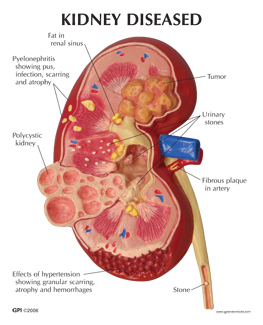
One of the more characteristic symptoms of chronic kidney disease include feeling discomfort in the back or in the legs. In some cases, the feelings of discomfort could be painful. It is also possible to experience pain as far as the upper back. Problems that can cause pain include: • Kidney stones and infections, which cause severe spasms of pain • Bladder infections, which can produce a burning sensation during urination • Polcystic kidney disease, which produces painful cysts on the kidneys and liver.

9. Out of Breath

If you have been experiencing shortness of breath lately, it could be connected to the kidneys in two different ways. The first possible connection is a result of the extra fluid buildup; sometimes, this extra fluid builds up in the lungs, making it more difficult to breathe. Otherwise, the shortness of breath can be a result of anemia; in this case, there are an insufficient number of red blood cells available to carry oxygen throughout the body. This leaves the brain and body starved and short of breath. If you experience shortness of breath, sit down for a moment and calmly attempt deep breaths. The experience is naturally frightening, but panicking can only lead to more difficulty breathing.

10. Dizziness

Anemia as a result of kidney disease has one more grasp on the body: It can make you dizzy and cause you to have trouble concentrating on things. When this happens, your brain is becoming starved of the oxygen it needs to be at full power. When your brain isn’t getting enough oxygen, it manifests beyond dizziness and concentration problems; you can also experience memory problems and other issues with cognitive functions. This symptom often goes hand in hand with fatigue due to the taxing effects on the brain.

QUOTE FOR MONDAY:

” Kidneys cleanse your blood by removing waste and excess fluid, maintain the balance of salt and minerals in your blood, and help regulate blood pressure.”

Linda Bernstein MD      M.D. with Web Med

QUOTE FOR THE WEEKEND:

“The foundation stones for a balanced success are honesty, character, integrity, faith, love and loyalty.”

Zig Ziglar  (November 6, 1926 – November 28, 2012, was an American author, salesman, and motivational speaker).

Building a great childhood foundation for your child’s success in the future.

childhood relationshifps

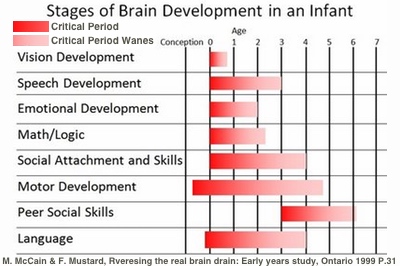
You were born preprogrammed to bond with one very significant person—your primary caregiver, probably your mother. Like all infants, you were a bundle of emotions—intensely experiencing fear, anger, sadness, and joy. The emotional attachment that grew between you and your caregiver was the first interactive relationship of your life, and it depended upon nonverbal communication. The bonding you experienced determined how you would relate to other people throughout your life, because it established the foundation for all verbal and nonverbal communication in your future relationships.

Individuals who experience confusing, frightening, or broken emotional communications during their infancy often grow into adults who have difficulty understanding their own emotions and the feelings of others. This limits their ability to build or maintain successful relationships. Attachment—the relationship between infants and their primary caregivers—is responsible for:

  • shaping the success or failure of future intimate relationships
  • the ability to maintain emotional balance
  • the ability to enjoy being ourselves and to find satisfaction in being with others
  • the ability to rebound from disappointment, discouragement, and misfortuneWhether it turns out good or bad, the infant brain is profoundly influenced by the attachment bond—a baby’s first love relationship. When the primary caretaker can manage personal stress, calm the infant, communicate through emotion, share joy, and forgive easily, the young child’s nervous system becomes “securely attached.” The strong foundation of a secure attachment bond enables the child to be self-confident, trusting, hopeful, and comfortable in the face of conflict. As an adult, he or she will be flexible, creative, hopeful, and optimistic.
  • Our secure attachment bond shapes our abilities to:
  • Scientific study of the brain—and the role attachment plays in shaping it—has given us a new basis for understanding why vast numbers of people have great difficulty communicating with the most important individuals in their work and love lives. Once, we could only use guesswork to try and determine why important relationships never evolved, developed chronic problems, or fell apart. Now, thanks to new insights into brain development, we can understand what it takes to help build and nurture productive and meaningful relationships at home and at work.
  • feel safe
  • develop meaningful connections with others
  • explore our world
  • deal with stress
  • balance emotions
  • experience comfort and security
  • make sense of our lives
  • create positive memories and expectations of relationships
  • The powerful, life-altering lessons we learn from our attachment bond—our first love relationship—continue to teach us as adults. The gut-level knowledge we gained then guides us in improving our adult relationships and making them secure.Relationships in which the parties are tuned in to each other’s emotions are called attuned relationships, and attuned relationships teach us that:
  • Lesson No. 1—adult relationships depend for their success on nonverbal forms of communication nonverbal. Newborn infants cannot talk, reason or plan, yet they are equipped to make sure their needs are met. Infants don’t know what they need, they feel what they need, and communicate accordingly. When an infant communicates with a caretaker who understands and meets their physical and emotional needs, something wonderful occurs.
  • Attachment bonds are as unique as we are. Primary caretakers don’t have to be perfect. They do not have to always be in tune with their infants’ emotions, but it helps if they are emotionally available for the majority of the time.
  • nonverbal cues deeply impact our love relationships
  • play helps us smooth over the rough spots in love relationships
  • conflicts can build trust if we approach them without fear or a need to punish
  • When we can recognize knee-jerk memories, expectations, attitudes, assumptions and behaviors as problems resulting from insecure attachment bonds, we can end their influence on our adult relationships. That recognition allows us to reconstruct the healthy nonverbal communication skills that produce an attuned attachment and successful relationships.