Let there be work, bread, water and salt for all.
– Nelson Mandella
– Nelson Mandella
Why the body needs salt (Sodium), how it works in our body & Why not Too Use it much in Your diet.
First we’ll cover how water, electrolytes, proteins work in the body to understand how sodium (being a electrolyte) is so important with our health. Then we will cover how to use sodium therapeutically in our diet with knowing how it impacts how your future health and how it prevents with even help you in managing certain diseases or illnesses you already have.
Let us first understand the basics of the human body: a large percentage of body weight is composed of water that is containing dissolved particles of organic and inorganic substances vital to life. A young adult male is about 60% water whereas a female is 50%. Than the percentage of the body weight, that is WATER, declines with age. Since fat contains little water, the more obese a person gets the smaller the percentage of water weight is in that person. Salt is what we call sodium (NA) + chloride (Cl)=Sodium chloride =NaCl, which are both an electrolytes. Water is distributed throughout the body, but in compartments that are inside our cells, outside of our cells (being plasma), and in our tissues. In these compartments with the water are electrolytes but in varying amounts. The largest percentage of water in our body is inside the cells. The body fluid in us is constantly being lost and replaced for normal body processes to occur. If we eat daily food and fluids the body easily maintains the compartments in balancing the water and electrolytes in our body (remember the compartments are in the cells, outside of cells, and in the tissues). We know the body receives water to these different compartments through our diet in what we eat (foods & liquids) and through the metabolism (break down) of the those foods & liquids=nutrition that we eat and through the body tissues. There are ending products from the metabolism (break down) of tissues in our body and our foods and fluids through digestion causing our body to have an ending result of toxins in the body but are body gets rid of them if functioning within normal limits. Two vital processes that do this which demand continual expenditure of water in removal of toxins is: 1.) removal of body heat by vaporization of water via the lungs and the skin(perspiration). 2.)excretion of urea and other metabolic wastes by the kidneys dumping them in our urinary bladder; the stool also in our GI tract plays a role in this removal of metabolic wastes in evacuation. Solid foods such as meats and vegetables contain 60 to 90% water . Note the normal daily replacement of water roughly equals the normal daily loss with an entire body functioning properly. The volume of water used in these processes varies greatly with external influences such as temperature and humidity.
All body fluids contain chemical compounds. Chemical compounds in solution may be classified as electrolytes or nonelectrolytes based on their ability to conduct an electric current in the solution. Electrolytes are either positive, which is a charged particle called an cation (electric current=Na+); or negative which is not a charged particle called an anion (no electric current=Cl-). This is why you’ll see an electrolyte banner or board up in the front of chemistry class or just in your chemistry book (a positive or negative sign after every abbreviation of each element). It’s letting you know if it is + or -. Proteins are special types of charged molecules. They both have a charge that is dependent on the pH of the body fluids. A normal pH in our plasma is 7.35 to 7.45 and at this level your proteins exist with a net negative charge. In our bodies compartments, when imbalances happen regarding fluids, electrolytes or proteins problems occur; acidity and alkalinity distribution in the body becomes effected.


Happy New Year to all and try to find to take a moment out of the day toasting in 2016~~!

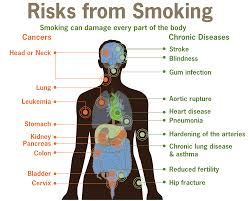
If you read yesterday’s article than now you’ll understand why smoking alone can cause the following conditions, Through the Centers for Disease Control and Prevention. They state the following:
Smoking and Increased Health Risks
Compared with nonsmokers, smoking is estimated to increase the risk of—
Smoking and Cardiovascular Disease
Smoking and Respiratory Disease
Smoking and Cancer
Smoking causes the following cancers: (in alphabetical order)
Smoking and Other Health Effects
Smoking has many adverse reproductive and early childhood effects, including increased risk for—
References
GET IT NOW? Please say yes. Smoking rots for your body not just in the lungs but everywhere. How do you make a complete turn-around? Look at your health in regards to what your goal is out of life. Do you want to live longer and most importantly HEALTHIER? When healthier in mind and body you are able to do more with your life in activities of daily living and more than that, so QUIT. If you want to sit most of your life with continuing to smoke but if not you must stop smoking now unless you have a unusual discipline in your way of living that allows you to have a about 6 cigarettes to 1 pack a YEAR, not daily. It is recommended you stop completely but if it actually has to be a part of your life than do it in moderation or less. If you’re able to do that your definitely not addicted to the bad habit physically, if anything addicted to it mentally. That would still make your life healthier as to smoking frequently every day. Know you take the risk of increasing your quantity in time so I recommend Quit.
Various lifestyle factors have been associated with increasing the risk of stroke. These include lack of exercise, alcohol, diet, obesity, smoking, drug use, and stress. Guidelines endorsed by the Centers for Disease Control and Prevention and the National Institutes of Health recommend that Americans should exercise for at least 30 minutes of moderately intense physical activity on most, and preferably all, days of the week. Recent epidemiologic studies have shown a U-shaped curve for alcohol consumption and coronary heart disease mortality, with low-to-moderate alcohol consumption associated with lower overall mortality. High daily dietary intake of fat is associated with obesity and may act as an independent risk factor or may affect other stroke risk factors such as hypertension, diabetes, hyperlipidemia, and cardiac disease. Homocysteine is another important dietary component associated with stroke risk, while other dietary stroke risk factors are thought to be mediated through the daily intake of several vitamins and antioxidants. Smoking, especially current smoking, is a crucial and extremely modifiable independent determinant of stroke. Despite the obstacles to the modification of lifestyle factors, health professionals should be encouraged to continue to identify such factors and help improve our ability to prevent stroke, decrease cancers caused by smoking, decrease coronary artery disease, and obesity. Learn healthy habits or healthier habits, broaden your knowledge on the 4 food groups in what is lean or leaner or leanest with each group, increase your activity 30 minutes a day and learn what a healthy diet actually is through Dr. Wayne Scott Anderson’s book “Dr. A’s habits of health” and even if you need to lose weight we can show you the way to do it healthy, for example or many other authors available in how to live healthy. Wouldn’t you and the future want to get better in mind and body to impact our health care system that includes our insurance and most importantly lives of citizens in the USA in how they live (which would be more active). It just takes discipline and the drive to want to stay healthy or get in a better state of heath. Hope I have helped someone out there in broadening your knowledge regarding how to keep or reach a healthier life.
“Know when the lungs get effected in time the heart gets effected. One Affects the other in time.”
Elizabeth Lynch RN BSN (Nurse almost 30 years and cardiac & pulmonary a major area of experience)
Let’s start with what smoking actually does to the body. Smoking harms nearly every organ of the body. Smoking causes many diseases and reduces the health of smokers in general. It primarily starts at the lungs. How? Well think of your lung tissue with openings all over which are air sacs called alveoli. This is an anatomical structure that has the form of a hollow cavity which does the exchange of oxygen and carbon dioxide in and out of our body, when we inhale and exhale. The thing to know about this tissue is that before you start smoking the alveoli are expandable (think of it like a rubber band) allowing the person to get a good exchange of oxygen getting in the body to go to all our tissues and carbon dioxide getting out of the body (O2=oxygen being the fuel to our tissues and without it causes cellular starvation, carbon dioxide=CO2 being an acid / toxin to the human body and exhaled by the lungs). After years of smoking the alveoli stretches out not allowing a good exchange of O2 and CO2. The sad thing for a smoker is the alveoli cannot REVERSE back after damage has already occurred unless you had a lung transplant with continuing to smoke, which no M.D. or health insurance would allow. More realistic would be QUIT the bad habit. The tissue doesn’t get completely better but it improves when you quit. So the pt with Emphysema has alveoli that can’t exchange oxygen and carbon dioxide from the blood like it use to at the bottom of the lungs, prior to even starting to smoke. Also, after smoking years and when diagnosed with COPD you have difficulty breathing (that is why smoking is a major cause of bronchitis or Emphysema=types of chronic obstructive pulmonary disease=COPD and it is not REVERSIBLE). Emphysema is the worst type of COPD you can get. COPD is the third leading cause of death in the U.S., and the economic burden of COPD in the U.S. in 2007 was $42.6 billion in health care costs and lost productivity. Isn’t this reason enough to stop smoking?
Emphysema is an enlargement of the air spaces distal to the terminal bronchioles, with destruction of their walls. People with emphysema have historically been known as “Pink Puffers”, due to their pink complexion.
Chronic bronchitis is defined in clinical terms as a cough with sputum production on most days for 3 months of a year, for 2 consecutive years. People with advanced COPD that have primarily chronic bronchitis were commonly referred to as “Blue Bloaters” because of the bluish color of the skin and lips (cyanosis) along with hypoxia and fluid retention.
References
Children with Williams syndrome are extremely sensitive to sound and may overreact to unusually loud or high-pitched sounds (hyperacusis). Chronic middle ear infections (otitis media) are often present.
National Organization of Rare Disorders
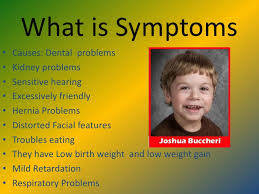
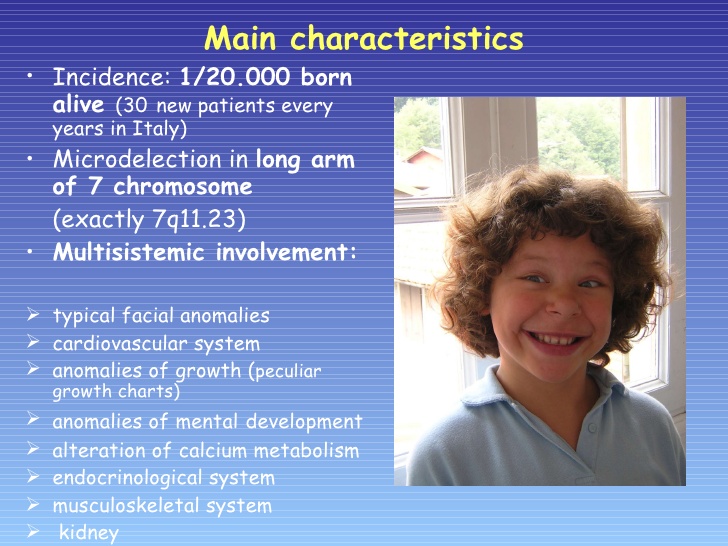
Williams syndrome (WS) is a genetic condition that is present at birth and can affect anyone. It is characterized by medical problems, including cardiovascular disease, developmental delays, and learning disabilities. The most significant medical problem associated with WS is the cardiovascular disease caused by the narrowed arteries. WS is also associated with elevated blood calcium levels in infancy. A random genetic mutation (deletion of a small piece of chromosome 7), rather than inheritance, most often causes the disorder. Williams syndrome is considered an autosomal dominant condition because one copy of the altered chromosome 7 in each cell is sufficient to cause the disorder. In a small percentage of cases, people with Williams syndrome inherit the chromosomal deletion from a parent with the condition.
Most cases of Williams syndrome are not inherited but occur as random events during the formation of reproductive cells (eggs or sperm) in a parent of an affected individual. These cases occur in people with no history of the disorder in their family.
WS affects 1 in 7,500 – 10,000 people worldwide – an estimated 20,000 to 30,000 people in the United States. It is known to occur equally in both males and females and in every culture.
Unlike disorders that can make connecting with your child difficult, children with Williams syndrome tend to be social, friendly and endearing. Parents often say the joy and perspective a child with WS brings into their lives had been unimaginable.
But there are major struggles as well. Many babies have life-threatening cardiovascular problems. Children with WS need costly and ongoing medical care and early interventions (such as speech or occupational therapy) that may not be covered by insurance or state funding. As they grow, they struggle with things like spatial relations, numbers, and abstract reasoning, which can make daily tasks a challenge. As adults, most people with Williams syndrome will need supportive housing to live to their fullest potential. Many adults with WS contribute to their communities as volunteers or paid employees; often working at assisted living homes for senior citizens, hospitals and libraries, or as store greeters or veterinary aides.
However, individuals who have WS have a 50 percent chance of passing it on if they decide to have children. The characteristic facial features of WS include puffiness around the eyes, a short nose with a broad nasal tip, wide mouth, full cheeks, full lips, and a small chin. People with WS are also likely to have a long neck, sloping shoulders, short stature, limited mobility in their joints, and curvature of the spine. Some individuals with WS have a star-like pattern in the iris of their eyes. Infants with WS are often irritable and colicky, with feeding problems that keep them from gaining weight. Chronic abdominal pain is common in adolescents and adults. By age 30, the majority of individuals with WS have diabetes or pre-diabetes and mild to moderate sensorineural hearing loss (a form of deafness due to disturbed function of the auditory nerve). For some people, hearing loss may begin as early as late childhood. WS also is associated with a characteristic “cognitive profile” of mental strengths and weaknesses composed of strengths in verbal short-term memory and language, combined with severe weakness in visuospatial construction (the skills used to copy patterns, draw, or write). Most older children and adults with WS speak fluently and use good grammar. More than 50% of children with WS have attention deficit disorders (ADD or ADHD), and about 50% have specific phobias, such as a fear of loud noises. The majority of individuals with WS worry excessively.
Unfortunately there is no cure for Williams syndrome, nor is there a standard course of treatment.
The prognosis for individuals with WS varies. Some degree of impaired intellect is found in most people with the disorder. Some adults are able to function independently, complete academic or vocational school, and live in supervised homes or on their own; most live with a caregiver.
Where you can find additional information about Williams syndrome:
You may find the following resources about Williams syndrome helpful. These materials are written for the general public.
“Reasons for feeling blue around the holidays are numerous. Fatigue, due to holiday activity, family tensions to financial issues that all can prevail. Taking the focus off yourself and putting the focus on others can make you feel better.”
MAYO CLINIC