AMYLOIDOSIS:

Diagnostic Tests for Amyloidosis:

*1.  First your doctor would do a thorough medical exam with blood/urine tests searching for clues of high protein where it shouldn’t belong or certain liver or thyroid abnormal findings.  The MD will follow with further diagnostic tooling especially if these findings show up in blood/urine tests.  Common blood exams used are BNP (basic natriuretic peptide).  BNP is a substance secreted from the ventricles or lower chambers of the heart in response to stress and changes in pressure that occur when to heart failure develops and worsens.  The level of BNP in the blood increases when heart failure symptoms worsen, and decreases when heart failure condition is stable.  It is not so much elevated over the norm but more with this disease patients the MD will see where the BNP level was at last visit & compare.

Another blood test is troponin and this gets released into the bloodstream when your heart is affected by amyloids.


*2.  Second your MD may want to further diagnose for this disease through getting a tissue biopsy where the MD’s intent is to check for signs indicating this is highly possible for amyloidosis.  The biopsy could be taken from your abdominal fat, bone marrow, or an organ such as your liver or kidney.  Tissue analysis can help determine the type of amyloid deposit.


*3.  Imaging Tests.  Images taken of the organs that are affected by amloidosis can help the MD establish the intensity or stage your disease is at.  There are 2 most commonly imaging tests used and can diagnose the disease early.  There is the echocardiogram test, sound wave imaging of the heart, that will be used to assess the size and functioning capability level of the heart.  Another test is a MRI of the heart (magnetic residence imaging).  Other imaging tests can evaluate the extent of amyloidosis in the liver or spleen.


When the heart chambers become filled with amyloids it thickens the walls of those chambers especially the lower chambers which can be picked up by the echocardiogram through the different angles of sound waves that go via the heart during this exam.  Another thing that can be measured through the echocardiogram is your diagnostic function; that represents a measure of how stiff your heart is and how well is your heart actually functioning.

Another technique that can be used is strain imaging.  This is also done through echocardiogram.  This tells the doctor in more detail how much the muscle fibers in the heart are actually shortening and contracting.  It measures certain parts of the heart in actually contracting and function.  This is actually better in help diagnosing compared to just looking at ejection fraction, which is the amount of blood pumped out of the left ventricle chamber upon contraction of the heart (When he hear lub dub of the heart with a stethoscope that is the heart actually contracting.  First the upper chamber on lub is contracting and on dub is the lower chambers contracting).  This test is a specializing test and is not widely used but it is available in certain hospitals.

Ending line amyloidosis is a group of diseases in which one or more organ systems in the body accumulate abnormal proteins known as amyloid.  The name amyloidosis was first used more than 150 years ago, but cases were described over 300 years ago.  However, only in the past ¼ of a century have MD’s understood the specific make up and structure of amyloid proteins.  Although amyloidosis is not a cancer but it is a serious condition.  It is disabilitating and gets to life threatening.  However, growing aware- ness of the condition seems to be leading to substantial new research and Rx alternatives.

There’s no cure unfortunately for amyloidosis. But treatments can help you manage your symptoms and limit the production of amyloid protein.

Treatment is usually aimed at eliminating the source of the abnormal precursor protein.

Primary amyloidosis (AL, amyloid light chain) is associated with a clonal plasma cell disease and the immunoglobulin light chains made by the abnormal plasma cells. AL also occurs in amyloidosis associated with multiple myeloma. Treatment involves chemotherapy or stem cell transplantation to eliminate the plasma cells (the source of the abnormal light chains).

Familial amyloidosis (AF) is associated with a genetic abnormality that can be inherited. AF causes the liver to make an abnormal form of a protein called transthyretin. The treatment for AF is liver transplantation.

Secondary amyloidosis (AA) is associated with inflammation and elevated levels of serum amyloid A caused by inflammation. Treatment involves elimination of the source of inflammation.

Through “The Amyloidosis Foundation” they provide over the world medical facilities/hospitals that major in this disease at http://www.amyloidosis.org/PatientPrograms/physiciansusa.html.


Hope this article has helped you in some way for yourself or family or friend in better understanding about the disease, knowing tests for it, and places majored with this unfortunate disease an expert can treat in a medical facility.
 

QUOTE FOR THURSDAY:

Today, the Centers for Disease Control and Prevention (CDC) announced that the incidence rate of autism among eight year olds in the United States remains 1 out of 68 children. This updated report occurs every two years, with the previous report being released from the CDC in April 2014.

Autism Society . Org

Part 2-CHF (heart failure) Signs&Symptoms/Diagnosis and Prevention

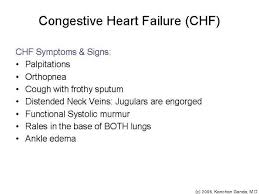
A number of symptoms are associated with heart failure, but none is specific for the condition.  Perhaps the best known symptom is short of breath (called dyspnea).  In heart failure, this may result from excess fluid in the lungs.  The breathing difficulties may occur at rest or during exercise.  In some cases, congestion may be severe enough to interrupt or prevent you from sleeping.

-Fatigue or easy tiring is another common symptom.  As the heart’s pumping capacity decreases, muscles and other tissues receive less oxygen and nutrition, which are carried in the blood.  Without proper fuel (oxygen from the blood) provided by our engine (the heart), the body cannot perform as much work as it use to do (just like going from in shape to out of shape in time).  The ending line is this will result into fatigue.

-Fluid accumulation will cause swelling in the feet, ankles, legs, and occasionally the abdomen (if the fluid building up in the body gets severe), what we medically call edema.   Through gravity the blood goes backwards and our body allows water to transfer in the skin to allow the fluid to go somewhere other than the bloodstream to decrease fluid overload to the heart by compensating.  It body compensates since the blood is going backwards from the heart causing fluid back up.  Excess fluid retained by the body will result into weight gain, which sometimes occurs fairly quickly (if you have CHF already you should always call your M.D. if you weight gain is 3lbs or more in a week, odds are high this is due to fluid building up).

-Persistent coughing is another common sign, especially coughing that regularly produces mucus or pink, blood-tinged sputum.  Some people develop raspy breathing or wheezing.

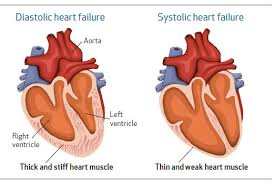
Heart failure usually goes through a slow development process, the symptoms may not appear until the condition has progressed over the years.  This happens because the heart first compensates by making adjustments with the heart that delay or slow down but do not prevent, the eventual loss in pumping capacity.  In time failure happens, just like a car in when it gets older over several years is starts showing one problem after another and is exchanged for a newer car; same principle with the heart in that you show signs and symptoms as your heart starts to slow down to failure and its either treat the problem or get a transplant of the organ (which is unlikely to happen).   The heart first hides the underlying process but compensates by doing this to your heart:

1- Enlargement to the muscle of the heart (causing “dilatation”) which allows more blood into the heart.

2- Thickening of muscle fibers (causing “hypertrophy”) to strengthen the heart muscle, which allows the heart to contract more forcefully and pump more blood.

3- More frequent contraction, which increases circulation.

By making these adjustments, or compensating, the heart can temporarily make up for losses in pumping ability, sometimes for years.  However, compensation of the organ can only last so long, not forever (like anything in life the living thing or an object will go through a ending life process to termination).  Eventually the heart cannot offset the lost ability to pump blood, and the signs of heart failure appear.

DIAGNOSIS

In many cases, physicians diagnose heart failure during a simple physical examination.  Readily identifiable signs are shortness of breath, fatigue, and swollen ankles and feet.  The physician also will check for the presence of risk factors, such as hypertension, obesity and a  history of heart problems.

Using a stethoscope, the physician can listen to a patient breathe and identify the sounds of lung congestion.  The stethoscope also picks up the abnormal heart sounds indicative of heart failure.

If one or not both symptoms or the patient’s history point to a clear cut diagnosis, the physician may recommend any of a variety of laboratory tests, including, initially, an electrocardiogram (EKG), which uses recording devices placed on the chest to evaluate the electrical activity of a patient’s heartbeat which will be affected by CHF.

Echocardiography is another means of evaluating heart function from outside the body.  This works through sound waves that bounce off the heart are recorded and translated into images.  The pictures can reveal abnormal heart sizes, shape, and movement.  Echocardiography also can be used to calculate a patient’s ejection fraction which is a measurement of the amount of blood pumped when the heart contracts.

Another possible test is the chest x-ray, which also determines the heart’s size and shape, as well as the presence of congestion in the lungs.

Tests help rule out other possible causes of symptoms.  The symptoms of heart failure can result when the heart is made to work too hard, instead of from damaged muscle (like in a heart attack).  Conditions that overload the heart occur rarely and include severe anemia and thyrotoxicosis (a disease resulting from an overactive thyroid gland).

Prevention of CHF:

-If not diagnosed yet your already possibly ahead.  Without this diagnosis you can get started on making yourself further away from being diagnosed with this disease.  How to reach this goal is through living a routine life through healthy habits practiced, healthy dieting over all, and balancing rest with exercise during the week 30-40 minutes a day or 1 hour to 1.5 hours 3 times a week and not being obese.  They all would benefit the heart in not stressing it out making the heart’s function harder in doing its function.  When the heart stresses out it is at risk for lacking oxygen putting it at potential for angina (heart pain) to a heart attack with over time leading toward failure of the heart.  Need to learn more about what is and how to get your weight in therapeutic body mass index range through dieting of all 4 food groups, balancing exercise/rest, and knowing how the body works with all ingredients in foods including portion sizes (fats, calories, starches, carbohydrates, proteins with vitamins and minerals) to understanding how all this information takes effect in how your metabolism operates in being beneficial or against you?   Than get into a workout place or just go to channels on TV/cable that offer classes for free, read up on good foods vs. bad foods as simple as on the internet or even again TV/cable channels and balance rest with exercise; it is just taking action and doing what you need to stay healthy for the heart.   Remember staying healthy for the heart is being healthy for so many other areas of the body (the heart is the engine to the body).;)


QUOTE FOR MONDAY:

“Heart failure is a condition in which the heart can’t pump enough blood to meet the body’s needs.”

NIH National Heart Lung and Blood Institute

QUOTE FOR THE WEEKEND:

“Ablation therapy is a type of minimally invasive procedure doctors use to destroy abnormal tissue that occurs with many conditions. For example, your doctor may use an ablation procedure to treat or to destroy (ablate) a small amount of heart tissue that’s causing abnormally rapid heart rhythms.”

MAYO CLINIC

QUOTE FOR FRIDAY:

“The general population has about a 1% risk of developing epilepsy.   Meanwhile, children of mothers with epilepsy have a 3 to 9% risk of inheriting this disease, while children of fathers have a 1.5 to 3% risk of inheritence.”  Based on genes research

Dr. Robert S. Fischer  Ph D. Stanford Epilepsy Center

QUOTE FOR THURSDAY:

“Women have more colds than men, and this is probably due to increased interaction with children, children get around seven to ten colds a year, compared with two to three for adults. So people who spend a lot of time with children, such as childminders, nursery teachers or school teachers, are more likely to pick up the viruses.”

Professor Eccles of the Common Cold Centre in Cardiff