Part II Thrombocytopenia


Treatment:

There are a lot of treatment options for thrombocytopenia and ITP. You’ll need to work with your doctor to weigh the pros and cons of each and find a therapy that’s right for you.

If you have ITP, your treatment depends on how severe a case you have. If it’s mild, you may only need to get regular checks of your platelet levels.

When you do need treatment, the goal is to get your platelet count to a level that’s high enough to prevent serious bleeding in the gut or brain.

Your doctor will likely suggest these treatments for ITP first:

Corticosteroids. Dexamethasone or prednisone is typically prescribed to raise your platelet count. You take it once a day in the form of a pill or tablet. An increased or normalized platelet count is generally seen within two weeks of therapy, particularly with high-dose dexamethasone. Your doctor will then likely gradually reduce your dose over the next 4 to 8 weeks. The treatment may have to be repeated, but once your platelet count is normalized, none is needed again.

There are some side effects to prednisone, especially if you use it for a long time. Even after a short time, you can get irritable, have stomach upsets, and have other problems such as:

  • Sleep problems
  • Weight gain
  • Puffy cheeks
  • Frequent urination
  • Lower bone density
  • Acne

Besides side effects, another disadvantage to prednisone is that your platelet count may drop once you’ve finished your treatment.

IVIG (intravenous immune globulin). If you can’t get your platelet count up with prednisone, if you cannot tolerate steroids, or if your count drops after you’re done with your treatment, your doctor may suggest IVIG. You take this medication through an IV, usually for several hours a day over a period of 1 to 5 days.

The advantage of IVIG is that it can raise your platelet count quickly. The increase in platelets, however, is only temporary. It is useful for people who need to get their levels boosted fast or who cannot tolerate steroids. The side effects include:

  • Nausea and vomiting
  • Headaches
  • Fever, chills

Surgery. If you have ITP and other treatments haven’t raised your platelet levels enough, you may benefit from an operation to remove your spleen. That’s the organ that destroys your platelets, so taking it out can give your platelet count a boost. But this doesn’t always work.

Getting your spleen removed can make it harder for you to fight infections. Your infection risk is greatest in the first 3 months after your surgery.

Rituximab (Rituxan). This drug is a type of treatment known as biologic therapy. It attacks B cells, a type of white blood cell that can destroy platelets. It’s sometimes used if you have severe ITP despite treatment with steroids and you aren’t able to have surgery to remove your spleen. Your doctor may also suggest it if you’ve had your spleen removed but you still have low platelet counts.

Side effects for rituximab include:

  • Fever
  • Chills
  • Weakness
  • Nausea
  • Headaches
  • Weakened immune system

Rho(D) immune globulin. This treatment, which you also take through an IV, is an alternative to traditional IVIG in patients who have Rh+ blood. It generally takes less than half an hour. The side effects are similar to IVIG.

If corticosteroids, IVIG, and Rho D aren’t improving your platelet count and you’re having bleeding problems, your doctor may switch to a second set of options. There are pros and cons for each. They include:

Thrombopoietin (TPO) receptor agonists. These drugs are also called platelet growth factors. If you have severely low platelets even after treatment with steroids, surgery to remove the spleen, or rituximab, you will likely do well on these medicines, but you may need to take them long-term.

A TPO drug may also be used in a patient who requires an increase in platelet count for a period of time, such as during an acute bleeding episode, in preparation for elective surgery, or while deciding about, planning, or awaiting a splenectomy.

Two TPO drugs are available: eltrombopag (Promacta) and romiplostim (Nplate). Eltrombopag is a once-daily pill, and romiplostim is taken by injection once a week. They get your bone marrow to make more platelets. Side effects include nausea, vomiting, and headache, and a higher risk of blood clots.

If you’ve tried those and still can’t get your platelet count to the right level, your doctor may suggest these medicines:

A newer drug called Fostamatinib (Tavalisse), a spleen tyrosine kinase inhibitor, is designed to treat thrombocytopenia in adults with chronic ITP who haven’t responded to previous treatment. The initial dose is a pill twice a day.

Immunosuppresants, such as azathioprine (Imuran), cyclosporine, and mycophenolate mofetil (CellCept). They work by keeping your immune system in check.

Androgens, such as danazol (Danocrine). It’s not used in women because it can cause unwanted hair growth called hirsutism.

Vinca alkaloids, such as vinblastine, vincristine (Vincasar), and rarely, cyclophosphamide (Cytoxan). Doctors sometimes suggest these if you’re having severe bleeding and your platelet count isn’t getting a boost from other treatments.

Taking Care of Yourself

You can still do a lot of things, but you may need to make some changes to your lifestyle to prevent getting hurt or cut. For instance, avoid sports such as football and downhill skiing.

Eat a healthy diet with lots of fruits and vegetables, especially leafy greens, to give your body the nutrients it needs. Ask your doctor if you should avoid food with quinine and aspartame, like tonic water, bitter lemon, bitter melon, some diet sodas, and sugar-free foods.

You shouldn’t take medicines that make bleeding easier, such as aspirin and ibuprofen.

Ask your doctor if it’s OK for you to drink alcohol, and if it is, how much.

What to Expect

Your case may be different from someone else’s. Your doctor will watch you to see how you’re doing. If your case is mild, you may not need any treatment. But even people who do need treatment can lead full lives.

Find out as much as you can about your condition so you can best manage it.

Getting Support

The Platelet Disorder Support Association has information about ITP and ways to connect with others who also have it.


QUOTE FOR MONDAY:

Thrombocytopenia (THROM-bo-si-to-PE-ne-ah) is a condition in which your blood has a lower than normal number of blood cell fragments called platelets (PLATE-lets). Platelets are made in your bone marrow along with other kinds of blood cells.

National Heart, Lung and Blood Institute (NHLBI) – nih.gov

Part I Thrombocytopenia

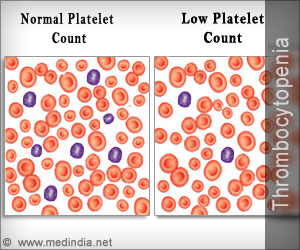
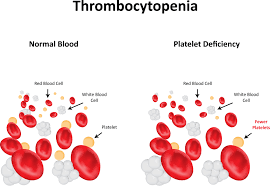
Thrombocytopenia is a condition in which you have a low blood platelet count. Platelets (thrombocytes) are colorless blood cells that help blood clot. Platelets stop bleeding by clumping and forming plugs in blood vessel injuries.

Thrombocytopenia often occurs as a result of a separate disorder, such as leukemia or an immune system problem. Or it can be a side effect of taking certain medications. It affects both children and adults.

Thrombocytopenia may be mild and cause few signs or symptoms. In rare cases, the number of platelets may be so low that dangerous internal bleeding occurs. Treatment options are available.

SIGNS AND SYMPTOMS OF THROMBOCYTOPENIA:

  • Easy or excessive bruising (purpura)
  • Superficial bleeding into the skin that appears as a rash of pinpoint-sized reddish-purple spots (petechiae), usually on the lower legs
  • Prolonged bleeding from cuts
  • Bleeding from your gums or nose
  • Blood in urine or stools
  • Unusually heavy menstrual flows
  • Fatigue
  • Enlarged spleen
  • Jaundice

What causes Thrombocytopenia:

If for any reason your blood platelet count falls below normal, the condition is called thrombocytopenia. Normally, you have anywhere from 150,000 to 450,000 platelets per microliter of circulating blood. Because each platelet lives only about 10 days, your body continually renews your platelet supply by producing new platelets in your bone marrow.

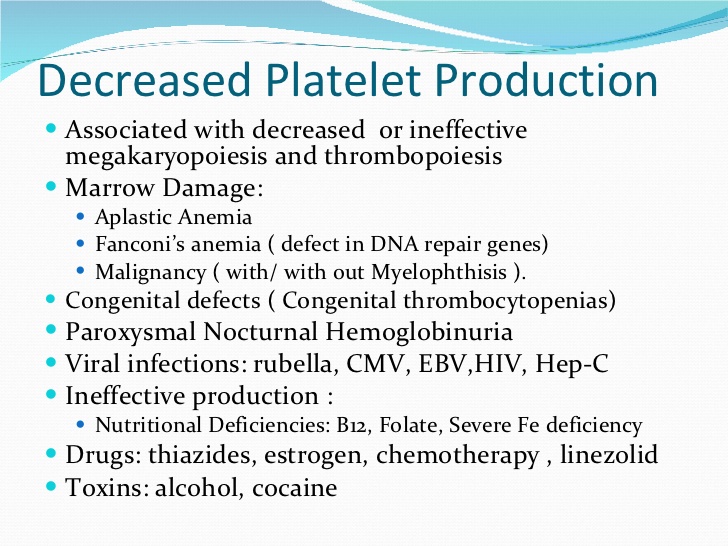
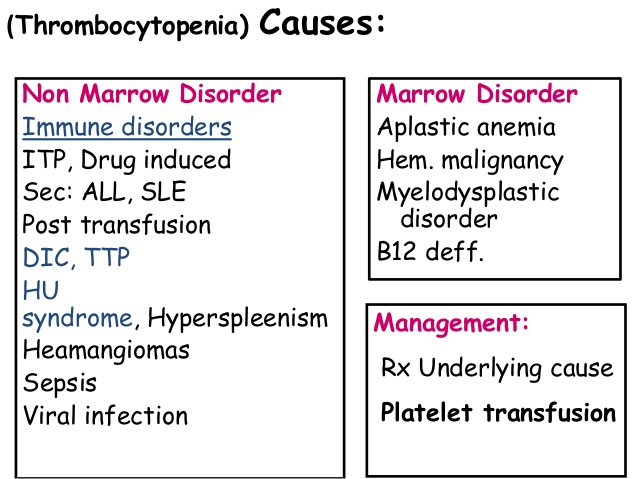
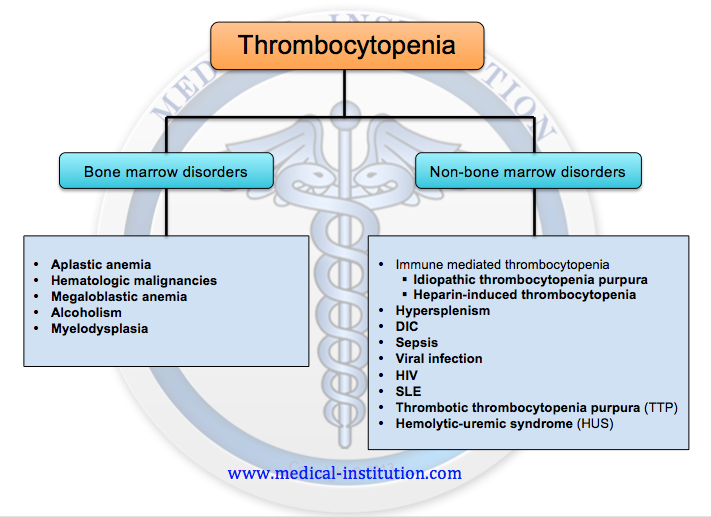
Thrombocytopenia can be inherited or it may be caused by a number of medications or conditions. Whatever the cause, circulating platelets are reduced by one or more of the following processes: trapping of platelets in the spleen, decreased platelet production or increased destruction of platelets.

This could be conditions causing your thrombocytopenia:

INFECTIONS:

  • Viral infections, including chickenpox, parvovirus, hepatitis C, Epstein-Barr, and HIV, systemic lupus erythematosus (SLE), chronic lymphocytic leukemia (CLL) and drug-induced immune thrombocytopenia
  • Sepsis, a severe bacterial infection in your blood
  • Helicobacter pylori (H. pylori), a bacteria that can live in your digestive system

MEDICINES:

  • Medication side effects, including drugs for heart problems, seizures, and infections
  • Heparin, a blood thinner used to prevent blood clots
  • Chemotherapy

OTHER TREATMENTS:  Heart bypass surgery and Radiation treatment on your bone marrow.

MEDICAL CONDITIONS:

  • Blood cancer such as leukemia or lymphoma
  • A problem with your bone marrow, like toxicity from excessive alcohol use
  • Vitamin B12 or folate (vitamin B9) deficiency
  • Pregnancy. Up to 5% of healthy women get it during pregnancy, and it usually gets better on its own after your baby is born. But it can also be a sign of something more concerning, like preeclampsia or HELLP syndrome.
  • An enlarged spleen
  • Your body uses too many platelets, leaving you without enough of them. That can happen if you have an autoimmune disease, like rheumatoid arthritis or lupus.
  • Rare disorders like hemolytic uremic syndrome and thrombotic thrombocytopenic purpura (TTP), which uses a lot of platelets to make small blood clots throughout your body.

TESTS TO HELP DIAGNOSE THROMBOCYTOPENIA:

Physical exam, including a complete medical history. Your doctor will look for signs of bleeding under your skin and feel your abdomen to see if your spleen is enlarged. He or she will also ask you about illnesses you’ve had and the types of medications and supplements you’ve recently taken.

CBC ( complete blood count ). This measures the number of your red and white blood cells and platelets.

Blood smear. This shows how your platelets look under a microscope.

Bone marrow test . Your doctor uses a very fine needle to draw a small amount of liquid bone marrow and check it for cells that may not be working right. Or you may get a biopsy using a different kind of needle, so your doctor can check the types and numbers of cells in the bone marrow.

You may need more tests to help your doctor figure out what’s going on.


QUOTE FOR FRIDAY:

August 1 to 7 every year is observed as World Breastfeeding Week. Breastfeeding is an important task both for the mother and child. According to many, breastfeeding is recommended for first 6 months of the baby’s life’s.”

American Academy of Pediatrics (AAP)


QUOTE FOR THURSDAY:

“How doctors treat gastroparesis depends on the cause, how severe your symptoms and complications are, and how well you respond to different treatments.”

NIH National Institute for Diabetes and Digestive and Kidney Disease


QUOTE FOR TUESDAY:

Anemia occurs when you do not have enough red blood cells or when your red blood cells do not function properly. It is diagnosed when a blood test shows a hemoglobin value of less than 13.5 gm/dl in a man or less than 12.0 gm/dl in a woman.

American Society of Hematology

QUOTE FOR MONDAY:

“Diffusion is by far the most important process involved in the transport of electrolytes and solutes in peritoneal dialysis (PD). Examples of such solutes include: Urea, Creatinine, K+, H+, HCO3, Phosphate, Albumin, proteins and toxins3,7. Diffusive transport of Na+ and Ca2+ is minimal.”

Advanced Renal Education (advancedrenaleducation.com)

QUOTE FOR THE WEEKEND:

Cardiomyopathy refers to diseases of the heart muscle. These diseases have many causes, signs and symptoms, and treatments. The heart muscle becomes enlarged, thick or rigid in cardiomyopathy, and in rare cases the muscle tissue is replaced with scar tissue.”

American Heart Associaton