Part III Cardiomyopathy – Types of it, risk factors in getting it, complications from the diagnosis, and how to prevent it!

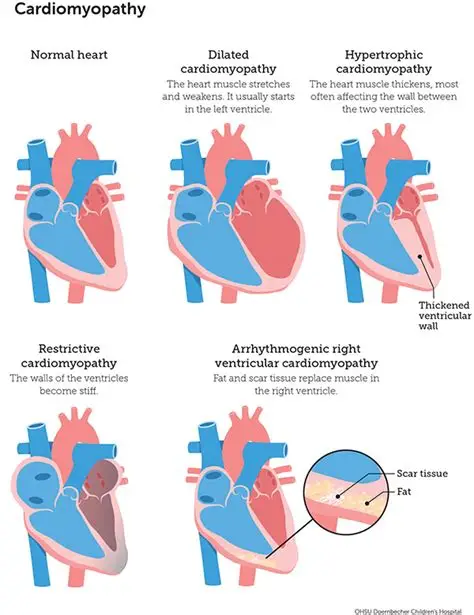
The main types of cardiomyopathy include dilated, hypertrophic and restrictive cardiomyopathy.

Types of cardiomyopathy include:

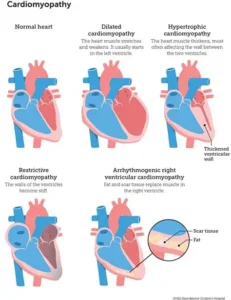
  • Dilated cardiomyopathy. In this type of cardiomyopathy, the pumping ability of your heart’s main pumping chamber — the left ventricle — becomes enlarged (dilated) and can’t effectively pump blood out of the heart.Although this type can affect people of all ages, it occurs most often in middle-aged people and is more likely to affect men. The most common cause is coronary artery disease or heart attack.
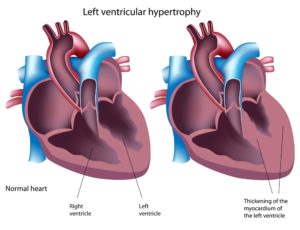
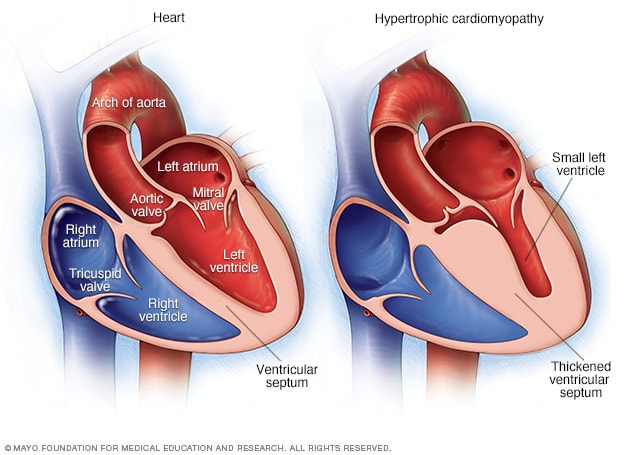
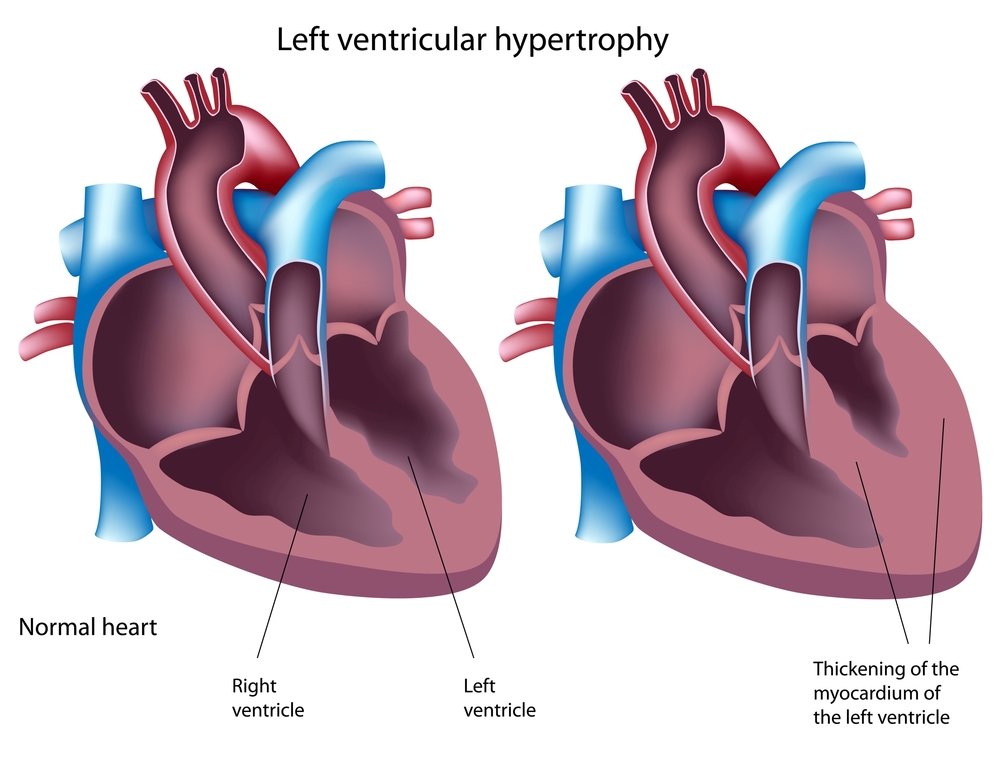
  • Hypertrophic cardiomyopathy. This type involves abnormal thickening of your heart muscle, particularly affecting the muscle of your heart’s main pumping chamber (left ventricle). The thickened heart muscle can make it harder for the heart to work properly.Hypertrophic cardiomyopathy can develop at any age, but the condition tends to be more severe if it becomes apparent during childhood. Most affected people have a family history of the disease, and some genetic mutations have been linked to hypertrophic cardiomyopathy.
  • Restrictive cardiomyopathy. In this type, the heart muscle becomes rigid and less elastic, so it can’t expand and fill with blood between heartbeats. This least common type of cardiomyopathy can occur at any age, but it most often affects older people.Restrictive cardiomyopathy can occur for no known reason (idiopathic), or it can by caused by a disease elsewhere in the body that affects the heart, such as when iron builds up in the heart muscle (hemochromatosis).
  • Arrhythmogenic right ventricular dysplasia. In this rare type of cardiomyopathy, the muscle in the lower right heart chamber (right ventricle) is replaced by scar tissue, which can lead to heart rhythm problems. It’s often caused by genetic mutations.
  • Unclassified cardiomyopathy. Other types of cardiomyopathy fall into this category.

Risk factors

There are a number of factors that can increase your risk of cardiomyopathy, including:

  • Family history of cardiomyopathy, heart failure and sudden cardiac arrest
  • Long-term high blood pressure
  • Conditions that affect the heart, including a past heart attack, coronary artery disease or an infection in the heart (ischemic cardiomyopathy)
  • Obesity, which makes the heart work harder
  • Long-term alcohol abuse
  • Illicit drug use, such as cocaine, amphetamines and anabolic steroids
  • Certain chemotherapy drugs and radiation therapy for cancer
  • Certain diseases, such as diabetes, an under- or overactive thyroid gland, or a disorder that causes the body to store excess iron (hemochromatosis)
  • Other conditions that affect the heart, such as a disorder that causes the buildup of abnormal proteins (amyloidosis), a disease that causes inflammation and can cause lumps of cells to grow in the heart and other organs (sarcoidosis), or connective tissue disorders

Complications

Cardiomyopathy can lead to other heart conditions, including:

  • Heart failure. Your heart can’t pump enough blood to meet your body’s needs. Untreated, heart failure can be life-threatening.
  • Blood clots. Because your heart can’t pump effectively, blood clots might form in your heart. If clots enter your bloodstream, they can block the blood flow to other organs, including your heart and brain.
  • Valve problems. Because cardiomyopathy causes the heart to enlarge, the heart valves might not close properly. This can lead to a backward flow of blood.
  • Cardiac arrest and sudden death. Cardiomyopathy can lead to abnormal heart rhythms. These abnormal heart rhythms can result in fainting or, in some cases, sudden death if your heart stops beating effectively.

Prevention

In many cases, you can’t prevent cardiomyopathy. Let your doctor know if you have a family history of the condition.

You can help reduce your chance of cardiomyopathy and other types of heart disease by living a heart-healthy lifestyle and making lifestyle choices such as:

  • Avoiding the use of alcohol or cocaine
  • Controlling high blood pressure, high cholesterol and diabetes
  • Eating a healthy diet
  • Getting regular exercise
  • Getting enough sleep
  • Reducing your stress

QUOTE FOR TUESDAY:

“Cardiomyopathy (kahr-dee-o-my-OP-uh-thee) is a disease of the heart muscle. It causes the heart to have a harder time pumping blood to the rest of the body, which can lead to symptoms of heart failure. Cardiomyopathy also can lead to some other serious heart conditions.

There are various types of cardiomyopathy in all age groups.”

MAYO CLINIC (Cardiomyopathy – Symptoms and causes – Mayo Clinic)


Part II Types of Cardiomyopathy, including how it’s diagnosed and the various treatments in all ages!


C

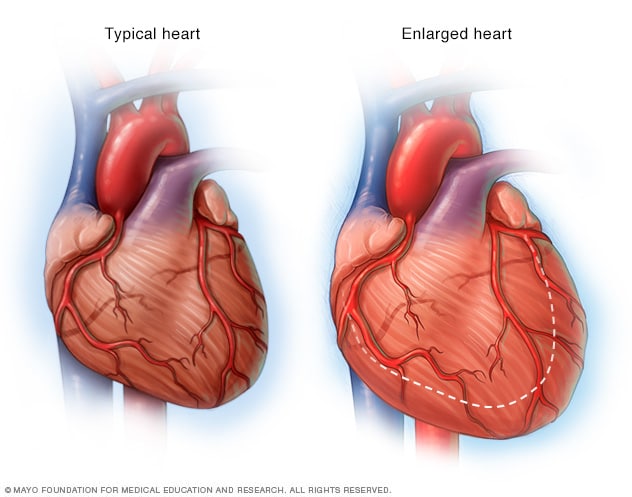
Heart Enlarged


Cardiomyopathy is cardiomyopathy, meaning rather in adult or child the same problems in each age group occur but degree of the disease varies for all, it is case by case.  What is cardiomyopathy?

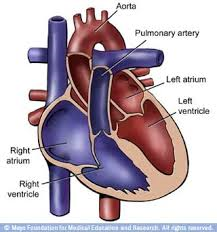
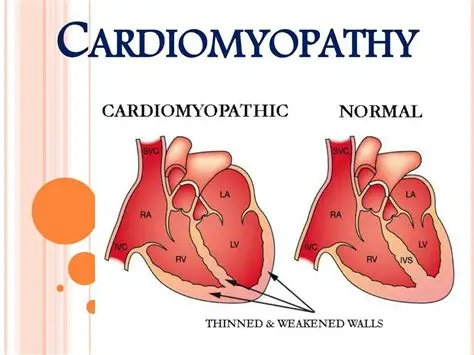
Cardiomyopathy is a disease of the heart muscle characterized by an abnormally large, thick or stiff heart muscle. It may affect only the heart’s lower chambers (ventricles) or both the lower and upper chambers (atria).  For an adult there just more wear and tear on the organ due to age and severity of the disease.

Cardiomyopathy causes damage to tissue around the heart, as well as heart muscle cells. In severe cases, the heart becomes so weak that it can’t pump blood properly. This can lead to heart failure or irregular heartbeats (arrhythmias). In some cases, cardiomyopathy also involves a buildup of scar tissue or fat within the heart muscle. In rare cases, the heart muscle can’t relax and blood can’t fill the heart properly.

Remember the natural pacemaker in humans is located in the upper right chamber (Rt. atrium) in the upper right region called the sinus node.  The sinus node initiates our impulses from that right atrium across to the Lt. atrium and works the impulse sensation down thru the A-V node-atrioventricular node (site between upper and lower chambers in the heart located at the inferior end of the interatrial septum ending at the top of the ventricles in the heart)).   From the A-V node the impulse sensation continues on from A-V node to the end of the lower right and left lower chambers (called the ventricles) of the heart that continues up the ventricles and passing through the bundle of His to the bundle branches/Purkinje fibers (The bundle of His is an important part of the electrical conduction system of the heart, as it transmits impulses from the A-V node, located at the inferior end of the interatrial septum, to the ventricles of the heart).   Than the impulse sensation goes located in the inner ventricular walls of the heart radiating over the outside of the ventricles = Purkinje Fibers. This whole process allows the heart beat to occur sounding “LubDub”.

This entire impulse conduction process allows the heart to fill up the chambers with blood first in upper chambers to lower ones to releasing the blood in the ventricles (the Rt Ventricle pumps blood to the heart to get more oxygen from lungs that sends this fresh oxygenated blood to the left side of the heart.  The left ventricle pumps the filling of its blood into our blood stream called Cardiac Output in creating the heart to beat.  Stroke Volume x Heart Rate=our Cardiac Output (SVxHR=CO).  Stroke volume is the amount of blood circulated by the heart with each beat  x HR = beat in 60 secs.

Cardiomyopathy is very often a “time-will-tell” disease. Symptoms can vary and the progression of the disease can be unpredictable.  There are many forms of cardiomyopathy; just like in the adult.

What are the types of cardiomyopathy?

The main types include:

Dilated cardiomyopathy (DCM)

DCM is the most common type and occurs when the main pumping chamber of the heart muscle is too stretched out (dilated). Dilated cardiomyopathy makes the heart unable to pump blood effectively.

Hypertrophic cardiomyopathy (HCM)

HCM makes the heart muscle too thick. Usually, the thickening occurs in the muscle of the left ventricle in the heart, often involving the wall between the heart’s two ventricles.

Restrictive cardiomyopathy

Restrictive cardiomyopathy is a rare type of cardiomyopathy that causes the heart muscle to become very rigid or stiff. This makes it difficult for the ventricles of the heart to properly fill with blood.

Arrhythmogenic right ventricular cardiomyopathy (ARVC)

ARVC is a rare form of cardiomyopathy that affects only one in 5,000 people. It occurs when the muscle of the heart’s right ventricle is replaced by thick or fatty scar tissue. The scarring “scrambles” electrical signals within the heart and can make it difficult for the heart to pump blood.

Remember the sinus node (natural pacemaker) of the heart.

How Cardiomyopathy is diagnosed:

Because the symptoms of cardiomyopathy can be diverse, it is often misdiagnosed as asthma, an infection or a gastrointestinal problem but the tests similar to adults tests being ruled out for this disease.  Remember its the same problem at a different age.

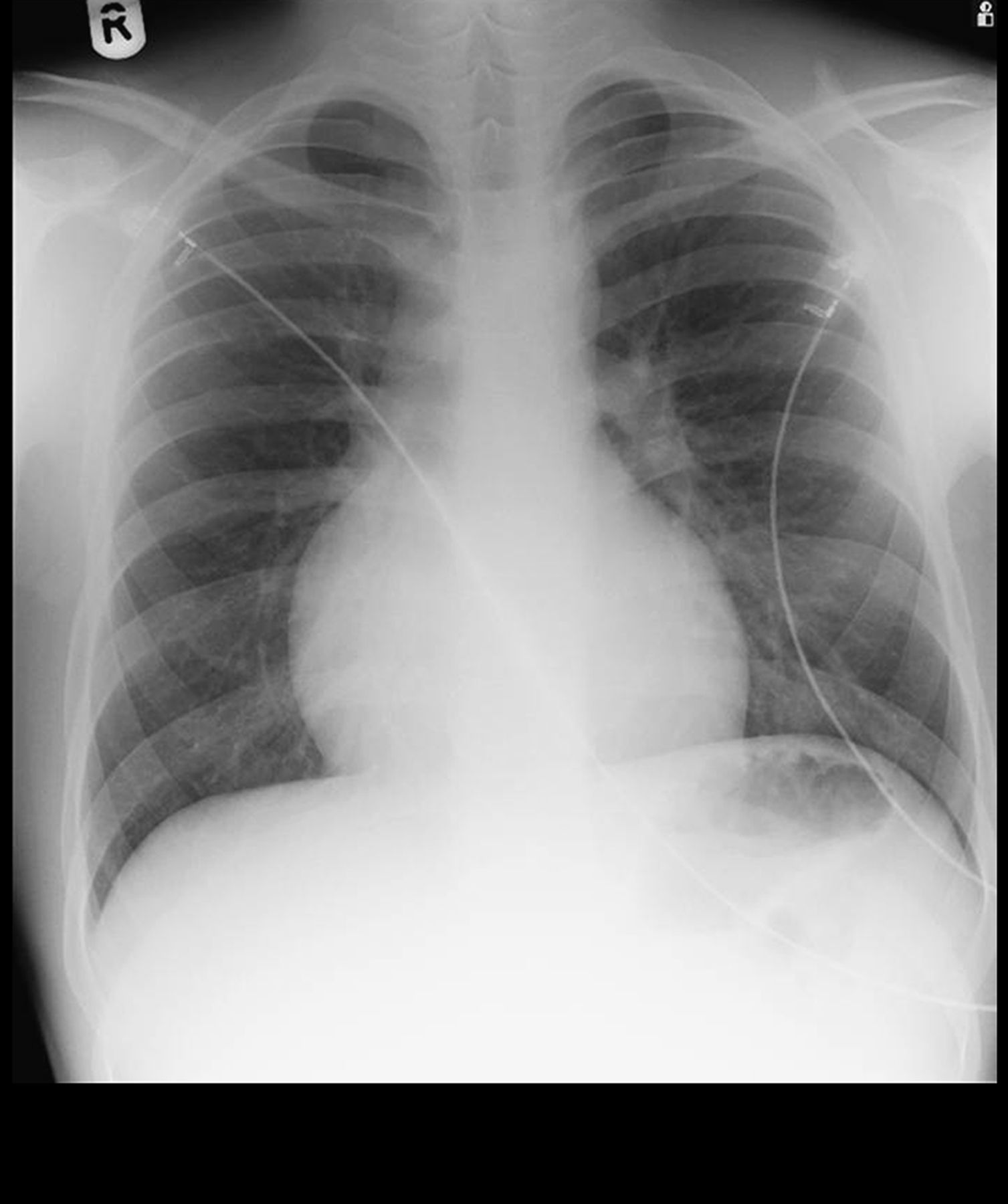
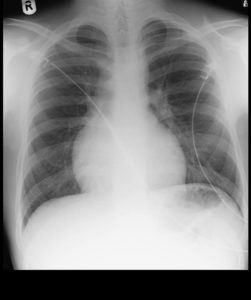
In children who have no symptoms, cardiomyopathy is sometimes diagnosed when the child has a chest x-ray that shows an enlarged heart or an echocardiogram for another reason.

If your child’s doctor suspects cardiomyopathy, he or she may order one or more of the following tests, from least invasive to most invasive tests:

  • blood tests
  • chest x-rays
  • electrocardiogram  (EKG or ECG)
  • echocardiogram (cardiac ultrasound)
  • cardiac magnetic resonance imaging (MRI)
  • stress echocardiography, which uses ultrasound and heart-rate monitoring to assess your child’s heart function just before and just after exercise
  • stress test, or exercise test
  • cardiac catheterization
  • coronary angiography

What are the treatment (Rx) options for cardiomyopathy, again similar to adults Rx.?

Your child’s treatment options will be determined by the type of cardiomyopathy he or she has, as well as the specific symptoms. A child with no symptoms might not need medication or other treatment right away. Instead, the cardiologist will monitor your child to gauge the progression of the disease.

A child with more serious symptoms may need additional tests to give the treatment team more detailed information about how the cardiomyopathy is affecting the heart and the rest of the body. .

Many children with cardiomyopathy do well with medication alone. Others need surgery to improve the function of valves, and in the most severe cases, some children need a heart transplant.

Medication for cardiomyopathy

There are several different types of medications for cardiomyopathy, depending on which type your child has and the symptoms.

  • Angiotestin converting enzyme (ACE) inhibitors are drugs that dilate blood vessels in the body, fighting the constricting effect caused by heart failure.
  • Antiarrhythmic medications combat the abnormal heart rhythms caused by irregular electrical activity within the heart.
  • Beta blockers block certain chemicals from binding to nerve receptors in the heart, slowing the heart rate and lowering blood pressure.
  • Blood thinners or anticoagulants help prevent the formation of blood clots, especially in children with the dilated form of cardiomyopathy.
  • Diuretics prevent the buildup of fluid in the body and can help breathing by reducing fluid in the lungs. These drugs may also be helpful in treating scar tissue on the heart.

Surgical treatments for cardiomyopathy

There are several options for treating cardiomyopathy using surgery or minimally-invasive procedures.

Defibrillators

For some children with cardiomyopathy — particularly HCM — an implantable cardioverter-defibrillator (ICD) can be a life-saving option. This tiny instrument, about the size of a deck of cards, is placed in the chest to monitor the child’s heartbeat. If the child has an arrhythmia, the defibrillator will administer a precise electrical pulse to restore normal heart rhythm.

Pacemakers

Pacemaker implantation is minimally invasive option for some children with cardiomyopathy. The pacemaker — a small electronic device — is inserted directly under the skin, where it sends electric signals to the child’s heart, controlling and monitoring the heart rate. The procedure can be performed under local anesthesia in a matter of hours.

Radiofrequency ablation

Radiofrequency ablation is another type of minimally invasive treatment that can be very effective for some children with cardiomyopathy due to arrhythmia. A small, needle-like probe is inserted into the scarred tissue of the heart muscle, sending out radiofrequency waves that burns away the scar tissue and the arrhythmia.

Surgical removal of some heart muscle

In serious cases of hypertrophic cardiomyopathy, the treatment team may perform a surgery called a septal myectomy or septal myomectomy. This procedure involves the removal of a portion of the thickened muscle in the heart, widening the channel in the heart’s ventricle that leads to the aortic valve. The procedure has a very good success rate, and most children have improved blood flow throughout the heart and body.

Ventricular assist device

In certain types of cardiomyopathy, a ventricular-assist device (VAD) can be used to help recover the heart and normalize the heart’s function. After the heart’s function has returned to normal, the VAD will be removed and the child will be monitored for any further heart problems. This approach using the VAD is called a “bridge to recovery.”

Heart transplant

Children with the most severe cases of cardiomyopathy may need a heart transplant if other methods don’t manage symptoms. While your child is waiting for an available heart, a VAD may be used to support the heart. In many cases, children can return to school and other activities while waiting for a transplant.

So similar to how adults are treated also with cardiomyopathy.  The age is the pretty much the difference.
 

QUOTE FOR MONDAY:

“In the United States, approximately 1.1 million people, have some form of cardiomyopathy.  In 2021, there were 14,770 hospitalizations for cardiomyopathy as the principal diagnosis, and it accounted for 23% of all heart failures.  Some people with cardiomyopathy don’t ever get symptoms. For others, symptoms appear as the condition becomes worse. ”

American Heart Association (2024-Statistics-At-A-Glance-final_2024.pdf)

Part I Cardiomyopathy – what it is, the symptoms, when to see a doctor and causes!

Cardiomyopathy (kahr-dee-o-my-OP-uh-thee) is a disease of the heart muscle that makes it harder for your heart to pump blood to the rest of your body. Cardiomyopathy can lead to heart failure.

Symptoms

There might be no signs or symptoms in the early stages of cardiomyopathy. But as the condition advances, signs and symptoms usually appear, including:

  • Breathlessness with exertion or even at rest
  • Swelling of the legs, ankles and feet
  • Bloating of the abdomen due to fluid buildup
  • Cough while lying down
  • Fatigue
  • Heartbeats that feel rapid, pounding or fluttering
  • Chest discomfort or pressure
  • Dizziness, lightheadedness and fainting

Signs and symptoms tend to get worse unless treated. In some people, the condition worsens quickly; in others, it might not worsen for a long time.

When to see a doctor

See your doctor if you have one or more signs or symptoms associated with cardiomyopathy. Call 911 or your local emergency number if you have severe difficulty breathing, fainting or chest pain that lasts for more than a few minutes.

Because some types of cardiomyopathy can be hereditary, if you have it your doctor might advise that your family members be checked.

Causes

Often the cause of the cardiomyopathy is unknown. In some people, however, it’s the result of another condition (acquired) or passed on from a parent (inherited).

Contributing factors for acquired cardiomyopathy include:

  • Long-term high blood pressure
  • Heart tissue damage from a heart attack
  • Chronic rapid heart rate
  • Heart valve problems
  • Metabolic disorders, such as obesity, thyroid disease or diabetes
  • Nutritional deficiencies of essential vitamins or minerals, such as thiamin (vitamin B-1)
  • Pregnancy complications
  • Drinking too much alcohol over many years
  • Use of cocaine, amphetamines or anabolic steroids
  • Use of some chemotherapy drugs and radiation to treat cancer
  • Certain infections, especially those that inflame the heart
  • Iron buildup in your heart muscle (hemochromatosis)
  • A condition that causes inflammation and can cause lumps of cells to grow in the heart and other organs (sarcoidosis)
  • A disorder that causes the buildup of abnormal proteins (amyloidosis)
  • Connective tissue disorders

QUOTE FOR THE WEEKEND:

“Health care providers can treat hemochromatosis safely and effectively by removing blood from the body on a regular basis. This is similar to donating blood. The process is known as phlebotomy.

The goal of phlebotomy is to lower your iron levels. The amount of blood removed and how often it’s removed depend on your age, your overall health and the severity of iron overload.”

MAYO CLINIC (https://www.mayoclinic.org/diseases-conditions/hemochromatosis/diagnosis-treatment/drc-20351448)

Part II Hemochromatosis – How its Diagnosed & Rx.

Diagnosis

It can be tricky for your doctor to diagnose hemochromatosis, because other conditions have the same symptoms. He might want you to get tested if:

  • You’re having symptoms.
  • You have one of the problems listed above.
  • A family member has the disorder.

There are some other ways your doctor can figure out if you have it:

Checking your history. He’ll ask about your family and if anyone has hemochromatosis or signs of it. He might also ask about things like arthritis and liver disease, which might mean you or someone in your family has hemochromatosis but doesn’t know it.

Physical exam. Your doctor will examine your body. This involves using a stethoscope to listen to what’s going on inside. He might also tap on different parts of your body.

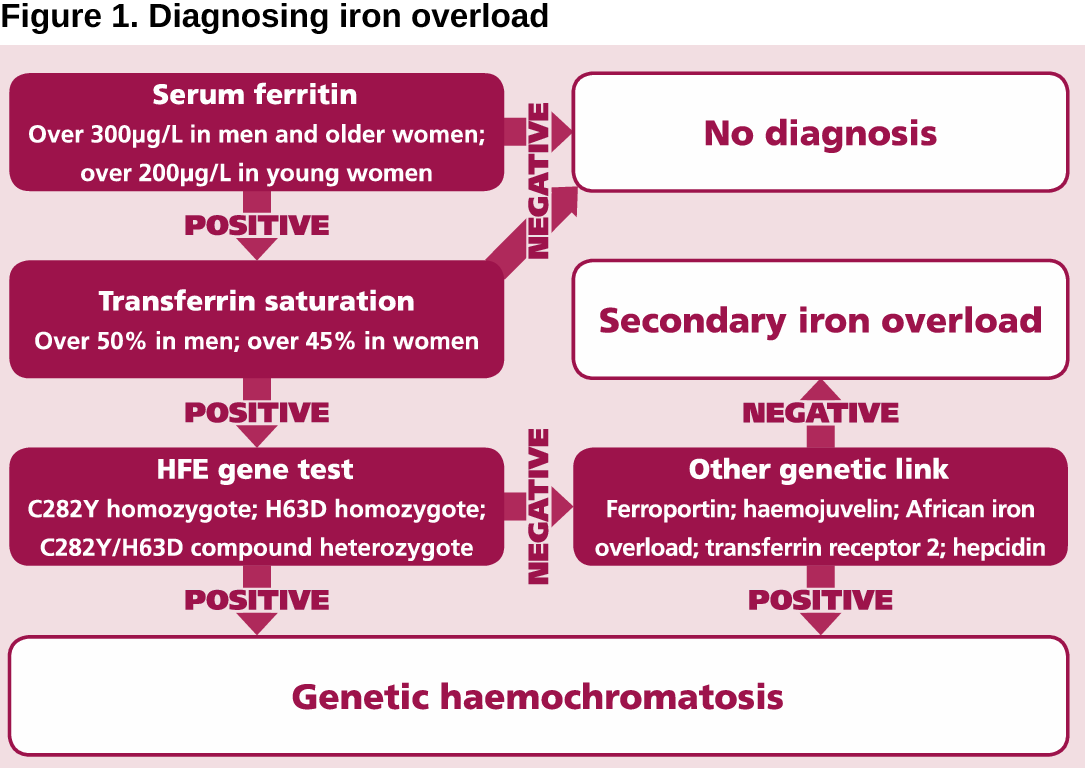
Blood tests. Two tests can give your doctor a clue about hemochromatosis:

  • Transferrin saturation. This shows how much iron is stuck to transferrin, a protein that carries iron in your blood.
  • Serum ferritin. This test measures the amount of ferritin, a protein that stores iron, in your blood. – If either of these show you have more iron than you should, your doctor might order a third test to see if you have a gene that causes hemochromatosis.
  • Liver biopsy. Your doctor will take a small piece of your liver. He’ll look at it under a microscope to see if there’s any liver damage.
  • MRI. This is a scan that uses magnets and radio waves to take a picture of your organs.

    Treatment

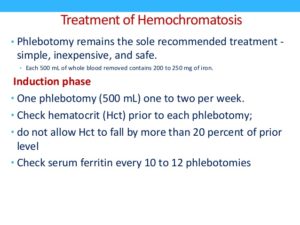
    If you have primary hemochromatosis, doctors treat it by removing blood from your body on a regular basis. It’s alot like donating blood. Your doctor will insert a needle into a vein in your arm or leg. The blood flows through the needle and into a tube that’s attached to a bag.

    • Initial treatment schedule. In the beginning, you may have a pint (about 470 milliliters) of blood taken once or twice a week — usually in a hospital or your provider’s office. While you lean back in a chair, a needle is inserted into a vein in your arm. The blood flows from the needle into a tube that’s attached to a blood bag. The process of removing blood is referred to as therapeutic blood removal.  In the Initial treatment. You’ll visit your doctor’s office or a hospital once or twice a week to have your blood drawn. You may have up to a pint taken at a time.
    • Maintenance treatment schedule. Once your iron levels go down, blood can be removed less often, typically every 2 to 3 months. Some people may maintain typical iron levels without having any blood taken. Some may need to have blood removed monthly. The schedule depends on how quickly iron builds up in your body.  So Maintenance treatment starts when once your blood iron levels have gone back to normal, you’ll still have to have to have blood taken, but not as often. It’ll be based on how fast iron builds back up in your body.

    The goal is to remove some of your blood so that your iron levels return to normal. This could take up to a year or more. Blood removal is divided into two parts: initial treatment and maintenance treatment.


QUOTE FOR FRIDAY:

“Hemochromatosis is a metabolic disorder in which your organs accumulate excess iron, leading to organ damage. Hereditary hemochromatosis affects one in 300 people in the United States.”

John Hopkins Medicine (https://www.hopkinsmedicine.org/health/conditions-and-diseases/hemochromatosis)

Part I – Hemochromatosis-What it is, primary/secondary, and symptoms!

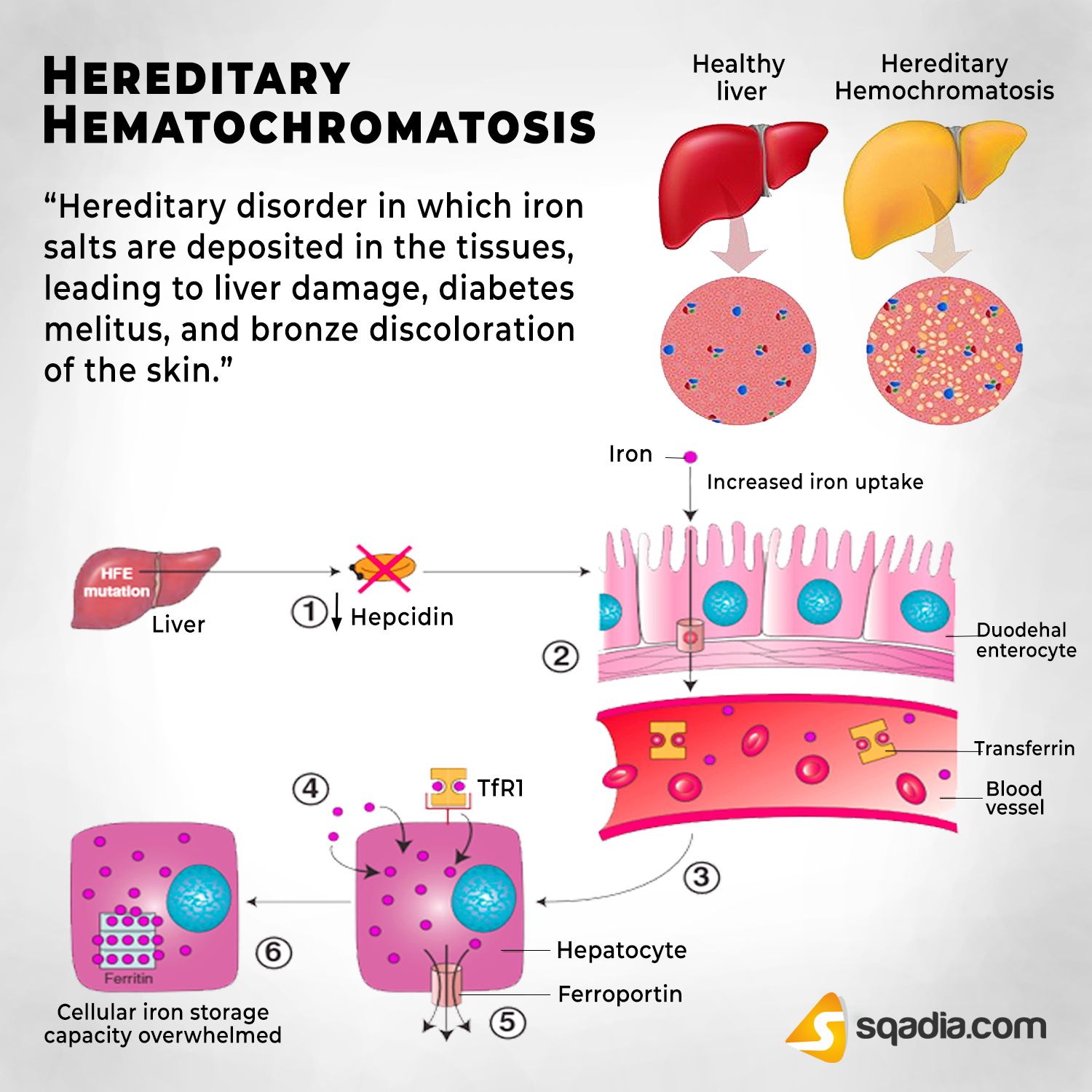
Hemochromatosis is a disorder where too much iron builds up in your body. Sometimes it’s called “iron overload.”   Hemo meaning blood and chromatosis means pigmentation specifically : deposit of pigment in a normally unpigmented area or excessive pigmentation in a normally pigmented site.

Normally, your intestines absorb just the right amount of iron from the foods you eat. But in hemochromatosis, your body absorbs too much, and it has no way to get rid of it. So, your body stores the excess iron in your joints and in organs like your liver, heart, and pancreas. This damages them. If it’s not treated, hemochromatosis can make your organs stop working.

There are two types of this condition — primary and secondary.

Primary hemochromatosis is hereditary, meaning it runs in families. If you get two of the genes that cause it, one from your mother and one from your father, you’ll have a higher risk of getting the disorder.

Secondary hemochromatosis happens because of other conditions you have. These include:

  • Certain kinds of anemia
  • Liver disease
  • Getting a lot of blood transfusions
  • White people of northern European descent are more likely to get hereditary hemochromatosis. Men are 5 times more likely to get it than women.

    Symptoms

    Up to half of people who have hemochromatosis don’t get any symptoms. In men, symptoms tend to show up between ages 30 and 50. Women often don’t show signs of this condition until they’re over 50 or past menopause. That may be because they lose iron when they get their periods and give birth.

    Symptoms of hemochromatosis include:

    • Pain in your joints, especially your knuckles
    • Feeling tired
    • Unexplained weight loss
    • Skin that has a bronze or gray color – pigmentation
    • Pain in your belly
    • Loss of sex drive
    • Loss of body hair
    • Heart flutter
    • Foggy memory

    Sometimes people don’t get any symptoms of hemochromatosis until other problems arise. These may include:

    • Liver
    • Diabetes
    • Abnormal heartbeat
    • Arthritis
    • Erectile dysfunction (difficulty having a erection)

    If you take a lot of vitamin C or eat a lot of foods that contain it, you can make hemochromatosis worse. That’s because vitamin C helps your body absorb iron from food.

    White people of northern European descent are more likely to get hereditary hemochromatosis. Men are 5 times more likely to get it than women.
     

QUOTE FOR THURSDAY:

“As advances in CF knowledge and care are potentially able to prolong the life expectancy of many patients, it’s important to keep in mind the complications—beyond lung disease—that will develop and progress as patients age.1,9-11 Monitoring for these complications can help detect their emergence and progression, which can ensure earlier intervention; this has been associated with better outcomes in patients.

Knowing CF affects the lungs this is how it happens:

Early as in utero and into infancy, inflammation may occur, with the possibility of mucus plugging and bronchiectasis.

Inflammation, lung structure and lung function may progress throughout childhood.

Childhood, adolescence and early adulthood what happens is lower airway inflammation and worsening airway abnormalities including established bronchiectasis may occur, driven by the inflammation in the lungs.

In Adulthood and Aging what happens is airway destruction and complications, including bacterial infections, bronchiectasis with hemoptysis, and pneumothorax, may occur and may lead to progressive respiratory failure, often requiring lung transplant.”

CF Source (Multi-Organ Disease Progression in Cystic Fibrosis (CF)