QUOTE FOR THE WEEKEND:

“During atrial fibrillation, the heart’s two upper chambers (the atria) beat chaotically and irregularly — out of coordination with the two lower chambers (the ventricles) of the heart.  Sometimes the misfiring signals can also make your heart’s two bottom chambers, called ventricles, beat too quickly. That’s a specific type of atrial fibrillation called AFib with rapid ventricular response.  Any type of AFib can lead to a stroke or heart failure. If you don’t get treated, over time the condition can damage your heart muscle and lead to heart failure.”.

WebMD

Part II Atrial Fibrillation Month Awareness

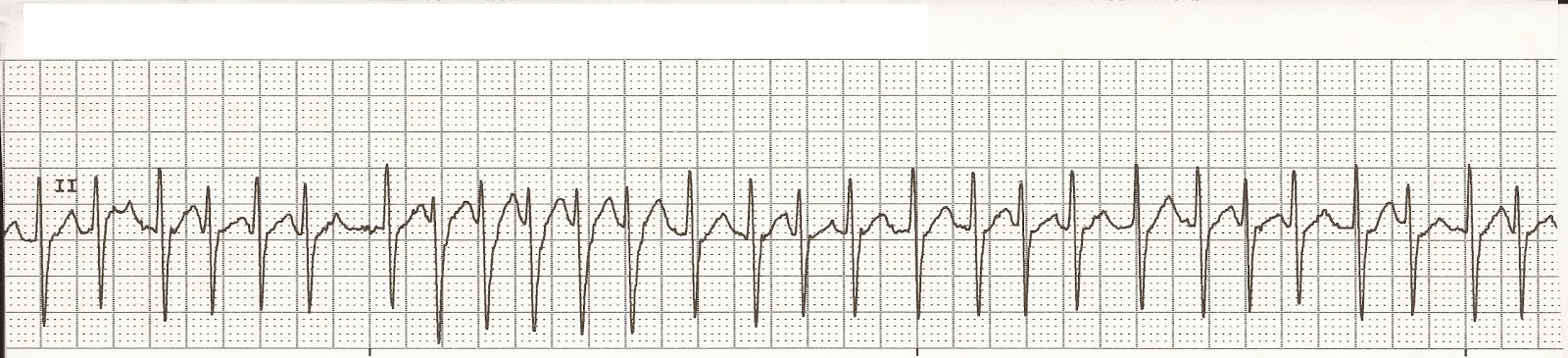
 Afib with RVR 6

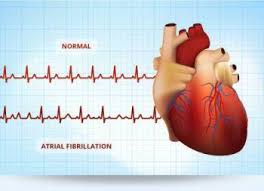
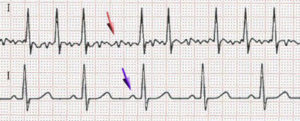
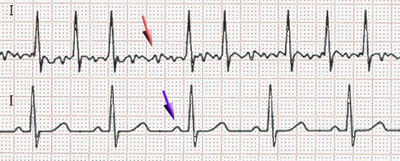
Top Line is Controlled AFIB less than 100 bts/min. Look how many spikes there are on the top line that’s the HR/min 8spikes x 10=80 in a 6 second strip from a EKG machine.  Controlled afib is your HR under 100/min. 

Bottom Line is Normal ( Sinus) rhythm, see how evenly spaced the spikes are. The rhythm rate is 5 spikes x 10=50 or a pulse or HR in a 6 second strip from a EKG machine. It’s not irregular and no stress to the heart.

A regular HR allows the heart chambers to fill up properly as opposed to irregular.  This allows less stress on the heart.  Ex an engine running properly in our car as opposed to not running properly puts a high potential for the engine to go into problems.  Same with an irregular HR for the heart.
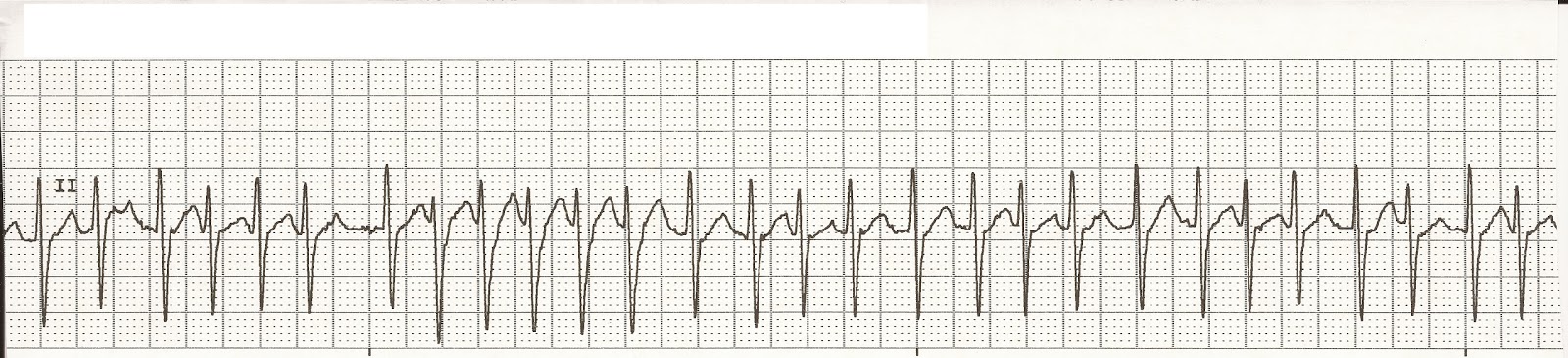
Afib with RVR 5

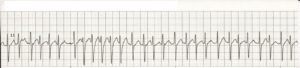
Each spike represents a heart pulsation which is when the organ is going lub dub, when the heart is contracting then relaxing, add them up on each strip on a 6 second strip (those above) x 10 tells you the heart rate by counting the spikes than x 10=that person’s heart rate.  The first strip above is only 80 of a heart rate in 60 seconds and the next one is in RVR=280 of a HR.  The heart can only take that so long before going into a worse rhythm called V-Tac or Ventricular Fibrillation and have to be shocked.  So it is vital to keep atrial fibrillation under control meaning pulse under 100 beats a minute.  Remember in a-fib. your upper chambers are in fibrillation (just quivering) as opposed to ventricular fibrillation, which is when we shock a pt. to knock their rhythm back to a better rhythm to stay alive.  In Vent.Fib. untreated results into death since the chambers are doing nothing but quivering.  The brain can live only 7 seconds without oxygen and barely any 02 is getting to your tissues in this rhythm.
Afib with RVR 9   Afib with RVR 8The heart is our ENGINE!


Some people in the US have this cardiac condition called Atrial Fibrillation where some with this condition even experience Rapid Ventricular Rate or Response with it.

Atrial fibrillation is an irregular and often rapid heart rate that commonly causes poor blood flow to the body.

During atrial fibrillation, the heart’s two upper chambers (the atria) beat chaotically and irregularly — out of coordination with the two lower chambers (the ventricles) of the heart causing your pulse to be irregular. We know now how the blood flows through the heart but due to the irregularity of the atriums which is not allowing the chambers to fill up to the maximal level they normally did when they didn’t have Atrial Fibrillation is decreasing the cardiac output (blood volume) from the left ventricle to be decreased.   This means the heart and all other tissus aren’t getting the regular amount of oxygen they got when they were in a regular normal rhythm.  Atrial fibrillation symptoms often include heart palpitations, shortness of breath and weakness.  Atrial fibrillation (also called AFib or AF) is a quivering or irregular heartbeat (arrhythmia) that can lead to blood clots, stroke, heart failure and other heart-related complications. Some people refer to AFib as a quivering heart.  What happens here is primarily the ventricles take over.   With the atriums quivering and the ventricles going at their rate this causes an irregular heart rate=HR.  Another problem with an irregular heart rate is this allows blood to pool in the heart putting the patient at risk for clot formation.  As this HR gets more irregular it puts the patient at a higher risk of allowing the clot to break off inside the heart now flowing freely in the blood stream.  If it reaches the lungs and stays there a pulmonary thrombus can occur causing breathing difficulties; if it bypasses the lungs the next place it goes to is the brain putting the person at risk for a stroke and if it reaches back to the heart the patient can have a heart attack.  This why you commonly see patients with atrial fibrillation on the med Coumadin or some form of anticoagulant drug to prevent clots from occurring.

An estimated 2.7 million Americans are living with Afib.

Episodes of atrial fibrillation can come and go, or you may develop atrial fibrillation that doesn’t go away and may require treatment. Although atrial fibrillation itself usually isn’t life-threatening if kept under control meaning HR under 100, it is a serious medical condition that sometimes requires emergency treatment. It can lead to complications. Atrial fibrillation may lead to blood clots forming in the heart that may circulate to other organs and lead to blocked blood flow (ischemia) to even stroke (cause the clot reached the brain or heart attack  cause the clot is in the heart) to pulmonary thrombus (cause the clot reached the lungs), as stated earlier.

Treatments for atrial fibrillation may include medications like anticoagulants primarily=Coumadin, Plavix, antiplatelets=aspirin (platelets are responsible for clotting in our bloodstream) with and other interventions to try to alter the heart’s electrical system such as cardioversion-shocking the heart at low level voltage, more common in newly diagnosed afib. in hope to knock the afib into a regular rhythm called normal sinus rhythm (the best rhythm to be in).  We have a normal sinus node in our right upper chamber that gives the signals for our pulsation of the heart and is the reason the best rhythm is called sinus normal rhythm.

Various studies have reported that electrical cardioversion is over 90 percent effective in converting to a normal sinus rhythm though many people revert back into afib shortly thereafter. Success has been shown to be enhanced when patients are on an anti-arrhythmic drug beforehand, which helps prevent reverting back to atrial fibrillation.

Success depends on the size of the left atrium as well as how long the patient has been in a=fib.. Patients with a very large left atrium, one greater than 5 cm, or who have been in constant a-fib for a year or two, may find that electrical cardioversion is not effective in converting to or maintaining a normal sinus rhythm (the best heart rate to be in; remember the natural pacemaker of the heart lies in our right upper side of the chamber on the lateral side not the medial side which we call the Sinus Node.  The sinus rhythm derives from this sinus node, that is why its the best rhythm to be in especially if your under HR is from 60 to less than 100.  Ideal HR a minute is 60-80s.).

Following a successful electrical cardioversion to treat uncontrolled atrial fibrillation (in the medical abbreviated by calling it afib also), the goal is to maintain a normal sinus rhythm, which only happens with about 20–30 percent of patients within the first year if they are not on anti-arrhythmic drugs for rhythm control. Overall, the likelihood is quite high that you will revert back into atrial fibrillation, regardless of whether you stay on rhythm control drugs.

Always remember if you remain in Atrial Fibrillation and the HR is kept under 100 with no symptoms you can live a completely normal life.  Also always follow up with your cardiologist to keep an eye on your rhythm with following the M.D. treatment.

When the ventricles beat too rapidly they don’t fill completely with blood from the atria. As a result, they cannot efficiently pump blood out to meet the needs of the body. This can ultimately lead to heart failure in time if not treated.  Just like us running from NY to California most will end up not being able to do it just like the heart can’t run in atrial fibrillation in a high heart rate for a long time,  it also will give out going into failure.  The heart can only compensate in atrial fibrillation in a rapid high heart rate for so long than stop if no treatment is done.

A cardiac condition called Rapid Ventricular Rate or Response which is seen sometimes with Atrial Fibrillation which is the heart is overloaded.  Our heart beats lub dub which is first the atriums opening and closing (lub) and than the ventricles opening and closing (dub).  When the heart gets overworked and tries to compensate the atriums can give up and just allow the ventricles to take over to beat which affects the heart and all other tissues to get proper amount of blood with oxygen in time.  Since you loose the atriums (the upper chambers of the heart) and they don’t fill up with the amount of blood volume like they use to before having afib+.  You loose a lot of blood volume(RBC’s); what the heart pumps out in the left ventricle to our tissues with oxygen get’s decreased in what we call your cardiac output=the volume of oxygenated blood pumped out of the left ventricle.  Well with atrial fibrillation this gets compensated.  In time if this is not repaired the blood goes backwards in how the heart pumps the blood.  It is regurgitating blood back in the heart back in the pulmonary vein back to the lungs putting fluid in the lungs even going further back into the Rt side of the heart if it is reaching that far and then superior vena cava and even further depending how long this hasn’t been treated.  Heart failure is set up, if not already diagnosed.

Heart failure can result of Atrial Fibrillation with RVR overtime and is the most common in those who already have another type of heart disease like CAD (Coronary Heart Disease, CHF,  heart valve disease etc…).

RVR can cause chest pains and make conditions like congestive heart failure worse (they are already with a heart not functioning at its optimal).   RVR is simply having a high heart rate with the ventricles only pumping.  The HR can be like over 100-280.  You need to get to an ER to be treated immediately.  This is where you would be started on a IV drip like Cardizem to bring the HR down to get you in controlled atrial fibrillation or some type of medication in bringing the HR down to cardioverted after cleared you have no clot in your heart especially since the shock can make it loose in your bloodstream.  We already reviewed earlier what a loose clot can cause.  HR meaning the heart rate or pulse which just like a car if not maintained properly it will wear down till it no longer works or dies!  Be could to your heart you only have one unless you get a transplant which is very hard to obtain; and why bother for if you control your a-fib it will allow you to live a completely normal life if that is your only medical  or medical condition you have.  Its all up to you!
 

QUOTE FOR FRIDAY:

“Atrial fibrillation (also called AFib or AF) is a quivering or irregular heartbeat (arrhythmia) that can lead to blood clots, stroke, heart failure and other heart-related complications. At least 2.7 million Americans are living with AFib. Heart disease is still the No. 1 killer in America, and stroke is No. 5. Let’s make September the month to make moves that help save lives.”
American Heart Association (heart.org)

Part I Atrial Fibrillation Month Awareness

Working of the heart:

 To easily identify atrial fibrillation with RVR, it is vital to understand the working of the heart. The atrium or atria (plural) is the upper chamber of the heart, bigger in size compared to the lower chambers known as the ventricles. The atria function by gathering blood as it flows into the heart and shrinking to forward the blood into the ventricles. At the very moment, the smaller ventricle must shrink to forward the blood to all parts of the body. This rhythm of blood flow creates a heart signature voice referred to as the Sinus rhythm. It is important that the sinus rhythm is synchronized so that the atrium does not send blood into the ventricle out of cue. To achieve this, an electric signal is generated to ensure the atrium contracts. When this signal short circuits (bypasses) the atrium, atrial fibrillation with RVR occurs, and the atrium is seen to vibrate just like jelly on a flat surface.

Atrial fib with RVR refers to atrial fibrillation with rapid ventricular rate. Usually the heart is like clockwork, the top (collecting) chambers beat then the bottom (main pumping) chambers sense this and also beat, and so on, in a nice regular fashion just like a clock ticking second after second. Usually the heart beats at about 60-80 beats per minute.

In atrial fibrillation the top chamber basically goes crazy often firing off over 400 beats per minute! Atrial fibrillation with RVR (Rapid Ventricular Response) is a heart condition caused by irregular electrical activity that results in irregular contractions of the 2 top heart chambers fibrillating. This means the heart (atriums), shakes with a rapid tremulous movement or makes fine irregular twitching movements, generally referred to as fibrillating causing little control in the heart output of blood by the heart but the lower chambers called the ventricles take over.

 These bottom chambers don’t allow all those impulses through but it does let every second or third one through. This can give a heart rate of 100-180 beats per minute at rest, still too many beats, known as Afib with RVR, leading to symptoms and problems with heart function. Afib does not necessarily lead to Afib with RVR however, Afib can be rate controlled, sometimes naturally, sometimes using medications and sometimes requiring procedures as discussed below.

In most people with AFib although symptoms can sometimes be unpleasant it is generally not harmful as long as the afib is controlled, meaning the heart in the afib rhythm with the pulse under 100. The main concern is stroke, but that can be treated with the use of blood thinning medications in people at risk. In Afib with RVR, basically the heart is beating too fast. Of course palpitations are the most common symptom. Other symptoms of AFib with RVR may include dizziness, lack of energy, exercise intolerance and shortness of breath. If Afib with RVR goes on for too long then this may result in heart failure and of course worsening of existing heart failure. Control of the heart rate in patients with Afib with RVR often causes these symptoms to improve, again meaning the HR is under 100 with the heart rhythm in afib.

A major indication of atrial fibrillation with RVR is a very rapid heartbeat rate, although some patients are known to have the condition without showing symptoms. Atrial fibrillation with RVR may occur when cardiac muscle cells overcome their intrinsic pacemaker’s signals and fire rapidly differently from their normal pattern spreading the abnormal activity to the ventricles. The rapid heart rate can strain the heart, developing a situation referred to as Tachycardia (meaning a pulse greater than 100). Atrial fibrillation with RVR can be detected from the various symptoms though it is important to remember that some patients have experienced the condition without symptoms.

Symptoms:

Some of the symptoms of this disease include heart palpitations (described as unnoticed skipped beats or skipped beats noticed from experienced dizziness or difficulty in breathing), shortness of breath when lying flat (orthopnea), shortness of breath (dyspnea after exertion) sudden onset of short breath during the night (also called paroxysmal nocturnal dyspnea) and gradual swelling of lower extremities. As a result of inadequate blood flow, some patients complain of light headedness and may feel like they are about to faint, a condition referred to as presyncope and may actually lose consciousness (syncope). Some patients experience respiratory distress that results in them appearing blue. A close examination of jugular veins usually reveals elevated pressure in some patients (jugular venous distention). When some patients are subjected to lung examinations, crackles and rales may be observed pointing to possible lung edema.


QUOTE FOR THURSDAY:

“Several National Foundation for Cancer Research-funded scientists, including Doctors Frederick Alt and Curt Civin, have dedicated their careers to fighting blood cancers.  The sooner patients and doctors can connect these dots, make the diagnosis of the blood cancer the better the chances are for that pt with blood cancer, if indeed present, can be eradicated successfully.”

National Foundation for Cancer Research

QUOTE FOR WEDNESDAY:

“Leukemia is the most common cancer in children and teens, accounting for almost 1 out of 3 cancers. Most childhood leukemias are acute lymphocytic leukemia (ALL). Most of the remaining cases are acute myeloid leukemia (AML). Chronic leukemias are rare in children.”
American Cancer Society

QUOTE FOR TUESDAY:

“In 2013, nearly two million Americans abused prescription painkillers and more than 16,000 people in the U.S. died. Each day, almost 7,000 people are treated in emergency departments for using these drugs in a manner other than as directed.

The most abused medications are pain relievers (opioids) such as oxycodone, hydrocodone, percocet, methodone and codeine. Those who abuse prescription narcotics drugs think they are safe because they are not illegal but once addicted, it can be hard to stop.”

iab Health Productions (iabhp.com)

QUOTE FOR MONDAY:

6 IN 10 Adults in the US have a chronic disease.  4 IN 10 Adults in the US have two or more. “.

cigarette  soda and friesman lying back and listening to headphones      alcohol

Smoking, Poor Nutrition, Immobility (no exercise or regular mobility/exercise routine each day, drinking!


QUOTE FOR THE WEEKEND:

“Epidermodysplasia verruciformis is usually an autosomal recessive inherited disorder.  Epidermodysplasia verruciformis is often due to mutations in the EVER1 or EVER2 genes on chromosome 17q25. The mutation decreases cell capacity to fight HPV infections.

The lesions usually start to appear during childhood and persist. About 7.5% of cases appear in infancy, 61.5% in children aged 5–11 years and 22.5% in puberty. The disease affects both males and females and people of all races.

Acquired epidermodysplasia verruciformis is a result of HIV infection, organ transplantation or a lymphoma.

Two clinical presentations: White, pink, reddish brown, dark brown or violet flat-topped papules and plaques with a scaly surface and irregular borders.  2-Verrucous or seborrhoeic keratoses-like lesions. These are raised brown warty lesions.”.

DernNet NZ all about skin (dernnetnz.org)

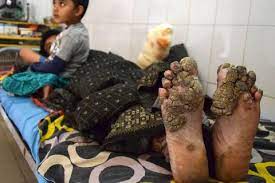
Epidermodysplasia verruciformis (EV) = Tree Man Syndrome

EV is an inherited genetic immune disorder. It makes people extremely susceptibleTrusted Source to human papillomavirus (HPV) infections and usually results in this type of infection becoming chronic.

Most people come into contact with HPV at some point, and having EV compromises a person’s immune function in a way that makes them more likely to develop the infection.

Over time, the infection causes skin growths, such as viral warts and pigmented, inflamed patches. In severe or extreme cases, a person may develop bark-like growths.

HPV is contagious and usually transmitted Trusted Source through skin-to-skin contact. A person can pass it on even if they experience no symptoms.

Symptoms:

The most striking symptom of EV is bark-like growths of tissue, which most commonlyTrusted Source develop on the hands and feet. However, it is important to note that this is a severe presentation.

People with EV tend to develop:

  • small pink, white, reddish-brown, dark brown, or violet growths called papules, which may be raised and flat-topped
  • larger scaly, raised, or inflamed patches of skin called plaques, which may have irregular edges
  • raised brown growths called viral warts

The warts tend to occur in clusters of a few to more than 100 lesions each. They commonly form on areas exposed to the sun, including the:

  • hands, feet, earlobes and face

Larger plaques associated with EV tend to form on the:

  • neck, arms, legs, trunk

However, people with EV can experience symptoms anywhere, including the:

  • soles of the feet, armpits, external genitalia, palms

Diagnosis:

According to the GARD, approximately 61.5% of people diagnosed with EV develop symptoms in childhood, while some 22% develop them during puberty, and 7.5% do so in infancy.

EV is an autosomal recessive genetic disorder, meaning that it results from mutations at specific locations on certain genes, and that the person has inherited the same mutations from both parents.

In about 10% of EV cases, the person’s parents were relatives.

Rarely, the condition can either be linked to sex, in the sense that the mutation developed on the X or Y genes, or it can be autosomal dominant — caused by a single mutated gene.

Also, acquired EV has developed in people with:

  • HIV
  • lymphoma
  • an organ transplant

According to the GARD, EV seems to occur due to a loss-of-function mutation in one of two adjacent genes, called EVER1/TMC6 and EVER2/TMC8.

These genes help facilitate the transportation of zinc in skin cells. Zinc, meanwhile, plays an importantTrusted Source role in immune function.

Treatment:

Though there is no cure for EV, some medications, therapies, and lifestyle changes may help make symptoms more manageable and reduce the chances of complications.

  • Systemic or topical retinoids: These medications may help prevent an HPV infection from spreading and reduce skin inflammation. Taking 0.5 to 1.0 milligrams of acitretin daily for 6 months may be the most effective treatment.
  • Interferon-alpha: This contains a natural compound that reduces cell growth and division, especially in cancer cells. It can also helpTrusted Source treat viral infections.
  • Cholecalciferol: This medication is similar to vitamin D.

Lifestyle changes made with this diagnosis:

  • Sun avoidance or protection: Avoiding sun exposure, covering up as much as possible, and wearing sunscreen may help prevent skin cancer from developing.
  • Quit smoking: Smoking increasesTrusted Source the risk of developing several types of cancer and reduces overall immune function.

Types of Surgery:

  • Cryotherapy: This involves freezing off growths.
  • Laser surgery or electrosurgery: These employ either lasers or high-frequency electrical currents to remove or destroy growths and other lesions.

If a growth is cancerous, a doctor may recommend surgery to remove it. In some cases, this requires a skin graft.

Lesions will continue to develop throughout a person’s life.