QUOTE FOR FRIDAY:

““Heart disease, often used interchangeably with the term “cardiovascular disease” (CVD), describes several conditions affecting the heart, the blood vessels that nourish the heart (the coronary arteries), and the arteries that distribute blood to the brain, legs, and everywhere in-between. Heart disease afflicts or kills as many as one in two adults in the United States and other developed countries. [1]”

Harvard T.H. Chan school of public health (https://www.hsph.harvard.edu/nutritionsource/disease-prevention/cardiovascular-disease/)

QUOTE FOR THURSDAY:

“​Eating disorders are real, treatable diseases. They frequently coexist with other illnesses such as depression, substance use, or anxiety disorders. Psychological and medicinal treatments are effective for many eating disorders. The earlier eating disorders are diagnosed and treated, the better the chances are for recovery.”.

healthychildren.org (https://www.healthychildren.org/English/health-issues/conditions/emotional-problems/Pages/Treating-Eating-Disorders.aspx)

Part IV Continuation of Treatments for Eating Disorders.


Setting up a treatment plan:

You and your treatment team will determine what your needs are and come up with goals and guidelines. This will include a plan for treating your eating disorder and setting up treatment goals. It will also make it clear what to do if you’re not able to stick with your plan or if you’re having health problems related to your eating disorder.

Your treatment team can also:

  • Treat physical complications. Your treatment team monitors and addresses any medical issues that are a result of your eating disorder.
  • Identify resources. Your treatment team can help you discover what resources are available in your area to help you meet your goals.
  • Work to identify affordable treatment options. Hospitalization and outpatient programs for treating eating disorders can be expensive, and insurance may not cover all the costs of your care. Talk with your treatment team about financial issues ― don’t avoid treatment because of the potential cost.

Ongoing treatment for health problems:

Eating disorders can cause serious health problems related to inadequate nutrition, overeating, bingeing and other factors. The type of health problems caused by eating disorders depends on the type and severity of the eating disorder. In many cases, problems caused by an eating disorder require ongoing treatment and monitoring.

Medications can’t cure an eating disorder, but they may help you follow your treatment plan. They’re most effective when combined with psychological counseling. Antidepressants are the most common medications used to treat eating disorders that involve binge-eating or purging behaviors, but depending on the situation, other medications are sometimes prescribed.Taking an antidepressant may be especially helpful if you have bulimia or binge-eating disorder. Antidepressants can also help reduce symptoms of depression, anxiety or obsessive-compulsive disorder, which frequently occur along with eating disorders.

You may also need to take medications for physical health problems caused by your eating disorder.

Hospitalization may be necessary if you have serious physical or mental health problems or if you have anorexia and are unable to eat or gain weight. Severe or life-threatening physical health problems that occur with anorexia can be a medical emergency.

In many cases, the most important goal of hospitalization is to get back to a healthy weight. Achieving your healthy weight can take months, so you’ll probably need to continue outpatient treatment to accomplish your goals once you get out of the hospital.

Health problems linked to eating disorders may include:

  • Electrolyte imbalances, which can interfere with the functioning of your muscles, heart and nerves
  • Heart problems
  • Digestive problems
  • Nutrient deficiencies
  • Dental cavities and erosion of the surface of your teeth from frequent vomiting (bulimia)
  • Low bone density (osteoporosis) as a result of irregular or absent menstruation or long-term malnutrition (anorexia)
  • Stunted growth caused by poor nutrition (anorexia)
  • Mental health conditions such as depression, anxiety and obsessive-compulsive disorder
  • Lack of menstruation and problems with infertility and pregnancy

What is being done to better understand and treat eating disorders?

Researchers are finding that eating disorders are caused by a complex interaction of genetic, biological, psychological, and social factors. But many questions still need answers. Researchers are studying questions about behavior, genetics, and brain function to better understand risk factors, identify biological markers, and develop specific psychotherapies and medications that can target areas in the brain that control eating behavior. Brain imaging and genetic studies may provide clues for how each person may respond to specific treatments for these medical illnesses. Ongoing efforts also are aimed at developing and refining strategies for preventing and treating eating disorders among adolescents and adults.

Taking an active role:

You are the most important member of your treatment team. For successful treatment, you need to be actively involved in your treatment and so do your family members and other loved ones. Your treatment team can provide education and tell you where to find more information and support.

There’s a lot of misinformation about eating disorders on the Web, so it’s important that you follow the advice of your treatment team and get suggestions on reputable websites to learn more about your eating disorder. Examples of helpful websites include the National Eating Disorders

QUOTE FOR WEDNESDAY:

Treatments for eating disorders include therapy, education and medication. Find out what works.  Eating disorder treatment depends on your particular disorder and your symptoms. It typically includes a combination of psychological therapy (psychotherapy), nutrition education, medical monitoring and sometimes medications.

Eating disorder treatment also involves addressing other health problems caused by an eating disorder, which can be serious or even life-threatening if they go untreated for too long. If an eating disorder doesn’t improve with standard treatment or causes health problems, you may need hospitalization or another type of inpatient program.”

MAYO CLINC (https://www.mayoclinic.org/diseases-conditions/eating-disorders/in-depth/eating-disorder-treatment/art-20046234)

Part III Treatments of eating disorders


The eating disorders anorexia nervosa, bulimia nervosa, and binge-eating disorder, and their variants, all feature serious disturbances in eating behavior and weight regulation. They are associated with a wide range of adverse psychological, physical, and social consequences. A person with an eating disorder may start out just eating smaller or larger amounts of food, but at some point, their urge to eat less or more spirals out of control. Severe distress or concern about body weight or shape, or extreme efforts to manage weight or food intake, also may characterize an eating disorder.

Eating disorder treatment also involves addressing other health problems caused by an eating disorder, which can be serious or even life-threatening if they go untreated for long enough. If an eating disorder doesn’t improve with standard treatment or causes health problems, you may need hospitalization or another type of inpatient program.

Having an organized approach to eating disorder treatment can help you manage symptoms, regain a healthy weight, and maintain your physical and mental health.

Eating disorders are real, treatable medical illnesses. They frequently coexist with other illnesses such as depression, substance abuse, or anxiety disorders. Other symptoms can become life-threatening if a person does not receive treatment, which is reflected by anorexia being associated with the highest mortality rate of any psychiatric disorder.

Eating disorders affect both genders, although rates among women and girls are 2½ times greater than among men and boys. Eating disorders frequently appear during the teen years or young adulthood but also may develop during childhood or later in life.

How are eating disorders treated?

Typical treatment goals include restoring adequate nutrition, bringing weight to a healthy level, reducing excessive exercise, and stopping binging and purging behaviors. Specific forms of psychotherapy, or talk therapy—including a family-based therapy called the Maudsley approach and cognitive behavioral approaches—have been shown to be useful for treating specific eating disorders. Evidence also suggests that antidepressant medications approved by the U.S. Food and Drug Administration may help for bulimia nervosa and also may be effective for treating co-occurring anxiety or depression for other eating disorders.

Treatment plans often are tailored to individual needs and may include one or more of the following:

  • Individual, group, or family psychotherapy
  • Medical care and monitoring
  • Nutritional counseling
  • Medications (for example, antidepressants).

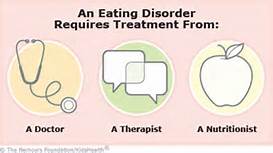
You may start by seeing your family doctor or mental health counselor, such as a psychologist. You may also need to see other health professionals who specialize in eating disorder treatment. Other members of your treatment team may include:

  • A registered dietitian to provide nutritional counseling.
  • A psychiatrist for medication prescription and management, when medications are necessary. Some psychiatrists also provide psychological counseling.
  • Medical or dental specialists to treat health or dental problems that result from your eating disorder.
  • Your partner, parents or other family members. For young people still living at home, parents should be actively involved in treatment and may supervise meals.

It’s best if everyone involved in your treatment communicates about your progress so that adjustments can be made to your treatment as needed.

Managing an eating disorder can be a long-term challenge. You may need to continue to see your doctor, psychologist or other members of your treatment team on a regular basis, even if your eating disorder and related health problems are under control.

Some patients also may need to be hospitalized to treat problems caused by malnutrition or to ensure they eat enough if they are very underweight. Complete recovery is possible.


QUOTE FOR TUESDAY:

“30 million people in the U.S. have an eating disorder.  95 percent of people with eating disorders are between the ages 12 and 25.  Eating disorders have the HIGHEST risk of death of any mental illness.  Eating disorders affect all genders, all races and every ethnic group.  Genetics, environmental factors and personality traits all contribute to the risk of developing an eating disorder.”.

John Hopkins All Children Hospital (https://www.hopkinsallchildrens.org/Services/Pediatric-and-Adolescent-Medicine/Adolescent-and-Young-Adult-Specialty-Clinic/Eating-Disorders/Eating-Disorder-Facts)

QUOTE FOR MONDAY:

“You may need treatment for medical complications caused by starvation, vomiting, or laxative use. You may also need general medical and dental care.  Medical complications due to starvation can include serious and even life-threatening problems to dehydration, low blood glucose levels, anemia (lack of red blood cells), low blood pressure, an extremely slow or irregular heartbeat, low white blood cell count, liver and kidney problems, changes in the structure of your brain, osteoporosis (weak, porous bones that break easily and heal slowly), if female menses with periods of it stopping.”.

QUOTE FOR THE WEEKEND:

“Every year from February 14-21, we at Planned Parenthood observe National Condom Week. This is a great time to learn more about the importance of using condoms and other barrier methods and to educate others, because everyone deserves to have a worry-free and healthy sex life. Condoms are the only form of birth control that also prevent sexually transmitted infections (STIs). ”

Planned Parenthood of the Pacific Southwest Inc (https://www.plannedparenthood.org/planned-parenthood-pacific-southwest/blog/celebrating-national-condom-week-2022)

QUOTE FOR FRIDAY:

“TED – also known as Graves’ Orbitopathy or Ophthalmopathy – is an autoimmune condition. It occurs when the body’s immune system attacks the tissue surrounding the eye causing inflammation in the tissues around and behind the eye. In most patients, the same autoimmune condition that causes TED also affects the thyroid gland, resulting in Graves’ disease. Graves’ disease most commonly causes thyroid overactivity (hyperthyroidism).”

British Thyroid Foundation – BTF (https://www.btf-thyroid.org/thyroid-eye-disease-leaflet)

QUOTE FOR THURSDAY:

“February is national age related macular degeneration (AMD) and low vision awareness month. AMD is the leading cause of low vision and blindness in Americans age 60 years and older and affects 1.6 million Americans.  As the Baby Boomer generation ages, the rates of AMD are expected to reach “epidemic proportions”.  AMD is a progressive disease with no known cure. It slowly steals vision as it affects the retina, a paper-thin tissue lining the back of the eye, and causes the cells in the area to die. As a result, if you have AMD, you see blind spots, grayness and other distortions in the center frame of your vision.”

UF Health – Department of Ophthalmology college of medicine                                                                       (https://eye.ufl.edu/2021/02/01/february-is-amd-macular-degeneration-low-vision-awareness-month/)