Archive | January 2025

QUOTE FOR WEDNESDAY:

“Your thyroid is a small, butterfly-shaped gland located at the front of your neck under your skin. It’s a part of your endocrine system and controls many of your body’s important functions by producing and releasing (secreting) certain hormones. Your thyroid’s main job is to control the speed of your metabolism (metabolic rate), which is the process of how your body transforms the food you consume into energy. All of the cells in your body need energy to function.

Your thyroid is an important endocrine gland that makes and releases certain hormones. Your thyroid’s main job is to control your metabolism — how your body uses energy. Sometimes, your thyroid doesn’t work properly. These conditions are common and treatable.

As an endocrine gland, your thyroid makes and secretes hormones.

Your thyroid produces and releases the following hormones:

  • Thyroxine (T4): This is the primary hormone your thyroid makes and releases. Although your thyroid makes the most of this hormone, it doesn’t have much of an effect on your metabolism. Once your thyroid releases T4 into your bloodstream, it can convert to T3 through a process called deiodination.
  • Triiodothyronine (T3): Your thyroid produces lesser amounts of T3 than T4, but it has a much greater effect on your metabolism than T4.
  • Reverse triiodothyronine (RT3): Your thyroid makes very small amounts of RT3, which reverses the effects of T3.
  • Calcitonin: This hormone helps regulate the amount of calcium in your blood.

Thyroid disease is an umbrella term for conditions that affect how your thyroid functions. Hypothyroidism and hyperthyroidism are the two main types of thyroid disease. But they each have multiple possible causes. Thyroid diseases are treatable — usually with medication but sometimes surgery.”.

Cleveland Clinic (Thyroid: What It Is, Function & Problems)
 

QUOTE FOR MONDAY:

“Cervical cancer is classified into several stages:

The first stage of cervical cancer is carcinoma in situ (also known as precancer or severe dysplasia), in which a group of abnormal cells has started to grow but has not yet spread to nearby tissues. Because stage 0 “precancers” are likely to eventually spread deeper into the tissue and become cancerous, they should be treated.

Early Cervical Cancer (Stages I–IIA)

Although more extensive than stage 0, these cancers are still limited to the cervix.

Advanced Cervical Cancer (Stages IIB–IVA)

Cervical cancer that has spread beyond the cervix and invaded the surrounding pelvic tissues in the vagina, rectum, or bladder is known as locally advanced cervical cancer.

Stage IVB and Recurrent Cervical Cancer

Cervical cancer that has spread beyond the pelvis (into the lungs or liver, for example), or has returned following initial therapy, is placed in this category.”

Memorial Sloan Kettering Cancer Center (Cervical Cancer Diagnosis & Stages 0, 1, 2 ,3, 4 | Memorial Sloan Kettering Cancer Center)


QUOTE FOR THE WEEKEND:

“Cervical cancer usually grows slowly, over many years. Before actual cancer cells in the cervix develop, the tissues of the cervix undergo changes at the cellular level — called dysplasia, or precancers. At this early precancer stage, these dysplastic cells can often be removed and the condition cured with an office procedure.
Experts at Memorial Sloan Kettering usually perform a biopsy and conduct other tests to confirm the diagnosis and determine the stage of the disease.”

QUOTE FOR FRIDAY:

“Cervical cancer is a growth of cells that starts in the cervix. The cervix is the lower part of the uterus that connects to the vagina.

Various strains of the human papillomavirus, also called HPV, play a role in causing most cervical cancers. HPV is a common infection that’s passed through sexual contact. When exposed to HPV, the body’s immune system typically prevents the virus from doing harm. In a small percentage of people, however, the virus survives for years. This contributes to the process that causes some cervical cells to become cancer cells.

You can reduce your risk of developing cervical cancer by having screening tests and receiving a vaccine that protects against HPV infection.”

MAYO CLINIC (Cervical cancer – Symptoms and causes – Mayo Clinic)

QUOTE FOR THURSDAY:

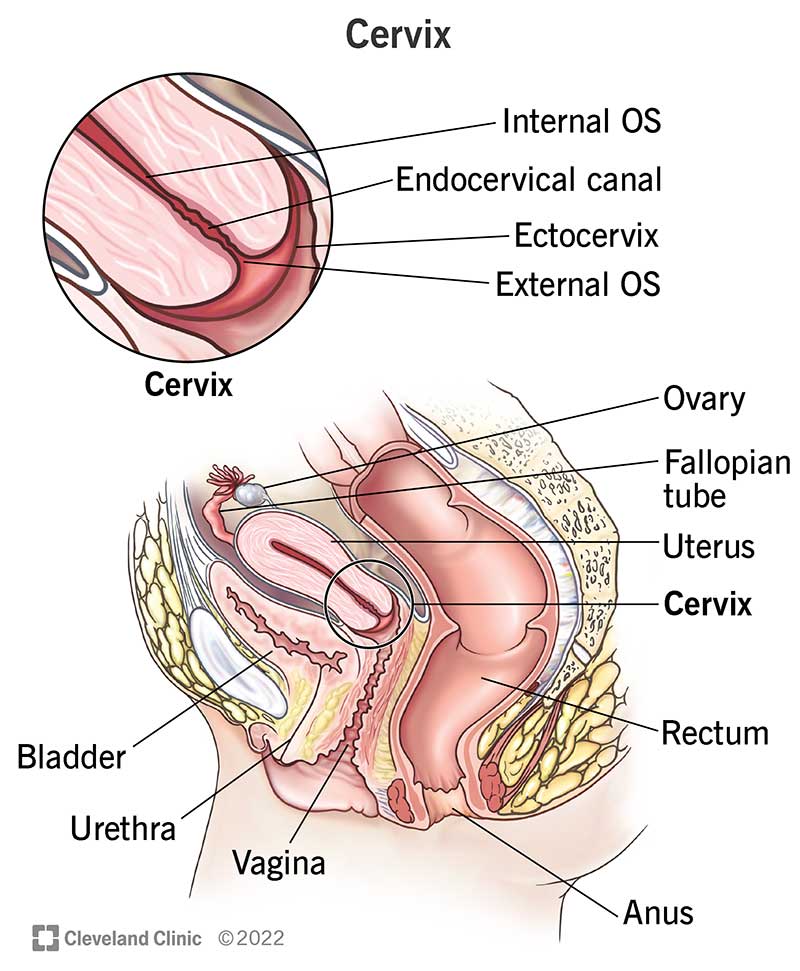
“The cervix is the lower, narrow end of the uterus that connects the uterus to the vagina. It is made up of the internal OS (the opening between the cervix and the upper part of the uterus), the endocervix (the inner part of the cervix that forms the endocervical canal), the ectocervix (the outer part of the cervix that opens into the vagina) and the external OS (the opening between the cervix and vagina).”

National Cancer Institute – NIH (Definition of cervix – NCI Dictionary of Cancer Terms – NCI)

Know what the cervix is and why this month!

Where is your cervix located?

Your cervix is an important part of your reproductive anatomy. Your cervix is located inside your pelvic cavity, anywhere from 3 to 6 inches inside your vaginal canal. It begins at the base of your uterus and extends downward onto the top part of your vagina. This place where your cervix bulges onto the uppermost part of your vagina is called your ectocervix.

Your vagina, cervix and uterus are located behind your bladder and urethra (organs that allow you to pee) and in front of your rectum and anus (organs that allow you to poop).

What does your cervix look like?

The word “cervix” comes from the Latin word meaning “neck.” Like a neck, your cervix is shaped roughly like a cylinder or tube and connects important body parts. While your neck connects your head to the rest of your body, your cervix connects your uterus to your vagina. Your cervix is wider in the middle and narrows at both ends, where it opens into your uterus (top) and vagina (bottom).

Your cervix consists of the following parts:

  • Internal OS: The opening that leads to your uterus. Your provider may refer to your internal OS during pregnancy.
  • Endocervical canal: A tunnel that extends from your Internal OS to your ectocervix.
  • Ectocervix: The part of your cervix that bulges onto the top of your vagina.
  • External OS: The opening that leads to your vagina.

Your cervix is a muscular, tunnel-like organ. It’s the lower part of your uterus, and it connects your uterus and vagina. Sometimes called the “neck of the uterus,” your cervix plays an important role in allowing fluids to pass between your uterus and vagina. It enables a baby to leave your uterus so that it can travel through your vagina (birth canal) during childbirth. The cervix is also a common site for cell changes that may indicate cancer.

Getting regular Pap smears allows your provider to screen for irregularities that may be signs of disease.

Who has a cervix?

People who are designated female at birth (DFAB) have a cervix. DFAB people include cisgender women — people who are DFAB and identify as women — and some transgender men and nonbinary individuals. Some intersex individuals have cervixes, too.

What is the functions of your cervix?

Your cervix is a passage that allows fluids to flow inside and out of your uterus. It’s also a powerful gatekeeper that can open and close in ways that make pregnancy and childbirth possible.

Your cervix plays important roles in the following:

  • Menstruation: The period blood you shed each month as part of your menstrual cycle has to pass from your uterus and through your cervix before exiting your vagina.
  • Pregnancy: During penis-in-vagina sex, or intercourse, your partner may ejaculate (release) sperm into your vagina. The sperm has to travel through your cervix to reach your uterus and fallopian tubes to fertilize an egg.
  • Fertility: Your cervical mucus plays a role in how easily you can become pregnant. Around ovulation (when your body releases an egg), your cervix secretes mucus that’s thinner and less acidic than usual, making it easy for sperm to pass through to your uterus. As a result, sperm can reach your egg and fertilize it more easily.
  • Vaginal delivery: Your cervix controls when a baby exits your uterus during childbirth. During pregnancy, your cervix secretes a mucus plug that seals entry to your uterus. Once it’s time for the baby to be born, the mucus plug dissolves, and your cervix becomes softer and thinner. Your cervix widens (dilates) so that the baby can exit your uterus. Your provider can estimate how long it will take for your baby to be born based on how much your cervix has dilated.
  • Protecting your uterus: Your cervix prevents objects inserted into your vagina, such as tampons or diaphragms, from slipping inside your uterus.

The place where the endocervical canal overlaps with the ectocervix is called the transformation zone (TZ). The TZ is the part of your cervix where cell changes happen most. It’s the most common site for abnormal cells to grow in your cervix, indicating conditions like cervical dysplasia or cervical cancer.

How big is your cervix?

Your cervix is about an inch long. Cervical sizes vary, though. Generally, your cervix is larger if you’ve given birth. The cervix is larger among people in their reproductive years than those who’ve gone through menopause. Your cervix gets significantly shorter during childbirth to allow a baby to easily exit your uterus and enter your vagina.

Can you touch your cervix?

Yes, depending on the timing of your menstrual cycle. If you insert your longest finger into your vaginal canal, you should eventually reach a barrier preventing your finger from sliding in further. This barrier is your cervix. It may feel firm and tight, or it may feel soft and spongy. The location and texture of your cervix change depending on whether or not you’re ovulating. It’s the softest and hardest to reach during ovulation.

Take care that you only attempt to touch your cervix when you’ve washed your hands thoroughly with mild soap and warm water. Otherwise, you could expose your cervix to bacteria and cause infection.

What is your cervix made of?

Your cervix consists of strong fibromuscular tissue. Two main types of cells line your cervix:

  • Glandular cells: These cells line the endocervical canal, the innermost part of your cervix.
  • Squamous cells: These cells cover the ectocervix, the outermost part of your cervix, and your vagina.

These different cell types meet at the TZ, where cell changes frequently take place. This area is of particular interest to your provider during screenings for cervical cancer.