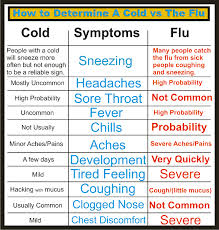
“When you wake up sneezing, coughing, and have that achy, feverish, can’t move a muscle feeling, how do you know whether you have cold symptoms or the flu?
Archive | December 2023
Part I Let’s be prepared for the fall and winter bugs – first lets discuss the difference about influenza vs common cold.
Those bugs that are common in fall & winter are 2 Viruses =The COLD and THE FLU.
HOW THEY ARE DIFFERENT:
Both influenza and the common cold are viral respiratory infections (they affect the nose, throat, and lungs). Viruses are spread from person to person through airborne droplets (aerosols) that are sneezed out or coughed up by an infected person, direct contact is another form of spread with infected nasal secretions, or fomites (contaminated objects). Which of these routes is of primary importance has not been determined, however hand to hand and hand to surface to hand to contact seems of more importance than transmission. The viruses may survive for prolonged periods in the environment (over 18 hours for rhinoviruses in particular=a common virus for colds) and can be picked up by people’s hands and subsequently carried to their eyes or nose where infection occurs. In some cases, the viruses can be spread when a person touches an infected surface (e.g., doorknobs, countertops, telephones) and then touches his or her nose, mouth, or eyes. As such, these illnesses are most easily spread in crowded conditions such as schools.
The traditional folk theory that you can catch a cold in prolonged exposure to cold weather such as rain or winter settings is how the illness got its name. Some of the viruses that cause common colds are seasonal, occurring more frequently during cold or wet weather. The reason for the seasonality has not yet been fully determined. This may occur due to cold induced changes in the respiratory system, decreased immune response, and low humidity increasing viral transmission rates, perhaps due to dry air allowing small viral droplets to disperse farther, and stay in the air longer. It may be due to social factors, such as people spending more time indoors, as opposed to outdoors, exposing him or her “self” to an infected person, and specifically children at school. There is some controversy over the role of body cooling as a risk factor for the common cold; the majority of the evidence does suggest a result in greater susceptibility to infection.
The SIMPLE COMMON COLD:
The common cold (also known as nasopharyngitis, rhinopharyngitis, acute coryza, head cold) or simply a cold is a viral infection of the upper respiratory tract which primarily effects the nose. There are over 200 different known cold viruses, but most colds (30% up to 80%) are caused by rhinovirusesThis means you can pass the cold to others, so stay home and get some much-needed rest for yourself and not passing it on to others for the contagious period at least.
If cold symptoms do not seem to be improving after a week, you may have a bacterial infection, which means you may need antibiotics, which only kill bacterial infections not viral.
Sometimes you may mistake cold symptoms for allergic rhinitis (hay fever) or a sinus infection (bacterial). If cold symptoms begin quickly and are improving after a week, then it is usually a cold, not allergy. If your cold symptoms do not seem to be getting better after a week, check with your doctor to see if you have developed an allergy or inflammation or the sinuses (sinusitis).
Influenza is commonly referred to as “the flu”, this is an infectious disease of birds and mammals caused by RNA viruses of the family Orthomyxoviridae, the influenza viruses. The most common sign or symptom are chills, fever, runny nose, coughing, aches and weakness to headache and sore throat. Although it is often confused with other influenza-like illnesses, especially the COMMON COLD, influenza is a more severe illness or disease caused by a different virus. Influenza nausea and vomiting, particularly in children but these symptoms are more common in the unrelated gastroenteritis, which is sometimes inaccurately referred to as “stomach flu” or “25 hour flu”.
The flu can occasionally lead to pneumonia, either direct viral pneumonia or secondary bacterial pneumonia, even for persons who are usually very healthy. In particular it is a warning sign if a child or presumably an adult seems to be getting better and then relapses with a high fever as this relapse may be bacterial pneumonia. Another warning sign is if the person starts to have trouble breathing.
Each year, 10% to 20% of Canadians are stricken with influenza. Although most people recover fully, depending on the severity of the flu season, it can result in an average of 20,000 hospitalizations and approximately 4000 to 8000 deaths annually in Canada. Deaths due to the flu are found mostly among high-risk populations, such as those with other medical conditions (such as diabetes or cancer) or weakened immune systems, seniors, or very young children. There are 3 types of influenza viruses: A, B, and C. Type A influenza causes the most serious problems in humans and can be carried by humans or animals (wild birds are commonly the host carriers). It is more common for humans seem to carry the most with ailments with type A influenza. Type B Influenza is found in humans also. Type B flu may cause less severe reaction than A type flu virus but for the few for the many can still be at times extremely harmed. Influenza B viruses are not classified by subtype and do not cause pandemics at this time. Influenza type C also found in people but milder than type A or B. People don’t become very ill from this Type C Influenza and do not cause pandemics.
The common cold eventually fizzles, but the flu may be deadly. Some 200,000 people in the U.S. are hospitalized and 36,000 die each year from flu complications — and that pales in comparison to the flu pandemic of 1918 that claimed between 20 and 100 million lives.
The best defense against it: a vaccine once a year.
References for Part 1 and 2 on the two bugs The FLU and The COLD:
1-Wikipedia “the free encyclopedia” 2013 website under the topic Influenza.
2-Kimberly Clark Professional website under the influenza.
3-Web MD under “COLD, FLU, COUGH CENTER” “Flu or cold symptoms?” Reviewed by Laura J. Martin MD November 01, 2011
4-2013 Novartis Consumer Health Inc. Triaminic “Fend off the Flu”
5-Scientific American “Why do we get the flu most often in the winter? Are viruses virulent in cold weather? December 15, 1997
6-Centers for Disease Prevention and Control CDC

QUOTE FOR MONDAY:
“The flu vaccine is safe for most people and is recommended for everyone ages 6 months and older. People who should not receive flu vaccines are those who have had a severe allergic reaction to the flu or other vaccine in the past and those who have had a condition called Guillan-Barre syndrome. Make a plan to get vaccinated and why is because of the following. You should get a flu vaccine before flu viruses begin spreading in your community since it takes about two weeks after vaccination for antibodies to develop in the body and provide protection against flu. A flu vaccine is needed every season for two reasons. First, a person’s immune protection from vaccination declines over time, so an annual vaccine is needed for optimal protection. Second, because flu viruses are constantly changing, flu vaccines may be updated from one season to the next to protect against the viruses that research suggests may be most common during the upcoming flu season.”.
Baltimore City Health Dept (https://health.baltimorecity.gov/flu/frequently-asked-questions-about-flu-vaccines)
QUOTE FOR THE WEEKEND:
“”Handwashing is one of the best ways to protect yourself and your family from getting sick. Washing hands can keep you healthy and prevent the spread of respiratory and diarrheal infections. Germs can spread from person to person or from surfaces to people when you:
-Touch your eyes, nose, and mouth with unwashed hands
-Prepare or eat food and drinks with unwashed hands
-Touch surfaces or objects that have germs on them
-Blow your nose, cough, or sneeze into hands and then touch other people’s hands or common objects.”
Center for Disease Control and Prevention-CDC (https://www.cdc.gov/hygiene/personal-hygiene/hands.htm)
QUOTE FOR FRIDAY:
“Hand hygiene saves millions of lives every year when performed at the right moments during health care delivery. It is also a smart investment that offers exceptional return for each dollar invested. Clean care is a sign of respect to those who seek care, and it protects health and other workers who provide that care.
Now is a critical time when countries across the world need to accelerate implementation of lessons from the COVID-19 pandemic and increase investments to close gaps in infection prevention and control (IPC), including hand hygiene. Indeed, many countries are demonstrating strong engagement and advancements in scaling-up those actions, but overall, the progress is slow, and gains are at risk.
Together, we can galvanize action on preventing infections and antimicrobial resistance in health care. Strong and engaged communities of health workers, policy makers and civil society organizations (CSOs) can accelerate and sustain action at the point of care to keep people safe and healthy.
For World Hand Hygiene Day 2023, we put CSOs in focus. Driven by their passion, values and strong social justice agendas, and often in close proximity to the communities they serve, CSOs can spearhead and accelerate change at local, national and international levels. ”
World Health Organization – WHO (https://www.who.int/campaigns/world-hand-hygiene-day/2023)
QUOTE FOR THURSDAY:
“80 % of communicable diseases are believed to be transmitted by human hands. According to the CDC and the latest research) is the most effective way to prevent the spread of Coronavirus and other communicable diseases is through washing your hands with soap and water frequently and correctly, following CDC guidelines. The U.S. as of Dec 2020 was currently experiencing the following that can be mitigated by regular hand washing, which was novel influenza virus pandemic, a national measles outbreak and a novel coronavirus pandemic. Why all this awareness on handwashing people? Because we are bad at remembering as a population and even worse at how we wash our hands. A quick survey of five pre-covid handwashing studies showed that on average, only about 40% of men and 64% of women wash their hands after using a public restroom.” Even though there is some evidence of some small improvements in these figures after the covid pandemic, that still leaves about 60% of men and 34% of women walking around with contaminated hands, not to mention cell phones, wallets, credit cards, and everything else we touch.”. If your not part of that percentile GREAT but if you are you may want to following hand washing week purpose with the including the understanding why. Look at disease or illnesses that can come from contacting or droplet that can be decreased in being transmitted to others in one step handwashing if the person who is ill is not on isolation quarantined that take other actions with handwashing to prevent transmission to others.”
QUOTE FOR THE WEEKEND:
”Research shows that you can prevent 1 in 3 illnesses that cause diarrhea and 1 in 5 respiratory infections by keeping your hands clean. That’s because your hands are a convenient transportation system for germs. Thinking of germs getting on and off a bus can help you understand how they travel from one spot to another. Germs can hop on the bus (your hands) and quickly get where they want to go (cells inside your body). All you have to do is touch a contaminated surface and then touch your eyes, nose or mouth. From there, the germs transfer to the mucus membranes that lead into your body, where they attempt to set up camp and multiply.”
Cleveland Clinic (https://my.clevelandclinic.org/health/articles/17474-hand-washing)
Part III National Handwashing Week! What the CDC states about handwashing!
THE CDC states:
“Feces (poop) from people or animals is an important source of germs like Salmonella, E. coli O157, and norovirus that cause diarrhea, and it can spread some respiratory infections like adenovirus and hand-foot-mouth disease. These kinds of germs can get onto hands after people use the toilet or change a diaper, but also in less obvious ways, like after handling raw meats that have invisible amounts of animal poop on them. A single gram of human feces—which is about the weight of a paper clip—can contain one trillion germs 1. Germs can also get onto hands if people touch any object that has germs on it because someone coughed or sneezed on it or was touched by some other contaminated object. When these germs get onto hands and are not washed off, they can be passed from person to person and make people sick.
Handwashing with soap removes germs from hands. This helps prevent infections because:
- People frequently touch their eyes, nose, and mouth without even realizing it. Germs can get into the body through the eyes, nose and mouth and make us sick.
- Germs from unwashed hands can get into foods and drinks while people prepare or consume them. Germs can multiply in some types of foods or drinks, under certain conditions, and make people sick.
- Germs from unwashed hands can be transferred to other objects, like handrails, table tops, or toys, and then transferred to another person’s hands.
- Removing germs through handwashing therefore helps prevent diarrhea and respiratory infections and may even help prevent skin and eye infections.
Teaching people about handwashing helps them and their communities stay healthy. Handwashing education in the community:
- Reduces the number of people who get sick with diarrhea by 23-40% 2, 3, 6
- Reduces diarrheal illness in people with weakened immune systems by 58% 4
- Reduces respiratory illnesses, like colds, in the general population by 16-21% 3, 5
- Reduces absenteeism due to gastrointestinal illness in schoolchildren by 29-57% 7
About 1.8 million children under the age of 5 die each year from diarrheal diseases and pneumonia, the top two killers of young children around the
world 8.
- Handwashing with soap could protect about 1 out of every 3 young children who get sick with diarrhea 2, 3 and almost 1 out of 5 young children with respiratory infections like pneumonia 3, 5.
- Although people around the world clean their hands with water, very few use soap to wash their hands. Washing hands with soap removes germs much more effectively 9.
- Handwashing education and access to soap in schools can help improve attendance 10, 11, 12.
- Good handwashing early in life may help improve child development in some settings 13.
- Estimated global rates of handwashing after using the toilet are only 19% 6.
Preventing sickness reduces the amount of antibiotics people use and the likelihood that antibiotic resistance will develop. Handwashing can prevent about 30% of diarrhea-related sicknesses and about 20% of respiratory infections (e.g., colds) 2, 5. Antibiotics often are prescribed unnecessarily for these health issues 14. Reducing the number of these infections by washing hands frequently helps prevent the overuse of antibiotics—the single most important factor leading to antibiotic resistance around the world. Handwashing can also prevent people from getting sick with germs that are already resistant to antibiotics and that can be difficult to treat.”
So what did we learn today WASH OUR HANDS REGULARLY!
QUOTE FOR WEDNESDAY:
“Key facts
- HIV remains a major global public health issue, having claimed 40.4 million [32.9–51.3 million] lives so far with ongoing transmission in all countries globally; with some countries reporting increasing trends in new infections when previously on the decline.
- There were an estimated 39.0 million [33.1–45.7 million] people living with HIV at the end of 2022, two thirds of whom (25.6 million) are in the WHO African Region.
- In 2022, 630 000 [480 000–880 000] people died from HIV-related causes and 1.3 million [1.0–1.7 million] people acquired HIV.”.
World Health Organization WHO (https://www.who.int/data/gho/data/themes/hiv-aids)
QUOTE FOR TUESDAY:
“Acquired immunodeficiency syndrome (AIDS) is a chronic, potentially life-threatening condition caused by the human immunodeficiency virus (HIV). By damaging your immune system, HIV interferes with your body’s ability to fight infection and disease.
HIV is a sexually transmitted infection (STI). It can also be spread by contact with infected blood and from illicit injection drug use or sharing needles. It can also be spread from mother to child during pregnancy, childbirth or breastfeeding. Without medication, it may take years before HIV weakens your immune system to the point that you have AIDS.
There’s still no cure for HIV/AIDS.”
MAYO CLINIC (https://www.mayoclinic.org/diseases-conditions/hiv-aids/symptoms-causes/syc-20373524)