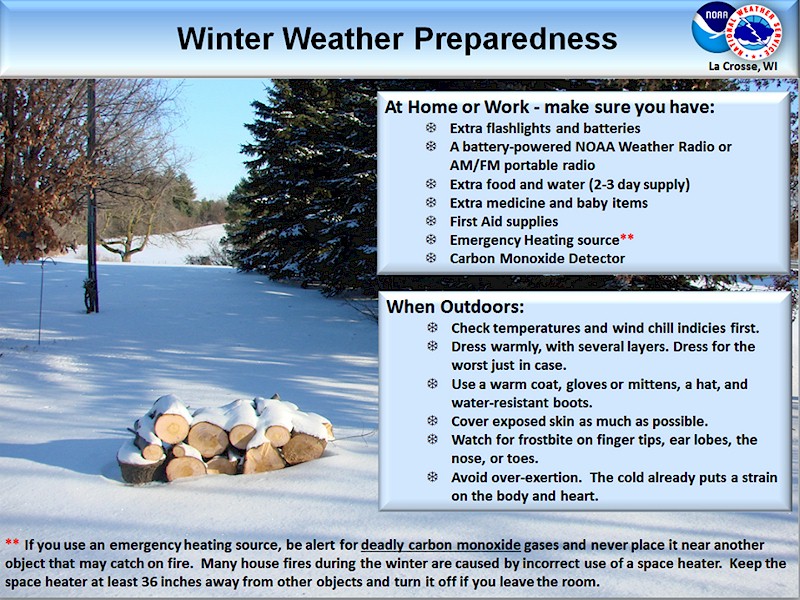
Although winter comes as no surprise, many of us are not ready for its arrival. If you are prepared for the hazards of winter, you will be more likely to stay safe and healthy when temperatures start to fall.
Striveforgoodhealth.com
Although winter comes as no surprise, many of us are not ready for its arrival. If you are prepared for the hazards of winter, you will be more likely to stay safe and healthy when temperatures start to fall.
Striveforgoodhealth.com

Bring out the crock pot! Emphasis slow cooked, warm, moist meals this season. Soups are a perfect match for the cold, dry days.
20. Finally, make a Feel Good menu specifically for winter. Take a moment to brainstorm all the things you can do in winter that you enjoy, that feel indulgent, and that make you happy. Keep this list posted and draw from it to make your days more special and when you need a little extra pampering



Goldsmiths College released a study that showed more dogs will approach someone who’s crying or in distress than someone who is not. This shows that dogs are empathetic and are eager to help comfort humans in pain.
Their sense of smell can do even more than we think; dogs can also detect low blood sugar in their master. They will either alert the person that the sugar has dropped or, if a diabetic attack has already occurred, will bark and bark and bark in an attempt to alert somebody to come help, thus working to save the diabetic’s life.
Some dogs are also able to detect seizures in humans. Recent research has shown certain dogs are able to warn seizure patients that they’re going to experience an attack, sometimes hours before it happens. Nobody yet knows how they do it, or why only certain dogs can do it. They also can’t be trained to do it, so if you feel you need a seizure-sniffing dog, you need to make sure you have yourself a natural.
Due to their incredible sense of smell, dogs have shown anywhere from 70 to 99% accuracy (depending on the study) when tasked with detecting lung cancer in a nearby patient.
Fibromyalgia is a debilitating disease that can leave its victim in constant pain. Studies have shown that the Xolo dog’s body temperature can be used as a kind of therapeutic heating pad, due to it being a hairless species. Of course, unlike heating pads, a Xolo will bond with you, snuggle with you and keep you warm as long as you need, leading to both external comfort and internal happiness.
In a surprising twist, it might actually be beneficial to get a dog for your baby, even if they’re allergic. Studies have shown that children under the age of one who live with a dog are much less likely to develop the chronic, and annoying, skin condition called eczema.
Dogs can highly make humans more social. The British Medical Journal has concluded that dogs act as “social catalysts,” who help people get out more, approach others more easily, and overall reduce isolation. This is actually just as important as the basic companionship that dogs provide, as human social support is beneficial to human health and the dog.
Simply by being themselves, dogs have been shown to help reduce PTSD among soldiers. In addition to providing the usual doggie companionship, they have been shown to help sufferers come out of their shells, be less numb and angry, and improve their social life as well.
A dog kissing you obviously feels wonderful, but it might actually have physical benefits too. Studies have shown that saliva, both the human and doggie variety, can help stimulate nerves and muscles, and get oxygen moving again, which is the secret ingredient in helping wounds to heal. In short, “licking your wounds” is not just a cliché after all.
Almost certainly due to the positive vibes and good feelings that dogs bring out of their masters, even in the worst of times, studies have found that older people who own dogs average at least one less doctor appointment per year than those who do not.
Not that they are the cure but preliminary studies by the American Heart Association are revealing that dog owners have less risk of heart disease than those without dogs. The reasons given are the exercise that owners get when walking their dogs, plus the presence of the dog helps the owner deal with stress better. The evidence is mostly anecdotal right now, but dog owners know that it’s all true.
Day-to-day depression, or even more serious chronic depression, is easier to handle with the love of a dog, studies show. Simply by having them around, and knowing that even at our worst, somebody loves us unconditionally and is eager to see us happy again, we’re given a reason to get up and keep going.
Autistic children often find the world very stressful, in ways that the non-autistic can’t understand. Luckily, a dog can. Studies are showing that bringing a therapy dog into an autistic household helps to reduce the amount of cortisol (a stress hormone) in the autistic child’s body. This both calms the child down and shows him that he has a friend.
Bullying has been a huge problem for a long time, and people are finally doing something about it. Dogs, too. Experimental programs have been launched that bring dogs into schools to promote empathy, with the lesson that you shouldn’t treat people badly, because you wouldn’t do it to a dog. Thus far, kids have been able to make the connection, which will hopefully continue to be the case.
Dogs have shown that they can help keep dementia sufferers on schedule, reminding them when its time for medicine and when to see the doctor. In addition, when the owner experiences frustration over the state of their mind, the “dementia dog” is right there to support them, comfort them, and remind them that someone’s always there for them.
AREN’T DOGS AMAZING!!
Gail Devers (born November 19, 1966) is a retired three-time Olympic champion in track and field for the US Olympic Team.
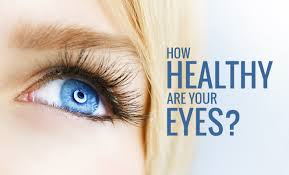
Like all organs if your diet is not healthy you’ll effect their functioning, including your eyes. Take for example the ingredients you include in the foods & fluids you eat. Just like how some drink from one up to three thousand cc’s of water a day to help prevent dehydration in their tissues if they work out daily from a gym to running miles outside OR take someone who simply includes calcium in their diet for their bones. Well what is good for the eyes and what can you do to help both your eyes?
Get an annual comprehensive dilated eye exam, know your families eye history since many eye diseases are through heredity, eat an eye healthy & well-balanced diet rich in salmon, tuna, dark leafy greens, colored vegetables and fruits, wear sunglasses with UV protection and avoid smoking (which effects the body everywhere, including the eyes).
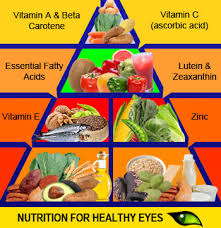
What ingredients do we need in our dieting that is so vital for the eyes to stay at their healthiest level? Well Lutein and Zeaxanthin (Pronounced loo’teen and Zee’-a-zan-thin)-Powerful antioxidants naturally present in the macula (the part of the retina that is responsible for central vision). Remember damage to the retina causes some degree of lack of vision to 100% blind. Lutein and Zeaxanthin are critical for helping to filter out harmful blue light, which can damage the macula. These vital antioxidants cannot be produced by our bodies on their own, so they must be obtained through diet and/or supplements (ex. Ocuvite Supplements in the store).
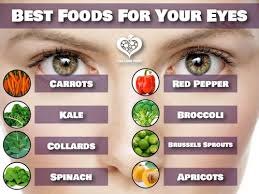
Another ingredient we need in our diet is Omega 3 Fatty Acids which is a family of fatty acids that help protect our eyes by keeping them healthy. Omega 3 is an important structural lipid in the retina and helps support proper function; and is vital for the health of your eyes as you age. Lastly it helps promote healthy tear production necessary for healthy and comfortable eyes. Other Nutrients Antioxidants Vitamins C and E, Zinc and beta carotene. They help protect eyes from oxidative stress (Oxidative stress reflects an imbalance between the systemic manifestation of reactive oxygen species and a biological system’s ability to readily detoxify the reactive intermediates or to repair the resulting damage and oxidative stress can cause disruptions in normal mechanisms of cellular signaling. It is thought to be involved in the development of many diseases.) Many dark leafy greens and brightly colored vegetables (including orange foods) are rich in Lutein and Zeaxanthin. We all heard about carrots (to get Beta-carotene)
Unfortunately, many of us do not consume enough of these eye-healthy foods in our daily diets. What should you have in your diet to eat per day to equal the amount of Lutein and Zeaxanthin you should have daily: 5 cups of broccoli, 6 cups of corn, 1 ounce of salmon or 4 ounces of tuna.
A lot of vegetables in cups but if you mix your foods in the 4 food groups that are healthy for the eye or just simply take supplements that your doctor recommends for eye health you won’t be eating cups and cups of vegetables if you don’t like the taste.
Many eye diseases can’t be avoided (like born blind) but there are many diseases that could have been avoided through prevention tactics in what you eat and in what you practice as your daily habits. For example some that could be prevented if not slowed down or suppressed in the intensity of the disease can be Age-Related Macular Degeneration, Cataracts, Dry Eye Syndrome and more.
Factors that also influence how our eyes turn out are: –
-If you do a lot of work daily on a computer or on any one thing, your eyes may forget to blink or get very fatigued, so attempt to do every 20 minutes looking away from the computer or one thing your focused on for hours (like at work) for 20 seconds. This helps your eyes in reducing eyestrain (it is an actually an exercise for the eye). –Clean your hands and your contact lenses properly. This is to avoid local infection in the eye. Always wash your hands before putting in and taking out the contact lenses. Follow your doctors and contact lenses website in keeping your eyes healthy and safe with using their service for your lenses. –Practice workplace eye safety as their organization policy and procedure states but also use common sense with wearing eye goggles when doing work around the house that puts you at risk for eye damage (like weed whacking, painting, using saws etc…)
How do you go about this if you need help in knowing what good foods of all the 4 food groups are, with knowing how to lose weight permanently without going on diets for 3 or 6 or 24 months than gaining it all back again including knowing how the body works with 3 meals a day as opposed to 6 small meals a day (one of them being a meat and vegetable meal that is lean in fat and green in vegetables with other colorful veggies added to it if you want) and understanding how the average American eats (especially with fast foods on a regular basis) with disease? Did you know you get a physician (Dr. Anderson) and a health coach (me a RN 25 years plus) for FREE?
“The estimated number of new HIV infections was greatest among MSM in the youngest age group. In 2010, the greatest number of new HIV infections (4,800) among MSM occurred in young black/African American MSM aged 13–24. Young black MSM accounted for 45% of new HIV infections among black MSM and 55% of new HIV infections among young MSM overall.”
The Center for Disease Control and Prevention
“The result is that the public remains in the dark about how exactly U.S. policy governing targeted killings is operating, under which legal authorities, and who exactly are its victims,” said a letter to Obama in December from nine rights groups.
CNN Politics Tom Cohen
Take Obama days before this assault in Paris, he stated it was contained, who can we trust. Now Obama still doesn’t want to do anything even after we are threatened by ISIS to be attacked next. Still feel safe with Obama in office?

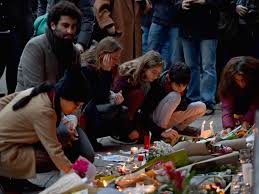
Well from different perspectives of professionals in why the human acts like this and here is my first one of Dr. K. Sohail:
When angry human beings act violently and aggressively, other caring and compassionate human beings sometimes tell them that they are acting like animals. Given the level of violence in the contemporary world, I would not be surprised to hear of some kind animals saying to other cruel animals that they were acting like humans. Eric Fromm in his famous book The Anatomy of Human Destructiveness shares his insight that animals express benign violence—they kill only in self defense or when they are hungry. Even a lion is peaceful when he is not hungry and does not feel threatened. On the other hand, humans are worse than animals as they exhibit malignant violence—they add a series of meanings to their violence. They justify their violent crimes and rationalize their aggressive acts.
When we study the history of humanity we realize that the intensity and severity of human violence and aggression has increased over the centuries. Only in the 20th century millions of humans have been killed by other humans by pre-meditated murder, including the use of nuclear weapons. If we review human murders we can classify them into the following seven groups based on emotional, social, religious, economic or political motivation.
There are many people in every community who have difficulties controlling their anger. If someone hurts them, rather than forgiving or reporting the matter to the authorities, they take the law into their own hands and kill their enemy.
While some people kill people that they know intimately, there are others who kill strangers. We call them serial killers and mass murderers. These serial killers, who were usually physically, emotionally and sexually abused as children, became revengeful against a particular group, be they blacks, whites or women, gays or Hispanics, whom they killed indiscriminately until they were caught by police. Many such serial killers have psychopathic and sociopathic personalities.
As more and more people move from villages to cities and adopt an urban lifestyle, they face the pains of migration, social alienation and unemployment and some of them become involved in violent gangs to sell drugs to make quick money. Unfortunately, once they enter the drug and gang culture it is difficult for them to leave for too many.
While the majority of murders are committed by psychopaths who do not suffer from mental illness, there are some murders committed by people who suffer from schizophrenia, manic depressive illness and paranoid psychosis.
As the concept of nationalism became popular in the West, states created national armies. Over the centuries, soldiers in the uniform of one country killed only the soldiers of the enemy army. As guerrilla war became popular, both sides have been killing innocent men, women and children. Some call it using human shields while others call it collateral damage. Innocent citizens are being killed with no twinge of conscience on either side. Can understand the few for the many who won’t stop hurting people continuously like ISIS for example.
Over the centuries believers have killed each other in the name of God. In the last few decades there have been a large number of killings between Sunnis and Shiites, Catholics and Protestants, Hindus and Muslims, and Muslims and Jews in different parts of the world.
Really in the name of your God killing is allowed. If so not a great philosophy of your religion.
In the recent past, Western governments have been sending their armies to other countries and invading sovereign states in order to topple their governments; they have killed innocent civilians and then rationalized their murders in the name of democracy, human rights and freedom.
Dr. Bruce D. Perry, M.D., Ph.D., is an internationally recognized authority on brain development and children in crisis. Dr. Perry leads the Child Trauma Academy, a pioneering center providing service, research and training in the area of child maltreatment. See what comments from his patients have said and it may shock you.
What he says in why do we humans do it? Why didn’t anyone see this coming? Why didn’t anyone intervene and prevent them from killing? How can we prevent anything like that from happening again?
Experts in crime, mental health, education, and social sciences have all been trying to understand the pathways to school violence. A few common observations emerge. The first, and most disturbing, is that human beings, like few other species, are pervasively aggressive, violent and murderous to each other. The major predators of humans are other humans.
The second important point is that all violence is not the same. Some violence is due to impulsive behavior, some due to the disinhibition by drugs or alcohol, some due to serious mental illness, some to hate, revenge, or retribution.
Yet this should not stop us from trying to understand and prevent violence. We know that not all humans kill. And some societies are more violent than others. So what do we know about the conditions that increase violence? What observations are common across cultures and through history when violence emerges?
“That’s so cool. Look at his head explode.” Spoken by a nine-year-old boy watching TV. His aggressive behaviors in school were so disruptive that he was placed in a special classroom.
Being part of the solution: Don’t watch so much violence. It is everywhere, but try to watch less. Certainly if you are watching and someone younger is in the room, turn the channel, get them out and help younger children see less violence. Try to see what a bullet really does. A little research can teach you more about violence than a lifetime of TV or movies.
Being part of the solution: Be part of something — at school or outside. Spend time with friends, in structured and non-structured activities. Talk, listen, laugh and be together. Time with friends, family, teammates, and classmates promote healthy social or emotional relationships.
“They were just camel jockeys. They don’t belong in this country anyway. I don’t see what the big deal is. It’s not like we robbed a priest.” Comments from an interview with a fifteen-year-old boy who participated in an armed robbery at a convenience store run by a family from Lebanon.
Being part of the solution: Be intolerant of intolerance.
.4. When we are under the influence of alcohol or drugs, violence increases.
“I don’t remember why it even started. We had a lot of beers and smoked some reefer. I didn’t think he would die.” A comment from a 17-year-old-boy who was one of three who beat a classmate to death at a party after a fight broke out — apparently about a parking place.
Being part of the solution: Stay away from alcohol and drugs. And if you won’t, be moderate in your use, and be with people you know and trust in places that are safe. Stay off the roads. Don’t ever pressure someone else to drink or use. Let them make up their own choices. And be prepared to live with the consequences of your choice. Grown-up behaviors have grown-up consequences. Hundreds of youth die each year due to the influence of alcohol or other drugs.
Over the last few generations, two new observations have emerged. There are some unique properties to our recent wave of violence in the United States.
“It was pretty strange. I just raised up the rifle and shot. Just like I had a million times when I was a kid. It was just a little pop. And he just looked at me. And then slumped down. I was just trying to warn him. I didn’t think it would kill him.” From an interview with a 13-year-old boy who killed another youth.
Being part of the solution: Decrease the amount of time spent playing violent video games or practicing lethal behaviors. If you see younger children “playing” at killing, see if you can help them find other ways to channel their energies.
Remember one thing more crimes of killing people are due to people with not licensed guns as opposed to stolen ones. So if taking guns away from legalized guns from individuals than it won’t change the crime rate by far.
“My dad just kept it in the drawer by his bed. I wanted to scare these guys that were messing with me at school. So I put it in my backpack and took it to school.” From an interview with a nine-year-old child who took a loaded handgun to school. The problem here is if your going to have a gun LOCK IT UP where the child has no access; including height (out of reach with locked).
Being part of the solution: Don’t play with guns. Use guns with supervision only if legal gun and a adult over 21 y/o. Never take guns to school. Never mix drinking and shooting. Don’t carry a weapon. And if your family has a gun, help your parents come up with a safe place to keep it.
Tage Rai is a post-doctoral research fellow at the Ford Center for Global Citizenship at the Kellogg School of Management at Northwestern University in Illinois. He is the co-author, with Alan Fiske, of Virtuous Violence (2014). From their point of view on this topic they say:
While we may never understand Columbine, we do know that we can help prevent more violence. We are not helpless. We know that acting in these six areas can decrease violence. Each of us plays a role. We are all part of a solution to school violence.
People seem to be able to invent all sorts of rationales for mass killing without feeling the need to cite the will of God. For example, just a few days prior to the September 11 attacks, two young men from the Sacramento area each killed half a dozen people, apparently out of personal revenge. And some of the most appalling atrocities in history have been rooted not in religion per se but rather in racial or class hatred. There may even be a genetic tendency in our species, like that of our chimpanzee relatives, to attack and kill others for no reason except that they aren’t “one of us.” (Wrangham and Peterson) But religious violence can take on a particularly intense and ruthless character, if the objects of that violence are seen as blaspheming or insulting God, as the enemies of God or God’s way narrowly conceived. The problem of indiscriminate holy war is particularly difficult for Judaism, Christianity, and Islam to eliminate from within because it’s so deeply rooted in their scriptures and traditions.
The ending good light to this article is most of us will never engage in an act of extreme brutality. We will never shoot, stab, or beat someone to death. We will never rape another human being or set them on fire. We will never strap a bomb to our chests and detonate ourselves in a crowded café. And so, when faced with these seemingly senseless acts, we find ourselves at a loss. What possible purpose could they serve? Fundamentally, why do people hurt and kill one another?
It sounds like an unanswerable question. Yet there is an answer. It is simple, powerful and very disturbing. We fail to recognize it almost everywhere it matters. But if we really want to solve the problem of violence, there is nothing for it. We have to risk a kind of understanding that threatens our own values, our own way of life. We have to gaze into an abyss.