“There’s no cure for amyloidosis. But treatments can help you manage your symptoms and limit the production of amyloid protein.”
MAYO CLINIC
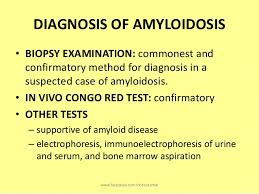
Diagnostic Tests for Amyloidosis:
*1. First your doctor would do a thorough medical exam with blood/urine tests searching for clues of high protein where it shouldn’t belong or certain liver or thyroid abnormal findings. The MD will follow with further diagnostic tooling especially if these findings show up in blood/urine tests. Common blood exams used are BNP (basic natriuretic peptide). BNP is a substance secreted from the ventricles or lower chambers of the heart in response to stress and changes in pressure that occur when to heart failure develops and worsens. The level of BNP in the blood increases when heart failure symptoms worsen, and decreases when heart failure condition is stable. It is not so much elevated over the norm but more with this disease patients the MD will see where the BNP level was at last visit & compare.
Another blood test is troponin and this gets released into the bloodstream when your heart is affected by amyloids.
*2. Second your MD may want to further diagnose for this disease through getting a tissue biopsy where the MD’s intent is to check for signs indicating this is highly possible for amyloidosis. The biopsy could be taken from your abdominal fat, bone marrow, or an organ such as your liver or kidney. Tissue analysis can help determine the type of amyloid deposit.
*3. Imaging Tests. Images taken of the organs that are affected by amloidosis can help the MD establish the intensity or stage your disease is at. There are 2 most commonly imaging tests used and can diagnose the disease early. There is the echocardiogram test, sound wave imaging of the heart, that will be used to assess the size and functioning capability level of the heart. Another test is a MRI of the heart (magnetic residence imaging). Other imaging tests can evaluate the extent of amyloidosis in the liver or spleen.
When the heart chambers become filled with amyloids it thickens the walls of those chambers especially the lower chambers which can be picked up by the echocardiogram through the different angles of sound waves that go via the heart during this exam. Another thing that can be measured through the echocardiogram is your diagnostic function; that represents a measure of how stiff your heart is and how well is your heart actually functioning.
Another technique that can be used is strain imaging. This is also done through echocardiogram. This tells the doctor in more detail how much the muscle fibers in the heart are actually shortening and contracting. It measures certain parts of the heart in actually contracting and function. This is actually better in help diagnosing compared to just looking at ejection fraction, which is the amount of blood pumped out of the left ventricle chamber upon contraction of the heart (When he hear lub dub of the heart with a stethoscope that is the heart actually contracting. First the upper chamber on lub is contracting and on dub is the lower chambers contracting). This test is a specializing test and is not widely used but it is available in certain hospitals.
Ending line amyloidosis is a group of diseases in which one or more organ systems in the body accumulate abnormal proteins known as amyloid. The name amyloidosis was first used more than 150 years ago, but cases were described over 300 years ago. However, only in the past ¼ of a century have MD’s understood the specific make up and structure of amyloid proteins. Although amyloidosis is not a cancer but it is a serious condition. It is disabling and gets to life threatening situations. However, growing awareness of the condition seems to be leading to substantial new research and Rx alternatives.
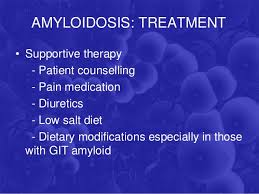
There’s no cure unfortunately for amyloidosis. But treatments can help you manage your symptoms and limit the production of amyloid protein.
Treatment is usually aimed at eliminating the source of the abnormal precursor protein.
Primary amyloidosis (AL, amyloid light chain) is associated with a clonal plasma cell disease and the immunoglobulin light chains made by the abnormal plasma cells. AL also occurs in amyloidosis associated with multiple myeloma. Treatment involves chemotherapy or stem cell transplantation to eliminate the plasma cells (the source of the abnormal light chains).
Familial amyloidosis (AF) is associated with a genetic abnormality that can be inherited. AF causes the liver to make an abnormal form of a protein called transthyretin. The treatment for AF is liver transplantation.
Secondary amyloidosis (AA) is associated with inflammation and elevated levels of serum amyloid A caused by inflammation. Treatment involves elimination of the source of inflammation.
Through “The Amyloidosis Foundation” they provide over the world medical facilities/hospitals that major in this disease at http://www.amyloidosis.org/PatientPrograms/physiciansusa.html.
Hope this article has helped you or some one in your life significant like your family or friends to better understand this disease, how its detected and what is done in treatment depending on what type of amyloidosis the individual has and what part of the body tissue is affected.
|
“Amyloidosis can affect different organs in different people, and there are different types of amyloid.”
MAYO CLINIC


What is Amyloidosis? Amyloidosis (am-uh-loi-DO-sis) is a rare disease that occurs when a substance called amyloid builds up in your organs. Amyloid is an abnormal protein that is usually produced in your bone marrow and can be deposited in any tissue or organ.
The cause of primary amyloidosis is unknown. The condition is related to abnormal and excess production of antibodies by a type of immune cell called plasma cells. Clumps of abnormal proteins build up in certain organs. This reduces their ability to work correctly.
Symptoms depend on the organs affected. Amyloidosis frequently affects the heart, kidneys, liver, spleen, nervous system and digestive tract. Severe amyloidosis can lead to life-threatening organ failure. This disease can affect the tongue, intestines, skeletal and smooth muscles, nerves, skin, ligaments, heart, liver, spleen, and kidneys. Skin changes, such as thickening or easy bruising, and purplish patches around the eyes, difficulty swallowing,
Symptoms include: enlarged tongue, difficulty swallowing, feeling full quickly when eating, and significant weight loss, diarrhea possibly with blood or constipation, abnormal heart rhythm, fatigue, numbness of hands or feet, shortness of breath, hoarseness or changing voice, swelling of your ankles and legs and joint pain.
Amyloid is produced in your bone marrow and can be deposited in any tissue or organ affecting the tissue and organs like stated previously. The specific cause of this condition depends on the type of amyloidosis present.
Unfortunately, there are many different types of amyloidosis. Here are the types:
– Immunoglobulin light chain (AL) amyloidosis. This is the most common type, can affect your heart, kidneys, skin, nerves and liver. It was previously known as primary amyloidosis. It occurs when your bone marrow produces abnormal antibodies that can’t be broken down. The antibodies are deposited in your tissues as amyloid, interfering with normal function. Most people diagnosed with AL amyloidosis, the most common type, are age 50 or older, although earlier onset can occur. This is hard in preventing this disease from occurring. Nearly 70 percent of people with AL amyloidosis are men.
– AA amyloidosis, mostly affects your kidneys but occasionally your digestive tract, liver or heart. It was previously known as secondary amyloidosis. It occurs along with chronic infectious or inflammatory diseases, such as rheumatoid arthritis or inflammatory bowel disease. One way to prevent this is through good health to prevent chronic infections, possibly rheumatoid arthritis or inflammatory bowel disease.
– Hereditary (familial) amyloidosis, is an inherited disorder that often affects the liver, nerves, heart and kidneys. One type is caused by a certain amyloid (transthyretin amyloid) that can affect the nervous system or the heart. This is hereditary and unlikely to prevent but see your MD regularly to be checked for it every 6 months or yearly. See what your MD suggests if you know this is in your family. African-Americans have a greater risk of this type than do Caucasians. It is thought to be a significant cause of heart failure in African-American men.
– Dialysis-related amyloidosis, develops when proteins in blood are deposited in joints and tendons which end up causing pain, stiffness and fluid in the joints, as well as carpal tunnel syndrome. This type generally affects people on long-term dialysis. Dialysis can’t always remove large proteins from the blood. If you’re on dialysis, abnormal proteins can build up in your blood and eventually be deposited in tissue. The good news regarding this type of amyloidosis is this condition is less common with modern dialysis techniques.
IN THE END WHAT THIS CONDITION LEAVES AS AN FINAL RESULT TO INTEFERE WITH NORMAL FUNCTION OF TISSUES/ORGANS IN THE HUMAN BODY:
1.) Amyloid can harm the kidneys’ filtering system=our toileting system of the human body which takes toxics out of the bloodstream dumping them into the urinary bladder that our body voids out of the body through urinating. If this organ, the kidneys are affected, this ends up causing protein to leak from your blood into your urine. The kidneys’ ability to remove waste products from your body is lowered, which may eventually lead to kidney failure (if 100% failure occurs now hemodialysis starts causing the amyloidosis to be at risk for just getting worse, see above dialysis-related amyloidosis).
2.) Amyloid can harm the nervous system, which affects our electrical system of the human body. You may experience pain, numbness or tingling of the fingers or numbness, lack of feeling or a burning sensation in your toes or the soles of your feet. If amyloid affects the nerves that control your bowel function, you may experience periods of alternating constipation and diarrhea. Sometimes amyloidosis affects nerves that control blood pressure, and you may experience dizziness or near fainting when standing too quickly, as a result of a drop in your blood pressure due to orthostatic hypotension occurring secondary to the nerves affecting the B/P.
3.) Amyloid if it affects the engine of the human body it will cause reduction of that organ’s function being the heart. It causes your heart’s ability to fill with blood between heartbeats. Less blood is filled up in each chamber of the heart at the normal level an this causes the heart to pump out less cardiac output with each beat, especially the left ventricle of the heart that pumps out oxygenated blood throughout the body. This causes less oxygenated blood to our tissues and like plumbing when the pipes (in this case the arteries with veins) cause back up in the running of blood which go back to the lungs first (does not take long) all the way down to the feet (this takes time). This in the end can make you experience shortness of breath due to fluid build up in the lungs. If amyloidosis affects your heart’s electrical system, your heart rhythm may be disturbed. This can put you into arrhythmias the longer you don’t take care of the situation the worse the rhythm will get.
You may go to your general practitioner first depending on your insurance coverage but if it is questionable or your GP thinks it amyloidosis you should be referred to a doctor who specializes in blood disorders (hematologist). Be prepared with questions already written out at home when you see your doctor so you don’t walk out of the office knocking your head saying “I forgot to ask him…”. That could be from signs and symptoms, causes, risk factors, tests, treatments/medications, etc…
There’s no cure unfortunately for amyloidosis. But treatments can help you manage your symptoms and limit the production of amyloid protein. Tune in tomorrow to Part II for diagnostic testing and treatments done for this disease.
“Although relatively few people have heard of it, chronic obstructive pulmonary disease (COPD) kills on average one person every 10 seconds. COPD is not a simple smoker’s cough, but an under-diagnosed, life threatening lung disease.”
World Health Organization (WHO)
“Most ventricular tachycardias are associated with serious heart disease such as coronary artery blockage, cardiomyopathy, or valvular heart disease. V-tach is often triggered by an extra beat originating in either the right or left ventricle. It also occurs frequently in connection with a heart attack.”
American Heart Association
Learn more today about Ventricular Rhythms on striveforgoodhealth.com and learn how they effect the heart function.
“Possibly most important, only humans, not cardiac monitors, can determine the goals of monitoring for an individual patient with guidance from doing close cardiac EKG monitoring.”
American Heart Association

“Dehydration and heatstroke go hand in hand,” says Peter Galier, MD, associate professor of medicine at the David Geffen School of Medicine at UCLA. “It happens most commonly in people who are out in the sun.”
What happens, explains Galier, is that people sweat and replace their lost electrolyte-packed body fluids with only water. Dehydration can soon follow, and heatstroke can set in if a person becomes so dehydrated they can’t sweat enough to cool down, and their body temperature rises.
How to avoid it. “If you are outside and sweating, you should be drinking at least a 50-50 mix of Gatorade and water, which has potassium and sodium,” Galier tells WebMD. “You need to be drinking at least one small liter bottle of this mix every hour if you’re working or exercising in the sun.”
Warning signs. “Symptoms of dehydration can run the gamut from thirst and general fatigue, to headaches, nausea, and confusion,” says Galier. “Heatstroke symptoms are also headache and confusion, but include delirium and even hallucinations.”
What to do. While mild dehydration can be treated by rehydrating with fluids, heatstroke is more serious. “If you have heatstroke, you need to go to the emergency room so you can have intravenous fluids,” says Galier. “With really bad heatstroke, your kidneys can shut down.”
The old adage still rings true, explains Galier. “Leaves of three — let them be,” he says. So when the summer months begin, plan ahead when you know you’re going to be trekking through the woods.
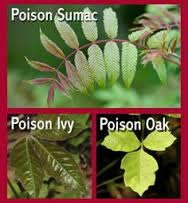
Remember the old adage: “Leaflets three, let them be.” Poison ivy and poison oak have a triple-leaf structure you can learn to recognize — and then avoid.
Remember poison oak is more allergenic than poison ivy and poison oak is poison sumac, a deciduous woody shrub or small tree that grows 5–20 feet tall and has a sparse, open form. It inhabits swamps and other wet areas, pine woods, and shady hardwood forests. In Florida, poison sumac has been confirmed in the north and central regions, as far south as Polk County.
Figure 10.
Poison sumac leaves consist of 7–13 leaflets arranged in pairs with a single leaflet at the end of the midrib. Distinctive features include reddish stems and petioles (Figure 10). Leaflets are elongated, oval, and have smooth margins. They are 2–4 inches long, 1–2 inches wide, and have a smooth, velvety texture. In early spring, the leaves emerge bright orange. Later, they become dark green and glossy on the upper leaf surface and pale green on the underside. In the early fall, leaves turn a brilliant red-orange or russet shade
How to avoid it. “Poison ivy or oak is a tri-leafed plant, usually with a little yellow and purple, and it tends to be anywhere with shrubbery, hiding out with other vegetation,” says Galier. “So stay out of shrub areas or wear high boots or high socks, stay on the path, and don’t touch anything you don’t recognize.” You find both in the woods also.
Warning signs. Poison ivy, oak or sumac can creep up on you, even if you wear head-to-toe clothing. “It’s the oil of the leaf that’s the problem,” says Galier. “If you take your clothes off and you touch your clothes, you’re going to get it.” The “it” he’s referring to is the itching and swelling.
What to do. It’s time to get out the topical anti-itching cream again, like calamine lotion. “If you can suffer through it and it doesn’t get worse, you can ride it out,” says Galier. If it gets worse, you’ll need to see a doctor for topical steroids or oral steroids.”
Have you ever wondered: Can I get poison ivy? What you’re really asking is: Am I allergic to the plant? Not everyone is. Up to 85% of Americans are allergic to poison ivy, leaving at least 15% resistant to any reaction.
If you are allergic to poison ivy, you’re more likely to be allergic to poison oak and poison sumac, because all three plants contain the same rash-triggering plant oil called urushiol (pronounced yoo-ROO-shee-all). You’re also more likely to have an allergic reaction to other plant resins, such as the oil from Japanese lacquer trees (used on furniture), mango rinds, and cashew shells.
Sensitivity to poison ivy, poison oak, and poison sumac varies from a mild to severe reaction, and may not cause any reaction at all the first time you’re exposed. Some adults who reacted to poison ivy as children may find that they are now less sensitive. Some may even lose their sensitivity altogether.
Many people break out in a rash when urushiol touches the skin. And even if you don’t recall touching the leaves of poison ivy, oak, or sumac, you may have unwittingly come in contact with their roots or stems.
Urushiol quickly penetrates the skin, often leaving red lines that show where you brushed against the plant. Symptoms appear 24 to 72 hours after exposure. Scratching the itchy rash doesn’t cause it to spread but can prolong skin healing and cause a secondary infection. The rash isn’t contagious, so you won’t spread it to others by going to school or work.
Symptoms, which generally last from one to two weeks, include:
Does it matter which plant you’re exposed to? NO unless you know Poison ivy, oak, and sumac all fall into the plant species called Toxicodendron, so the allergic reaction to all of these plants has the same name: Toxicodendron dermatitis. There are actually four poisonous plants in this group, since poison oak has both a western and an eastern variation. All four plants contain urushiol, so the skin reaction and treatment are essentially the same.
Poison ivy, oak, and sumac are generally diagnosed by their common symptoms of a rash, blisters, and itching following activity outside in a forest or field, but if you have any doubt, ask your doctor.
What’s the treatment for any 3:
Call your doctor or a dermatologist for:
Get immediate medical help for any difficulty breathing or severe coughing after exposure to burning plants.
In some cases, an oral steroid or other medication may be needed to relieve severe symptoms.
Transmission can occur in one of three ways:
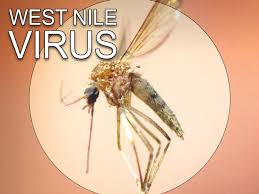
While mosquito bites used to be little more than annoying and itchy bumps on your arm or behind your ear, now we have even more reason to avoid them with things like West Nile virusand Triple E (Eastern equine encephalitis) making headlines.
How to avoid it. Your attack against a mosquito bite is three-pronged, according to the CDC’s web site: “Use insect repellent, particularly those with DEET, picaridin, or oil of lemon eucalyptus; wear as much clothing as the warm weather will allow; and avoid the outdoors during dusk and dawn — peak biting times.”
Warning signs. Mosquito bites will appear as red, raised bumps on your skin. Worse, they’ll itch.
What to do. Mosquito bites usually go away in less than a week, according to the web site of the University of Maryland Medical Center. In the meantime, you can wash the area and keep it clean, use an ice pack or a cool compress to alleviate itching, take an antihistamine, or use an anti-itching cream, such as calamine lotion.
Nearly 80% of people infected with West Nile virus will not have any symptoms. If you start to experience symptoms like fever, headache, body aches, nausea, vomiting, and sometimes swollen lymph glands or a skin rash on the chest, stomach, and back, according to the CDC’s web site, see your doctor. There’s a chance these could be symptoms of West Nile virus.
Swimmer’s ear is a kid’s nightmare when summer finally arrives.
“Just like when your fingers get pruney when you’re in the water too long, the same thing happens to your ears,” says Galier.
When you swim, or even shower or bathe, water can get trapped in your ear canal, causing the canal to get inflamed and infected.
How to avoid it. Gone are the days of Silly Putty in your ears. Now it’s simply wax ear plugs, or custom-fit ear plugs, explains Galier, to prevent swimmer’s ear.
Warning signs. “The symptoms of swimmer’s ear are ear pain and decreased hearing,” says Galier.
People’s biggest mistake by far is drinking and boating. People get out there and drink alcohol all day in the sun, and you end up with the same accidents you have with driving — with the added risks of falling out of boats, getting hit by propellers, and drowning.
It’s also easy to get lax about life jackets. Kids need to have them on all the time. Even if having them under the seat fulfills the law, in an accident, chances are anyone who doesn’t know how to swim won’t be able to get to them in time. When you are going to be out on a boat or at the beach with a child, you take on the responsibility to maintain the safety of that child and basic lifesaving skills are a must, not a luxury; especially for parents. The courses are easy, usually just one day or half a day and you may save your child’s LIFE or the child you take the responsibility in caring for. There’s no mouth-to-mouth [resuscitation] anymore if you are not trained — just chest compressions but if you get BCLS certified (basic care in life support) your CPR certified.
You can find first aid, cardiopulmonary resuscitation (CPR), and other emergency lifesaving courses near you with the American Heart Association’s ECC (Emergency Cardiovascular Care) Class Connector tool online at americanheart.org. or near you where you live.
We know almost every homeowner loves the sight of a pristine, neatly mowed yard. But in their haste to get that lawn in shape, some people forget to take precautions. “In the warmer months we see lots of mower injuries to toes, hands, and fingers getting caught in blades, and things like rocks and sticks getting flung out of them. People will start tinkering with the mower and reach under it to unclog it, and forget there’s a spinning blade there or take the key out when going under to see what clogged the blade from working. Those can be preventative moves and result in hideous injuries for some permanent and with others temporary.
They’re also hard to repair, because not only can whirling blades cause complex lacerations and fractures, but they can bury contaminants like grass and dirt in the wound putting the wound at risk for infection. To be safe:
Wear closed-toed shoes — preferably with a steel toe — when you mow, along with goggles or sunglasses, gloves, and long pants that will protect you from flying debris.
Keep kids away from the push mower and off the riding mower. Riding mowers are not just another ride-on toy.
Get a professional to service your mower or learn how to do it properly. Important: Disconnect the spark plug to prevent it from accidentally starting. Turning a push mower’s blade manually can ignite the engine.
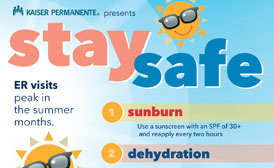
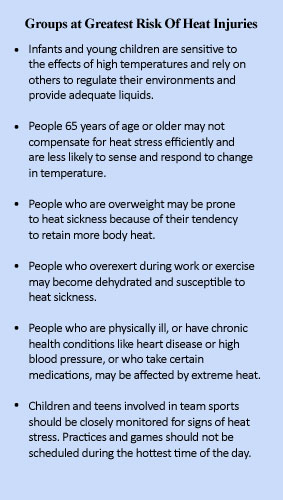
You’ve romped outdoors with the kids all day, and your water bottle ran dry long ago. Suddenly you feel dizzy and lightheaded, and your mouth tastes like cotton. You’re dehydrated — meaning you haven’t taken in enough fluids to replace those you’ve been sweating out.
People can get dehydrated any time of year, but it’s much more common in the summer months, when they are active outdoors in the warm sun. Heatstroke is the most severe form of dehydration. That’s when your internal temperature rises to dangerously high levels. Your skin gets hot, but you stop sweating. Someone with heatstroke may pass out, have hallucinations, or suffer seizures.
Preventing dehydration and heatstroke is so easy: Drink plenty of fluids, especially water, take regular breaks in the shade, and try to schedule your most vigorous outdoor activities for times when the heat isn’t so strong, such as early morning or late afternoon.
For persons suffering more serious dehydration or heatstroke, get them indoors, have them lie down, and cool them off with ice packs and cool cloths. Someone who is seriously affected by the heat may need intravenous fluids in the ER.
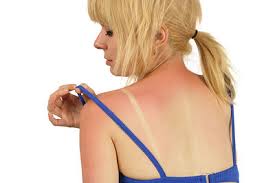
With all the skin cancer warnings, you’d think Americans would be getting fewer sunburns, not more. But you’d be wrong. The percentage of adults nationwide who got at least one sunburn during the preceding year rose from 31.8% in 1999 to 33.7% in 2004, according to the CDC.
Your risk for melanoma doubles if you’ve had just five sunburns in your life. A sunburn is a first-degree burn, right up there with thermal burns. Also, we even see some second-degree thermal burns, often when people are out drinking or falling asleep in the sun and don’t realize how long they’ve been out there.
In addition to practicing “safe sun” — wearing sunscreen that protects against both UVB and UVA rays, long-sleeved shirts, and wide-brimmed hats, and staying out of blistering midday rays — there are things you can do to treat a severe sunburn, Stanton says:
-Drink water or juice to replace fluids you lost while sweating in the hot sun.
-Soak the burn in cool water for a few minutes or put a cool, wet cloth on it.
-Take an over-the-counter pain reliever, such as acetaminophen.
-Treatitching with an OTC antihistamine cream or a spray like diphenhydramine (such as Benadryl), which helps block the inflammatory reaction.
-Apply an antibiotic ointment or an aloe cream with emollients that soften and soothe the skin directly to the burned area.
-You’re going to have a pretty miserable 12 to 24 hours with the initial symptoms no matter what you do.
Food poisoning puts about 300,000 people in the hospital every year, hitting its peak in the summer months. You don’t want diarrhea to be the souvenir of your family’s annual summer picnic.
Anything that has mayonnaise, dairy, or eggs in it and any meat products can develop some pretty nasty bacteria after only a couple of hours unrefrigerated. Every summer we’ll have five or six people coming in from the same reunion or family picnic with food poisoning symptoms.
To prevent food poisoning, follow the U.S. Department of Agriculture’s advice to:
Mild cases of food poisoning can be cared for at home. Avoid solid foods, and stick with small, frequent drinks of clear liquid to stay hydrated. Once the nausea and vomiting have eased, you can try bringing food back into your diet — slowly and in small, bland portions (Grandma knew what she was talking about when she recommended tea and toast to settle an upset stomach). If symptoms persist for more than a couple days (or more than 24 hours in small kids), see a doctor.
Independence Day arrives. Many people love fireworks, but fireworks don’t necessarily love them back. Nearly 9,000 individuals were injured by fireworks in 2009, according to the U.S. Fire Administration, and two were killed. We see pretty significant hand and eye injuries from fireworks every summer. The safest way to watch fireworks is at a professionally sponsored display. At least six states ban all consumer fireworks, and several more allow them only with limitations. But if you can buy fireworks legally and want to set off a few at home, take these precautions:
To care for a fireworks burn, wrap it in a clean towel or T-shirt saturated with cool water and get to an emergency room to have the injury checked out.