


“Group B Streptococcus (group B strep, GBS) are bacteria that come and go naturally in the body. Most of the time the bacteria are not harmful, but they can cause serious illness in people of all ages. In fact, group B strep disease is a common cause of severe infection in newborns.”
Centers for Disease Control and Prevention (www.CDC.gov)
“Cleft and craniofacial conditions affect thousands of infants, children, teens and adults in the United States each year. Some are born with congenital anomalies like cleft lip and palate, others with more complex, life-threatening craniofacial conditions.”
nccapm.org
““Thirty years ago this month, President Ronald Reagan issued a presidential proclamation designating the last week of June as “Helen Keller Deaf-Blind Awareness Week.” Every year since, the Helen Keller National Center for Deaf-Blind Youths & Adults (HKNC) commemorates the week with a national advocacy campaign in recognition of the achievements and capabilities of people who are deaf-blind.”
AHC – American Health Council
“If a child is born totally blind, how will that limitation affect her connection with those around her? The literature estimates that 75%of most people’s learning comes through vision (Smith & Cote, 1982). A deaf infant with normal vision will not have the same trouble developing early bonds with his caregivers as an infant who is blind because, as we have seen,the eyes are a main avenue for these early bonds.”
National Center on Deaf and Blindness (nationaldb.org)
“Sinusitis usually occurs after a viral upper respiratory infection or cold and includes thick, discolored nasal mucus, decreased sense of smell, and pain in one cheek or upper teeth. Headaches due to sinus disease often last days or longer and migraine headaches most commonly last hours to a day or two. Headaches due to sinus disease often last days or longer and migraine headaches most commonly last hours to a day or two.”
MAYO Clinic
“Nasal sinus disease, or sinusitis, affects approximately 33 million people and accounts for more than $5.8 billion in healthcare costs annually, according to a release from Monell. Most of the time, the condition is caused by infection or allergy, which, in turn, causes sinus tissues to swell.”
NBC NEWS
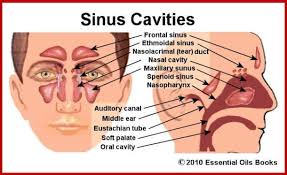
The sinus cavities include:
• The maxillary sinuses (the largest), in the cheekbones.
• The frontal sinuses, in the low-center of the forehead.
• The ethmoid sinuses, between the eyes, at the nasal bridge.
• The sphenoid sinuses, in bones behind the nasal cavity.
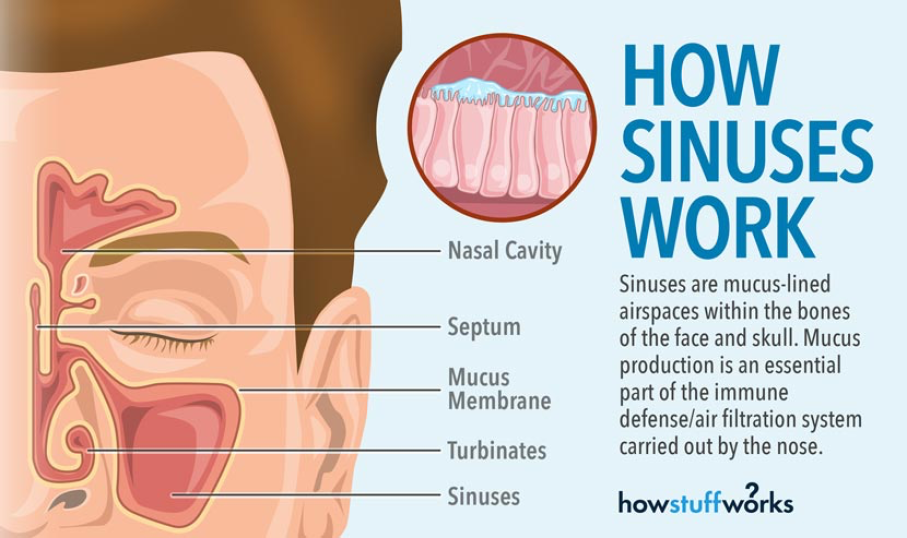
The sinuses are lined with soft, pink tissue called mucosa. Normally, the sinuses are empty except for a thin layer of mucus.
The inside of the nose has ridges called turbinates. Normally these structures help humidify and filter air. The nose is divided in the center by a thin wall, called the septum. Most of the sinuses drain into the nose through a small channel or drainage pathway called the middle meatus.
The purpose of the sinuses is unclear. One theory is that sinuses help humidify the air we breathe in; another is that they enhance our voices.
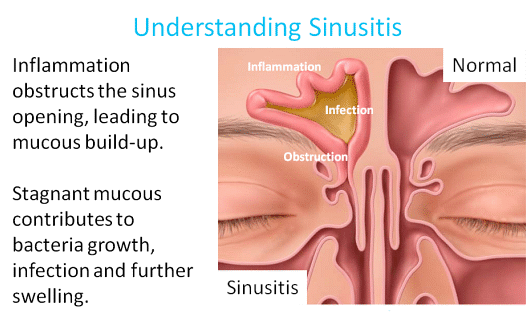
There are millions of bacteria in our noses, and most of the time, they’re harmless. Even when a few creep into the sinuses, they don’t cause trouble, as long as they keep draining into the nose along with mucus. But if sinus drainage is blocked, glands in the sinuses continue to produce mucus, and the resulting pool of backed-up mucus provides what Dr. Metson calls “the perfect culture medium.” The bacteria grow out of control, causing infection, and the immune system kicks off an inflammatory response. The result: swelling, which causes headache and facial pain; mucus buildup, which produces congestion; and an influx of white blood cells to fight the bacteria, which thickens the mucus and may tint it yellow or green. Other symptoms include loss of smell or taste, cough, bad breath, fever, toothache, and fullness in the ears.Sinus blockage can have a variety of environmental, anatomical, and genetic causes, but the main culprit is swelling of the nasal passages produced by the common cold or allergies. More serious sinusitis can result from structural problems, such as a deviated septum (a crook in the partition that separates the right from left nasal cavities) or nasal polyps (small, grapelike growths in the lining of the sinus cavity).
“As a person gets older, changes occur in all parts of the body, including the brain. Certain parts of the brain shrink, especially those important to learning and other complex mental activities.”
NIH National Institute on Aging