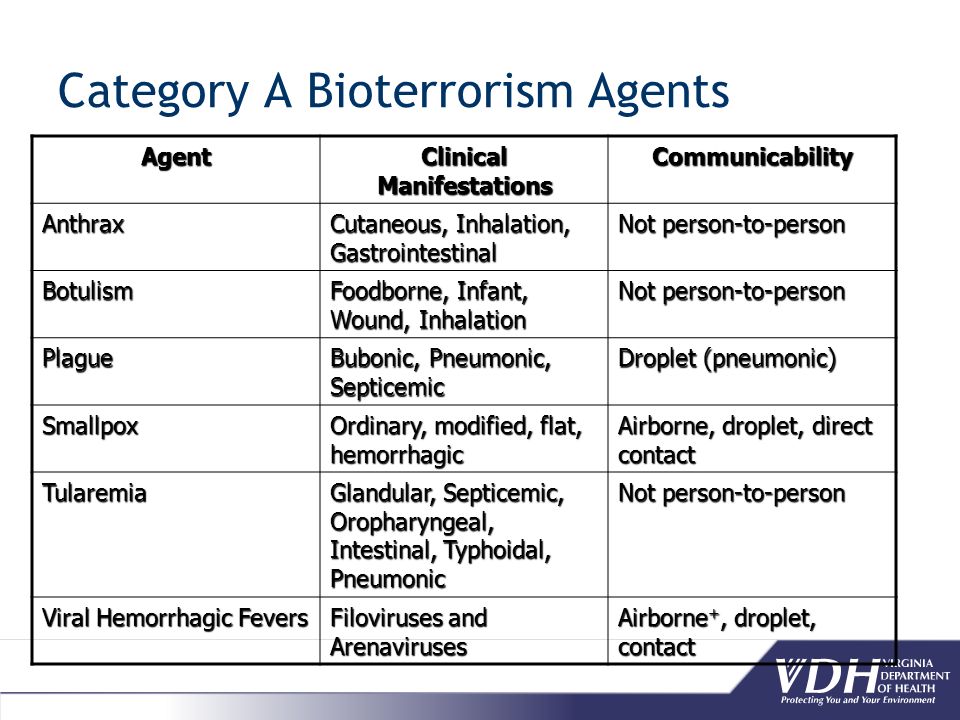

4-Smallpox is a deadly disease that has been around for thousands of years. It was declared eradicated in 1980 following a worldwide vaccination effort. The last naturally occurring case of the disease was in Somalia in 1977. Currently, the variola virus that causes smallpox only exists in two laboratories, one in Russia, the other in the U.S.
Following the terrorist events of September, 2001, there was concern that the variola virus could be used as an agent of bioterrorism. In response, the U.S. government launched a campaign to vaccinate key health care providers and public health workers against smallpox. The government also stockpiled enough smallpox vaccine to vaccinate every person in the U.S. in case of such an attack. Before smallpox was eradicated, it was mainly spread by direct and fairly prolonged face-to-face contact between people. Smallpox patients became contagious once the first sores appeared in their mouth and throat (early rash stage). They spread the virus when they coughed or sneezed and droplets from their nose or mouth spread to other people. They remained contagious until their last smallpox scab fell off. These scabs and the fluid found in the patient’s sores also contained the variola virus. The virus can spread through these materials or through the objects contaminated by them, such as bedding or clothing. People who cared for smallpox patients and washed their bedding or clothing had to wear gloves and take care to not get infected.
Rarely, smallpox has spread through the air in enclosed settings, such as a building (airborne route).
Smallpox can be spread by humans only. Scientists have no evidence that smallpox can be spread by insects or animals.
Thousands of years ago, variola virus (smallpox virus) emerged and began causing illness and deaths in human populations, with smallpox outbreaks occurring from time to time. Thanks to the success of vaccination, the last natural outbreak of smallpox in the United States occurred in 1949. In 1980, the World Health Assembly declared smallpox eradicated (eliminated), and no cases of naturally occurring smallpox have happened since.
Smallpox research in the United States continues and focuses on the development of vaccines, drugs, and diagnostic tests to protect people against smallpox in the event that it is used as an agent of bioterrorism.
5-Tularemia-is a naturally occurring disease of wildlife, particularly rabbits, squirrels, and other rodents; it is caused by the bacterium Francisella tularensis. Tularemia is zoonotic, meaning both people and animals can get this disease, through tick and fly bites, and following contact with infected animals. It cannot be transferred from person to person.
Tularemia is a disease caused by the bacterium Francisella tularensis (F. tularensis) that can affect humans, domestic animals, and wildlife. Tularemia occurs naturally in the United States and is most often found in animals such as rabbits, hares, squirrels and other rodents. Ticks and biting flies can also transmit the bacteria to humans and animals. Reported cases of tularemia in Minnesota are rare, with between 0-3 cases in humans and 0-5 cases in animals each year.
People and animals most commonly get tularemia from a bite by an infected tick or fly, or following contact with an infected animal . Tularemia can be spread to humans from infected pets or wildlife, but is not spread person to person. Tularemia is most often reported in cats with symptoms of high fever, swollen lymph nodes, mouth ulcers, depression, and loss of appetite. Dogs rarely show signs of illness.The signs and symptoms in people can vary. Illness generally starts with symptoms such as a fever, chills, and swollen lymph nodes. Symptoms may also include skin or mouth ulcers, diarrhea, muscle aches, joint pain, cough, and weakness. Symptoms usually appear 3 to 5 days after exposure to the bacteria, but may be as short as 1 day or take as long as 14 days. Yes there is Rx-a doctor can prescribe antibiotics to treat tularemia. Early recognition and treatment can help prevent serious illness. Veterinarians, hunters, trappers, landscapers, farmers, and people who spend time outdoors where ticks and biting flies are common are at higher risk for acquiring tularemia.
6-Viral hemorrhagic fevers (VHFs),including filoviruses (Ebola or Marburg) and arenaviruses (Lassa or Machupo),
They generally affect multiple organ systems in the body. The symptoms are often accompanied by hemorrhage (bleeding); however, the bleeding is itself rarely life-threatening. While some types of hemorrhagic fever viruses can cause relatively mild illnesses, many of these viruses cause severe, life-threatening disease.
There are a number of VHF viruses that could be used as weapons. They include
- Ebola
- Marburg
- Lassa
- New World arenaviruses
- Machupo (Bolivian hemorrhagic fever)
- Junin (Argentine hemorrhagic fever)
- Guanarito (Venezuelan hemorrhagic fever)
- Sabia (Brazilian hemorrhagic fever)
- Rift Valley Fever
- Yellow Fever
- Kyasanur Forest disease virus
- Omsk hemorrhagic fever
In nature, people get VHFs from infected ticks, mosquitoes or rodents. People can be infected when they come in contact with urine, feces and other material from an infected rodent. People can also get a VHF from the bite of a mosquito or tick, or by crushing an infected tick. In some cases, it isn’t clear how people became infected.
In nature, people get VHFs from infected ticks, mosquitoes or rodents. People can be infected when they come in contact with urine, feces and other material from an infected rodent. People can also get a VHF from the bite of a mosquito or tick, or by crushing an infected tick. In some cases, it isn’t clear how people became infected.
Some types of VHF viruses – including Ebola, Marburg and Lassa – can be spread from person to person. They are spread through close contact with infected people or their body fluids. People can also be infected through contact with contaminated objects like needles or syringes.
Some VHF viruses – including Ebola, Marburg, Lassa, yellow fever and some New World arenaviruses – can be prepared in liquid form. Then they can be released into the air and used to infect people. Other VHFs – including Rift Valley fever – have caused infection when released into the air in the laboratory.
The former Soviet Union developed the Marburg virus for use as a weapon, and conducted research on Ebola, Lassa, Rift Valley fever, yellow fever and New World arenaviruses. The U.S. has done research on all of these viruses, except Marburg and Ebola. North Korea is believed to have developed the yellow fever virus as a weapon.
A story about bioterrorism carries inherent drama but also certain responsibilities. A story can raise concerns and heighten the public’s awareness of the topic or it could cause alarm and panic. And because biological materials are inexpensive and readily available, some thought should be given to whether or not the show will give ideas to potential terrorists. If a person thinks they have been exposed to a biological incident or they suspect a biological threat is planned, they should contact their local health department and/or their local police department.