
Archives

Part III Treatments of eating disorders


The eating disorders anorexia nervosa, bulimia nervosa, and binge-eating disorder, and their variants, all feature serious disturbances in eating behavior and weight regulation. They are associated with a wide range of adverse psychological, physical, and social consequences. A person with an eating disorder may start out just eating smaller or larger amounts of food, but at some point, their urge to eat less or more spirals out of control. Severe distress or concern about body weight or shape, or extreme efforts to manage weight or food intake, also may characterize an eating disorder.

Eating disorder treatment also involves addressing other health problems caused by an eating disorder, which can be serious or even life-threatening if they go untreated for long enough. If an eating disorder doesn’t improve with standard treatment or causes health problems, you may need hospitalization or another type of inpatient program.

Having an organized approach to eating disorder treatment can help you manage symptoms, regain a healthy weight, and maintain your physical and mental health.

Eating disorders are real, treatable medical illnesses. They frequently coexist with other illnesses such as depression, substance abuse, or anxiety disorders. Other symptoms can become life-threatening if a person does not receive treatment, which is reflected by anorexia being associated with the highest mortality rate of any psychiatric disorder.

Eating disorders affect both genders, although rates among women and girls are 2½ times greater than among men and boys. Eating disorders frequently appear during the teen years or young adulthood but also may develop during childhood or later in life.

How are eating disorders treated?

Typical treatment goals include restoring adequate nutrition, bringing weight to a healthy level, reducing excessive exercise, and stopping binging and purging behaviors. Specific forms of psychotherapy, or talk therapy—including a family-based therapy called the Maudsley approach and cognitive behavioral approaches—have been shown to be useful for treating specific eating disorders. Evidence also suggests that antidepressant medications approved by the U.S. Food and Drug Administration may help for bulimia nervosa and also may be effective for treating co-occurring anxiety or depression for other eating disorders.

Treatment plans often are tailored to individual needs and may include one or more of the following:

  • Individual, group, or family psychotherapy
  • Medical care and monitoring
  • Nutritional counseling
  • Medications (for example, antidepressants).

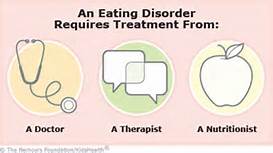
You may start by seeing your family doctor or mental health counselor, such as a psychologist. You may also need to see other health professionals who specialize in eating disorder treatment. Other members of your treatment team may include:

  • A registered dietitian to provide nutritional counseling.
  • A psychiatrist for medication prescription and management, when medications are necessary. Some psychiatrists also provide psychological counseling.
  • Medical or dental specialists to treat health or dental problems that result from your eating disorder.
  • Your partner, parents or other family members. For young people still living at home, parents should be actively involved in treatment and may supervise meals.

It’s best if everyone involved in your treatment communicates about your progress so that adjustments can be made to your treatment as needed.

Managing an eating disorder can be a long-term challenge. You may need to continue to see your doctor, psychologist or other members of your treatment team on a regular basis, even if your eating disorder and related health problems are under control.

Some patients also may need to be hospitalized to treat problems caused by malnutrition or to ensure they eat enough if they are very underweight. Complete recovery is possible.
QUOTE FOR TUESDAY:

“30 million people in the U.S. have an eating disorder.  95 percent of people with eating disorders are between the ages 12 and 25.  Eating disorders have the HIGHEST risk of death of any mental illness.  Eating disorders affect all genders, all races and every ethnic group.  Genetics, environmental factors and personality traits all contribute to the risk of developing an eating disorder.”.

John Hopkins All Children Hospital (https://www.hopkinsallchildrens.org/Services/Pediatric-and-Adolescent-Medicine/Adolescent-and-Young-Adult-Specialty-Clinic/Eating-Disorders/Eating-Disorder-Facts)

QUOTE FOR MONDAY:

“You may need treatment for medical complications caused by starvation, vomiting, or laxative use. You may also need general medical and dental care.  Medical complications due to starvation can include serious and even life-threatening problems to dehydration, low blood glucose levels, anemia (lack of red blood cells), low blood pressure, an extremely slow or irregular heartbeat, low white blood cell count, liver and kidney problems, changes in the structure of your brain, osteoporosis (weak, porous bones that break easily and heal slowly), if female menses with periods of it stopping.”.

QUOTE FOR THE WEEKEND:

“Every year from February 14-21, we at Planned Parenthood observe National Condom Week. This is a great time to learn more about the importance of using condoms and other barrier methods and to educate others, because everyone deserves to have a worry-free and healthy sex life. Condoms are the only form of birth control that also prevent sexually transmitted infections (STIs). ”

Planned Parenthood of the Pacific Southwest Inc (https://www.plannedparenthood.org/planned-parenthood-pacific-southwest/blog/celebrating-national-condom-week-2022)

QUOTE FOR FRIDAY:

“TED – also known as Graves’ Orbitopathy or Ophthalmopathy – is an autoimmune condition. It occurs when the body’s immune system attacks the tissue surrounding the eye causing inflammation in the tissues around and behind the eye. In most patients, the same autoimmune condition that causes TED also affects the thyroid gland, resulting in Graves’ disease. Graves’ disease most commonly causes thyroid overactivity (hyperthyroidism).”

British Thyroid Foundation – BTF (https://www.btf-thyroid.org/thyroid-eye-disease-leaflet)

QUOTE FOR THURSDAY:

“February is national age related macular degeneration (AMD) and low vision awareness month. AMD is the leading cause of low vision and blindness in Americans age 60 years and older and affects 1.6 million Americans.  As the Baby Boomer generation ages, the rates of AMD are expected to reach “epidemic proportions”.  AMD is a progressive disease with no known cure. It slowly steals vision as it affects the retina, a paper-thin tissue lining the back of the eye, and causes the cells in the area to die. As a result, if you have AMD, you see blind spots, grayness and other distortions in the center frame of your vision.”

UF Health – Department of Ophthalmology college of medicine                                                                       (https://eye.ufl.edu/2021/02/01/february-is-amd-macular-degeneration-low-vision-awareness-month/)

Age Related Macular Degenerative Disease.Month!

Macular Degenerative diseasemaculardegemerativedisease4

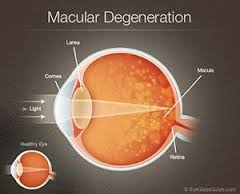
Age-related macular degeneration (AMD) is a deterioration or breakdown of the eye’s macula. The macula is a small area in the retina — the light-sensitive tissue lining the back of the eye. The macula is the part of the retina that is responsible for your central vision, allowing you to see fine details clearly.

The macula makes up only a small part of the retina, yet it is much more sensitive to detail than the rest of the retina (called the peripheral retina). The macula is what allows you to thread a needle, read small print, and read street signs. The peripheral retina gives you side (or peripheral) vision. If someone is standing off to one side of your vision, your peripheral retina helps you know that person is there by allowing you to see their general shape. 

Many older people develop macular degeneration as part of the body’s natural aging process. There are different kinds of macular problems, but the most common is age-related macular degeneration.

Signs and symptoms of Macular Degenerative Disease:

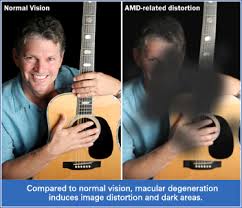
With macular degeneration, you may have symptoms such as blurriness, dark areas or distortion in your central vision, and perhaps permanent loss of your central vision. It usually does not affect your side, or peripheral vision. For example, with advanced macular degeneration, you could see the outline of a clock, yet may not be able to see the hands of the clock to tell what time it is.

  • Blurry distance and/or reading vision
  • Need for increasingly bright light to see up close
  • Colors appear less vivid or bright
  • Hazy vision
  • Difficulty seeing when going from bright light to low light (such as entering a dimly lit room from the bright outdoors)
  • Trouble or inability to recognize people’s faces
  • Blank or blurry spot in your central vision. *                                                                                                                The risks of Macular Degeneration:                                      For Developing Age-Related Macular Degeneration

The risk factors we can control=Modifiable Rish Factors:

  1. Smoking: Current smokers have a two-to-three times higher risk for developing age-related macular degeneration than people have who never smoked.
  2. Artificial fats: Usually labeled “partially-hydrogenated vegetable oils,” these artificial fats are pervasive in foods and particularly in low-fat bakery goods. Low-fat foods are good options if they’ve achieved their low-fat status through a process that physically removes the fat, as in skim milk or low-fat cottage cheese. Low-fat bakery goods are different, however. If you remove all or half the fat from a cake recipe, it won’t turn into a cake; thus, when cakes and bakery goods are labeled low-fat or no-fat, it means they contain artificial fats, or laboratory-produced chemicals. These chemicals are not food and our bodies can’t metabolize them.
  3. Sunlight: It is the blue wavelengths from the sun that damage the macula, not the ultraviolet (UV) rays.
  4. A diet high in processed, packaged foods and low in fresh vegetables: Vegetable oils are added in the packaging process. These oils are rich in omega-6 fatty acids, which promote inflammation.
  5. Uncontrolled hypertension and high cholesterol: Research by the National Eye Institute indicates that persons with hypertension are 1.5 times more likely to develop wet macular degeneration than persons without hypertension.
  6. Obesity: Being overweight doubles the risk of developing advanced macular degeneration.

The four risk factors we can’t control=Unmodifiable Risk Factors:

  1. Advanced age: Although AMD may occur earlier, studies indicate that people over age 60 are at greater risk than those in younger age groups. For instance, a large study found that people in middle age have about a 2% risk of getting AMD, but this risk increased to nearly 30 percent in those over age 75.
  2. Race: Whites are much more likely to lose vision from age-related macular degeneration than are Blacks or African-Americans.
  3. A gene variant that regulates inflammation: While not all types of macular degeneration are hereditary, certain genes have been strongly associated with a person’s risk of age-related macular degeneration, and genetic predisposition may account for half the cases of age-related macular degeneration in this country.
  4. Family history: Studies indicate that your chances of developing age-related macular degeneration are three to four times higher if you have a parent, child, or sibling with macular degeneration.

Treatment of Macular Degeneration:

People who develop significant age-related macular degeneration (AMD) typically compensate with large-print publications and magnifying lenses for everyday activities. In addition, evidence suggests that certain vitamins and antioxidants — vitamins C and E, beta-carotene, and zinc — may help reduce or delay the risk of severe vision loss. Ask your eye doctor about using nutritional supplements.

1. Treatment for Dry Macular Degeneration

Dry macular degeneration, the most common form of AMD, cannot be cured at this time, but patients with the condition should continue to remain under an ophthalmologist’s care to monitor both eyes. If the one eye is healthy, screening should still continue.

2. Treatment for Wet Macular Degeneration

A variety of treatments are available for wet AMD. Successful treatment may not restore normal vision, but it will improve sight and prevent central vision loss from worsening. While laser procedures can destroy the abnormal blood vessels, they also damage neighboring retinal tissue.

Medications, such as Eylea, Lucentis, and Macugen, have become the preferred treatment for acute wet macular degeneration, helping to prevent the growth of leaky blood vessels in your eye. Lucentis is given once every month, although some patients may need treatment only once every three months. Macugen is given every six weeks. Eylea is given once every two months after three once-monthly injections.

Laser photocoagulation destroys leaking blood vessels that have grown under the macula and halts the leakage. Laser therapy is helpful for about 10%-20% of people with wet macular degeneration. Some vision loss may occur, because this treatment creates scar tissue that is perceived as blind spots; however, even more vision would be lost if nothing is done at all. Up to half of patients who elect laser therapy may need repeat treatments.

Photodynamic therapy (PDT) uses a different, non-heat-generating laser to treat abnormal blood vessels. Visudyne is injected into the patient’s arm and flows through the vessels in the eye. Upon exposure to the laser, a chemical reaction occurs that seals off the leaky vessels. Since the dye is light sensitive, you must stay out of the sun or bright light for several days until the dye has passed from your system. Laser photocoagulation must be done before the abnormal blood vessels cause irreversible damage to the retina. More blood vessels could grow later on, so people who undergo this treatment also need to continue with regular follow-up appointments.

Vitamins. A large study performed by the National Eye Institute of the National Institutes of Health, called AREDS (Age-Related Eye Disease Study), showed that for certain individuals, vitamins C, E, beta-carotene, zinc and copper can decrease the risk of vision loss in patients with intermediate to advanced dry macular degeneration. In addition, there was a correlation between the hormone DHEA and the degree of macular degeneration. DHEA can be purchased over-the-counter.


QUOTE FOR WEDNESDAY:

“Prevent Blindness has declared February as Age-related Macular Degeneration (AMD) and Low Vision Awareness Month. According to the American Academy of Ophthalmology, AMD is a leading cause of vision loss in people 50 years or older, and more than 2.9 million Americans age 40 and older have low vision. Low vision is defined as a visual impairment that is not correctable through surgery, medicine, eye glasses or contact lenses.

AMD affects central vision, where sharpest vision occurs, causing difficulty conducting daily tasks such as driving, or reading. The most common form of AMD is “dry” AMD, caused by the appearance of small yellow deposits called drusen, which form under the retina. Dry AMD usually progresses slowly. “Wet” AMD generally causes more rapid and more serious vision loss. In this form of the disease, tiny new blood vessels grow under and into the retina. These blood vessels are fragile and often break and leak, causing a loss of vision.”

Prevent Blindness (https://preventblindness.org/february-age-related-macular-degeneration-amd-low-vision/)

QUOTE FOR TUESDAY:

“This year marks the 50th Anniversary of American Heart Month. For the past 55 years, the American Heart Association (AHA) has used the month of February to partner with the media, medical providers and community organizations to spread the word about heart disease prevention and treatment. Heart disease is a leading cause of death for both men and women.”

American Heart Association AHA (https://www.heart.org)

QUOTE FOR MONDAY:

“Sports help children develop physical skills, get exercise, make friends, have fun, learn teamwork, learn to play fair, and improve self-esteem.  It is important to remember that the attitudes and behavior taught to children in sports carry over to adult life. Parents should take an active role in helping their child develop good sportsmanship. To help your child get the most out of sports, you need to be actively involved.  Although this involvement takes time and creates challenges for work schedules, it allows you to become more knowledgeable about the coaching, team values, behaviors, and attitudes. Your child’s behavior and attitude reflect a combination of the coaching and your discussions about good sportsmanship and fair play.”

American Academy of Child and Adolescent Pschiatry (https://www.aacap.org/AACAP/Families_and_Youth/Facts_for_Families/FFF-Guide/Children-And-Sports-061.aspx)