Archives

Hernia Awareness!

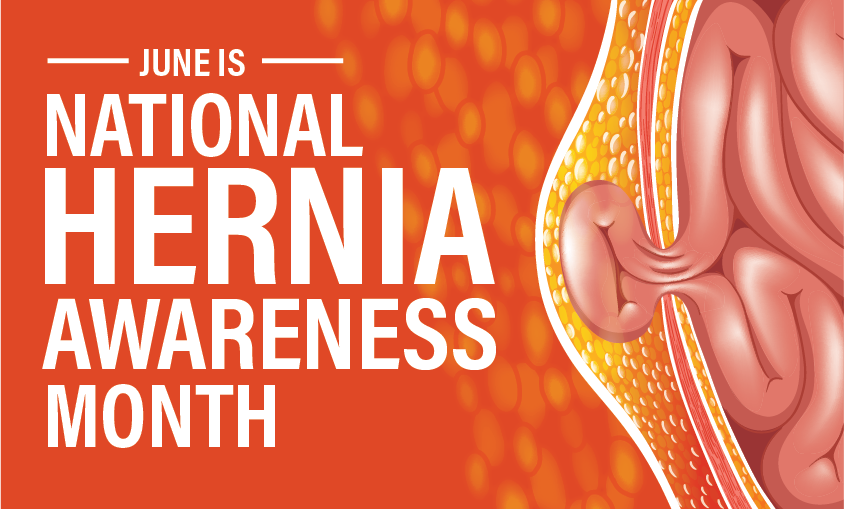
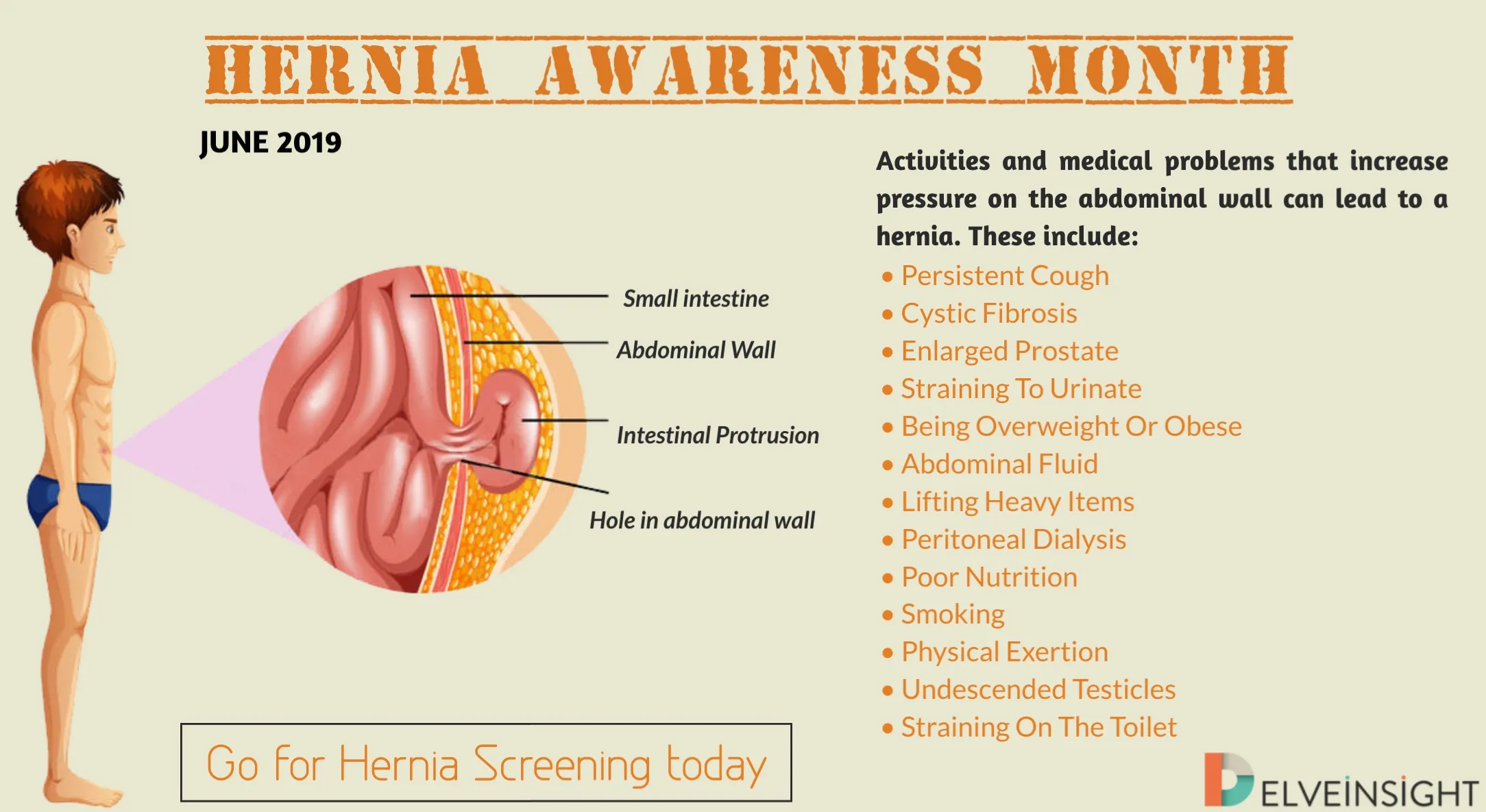
National Hernia Awareness Month is observed each June. Hernias can be described as abnormal bulges created by a weakness or a hole, usually in the abdominal wall or groin. It occurs when an internal organ, such as the bowel or bladder, extends through the wall of the muscle or tissue where it normally resides.

A bulge in the abdomen or groin caused by a hernia is a common condition in both men and women and can range from pain-free to painful. Nearly 1 million hernia operations are performed each year in the United States.

There are a number of places and types of hernias that can occur within the body.

  • Abdominal Hernia – Also referred to as a ventral hernia, abdominal hernias are generally a protrusion that occurs above the belt. This happens due to a weakness in the abdominal wall.
  • Hiatal Hernia – This type of hernia is closely connected & can coincide with a Paraesophageal Hernia, with the main symptom being gastric reflux or GERD. A hiatal hernia can commonly reoccur after surgery to repair it.
  • Umbilical Hernia – Occurs around or in your belly button. If your belly button typically is pushed in, leaving an indent, and suddenly it appears to have a something bulging out then you most likely have an umbilical hernia.
  • Incisional Hernia – Occurs at the incision line of a previous surgery, due to the cutting of the skin, tissue, & muscles in that particular area creating a weakened site.
  • Femoral Hernia – Occurs at the top of the leg or groin area. These types of hernias are more common in women and tend to be recurrent after a hernia has been repaired.
  • Inguinal Hernia –Occurs below the belt and on either side or both sides of the groin and/or the scrotum area. This particular hernia is more common in men and can also be recurrent, even after surgery.

Hernias can be congenital, which means they were present at the time of birth. They can also develop due to tissue weakness in the abdominal wall or groin, usually from overexertion and straining. Long-term constipation issues or urinating, persistent cough, heavy lifting and physical exertion can all contribute to the development of hernias. Other factors that can increase your risk for hernias include poor nutrition, chronic obstructive pulmonary disease, obesity, pregnancy, previous surgeries (specifically open surgeries) and smoking.

When hernias become painful or symptomatic it may prevent patients from participating in work, exercise or other activities that they love to do. When a hernia becomes symptomatic it is important to see your primary care physician to discuss repair before the hernia becomes very large or turns into a very serious complication. When organs are stuck in a hernia, they can lose their blood supply, which may result in an emergency that requires immediate attention.

Many times, your physician will be able to diagnosis a hernia by physical exam. However, sometimes a hernia may be difficult to see or feel due to its location or a person’s body size and shape. In those instances, radiologic tests like a CT (computerized tomography) scan or ultrasound may be ordered to help with the diagnosis.

There are different options for surgical repair, including both open surgery and minimally invasive laparoscopic (using small incisions with a laparoscope) approaches. Many times, we utilize mesh to help repair the hernia to lower the recurrence risk. Hernia repair is usually performed under general anesthesia or on an outpatient basis, so patients may be able to go home on the same day of surgery.

QUOTE FOR THURSDAY:

“Regarding risk factors, anyone can get cataracts. While most people don’t typically show symptoms until at least the age of 40, cataracts can also affect young adults or even children. Heredity, disease, eye injury and smoking could cause cataracts to develop at an earlier age.”

Specialty Eye Institute by midwest vision partners (https://www.specialtyeyeinstitute.com/june-is-cataract-awareness-month/)

QUOTE FOR TUESDAY:

Alzheimer’s is the most common cause of dementia, a general term for memory loss and other cognitive abilities serious enough to interfere with daily life. Alzheimer’s disease accounts for 60-80% of dementia cases.  Alzheimer’s worsens over time. Alzheimer’s is a progressive disease, where dementia symptoms gradually worsen over a number of years.  Alzheimer’s has no cure, but two treatments — aducanumab (Aduhelm™) and lecanemab (Leqembi™) — demonstrate that removing beta-amyloid, one of the hallmarks of Alzheimer’s disease, from the brain reduces cognitive and functional decline in people living with early Alzheimer’s. Other treatments can temporarily slow the worsening of dementia symptoms and improve quality of life for those with Alzheimer’s and their caregivers. Today, there is a worldwide effort underway to find better ways to treat the disease, delay its onset and prevent it from developing.  Just like the rest of our bodies, our brains change as we age. Most of us eventually notice some slowed thinking and occasional problems with remembering certain things. However, serious memory loss, confusion and other major changes in the way our minds work may be a sign that brain cells are failing.”

Alzheimer’s Association (https://www.alz.org/alzheimers-dementia/what-is-alzheimers)

QUOTE FOR MONDAY:

“Alzheimer’s disease (AD), the most generic form of dementia, is an irreversible, progressive brain disorder that destroys neuronal cells. AD is the fifth leading cause of death for people aged sixty-five and older []. Scientists do not yet fully understand the cause of this disease, which is likely to involve several factors and can affect each person differently. Health care providers often fail to diagnose AD at an early stage; thus, researchers are currently working on a diagnostic framework in which AD onset can be detected based on biological changes in the brain and body even before any symptoms appear []. Early AD identification remains challenging as the conventional biomarkers for AD can overlap with the classical aging process.

Recent studies suggest that dysfunctional glucose metabolism is often found in AD brains. An aged-matched comparison between regular and AD brains showed reduced glucose utilization, evidenced in APP (AD model) mice []. Thus, glucose utilization could be an early important imaging marker for AD detection. Under normal physiological conditions, brain cells use a relatively higher percentage of glucose for their function and energy source []. Alteration in cerebral glucose metabolic rate and glucose consumption are reflected in the synaptic excitability and neuronal activity []. In the AD brain, a lesser extent of glucose utilization was detected by positron emission tomography (PET) using 18F-fluorodeoxyglucose (FDG) as a tracer []. Specifically, a reduction in glucose consumption at the hippocampal and posterior cingulate of the brain was observed in the early AD stages [,,].

NIH National Library of Medicine (https://www.ncbi.nlm.nih.gov/pmc/articles/PMC9455726/)

QUOTE FOR THE WEEKEND:

To diagnose Alzheimer’s dementia, doctors conduct tests to assess memory impairment and other thinking skills, judge functional abilities, and identify behavior changes. They also perform a series of tests to rule out other possible causes of impairment.  Alzheimer’s dementia can be diagnosed in several different ways. Often, Alzheimer’s is diagnosed through a doctor’s exam. They will evaluate your signs and symptoms and do several tests. They may talk to friends and family members to find out more about symptoms and behavior.

It’s important to get an accurate diagnosis of Alzheimer’s, the most common type of dementia. The correct diagnosis is an important first step toward getting the appropriate treatment, care, family education and plans for the future.”.

MAYO CLINIC (https://www.mayoclinic.org/diseases-conditions/alzheimers-disease/in-depth/alzheimers/art-20048075)

QUOTE FOR FRIDAY:

“Alzheimer’s disease is a type of brain disease, just as coronary artery disease is a type of heart disease. It is
caused by damage to nerve cells (neurons) in the brain. The brain’s neurons are essential to thinking, walking,
talking and all human activity.  In Alzheimer’s, the neurons damaged first are those in parts of the brain responsible for memory, language and thinking. As a result, the first symptoms tend to be memory,
language and thinking problems. Although these symptoms are new to the individual affected, the brain changes that cause them are thought to begin 20 years or more before symptoms start.”.

Alzheimer’s Association (https://www.alz.org › alzheimers-facts-and-figures)

QUOTE FOR THURSDAY:

“The Lupus Foundation of America estimates that 1.5 million Americans, and at least five million people worldwide, have a form of lupus!  Lupus strikes mostly women of childbearing age. Ninety percent (90%) of people living with lupus are women. However, men, children, and teenagers develop lupus, too. Most people with lupus develop the disease between the ages of 15-44. Most people with lupus develop the disease between the ages of 15-44.  Lupus is two to three times more prevalent among African American, Hispanic/Latina, Asian American, Native American, Alaska Native, Native Hawaiian and other Pacific Islander women than among White women.”.

Lupus Foundation of America (https://www.lupus.org/resources/lupus-facts-and-statistics)

QUOTE FOR WEDNESDAY:

“World Lupus Day was 5/10/23 and by WELCOA a health topic for May. Genes do play a role in the predisposition to the development of lupus. There are dozens of known genetic variants linked to lupus. These genes impact both who gets lupus and how severe it is.  20 percent of people with lupus will have a parent or sibling who already has lupus or may develop lupus. About 5 percent of the children born to individuals with lupus will develop the illness.  Although lupus can develop in people with no family history of lupus, there are likely to be other autoimmune diseases in some family members.  Lupus is not contagious, not even through sexual contact. You cannot “catch” lupus from someone or “give” lupus to someone.

World Lupus Day (https://worldlupusday.org/lupus-facts-and-statistics/)

QUOTE FOR TUESDAY:

“You can’t cure or slow the progression of Huntington disease, but health care providers can offer medications to help with certain symptoms.   As Huntington disease progresses, you will need constant assistance and supervision because of the debilitating nature of the disease. People usually die from the disease within 15 to 20 years of developing symptoms.  If you have been diagnosed with, or are at risk for Huntington disease, it is critical to maintain your physical fitness as best you can. People who exercise regularly and stay active tend to do better than those who don’t.  A number of studies are currently under way to examine possible therapies for Huntington disease.”

John Hopkins Hospital (https://www.hopkinsmedicine.org/health/conditions-and-diseases/huntingtons-disease)

QUOTE FOR MONDAY:

“Huntington Disease (HD) typically begins between the ages of 30-45, though onset may occur as early as the age of two or as late as the 70s.  HD affects males and females equally and affects all ethnic and racial groups.  Symptoms of HD can differ from person to person, even for members of the same family.  Early symptoms may include depression, mood swings, forgetfulness, clumsiness, involuntary twitching, and lack of coordination.  HD usually progresses over a 10-25 year period. Death follows from complications such as choking or infection.  Affected individuals require assistance for daily care such as bathing and dressing.  Each child of a person with HD has a 50% chance of inheriting the HD-causing gene mutation.  More than 250,000 Americans have HD or are “at-risk” of inheriting the disease from an affected parent.  A blood test can accurately determine whether an adult carries the HD-causing gene.”

Hennepin Healthcare (https://www.hennepinhealthcare.org/specialty/neurology/huntingtons-disease-clinic/hd-facts/)