Archives

QUOTE FOR TUESDAY:

“Did you know that our brains are much more efficient than computers in every way? Or that our brains have 100,000 miles of blood vessels, which is enough to circle the earth four times?

“The brain is the most complex thing in the universe,” says neurologist Marwan Sabbagh, MD. “On one level, it’s a softball-sized collection of cells, chemical and connective tissue and on another level, it’s the totality of all things.”

He shares 3 interesting facts of the brain:

  1. The human brain is the only object of any kind that can contemplate itself.
  2. The brain only feels pleasure and there are no pain receptors in the brain. Migraine and headache pain arise in the meninges, or the brain’s covering.
  3. The brain runs on electricity, producing enough power to light a 25 watt bulb.”

Cleveland Clinic (https://health.clevelandclinic.org/brain-teasers-infographic/)

QUOTE FOR MONDAY:

“Your body produces C-reactive protein, or CRP, when something is starting to become inflamed. So if a doctor finds CRP in your blood, which they can do through a test, they’ll know there’s inflammation happening somewhere in your body.

If your arteries are inflamed, you have a greater risk of:  Heart disease, Heart attack, Stroke & Peripheral arterial disease.

CRP seems to predict the chance of having cardiovascular problems at least as well as cholesterol levels. A recent study found that elevated levels of C-reactive protein were associated with three-times-greater risk of a heart attack.”

Medically Reviewed by James Beckerman, MD, FACC on August 19, 2022

WEB MD (https://www.webmd.com/heart-disease/heart-disease-c-reactive-protein-crp-testing)


QUOTE FOR THE WEEKEND:

“Gardening has many health benefits. It allows you to get outside, get active, and sit less, which might help to reduce stress,” says Dr. Philip Smith, a life-long gardener who oversees obesity research at NIH. “Gardening can also help to improve your diet if you eat more fruits and vegetables. They’re especially delicious, with a more intense flavor, when ripe and freshly picked.”

News in Health NIH (https://newsinhealth.nih.gov/2016/04/plants-partners-health)

QUOTE FOR FRIDAY:

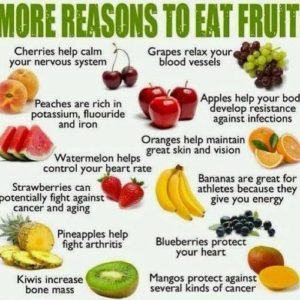
Vegetables and fruits are an important part of a healthy diet, and variety is as important as quantity.  No single fruit or vegetable provides all of the nutrients you need to be healthy. Eat plenty every day.  At least nine different families of fruits and vegetables exist, each with potentially hundreds of different plant compounds that are beneficial to health. Eat a variety of types and colors of produce in order to give your body the mix of nutrients it needs. This not only ensures a greater diversity of beneficial plant chemicals but also creates eye-appealing meals.”

Harvard T.H. Chain (https://www.hsph.harvard.edu/nutritionsource/what-should-you-eat/vegetables-and-fruits/)

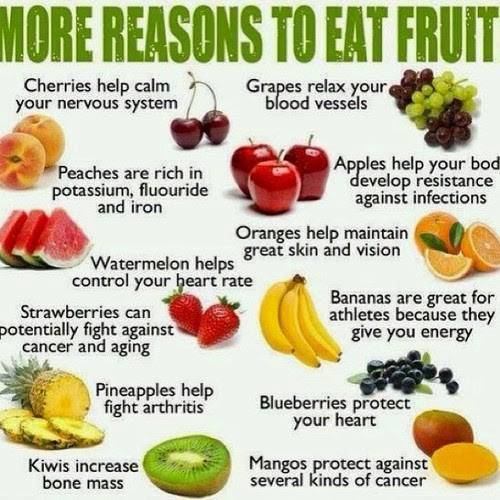
Fruit help’s you in both diet and health when eaten RIGHT.

You say WHY?

Let’s look at the health aspects of them for our body:

1- They are high in vitamins, minerals, some with antitoxins (helping the immune system) and have anti-inflammatory effects that can help you build up to your optimal health.  Some fruits have soluble fiber in them that slows down the breakdown of complex carbohydrates and helps reduce blood sugar.

2- Fruit taken in proper portions (moderate amts.) can even help lower blood cholesterol.

3- Soluble fiber is not just in rye, barley, oats, and vegetables but in fruits as well.  Insoluble fiber can’t be absorbed or digested by the human body but can still provide the body with advantages like reducing hunger, stimulates regular bowel movements, and can be found in fruits as well as vegetables, seeds whole wheat bread and other foods.

Let’s look at what you look for in the food you put in your body:

One of my healthy eating rules is know what the food’s makeup is before eating it; yes this includes calories, fat, sugars, carbs and sodium but knowing the energy density in the foods you eat is very important too.  Foods with the lowest density are foods that help curb your appetite that can help you maintain or even lose weight.

The lowest energy density food group contains healthy foods like most vegetables and fruits with based broth soups & skim milk.  The highest density groups are cookies, chips, nuts, full-fat condiments, chocolate and butter (not the best nutritional foods to be eating regularly).  Remember, if you’re trying to be healthy or even losing weight than know fruits are high glycemic foods.  If you eat too much fruit at one time it will result in high glycemic amounts in your body at that one time putting you at risk for fat storage=weight gain.

You see, digestion of the foods whether calories, carbohydrates, sugars, or some fats get broken down into simple or complex sugar molecules=glucose or fructose.  One of the body’s major fuels for energy so we can function with working properly & survive is glucose (the same concept like fuel for a car=gas=it operates).

The body utilizes glucose after digestion takes place in the stomach where the foods break down into simple and complex sugars than transferred into our bloodstream as our active fuel for energy (like our car’s tank sending gas to the engine to be able to run).  Our fuel, being the glucose, then gets sent to all our tissues and into our cells but only for the amount they need at that time (sort of like the car in filling the gas tank to full).  When our body reaches full for all energy needed to all areas of the body at that time if there is extra un-needed glucose in the bloodstream it has to go somewhere and the body stores it=fat storage=weight gain.  In the diabetic if no insulin too pass the sugar over through the cell membrane in the red blood cell (RBC) or if all extra sugar that can go into RBCs is full than the sugar has to to go somewhere.

Take the car, the storage reservoir is the gas tank it only stores in the tank, but if the tank reaches full with gas (its energy) it would just overflow as opposed to the human body with extra glucose in the bloodstream=our extra fuel which doesn’t overflow by leaving our body somehow but gets stored in our body as fat storage. Thus, when it’s needed (glucose) it will be released back in the bloodstream.  If you more frequently have in your body more overflow of glucose versus the need for it you’ll have more fat storage occuring as opposed to energy utilized by the body.  This causes you to be at a higher risk of becoming overweight to obese (that’s the logic in eating 6 small low glycemic meals a day which prevents this from happening).

To prevent a high risk of becoming overweight to obese stay off of 3 large meals/day and high sugar snacks during the day.  Also, don’t have constant healthy frequent high glycemic meals day in and day out especially with no activity/exercise other than your regular activities of daily living, which doesn’t count as exercise.

Remember, eat fruits in moderation not in excess; including the size of your meals (don’t allow the size of the plate greater than 9” including NO second helpings).   The key to eating healthy is to include all 4 food groups (Meats/Fishes, Vegetables, Fruits, and Dairy) and eat your first meal for the day within 30 minutes.  You can also learn exercise that fits into your lifestyle (ranging from walking fast 30 minutes for 2 to 3 times a week to daily workouts) with knowing healthy habits to add in your life to stay or get within your ideal weight.  The ending result is you feel better, look better, and have higher odds you’ll live a longer life that allows more excitement in it due to being in better shape.  Good luck in getting yourself on the right track of health independently.
QUOTE FOR THURSDAY:

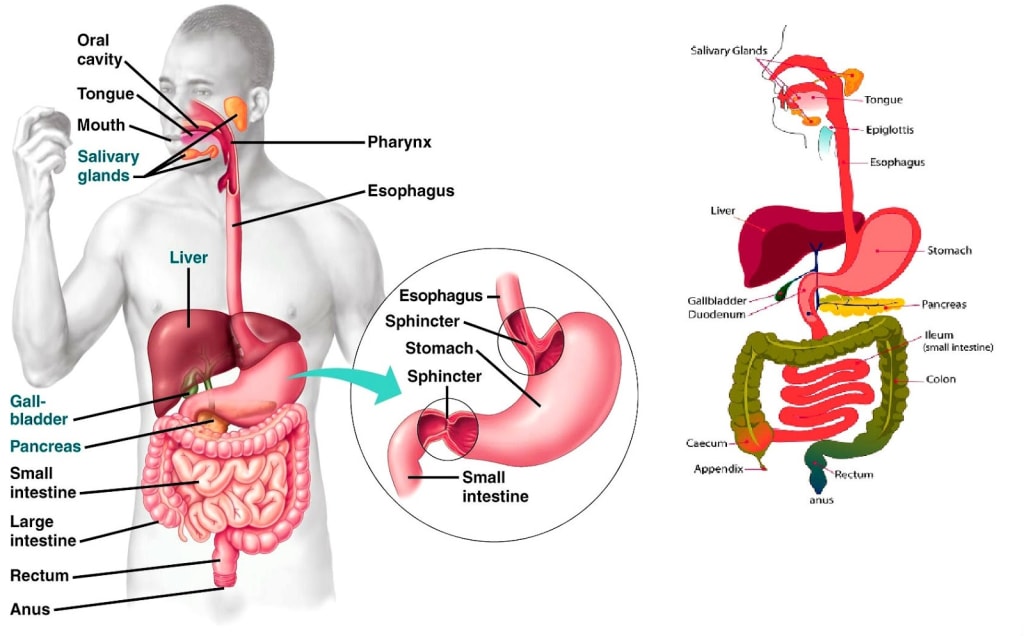
“In digestion there are 4 major organs that are involved in digestion process.  This entails the stomach, small intestines, liver and the pancreas.

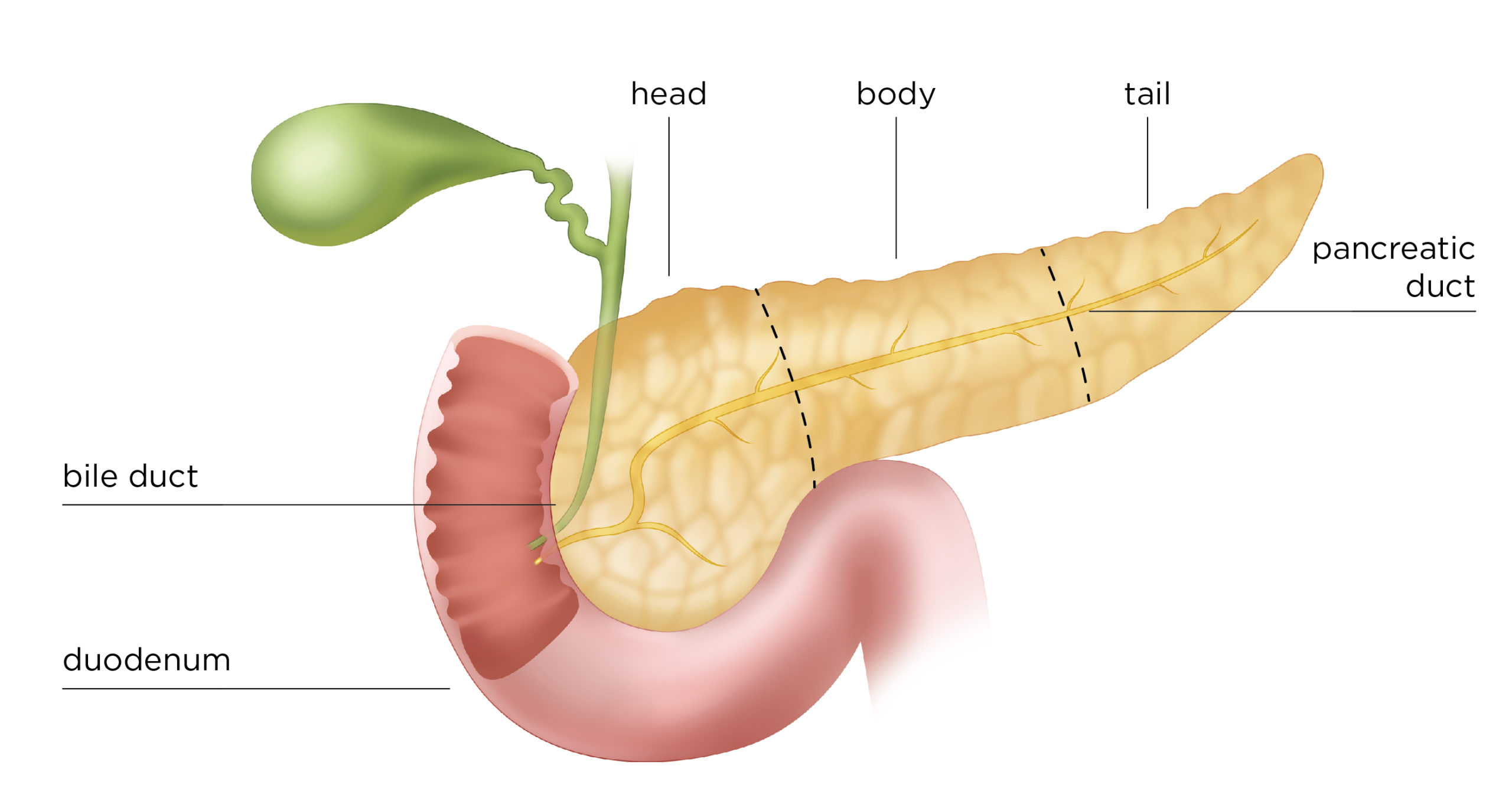
The pancreas is quite high up in your abdomen. It lies across your body where your ribs meet at the bottom of your breastbone, just behind your stomach. It is about 6 inches (15 centimetres) long and shaped like a leaf. The pancreas has 3 parts the head, body and tail.

The pancreas is a large gland that makes digestive juices and hormones, including insulin. The digestive juices flow down a tube (pancreatic duct) into the duodenum. The duodenum is the first part of the small bowel and is joined to the stomach.

Another tube (duct) joins the duodenum. The bile duct comes down from the gallbladder and liver and joins the duodenum right next to the pancreatic duct. The place where the two ducts join and meet the bowel is called the ampulla of Vater.”

Cancer Research UK (https://www.cancerresearchuk.org/about-cancer/pancreatic-cancer/about)

Learn how the Stomach, Gallbladder, Small Intestines, and Liver all deal with Digestion & know how pancreatic cancer spreads!

How our stomach including, gallbladder, pancreas and liver work with digestion:

During digestion of a meal, smooth muscles in the walls of the gallbladder contract to push bile into the bile ducts that lead to the duodenum. Once in the duodenum, bile helps with the digestion of fats.  Gallbladder: A pear-shaped reservoir located just under the liver that receives and stores bile made in the liver. The gallbladder sends this stored bile into the small intestine to aid in the digestion of food.

The stomach, gallbladder, and pancreas and liver are four of the most important digestive organs in the human body.

These organs work together to produce and store secretions that digest our food into its most basic building blocks. Once digested, these small molecules pass into our intestines to be absorbed and to feed our body’s tissues. These are major organs that actually produce hormones for food digestion or store the hormones for digestion that help to coordinate their functions and even lead to the feeling of fullness after consuming a meal since it allows the food to get in smaller pieces to moves into the large intestines where the stool forms into a more solid form to evacuate via our rectum to the anus.

The common bile duct is formed by the union of the common hepatic and the cystic ducts. It leads to the duodenum, where a sphincter muscle guards its exit. This sphincter normally remains contracted until the bile is needed, so that bile collects in the common bile duct and backs up to the cystic duct. When this happens, the bile flows into the gallbladder and is stored there.

Yes the gallbladder stores bile produced by the liver so that there is a sufficient supply of bile on hand to digest fats at any given time.  Remember this, that the pancreas stores the pancreatic juice produced by its own exocrine glands so that it is prepared to digest foods at all times but passes the bile to the gallbladder which reaches the small intestines via the common bile duct (between the gallbladder and the duodenum). The small intestine is made up of the duodenum, jejunum, and ileum. In living humans, the small intestine alone measures about 6 to 7 meters long.   After death, this length can increase by up to half. It has a surface area of over 200 meters.

The pancreas is a large gland that makes digestive juices and hormones, including insulin. The digestive juices flow down a tube (pancreatic duct) into the duodenum. The duodenum is the first part of the small bowel and is joined to the stomach.

Another tube (duct) joins the duodenum. The bile duct comes down from the gallbladder and liver and joins the duodenum right next to the pancreatic duct. The place where the two ducts join and meet the bowel is called the ampulla of Vater.


General Information About Bile Duct Cancer

So there is a relation between digestion in 5 major areas the stomach to the intestines, the gallbladder and theliver with the pancreas. 

How does cancer relate to these  areas?

Well if your diagnosed with intestinal blockage that shows cancer cells you need to know where its located.  If cancer cells where questionable by the doctor in certain tests done in the stomach or small intestines.  You need to find out where the location is and if your told the small intestines find out if the MD questions the cancer cells going to the common bile duct to the gall bladder that could further end up in the pancreas also.  If pancreatic cancer is determined this now means in the 3 parts of the pancreas cancer is high probability being in the head of the pancreas.  The pancreas has a tail, body and head the head is located to easy access of spreading the cancer in ducts and to the gallbladder which can further have its cancer cells go into the small intestines from the bile duct that is connected to release stored bile when needed for digestion in the small intestines.


QUOTE FOR WEDNESDAY:

“It’s natural for your mind to recall painful events. But if these thoughts are interfering with your everyday life, there are strategies that can help.

There may be some things you remember that you wish you didn’t.

Maybe you lost someone or something close to you or close in dealing with in your life, or there was a divorce you didn’t see coming, or you were let go from your job in a painful way.

It’s easy for these kinds of memories to keep you up at night. But there are some expert-backed ways to help you process and integrate painful experiences.”

Psych Central (https://psychcentral.com/health/letting-go-of-the-past-why-memories-remain-painful-over-time)

Don’t let bad memories control your life and some tips in how to deal with them!


Consider 8 Ways to Heal:

1. Psychotherapy can help identify past trauma.  Let the unfortunate trauma that happened to you diminish in time with doing things to deal with your stress or past traumatic injury you experienced but you become determined not to let those wounds ruin your life today.  If no good memories came out of it don’t dwell on it and turn into someone whose bitter or whines all the time.  Show the world your dealing with it and got over it!!  Your now a stronger person.

2. Grief requires dealing with your deceased parent; warts and all. You accept that you were traumatized; you may even forgive and if traumatized in a way in losing something or someone remember the good memories it gave you or in just a loss of a one you loved with all good memories remember that.  The hole in your heart is a mental injury like all types it will heal in time.

3. Identify your triggers. Everyone who’s been traumatized has triggers and responses. Get to know yours.  Utilize what calms your trigger down whether it be work out or hobbies or some type or work.

4. The Trigger-Response recreates the past. When you run, freeze or attack, you end up recreating and therefore, re-enforcing the past. You freeze and people think you are cold and stonewalling. If you run, nothing will last. And, if you rage in response to being triggered, you are doing what was done to you possibly. People will withdraw or be injured; not a good outcome.

5. Good therapy also helps you to rediscover your strengths. We are not just damaged creatures, but also living beings with power and talents. Many people discover strength they never knew they had in treatment. This, in turn, gives you more motivation to overcome  the trauma of your youth. With competent psychotherapy you may be able to gain the strength to deal with being triggered, without harming others – or yourself. Happiness is that important.

6. Alternative treatments like EMDR, Somatic Experiencing and DBT may help as well. These treatments help with muting the triggers that are neurologically embedded in your brain. Remember that the fight, flight and freeze response has an evolutionary purpose. It protects the organism from dangerous situations. You may need specialized expertise to overcome this programming.

7. Often trauma is found alongside other psychiatric disorders like Anxiety or Depression. An intelligent use of psychiatric medications can reduce the trigger-response effect and give you an opportunity to create a future response that is not dictated by your past.

8. Spirituality can be invaluable. No one can tell you HOW to be spiritual, but for many, some form of faith can truly detoxify. (As long as you are not in a faith that makes you more anxious and burdened.) People may have hurt you, but a new life is yours for the taking. Look up at the stars. Smell the fresh air. Sense the opportunity in every moment. And, know that you are part of something larger than you. It settles the soul.

The Power of Letting Go: We often speak of the dead with the words;

“He (or She) Should Rest in Peace.” Yes, they should.

Yet, we often don’t think about the ways that people who are gone still impact us, even though they are not here. Your mom or dad may be gone, but their hurt remains. And, you have some choice to live a better life despite what happened to you.

Open your door the past does affect it now possibly with negative thinking or responses but the present – and the future higher odds does not.

But, contemporary psychology opens the door wider. You can be free from your past.

It starts with consciousness. Then, the journey is all up to you.


About the Author

You are reading

The Intelligent Divorce

Parents, Cyber-Sex, and Children

The shocking things kids discover about their parent’s social media.

How Young Are You?

Is chronological age simply a construct?

The Borderline Dad

How borderline fathers can act out in a divorce

Countries:

QUOTE FOR TUESDAY:

“More and more US adults are dealing with stress, which can lead to mental health problems.  In August 2022, more than 32% of US adults reported having symptoms of depression or anxiety in the last 2 weeks.  Quick activities to improve your emotional well being!

  • Be active—Take a dance break! Lift weights. Do push-ups or sit-ups. Or kick around a soccer ball for a few minutes.
  • Close your eyes, take deep breaths, stretch, or meditate.
  • Write three things you are grateful for.
  • Check in with yourself—take time to ask yourself how you are feeling.
  • Laugh! Think of someone who makes you laugh or the last time you laughed so hard you cried.
  • Find an inspiring song or quote and write it down (or screenshot it) so you have it nearby.”

Centers for Disease Control and Prevention (https://www.cdc.gov/emotional-wellbeing/features/reduce-stress.htm)