Symptoms of muscle atrophy
You may have muscle atrophy if:
- One of your arms or legs is noticeably smaller than the other.
- You are experiencing marked weakness in one limb.
- You have been physically inactive for a very long time.
Contact your doctor to have a complete medical examination if you believe you may have muscle atrophy or if you are unable to move normally. You may have an undiagnosed condition that requires treatment. Your doctor will be able to provide you with diet and exercise options.
S/S of Spinal Muscular Atrophy (SMA):
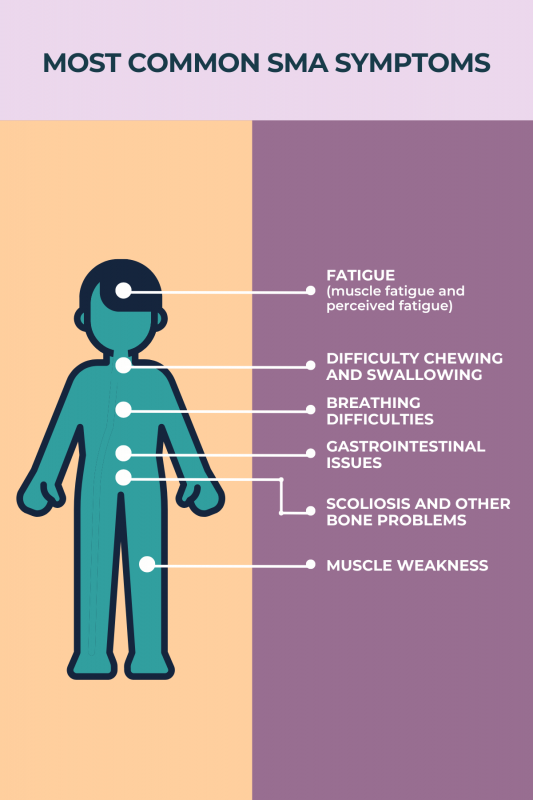
Symptoms of SMA may include:
- muscle weakness and decreased muscle tone
- limited mobility
- breathing problems-Remember we say the weakness tends to be more severe in the muscles that are close to the center of the body (proximal) compared to muscles away from the body’s center (distal). So your respiratory muscles are close to the center.
- problems eating and swallowing
- delayed gross motor skills
- spontaneous tongue movements
- scoliosis (curvature of the spine)
At birth, infants may appear normal, but can develop some of these signs as they age 6 mths or 18mths and 3,4,6 (it all depends on what stage level they are in since the stages happen at different ages, discussed after the s/s:
- Muscle weakness and hypotonia
- Areflexia
- Impaired head control
- Reduced bulbar function, including impaired swallowing, feeding, and weak cry and cough
- Tongue fasciculations
- Paradoxical breathing, also known as “belly breathing,” and bell-shaped chest due to intercostal muscle weakness
- Progressive respiratory failure requiring noninvasive ventilation (NIV)
- Missed motor milestones
Spinal Muscular Atrophy (SMA)-WHEN S/S start?
All signs snd symptoms depends on the type of Spinal Muscular Atrophy you are diagnosed with.
TYPES OF SMA:
There are five subtypes of SMA. Healthcare providers classify them based on the age of onset, as well as the severity and life expectancy. The subtypes include:
- SMA type 0 (congenital SMA): This is a rare subtype that affects a fetus before birth. Pre-birth, there are typically decreased fetal movements. At birth, infants with type 0 have severe muscle weakness and typically go into respiratory failure. Death usually happens at birth or within the first month of life.
- SMA type 1 (severe SMA): About 60% of SMA cases are type 1 — also called Werdnig-Hoffman disease. Symptoms arise within the first six months of life and include limited head control and decreased muscle tone (hypotonia). Infants with type 1 SMA also have difficulty swallowing and breathing. Without breathing support, children with type 1 SMA die before their second birthday.
- SMA type 2 (intermediate SMA): Symptoms of type 2 SMA (also called Dubowitz disease) appear between six months and 18 months of life. Symptoms include hypotonia and worsening muscle weakness, which tends to affect their legs more than their arms. Children with type 2 SMA may be able to sit up but can’t walk. Around 70% of people with type 2 will survive until 25, with some surviving into their 30s. Respiratory issues are the major cause of death.
- SMA type 3 (mild): Symptoms of type 3 SMA (also called Kugelbert-Welander disease) appear after a child’s first 18 months of life. Type 3 symptoms include lower limb muscle weakness, leading to difficulty walking. People with type 3 MSA don’t tend to develop breathing issues, and it typically doesn’t affect life expectancy.
- SMA type 4 (adult): This is the mildest form of SMA. It doesn’t typically appear until after the age of 21. Muscle weakness symptoms progress slowly, so most people with type 4 remain mobile. It typically doesn’t affect life expectancy.
Updated 8/06/2025