
The differences between UTUC, Small cell carcinoma, squamous cell carcinoma, adenocarcinoma, and NMIBC and Urothelial Carcinoma of the Bladder are as follows:
- UTUC (Urothelial Carcinoma of the Ureter): Develops in mesoderm-derived epithelium and has lymphatic drainage patterns that vary by anatomical location.
- Small cell carcinoma: Has oat-grain shaped cells and is found in cancers like lung, prostate, and pancreatic neuroendocrine tumors.
- Squamous cell carcinoma: Cells look flat and are often arranged like tiles on a floor.
- Adenocarcinoma: Arises from glandular cells and is found in organs like the lungs, breast, and colon.
- NMIBC (Non-Malignant Invasive Bladder Carcinoma): A precursor lesion that is not yet malignant but may progress to bladder cancer.
NMIBC and Urothelial Carcinoma of the Bladder
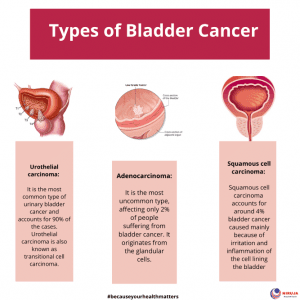
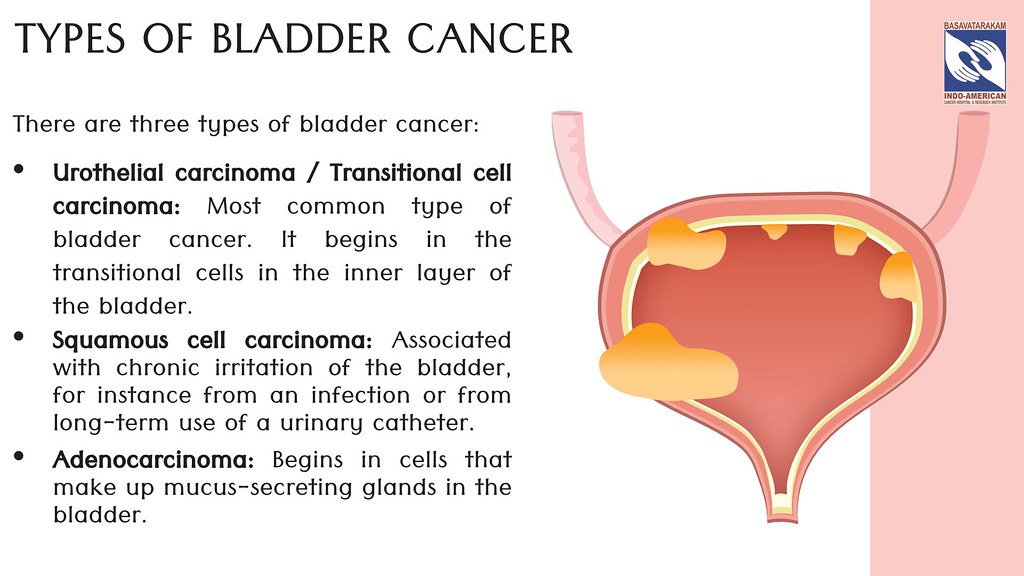
About 9 out of 10 bladder cancers are urothelial carcinoma (also called transitional cell carcinoma). They start in the cells on the surface of the bladder’s inner linings. Most urothelial carcinomas are a form of non-muscle invasive bladder cancer (NMIBC). That means the tumor stays within the bladder’s inner lining.
Urothelial carcinoma also has rarer subtypes, called variants. Each one has a different treatment. We identify the variant based on how the cells look under a microscope. The variants are called:
- Plasmacytoid
- Nested
- Micropapillary
- Lipoid cell
- Sarcomatoid
- Microcystic
- Lymphoepithelioma-like
- Inverted papilloma-like
- Clear cell
Cancer occurs when cells in the bladder start to grow out of control. Most tumours develop on the inner layer of the bladder. Some can grow into the deeper bladder layers. As cancer grows through these layers into the wall, it becomes harder to treat. The lining, where tumours initiate, is also found in the inner layers of the kidneys, ureters, and urethra. So, similar cancers can occur in these areas, though much less frequently.
Three types of bladder cancer may form, and each type of tumor can be present in one or more areas of the bladder, and more than one type can be present at the same time:
- Papillary tumors stick out from the bladder lining on a stalk. They tend to grow into the bladder cavity, away from the bladder wall, instead of deeper into the layers of the bladder wall.
- Sessile tumors lie flat against the bladder lining. Sessile tumors are much more likely than papillary tumors to grow deeper into the layers of the bladder wall.
- Carcinoma in situ (CIS) is a cancerous patch of bladder lining, often referred to as a “flat tumor.” The patch may look almost normal or may look red and inflamed. CIS is a type of nonmuscle-invasive bladder cancer that is of higher grade and increases the risk of recurrence and progression. At diagnosis, approximately 10% of patients with bladder cancer present with CIS.
While the majority of bladder cancers (approximately 90-95%) arise in the bladder, the urothelial cells that line the bladder are found in other locations in the urinary system. Sometimes these urothelial cancers can occur in the lining of the kidney or in the ureter that connects the kidney to the bladder. This is known as upper tract urothelial cancer (UTUC) correspond to a subset of urothelial cancers that arise in the urothelial cells in the lining of the kidney (called the renal pelvis) or the ureter (the long, thin tube that connects that kidney to the bladder).
Upper Tract Urothelial Carcinoma, or UTUC, is urothelial carcinoma that occurs in the renal pelvis or ureter(s). Approximately 5-7% of urothelial cancer can occur in the inner lining of the kidney, called the calyx and renal pelvis. It could also occur in one or both of the ureter(s), tubes that lead from each of your kidneys to the bladder.
Types of urothelial carcinoma:
- Non-invasive: More than half the people have this type, where the cancer remains in the urothelial cells that line the renal pelvis or ureters.
- Invasive: the rest have this type, where the cancer has grown beyond those urothelial cells. Or it may have spread to other parts of the body.
Just as with bladder cancer, UTUC tumors can be low grade or high grade. The grade of the UTUC is important to know as you and your doctor choose the best treatment for your cancer. The grade of the tumor is determined by a pathologist who examines the cells under a microscope. Doctors may also use imaging studies to help them stage UTUC.
- Low grade UTUC: In low grade UTUC, the tumors are typically noninvasive and are less aggressive.
- High grade UTUC: High grade UTUC can be more aggressive. It may spread to other parts of your urinary tract, or to other parts of your body.
Ask your doctor to explain the details about your diagnosis and pathology report.
Understanding your UTUC combined with your overall health, will help your doctor recommend the best treatment options for your cancer.
Urothelial carcinoma (yoo-REE-thrul KAR-sih-NOH-muh) is by far the most common type of bladder cancer in the United States. Others are rarer. This section has information on some of these rarer types. Some rare bladder cancers are more common outside of the United States.
Squamous Cell Carcinoma of the Bladder
This cancer begins in the thin, flat squamous cells that can form in the bladder after chronic inflammation (swelling) and infection. It’s most often found in areas, such as the Middle East, where a parasitic infection called schistosomiasis is common. In North America and Europe, squamous cell carcinoma is the second most common bladder cancer. It accounts for about 5 out of every 100 cases.
Adenocarcinoma of the Bladder
This rare form of bladder cancer accounts for about 1 out of every 100 cases of the disease. denocarcinoma (A-deh-noh- KAR-sih-NOH-muh) can be caused by certain bladder problems you’re born with. It’s also caused by chronic infection and inflammation.
Small Cell Carcinoma of the Bladder
This form of the disease can spread very quickly. It’s often, but not always, found at an advanced stage, after it has metastasized (spread). Small cell bladder cancers usually need a combination of treatments, including chemotherapy, surgery, and radiation therapy.
Small cell carcinoma starts in small, nerve-like cells in the bladder called neuroendocrine (NOOR-oh-EN-doh-krin) cells. It makes up about 1 out of every 100 cases of bladder cancers.