Archive | April 2024

QUOTE FOR FRIDAY:

“Prevent Blindness has declared April as Women’s Eye Health and Safety Month in an effort to educate the public on the increased risk for women and vision health issues, as well as steps that can be taken to prevent vision loss.

Two out of every three people living with blindness or vision problems are women according to the National Eye Institute. Women are at greater risk of developing a number of eye conditions, including age-related macular degeneration (AMD), cataracts and glaucoma.

At Texas Retina, we know that women often manage their family’s health and take care of everyone else first. However, it is important that women make their own eye health a priority as early detection and consistent treatment can significantly reduce the risk of vision loss. Here are a few tips:

  • Women 40 and older should have an annual dilated eye exam.
  • They should also see their optometrist or ophthalmologist any time they experience a change in vision.
  • Eat a healthy diet rich in vitamin C, vitamin E, beta carotene, lutein, zeaxanthin, zinc and omega-3 fatty acids. This should include foods such as salmon, broccoli and dark leafy greens.
  • Stay active as regular exercise is known to reduce the risk of eye disease.
  • Protect your eyes from the sun by wearing proper sunglasses that block ultraviolet radiation.
  • Avoid smoking.

Texas Retina (https://www.texasretina.com/2024/04/02/april-is-womens-eye-health-and-safety-month)

QUOTE FOR THURSDAY:

“Head and neck cancers usually begin in the squamous cells that line the mucosal surfaces inside the mouth, nose, throat, and salivary glands. They are often referred to as squamous cell carcinomas of the head and neck.

Head and neck cancers account for nearly 4 percent of all cancers in the United States, according to the National Cancer Institute (NCI).

Counting cancers of the oral cavity, pharynx, and larynx, the NCI estimates that about 66,920 cases occurred in the U.S. in 2023. About 15,400 people died from these diseases, according to the NCI’s Surveillance, Epidemiology and End Results (SEER) program.

Head and neck cancer is more common among men than women. These cancers are also diagnosed more often among people over age 50 than among younger people.

Symptoms of head and neck cancers may include a lump or a sore that doesn’t heal. In addition, symptoms can include sore throat that doesn’t go away, difficulty in swallowing, and a hoarse voice.

Alcohol and tobacco use are major risk factors for head and neck cancers. Also, infection with cancer-causing types of human papillomavirus (HPV) increases a person’s risk of certain head and neck cancers.”

American Association for Cancer Research – AACR (https://www.aacr.org/patients-caregivers/awareness-months/head-and-neck-cancer-awareness-month/)

QUOTE FOR WEDNESDAY:

“In 1986, President Reagan recognized March as “National Hemophilia Month” which has since been changed to #BleedingDisordersAwarenessMonth to be inclusive of all #bleedingdisorders. We’ll be posting facts throughout the month to honor our history and raise awareness about all #bleedingdisorders. Hemophilia is usually an inherited bleeding disorder in which the blood does not clot properly. This can lead to spontaneous bleeding as well as bleeding following injuries or surgery.

World Federation of Hemophilia – WFH (https://www.hemophiliafed.org/resource/bleeding-disorders-awareness-month/)

QUOTE FOR TUESDAY:

  • Sarcoidosis is an inflammatory disease in which the immune system overreacts, causing groups of cells to form clusters of inflamed tissue called “granulomas” in one or more organs of the body.
  • Sarcoidosis most commonly affects the lungs and lymph nodes, but it can affect any organ including the eyes, skin, heart and nervous system.
  • Sarcoidosis is a rare disease with 150,000-200,000 cases in the United States per year and approximately 27,000 new cases per year.
  • Lofgren’s syndrome is an acute, milder form of sarcoidosis that usually goes away within six months to two years after diagnosis.
  • Black women are three times more likely to be diagnosed with sarcoidosis than White women, tend to have more severe disease, are more likely to be hospitalized and have a higher mortality rate.
  • In severe cases, sarcoidosis can be life-threatening if it progresses to heart or severe lung disease.
  • Severe fatigue can impact up to 70% of patients with sarcoidosis even when inflammation is controlled with medication. Fatigue can be disabling, and lead to loss of work.

Sarcoidosis in the lungs is often separated into the “Scadding stages” based on the chest X-ray. There are five Scadding stages, Stage 0 through Stage 4. The stages use the location of the granulomas in the lungs and lymph nodes, to predict the chance of the disease resolving on its own, with lower stages being more likely to resolve or not need treatment. At each stage you can have serious symptoms. You also can move between the stages of sarcoidosis. Patients of any Scadding stage can have involvement of other organs from sarcoidosis.”

American Lung Association (https://www.lung.org/lung-health-diseases/lung-disease-lookup/sarcoidosis/learn-about-sarcoidosis)

QUOTE FOR MONDAY:

“Sarcoidosis is considered a rare disease. There are usually fewer than 200,000 cases of sarcoidosis at any given time in the U.S.

Research suggests that a combination of genetics and environmental factors cause sarcoidosis, but its exact cause is unknown. We think certain people are more likely to have their immune system overreact to certain triggers (antigens), like bacteria and viruses. Despite the immune system’s involvement, sarcoidosis isn’t considered an autoimmune disorder.

Since we don’t know for sure which combination of genes and triggers causes sarcoidosis, it’s impossible to predict who will get it.”

Cleveland Clinic (https://my.clevelandclinic.org/health/diseases/11863-sarcoidosis#:~:text=Sarcoidosis%20is%20a%20condition%20that%20causes%20your%20immune%20system%20to,fibrosis%2C%20causing%20permanent%20lung%20scarring.)

QUOTE FOR THE WEEKEND:

“Sarcoidosis is a disease characterized by the growth of tiny collections of inflammatory cells (granulomas) in any part of your body — most commonly the lungs and lymph nodes. But it can also affect the eyes, skin, heart and other organs.

The cause of sarcoidosis is unknown, but experts think it results from the body’s immune system responding to an unknown substance. Some research suggests that infectious agents, chemicals, dust and a potential abnormal reaction to the body’s own proteins (self-proteins) could be responsible for the formation of granulomas in people who are genetically predisposed.”

MAYO CLINIC (https://www.mayoclinic.org/diseases-conditions/sarcoidosis/symptoms-causes/syc-20350358)

QUOTE FOR FRIDAY:

“Researchers don’t know the primary causes of ASD, but studies suggest that a person’s genes can act together with aspects of their environment to affect development in ways that lead to ASD. Some factors that are associated with an increased likelihood of developing ASD include:

  • Having a sibling with ASD
  • Having older parents
  • Having certain genetic conditions (such as Down syndrome or Fragile X syndrome)
  • Having a very low birth weight

Caregivers and teachers are often the first to recognize ASD symptoms in older children and adolescents who attend school. The school’s special education team may perform an initial evaluation and then recommend that a child undergo additional evaluation with their primary health care provider or a health care provider who specialize in ASD.

A child’s caregivers may talk with these health care providers about their child’s social difficulties, including problems with subtle communication. For example, some children may have problems understanding tone of voice, facial expressions, or body language. Older children and adolescents may have trouble understanding figures of speech, humor, or sarcasm. They also may have trouble forming friendships with peers.”

NIH National Institute or Mental Health (https://www.nimh.nih.gov/health/topics/autism-spectrum-disorders-asd)

QUOTE FOR THURSDAY:

“Autism spectrum disorder (ASD) is a developmental disorder. Someone with ASD may have difficulty with social interaction, communication, and behavior. For example, the earliest signs of ASD are that children may not make eye contact with their parents and may not be aware when someone is talking to them. About 30% of people (about 1 in 3) with ASD have an intellectual disability.”

Centers for Disease Control and Prevention – CDC (https://www.cdc.gov/genomics/disease/autism.htm)

“Statistics by CDC:

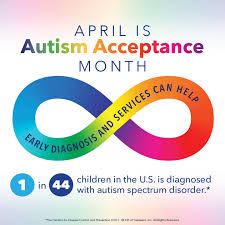
  • About 1 in 36 children has been identified with autism spectrum disorder (ASD) according to estimates from CDC’s Autism and Developmental Disabilities Monitoring (ADDM) Network.
  • ASD is reported to occur in all racial, ethnic, and socioeconomic groups.
  • ASD is nearly 4 times more common among boys than among girls.”

Centers for Disease Control and Prevention – CDC (https://www.cdc.gov/ncbddd/autism/data.html)


Part I Month of Autism Awareness


What is autism spectrum disorder?

Autism spectrum disorder (ASD) refers to a group of complex neurodevelopment disorders characterized by repetitive and characteristic patterns of behavior and difficulties with social communication and interaction. The symptoms are present from early childhood and affect daily functioning.

The term “spectrum” refers to the wide range of symptoms, skills, and levels of disability in functioning that can occur in people with ASD. Some children and adults with ASD are fully able to perform all activities of daily living while others require substantial support to perform basic activities. The Diagnostic and Statistical Manual of Mental Disorders (DSM-5, published in 2013) includes Asperger syndrome, childhood disintegrative disorder, and pervasive developmental disorders not otherwise specified (PDD-NOS) as part of ASD rather than as separate disorders. A diagnosis of ASD includes an assessment of intellectual disability and language impairment.

ASD occurs in every racial and ethnic group, and across all socioeconomic levels. However, boys are significantly more likely to develop ASD than girls. The latest analysis from the Centers for Disease Control and Prevention estimates that 1 in 68 children has ASD.

What are some common signs of ASD?

Even as infants, children with ASD may seem different, especially when compared to other children their own age. They may become overly focused on certain objects, rarely make eye contact, and fail to engage in typical babbling with their parents. In other cases, children may develop normally until the second or even third year of life, but then start to withdraw and become indifferent to social engagement.

The severity of ASD can vary greatly and is based on the degree to which social communication, insistence of sameness of activities and surroundings, and repetitive patterns of behavior affect the daily functioning of the individual.

Social impairment and communication difficulties
Many people with ASD find social interactions difficult. The mutual give-and-take nature of typical communication and interaction is often particularly challenging. Children with ASD may fail to respond to their names, avoid eye contact with other people, and only interact with others to achieve specific goals. Often children with ASD do not understand how to play or engage with other children and may prefer to be alone. People with ASD may find it difficult to understand other people’s feelings or talk about their own feelings.

People with ASD may have very different verbal abilities ranging from no speech at all to speech that is fluent, but awkward and inappropriate. Some children with ASD may have delayed speech and language skills, may repeat phrases, and give unrelated answers to questions. In addition, people with ASD can have a hard time using and understanding non-verbal cues such as gestures, body language, or tone of voice. For example, young children with ASD might not understand what it means to wave goodbye. People with ASD may also speak in flat, robot-like or a sing-song voice about a narrow range of favorite topics, with little regard for the interests of the person to whom they are speaking.

Repetitive and characteristic behaviors
Many children with ASD engage in repetitive movements or unusual behaviors such as flapping their arms, rocking from side to side, or twirling. They may become preoccupied with parts of objects like the wheels on a toy truck. Children may also become obsessively interested in a particular topic such as airplanes or memorizing train schedules. Many people with ASD seem to thrive so much on routine that changes to the daily patterns of life — like an unexpected stop on the way home from school — can be very challenging. Some children may even get angry or have emotional outbursts, especially when placed in a new or overly stimulating environment.