Part IV The pros & cons to Hemodialysis vs. Peritoneal Dialysis!

hemodialysis VS Hemodialysis3


There is not always a simple easy answer for a patient that has chronic renal disease regarding which choice or option of dialysis that is best for him or her ; so let’s investigate the options & know you can always change the choice of dialysis you initially go on.  But remember you are going from a tube placed in your circulatory system to a tube now in your abdomen or visa versa (depending on what your first choice of diaysis was) and that both tubes take time to be ideally ready and final for dialysis after inserted.  So definitely take consideration in your choice both for your body and time it takes to allow the tube (especially in hemodialysis) in getting at its optimal level or state in being used:

  Advantages Limitations
Peritoneal Dialysis ·Flexible lifestyle and independence.

-Time commitment: usually less than 10 hrs per week

-Time allotment: as per patient convenience

-No needles

-Simple techniques: easy learning

-Continuous therapy: minimal fluctuation of symptoms

-Once a month clinic, so no need to travel repeatedly

-Easy personal travel, pack bags and go

-Can use APD: connect at night and go to sleep

Limitations are you need to weave this into lifestyle

-Abdominal catheter

-Does have passive sugar intake, so need to watch for weight gain

-Needs storage space of around half a closet (supplies)

Home Hemodialysis -Flexible lifestyle and independence

-Time commitment: based on therapy ~ 22 hours a week

-Time allotment: at patient convenience

-5-6 times a week so less symptomatic fluctuations

-Much higher freedom in dietary and fluid intake

-May eliminate the need for BP and some of the other medications

-Easy to travel with, pack and go..

-Needs a caregiver at least for the duration of dialysis 5-6 times a week

-Higher commitment compared to hemodialysis

-Need to weave into lifestyle

-Needs storage space of around half a closet

-Does need AVF creation and needle access

In Center Hemodialysis -Dialysis done at clinic by dialysis technicians and nurses  

-Rigid schedule, limited flexibility

-Time commitment: ~20 hours a week

-Time allotment: no flexibility, as per dialysis unit

-Need prior authorization and arrangement for travel

-Cannot travel to region not having dialysis clinic

-Significant fluctuation of symptoms

-Does need AVF creation and needle access

-Need transportation arrangements


More than 1/2 a million patients in USA suffer from stage V CKD commonly referred to as Renal Failure (or End Stage Renal Disease (ESRD)) with nearly similar number of patients suffering with the pre-dialysis, stage IV CKD. The management of ESRD involves either replacement of the lost kidney function through the kidney transplantation, or clearing body of the accumulating toxins through maintenance dialysis. Unfortunately, kidney transplantation is not a viable option for a majority of ESRD patients due to a limited availability of donor organs, further compounded by the fact that many of the dialysis patients are medically unsuitable for transplantation. Thus, maintenance dialysis forms mainstay of the treatment for this large majority of the ESRD patients.

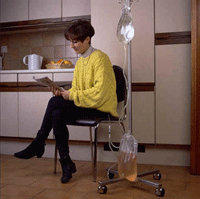
  1.  Peritoneal Dialysis (PD): This has been argued as one of the simplest form of dialysis with limited life style interruptions and high degree of freedom. In this form of dialysis a synthetic tube is placed in the abdominal cavity which then allows dialysis by exchange of dialysis fluid at regular intervals. It can be tailored to individual needs so that the patient can perform this at night while asleep with the help of a small machine called “Cycler” or during daytime by performing around four manual exchanges, each lasting around 15-30 minutes. Because of its simplicity, PD is many times a chosen modality for persons with busy lifestyle, active family responsibilities and significant time constraints.
  2. Home Hemodialysis (HHD): Advances in dialysis technologies in recent times has highly simplified the above-mentioned form of hemodialysis allowing it to be performed in the comforts of patients’ home. Development of smaller dialysis machine that can be placed on a nightstand; and simpler blood tubing and dialyzer connections, has resulted in increasing number of patients choosing this modality of dialysis to preserve their independence and high functional status. Though the typical duration for individual patient varies, these form of dialysis can be tailored for an individual’s needs with 5-6 times a week frequency for dialysis with each individual session duration ranging from 3-6 hours. The shorter versions called short daily hemodialysis (SDHD) whereas the longer versions are typically performed at night and thus called nocturnal hemodialysis (NHD). The typical home hemodialysis allows a much higher clearance compared to other forms of dialysis and thus gives greater freedom in terms of dietary restriction and life style choice.
  3. In Center Hemodialysis (HD): Where blood is taken out of the body through a complex set of tubes, run through a filter called dialyzer, cleaned off various impurities, and returned back to the patient. During its passage through the filter, the blood comes in contact with dialysate, which mirrors the body fluid except for the presence of impurities.  This is conventionally performed in dialysis centers across various medical and commercial facilities and typically involves patients receiving dialysis three times a week (either on Monday, Wednesday and Friday OR Tuesday, Thursday and Saturday) with four hour session each time. This is a relatively complex form of dialysis with rigid treatment structure and limited flexibility in terms of patients’ time, mobility and transportation. Additionally, this involves creation and maintenance of vascular access such as dialysis catheter or creation of AV fistula or graft, in either arm or groin to access high flows of blood needed to perform dialysis.

It is uniformly agreed that no single type of dialysis (home Vs In-center dialysis, or Hemo Vs peritoneal dialysis) is superior to others in terms of hard clinical endpoints e.g. mortality or cardiovascular deaths.  However, home dialysis modalities (both PD and HHD) provide significant advantages in multiple outcome parameters important to the management of patients with ESRD namely quality of life, freedom of travel, greater liberty from dietary restrictions, preservation of residual kidney function etc.

Historically, analyses of various patient cohorts in US have consistently revealed that; a privileged patient cohort more frequently chooses a home dialysis. This in many circumstances have been reflected by higher use of peritoneal dialysis in patients that are Caucasians, patients with higher education, patient under the care of nephrologists during the pre-ESRD period, patients receiving pre-dialysis education etc. In fact, nearly half of the patients when provided with a comprehensive pre-dialysis education (CPE) opt for home dialysis. Additionally both individual kidney physician surveys and recommendations of various professional medical societies now recommend a higher utilization of home dialysis. Despite these, only a minority of ESRD patients in US are on Home dialysis modalities. Lack of patient awareness due to lack of pre-dialysis education and scarcity of medical experts performing the home dialysis therapies are the two principle reasons for this underutilization of Home dialysis therapies.

Considering these facts, University of Florida and DCI have established a specialized clinic and education set up where a comprehensive pre-dialysis education (CPE) will be provided to the patients with stage IV (pre-dialysis) CKD along with their multispecialty care for various ailments of CKD. This clinic will put a special emphasis on the comprehensive care of CKD patients with special attention towards their dietary needs, their social and pharmacological concerns and their awareness and needs for decision making for their eventual dialysis or transplant therapies.

In conclusion of renal failure and if you are chronic, it’s not always easy to decide which type of treatment is best for you. Your decision depends on your medical condition, lifestyle, and personal likes and dislikes.

**Discuss the pros and cons of each with your health care team. If you start one form of treatment and decide you’d like to try another, talk it over with your doctor. The key is to learn as much as you can about your choices. With that knowledge, you and your doctor will choose a treatment that suits you best.**

I hope this article help you in some small way or more in dealing with your chronic renal failure.  Know your not alone and have many sites and places in giving you direction and support!

  Always do a Comparison of dialysis methods :  Hemodialysis and Peritoneal dialysis:    
What is usually involved            HEMODIALYSIS

  • Before hemodialysis treatments can begin, your doctor will need to create a site where blood can flow in and out of your body.
  • Hemodialysis uses a man-made membrane called a dialyzer to clean your blood. You are connected to the dialyzer by tubes attached to your blood vessels.
  • You will probably go to a hospital or dialysis center on a fairly set schedule. Hemodialysis usually is done 3 days a week and takes 3 to 5 hours a day.
  • You may be able to do dialysis at home. Home hemodialysis requires training for you and at least one other person. Your home may need some changes so that the equipment will work. You may have choices in how often and how long you can have dialysis, such as every day for shorter periods, long nighttime dialysis, or several times a week for 3 to 5 hours a day.
         PERITONEAL DIALYSIS

  • Your will have a catheter placed in your belly (dialysis access) before you begin dialysis.
  • Peritoneal dialysis uses the lining of your belly, which is called the peritoneal membrane, to filter your blood.
  • The process of doing peritoneal dialysis is called an exchange. You will usually complete 4 to 6 exchanges every day.
  • You will be taught how to do your treatment at home, on your own schedule.
Advantages
  • It is most often done by trained health professionals who can watch for any problems.
  • It allows you to be in contact with other people having dialysis, which may give you emotional support.
  • You don’t have to do it yourself, as you do with peritoneal dialysis.
  • You do it for a shorter amount of time and on fewer days each week than peritoneal dialysis.
  • Home hemodialysis can give you more flexibility in when, where, and how long you have dialysis.
  • It gives you more freedom than hemodialysis. It can be done at home or in any clean place. You can do it when you travel. You may be able to do it while you sleep. You can do it by yourself.
  • It doesn’t require as many food and fluid restrictions as hemodialysis.
  • It doesn’t use needles.
Disadvantages
  • It causes you to feel tired on the day of the treatments.
  • It can cause problems such as low blood pressure and blood clots in the dialysis access.
  • It increases your risk of bloodstream infections.
  • Home hemodialysis may require changes to your home. You and a friend will need to complete training.
  • The procedure may be hard for some people to do.
  • It increases your risk for an infection of the lining of the belly, called peritonitis

QUOTE FOR THE WEEKEND:

“The stages of CKD (Chronic Kidney Disease) are mainly based on measured or estimated GFR (Glomerular Filtration Rate). There are five stages but kidney function is normal in Stage 1, and minimally reduced in Stage 2.”

The Renal Association (founded 1950)

Part III What GFR actually is + how GFR fits in with staging chronic renal failure and the treatment!

In general, kidney transplantation involves four phases:

  • The evaluation and listing phase
  • The pre-transplant waiting phase
  • The transplant surgery
  • The postoperative care and maintenance phase

________________________________________________

     PartIIIRenalFailure3

What is GFR & how it relates to kidney damage?

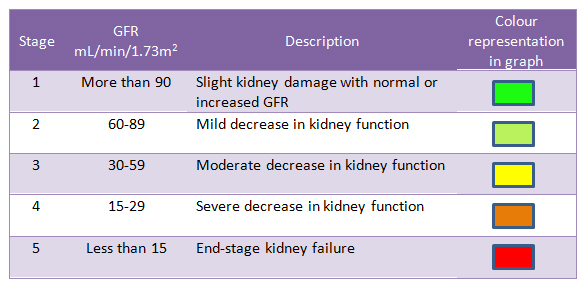
GFR – glomerular filtration rate is the best test to measure your level of kidney function and determine your stage of kidney disease. Your doctor can calculate it from the results of your blood creatinine test, your age, body size and gender. Your GFR tells your doctor your stage of kidney disease and helps the doctor plan your treatment. If your GFR number is low, your kidneys are not working as well as they should. The earlier kidney disease is detected, the better the chance of slowing or stopping its progression.

What are the Stages of Chronic Kidney Disease (CKD)?

Stage Description (GFR)
At increased risk Risk factors for kidney disease (e.g., diabetes, high blood pressure, family history, older age, ethnic group) More than 90
1 Kidney damage with normal kidney function 90 or above
2 Kidney damage with mild loss of kidney function 89 to 60
3a Mild to moderate loss of kidney function 59 to 44
3b Moderate to severe loss of kidney function 44 to 30
4 Severe loss of kidney function 29 to 15
5 Kidney failure Less than 15
Your GFR number tells you how much kidney function you have. As kidney disease gets worse, the GFR number goes down.

What happens if my test results show I may have chronic kidney disease?

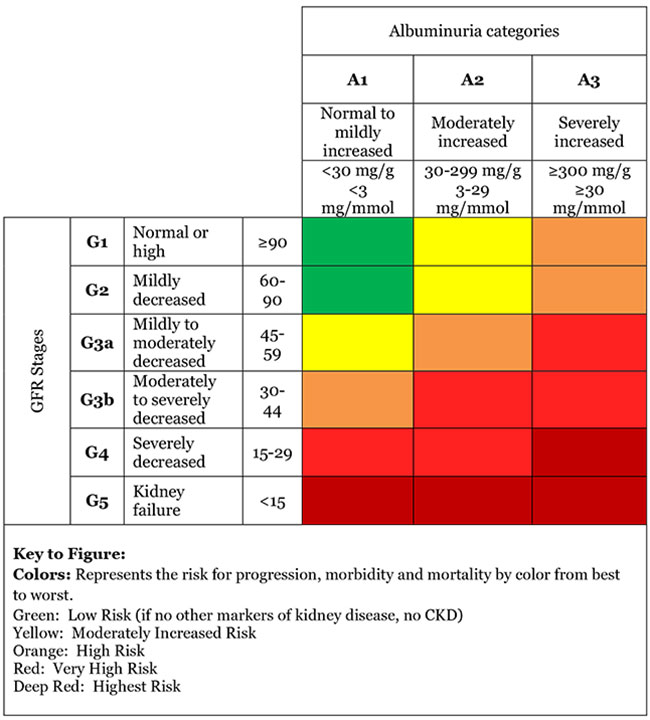
    • A GFR below 60 for three months or more or a GFR above 60 with kidney damage (marked by high levels of albumin in your urine) indicates chronic kidney disease. Your doctor will want to investigate the cause of your kidney disease and continue to check your kidney function to help plan your treatment.
    • Typically, a simple urine test will also be done to check for blood or albumin (a type of protein) in the urine. When you have albumin in your urine it is called albuminuria.  Blood or protein in the urine can be an early sign of kidney disease.
  • People with a high amount of albumin in their urine are at an increased risk of having chronic kidney disease progress to kidney failure; (See chart below looking at both where stages of chronic renal failure with albumin levels are when looked at together to put finalize what CRF stage you are in).

                                    PartIIIRenalFailureGFR


  • Your doctor may also suggest further testing, if necessary, such as:
  • Imaging tests such as an ultrasound or CT scan to get a picture of your kidneys and urinary tract. This tells your doctor whether your kidneys are too large or too small, whether you have a problem like a kidney stone or tumor and whether there are any problems in the structure of your kidneys and urinary tract.
  • A kidney biopsy, which is done in some cases to check for a specific type of kidney disease, see how much kidney damage has occurred and help plan treatment. To do a biopsy, the doctor removes small pieces of kidney tissue and looks at them under a microscope.
  • What is a normal GFR number in a lifetime?

  • In adults, the normal GFR number is more than 90. GFR declines with age, even in people without kidney disease.See chart below for average estimated GFR based on age.
  • Your doctor may also ask you to see a kidney specialist called a nephrologist who will consult on your case and help manage your care.
Age (years) Average estimated GFR
20–29 116
30–39 107
40–49 99
50–59 93
60–69 85
70+ 75

To treat CHRONIC RENAL FAILURE (CRF):

Follow a diet that is easy on your kidneys. A dietitian can help you make an eating plan with the right amounts of salt (sodium) and protein. You may also need to watch how much fluid you drink each day.

Make exercise a routine part of your life. Work with your doctor to design an exercise program that is right for you.

Do not smoke or use tobacco.

Do not drink alcohol.

When kidney function falls below a certain point, it is called Kidney failure. Kidney failure affects your whole body. It can cause serious heart, bone, and brain problems and make you feel very ill. Untreated kidney failure will be life-threatening at some point.

When you have kidney failure, you will probably have two choices: start dialysis or get a new kidney (transplant). Both of these treatments have risks and benefits. Talk with your doctor to decide which would be best for you.

Always talk to your doctor before you take any new medicine, including over-the-counter remedies, prescription drugs, vitamins,or herbs. These can hurt the kidneys further.

In COMPLETE RENAL FAILURE you have 2 choices for  Rx.:

1**-Dialysis is a process that filters your blood when your kidneys no longer can. It is not a cure, but it can help you feel better and live longer.  There is hemodialysis or peritoneal dialysis.

2-**Kidney transplant may be the best choice if you are otherwise healthy. With a new kidney, you will feel much better and will be able to live a more normal life. But you may have to wait for a kidney that is a good match for your blood and tissue type. And you will have to take medicine for the rest of your life to keep your body from rejecting the new kidney.  

John for your knowledge – Westchester Medical Center enjoys a long and illustrious history in kidney transplantation, having performed well over 2100 kidney transplants since the program opened in 1989. 

Making treatment decisions when you are very ill is hard! It is normal to be worried and afraid. Discuss your concerns with your loved ones and your doctor. It may help to visit a dialysis center or transplant center and talk to others who have made these choices. 


QUOTE FOR FRIDAY:

“Occasionally, acute kidney failure causes permanent loss of kidney function, or end-stage renal disease. People with end-stage renal disease require either permanent dialysis — a mechanical filtration process.”

MAYO CLINIC

QUOTE FOR WEDNESDAY:

“IBS is diagnosed by assessing symptoms and ruling out other conditions such as polyps, inflammation, food intolerance or allergies, and celiac disease. Doctors will perform a physical examination, blood tests, and an x-ray of the bowel. A colonoscopy also will be performed.”

NYP.ORG Columbia Presbyterian Digestive Diseases

QUOTE FOR MONDAY:

“There is increasing evidence that, with support from a caring adult and high-quality treatment, many children and parents effectively recover and may feel stronger and closer as a family in the aftermath of a traumatic experience.”

Esther Deblinger, PhD, an expert in the field of child sexual abuse (and co-director of the CARES Institute)

QUOTE FOR THURSDAY:

Today, the Centers for Disease Control and Prevention (CDC) announced that the incidence rate of autism among eight year olds in the United States remains 1 out of 68 children. This updated report occurs every two years, with the previous report being released from the CDC in April 2014.

Autism Society . Org