


Archive | July 2016

QUOTE FOR FRIDAY:

Treatment for Cushing’s syndrome depends on its cause. Surgery may be needed to remove the tumor or the pituitary or adrenal glands. Other treatment may include radiation, chemotherapy, and use of certain hormone-inhibiting drugs.

John Hopkins Medicine


Part II Cushing’s Syndrome Treatments

cushing's diagnosing  cushing's medical treatment


 Treatment of Cushings Syndrome:

 Treatment of cushings syndrome is by castigation of the under lying cause. Treatments for Cushing’s syndrome are contrived to pass your body’s cortisol production to normal. By indurate, or even distinctly lowering cortisol levels, you’ll feel evident improvements in your signs and symptoms. Left untreated, however, Cushing’s syndrome can finally induce to death. The treatment choice depend on the cause. For example:

*If a tumour in an adrenal gland is the reason, an operation to withdraw it will cure the condition.

*For adrenal hyperplasia, both adrenal glands may require to be withdraw. You will then require to take lifelong replacement therapy of several adrenal hormones.

*Other tumours in the body that produce ‘ectopic’ ACTH may be able to be removed, depending on the kind of tumour, where it is, etc.

*Medication to block the production or consequence of cortisol may be a choice.

 Ending line treatments for Cushing syndrome are designed to lower the high level of cortisol in your body. The best treatment for you depends on the cause of the syndrome. Treatment options include:

  • Reducing corticosteroid use. If the cause of Cushing syndrome is long-term use of corticosteroid medications, your doctor may be able to keep your Cushing signs and symptoms under control by reducing the dosage of the drug over a period of time, while still adequately managing your asthma, arthritis or other condition. For many of these medical problems, your doctor can prescribe noncorticosteroid drugs, which will allow him or her to reduce the dosage or eliminate the use of corticosteroids altogether.

Don’t reduce the dose of corticosteroid drugs or stop taking them on your own. Do so only under your doctor’s supervision.

Abruptly discontinuing these medications could lead to deficient cortisol levels. Slowly tapering off corticosteroid drugs allows your body to resume normal cortisol production.

  • Surgery. If the cause of Cushing syndrome is a tumor, your doctor may recommend complete surgical removal. Pituitary tumors are typically removed by a neurosurgeon, who may perform the procedure through your nose. If a tumor is present in the adrenal glands, lungs or pancreas, the surgeon can remove it through a standard operation or in some cases by using minimally invasive surgical techniques, with smaller incisions.

After the operation, you’ll need to take cortisol replacement medications to provide your body with the correct amount of cortisol. In most cases, you’ll eventually experience a return of normal adrenal hormone production, and your doctor can taper off the replacement drugs.

However, this process can take up to a year or longer. In some instances, people with Cushing syndrome never experience a resumption of normal adrenal function; they then need lifelong replacement therapy.

  • Radiation therapy. If the surgeon can’t totally remove a pituitary tumor, he or she will usually prescribe radiation therapy to be used in conjunction with the operation. Additionally, radiation may be used for people who aren’t suitable candidates for surgery.

Radiation can be given in small doses over a six-week period, or with a technique called stereotactic radiosurgery (Gamma Knife surgery). In the latter procedure, administered as a single treatment, a large dose of radiation is delivered to the tumor, and the radiation exposure to surrounding tissues is minimized.

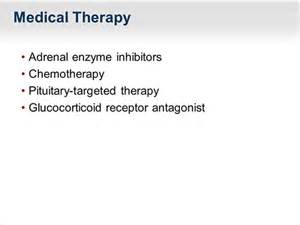
  • Medications. Medications can be used to control cortisol production when surgery and radiation don’t work. Medications may also be used before surgery in people who have become very sick with Cushing syndrome. Doctors may recommend drug therapy before surgery to improve signs and symptoms and minimize surgical risk.

Medications to control excessive production of cortisol at the adrenal gland include ketoconazole (Nizoral), mitotane (Lysodren) and metyrapone (Metopirone).

Mifepristone (Korlym) is approved for people with Cushing syndrome who have type 2 diabetes or glucose intolerance. Mifepristone does not decrease cortisol production, but it blocks the effect of cortisol on your tissues.

Side effects from these medications may include fatigue, nausea, vomiting, headaches, muscle aches, high blood pressure, low potassium and swelling. Some have more serious side effects, such as neurological side effects and liver toxicity.

The newest medication for Cushing’s is pasireotide (Signifor), and it works by decreasing ACTH production from a pituitary tumor. This medication is given as an injection twice daily. It’s recommended if pituitary surgery is unsuccessful or cannot be done.

Side effects are fairly common, and may include diarrhea, nausea, high blood sugar, headache, abdominal pain and fatigue.

In some cases, the tumor or its treatment will cause other hormones produced by the pituitary or adrenal gland to become deficient and your doctor will recommend hormone replacement medications.

If none of these treatment options are appropriate or effective, your doctor may recommend surgical removal of your adrenal glands (bilateral adrenalectomy). This procedure will cure excess production of cortisol, but will require lifelong replacement medications.

Complications are rare but include:

Bruising on your thigh

Ear pain during the procedure

Very rarely, neurological problems

QUOTE FOR THURSDAY:

“Cushing’s syndrome is a hormonal disorder caused by prolonged exposure of the body’s tissues to high levels of the hormone cortisol.”

NIH National Institute of Diabetes and Digestive and Kidney Diseases (U.S. Department of Health and Human Services)

QUOTE FOR WEDNESDAY:

“The Centers for Disease Control and Prevention estimates that 294,000 children in the United States have been diagnosed with arthritis and other rheumatic conditions.”

CDC Centers for disease and control

QUOTE FOR TUESDAY:

“Hepatitis types B and C lead to chronic disease in hundreds of millions of people and, together, are the most common cause of liver cirrhosis and cancer.”

WHO World Health Organization


QUOTE FOR MONDAY:

“Scientists have identified 5 unique hepatitis viruses, identified by the letters A, B, C, D, and E. While all cause liver disease, they vary in important ways.”

World Health Organization


The diagnosis and Treatment of Chronic Kidney (Renal) Failure = CRF Chronic Renal Failure


kidney disease 3    chronic-kidney-disease-25-728

chronic-kidney-disease-image  Kidney Tranplant Tourism

Kidney Transplant Tourism 2

There are things you can do to slow or stop the damage to your kidneys. Taking medicines and making some lifestyle changes can help you manage your disease, prevent further damage to the kidneys, if their functioning at all and make you possibly feel better.

Kidney disease is a complex problem. You will probably need to take a number of medicines and have many tests. To stay as healthy as possible, take your medicines just the way your doctor says to and work closely with your doctor.

Go to all your appointments for the MD to see a increase in function or decrease in function of your kidney or kidneys you have still functioning to a level. To do that you can’t just go every 6 months especially when first diagnosed with it or with a collapse of an exacerbation of kidney failure in a worse level that brought on new symptoms that brought you to the ER.

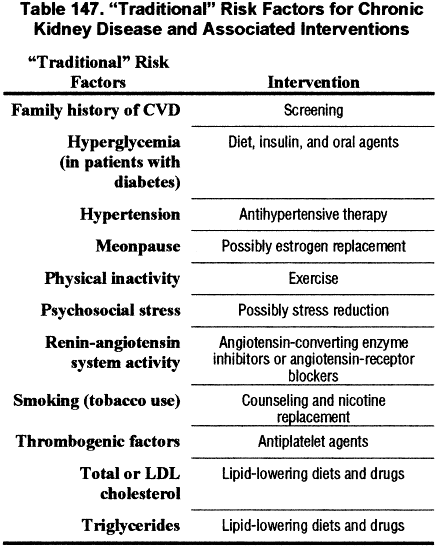
Lifestyle changes are an important part of your treatment. Taking these steps can help slow down kidney disease and reduce your symptoms. These steps may also help with high blood pressure, diabetes, and other problems that make kidney disease worse or made the kidney disease happen with the secondary diagnosis you had originally for years (ex. Hypertension or Diabetes if not both especially is uncontrolled)

Very hard, never a complete 100 % resolution. It is like emphysema done by smokers the damage is done or like a heart attack the area of the infarction=damage is already done to the heart muscle.

Scared now, understandable but unfortunately the damage is done, so its get the organ to its optimal level of functioning or replace the damaged kidney (s) through a transplant of one.  You need to know this, do it if you want to live LONGER.  Remember fear is fear itself, the fear run it over and deal with what you have and make your life longer & better!  It’s all up to you.  HANDSOME I know you can do it , I am there for you as a good friend and professional RN and I would love you to last longer John!! XO

You may have a test done that lets your doctor look at a picture of your kidneys, such as an ultrasound or CT (Cat Scan of the kidneys). These tests can help your doctor measure the size of your kidneys, estimate blood flow to the kidneys, and see if urine flow is blocked. In some cases, your doctor may take a tiny sample of kidney tissue (biopsy) to help find out what caused your kidney disease.

Chronic kidney disease is caused by damage of the kidneys whether the cause of it be primary a Renal or Kidney problem or a secondary, another disease or disorder that affects the kidneys in doing their job, like hyperglycemia related to a individual with uncontrolled diabetes, for instance.

Chronic kidney disease may seem to have come on suddenly. But it has been happening bit by bit for many years as a result of damage to your kidneys.

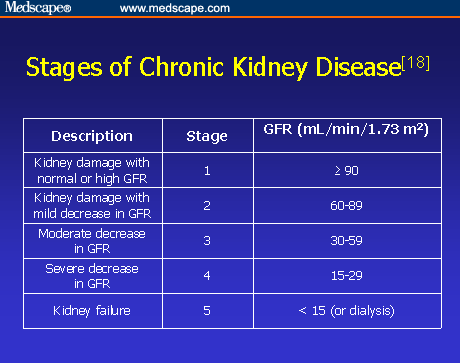
One way to measure how well your kidneys are working is to figure out your glomelular filtration rate (GFR). The GFR is usually calculated using results from your blood creatinine test. Then the stage of kidney disease is figured out using the GFR (glomelular filtration rate). There are five stages of kidney disease, from kidney damage with normal GFR to kidney failure.

Your doctor will do tests that measure the amount of urea (BUN) and creatinine in your blood. These tests can help measure how well your kidneys are filtering your blood. As your kidney function gets worse, the amount of nitrogen (shown by the BUN test) and creatinine in your blood increases. The level of creatinine in your blood is used to find out the glomerular filtration rate (GFR). The GFR is used to show how much kidney function you still have. The GFR is also used to find out the stage of your kidney disease your in if you have it and its to guide decisions about treatment. *

To treat CRF:

Follow a diet that is easy on your kidneys. A dietitian can help you make an eating plan with the right amounts of salt (sodium) and protein. You may also need to watch how much fluid you drink each day.

Make exercise a routine part of your life. Work with your doctor to design an exercise program that is right for you.

Do not smoke or use tobacco.

Do not drink alcohol.

When kidney function falls below a certain point, it is called Kidney failure. Kidney failure affects your whole body. It can cause serious heart, bone, and brain problems and make you feel very ill. Untreated kidney failure will be life-threatening at some point.

When you have kidney failure, you will probably have two choices: start dialysis or get a new kidney (transplant). Both of these treatments have risks and benefits. Talk with your doctor to decide which would be best for you.

Always talk to your doctor before you take any new medicine, including over-the-counter remedies, prescription drugs, vitamins,or herbs. These can hurt the kidneys further.

In COMPLETE RENAL FAILURE you have 2 choices for  Rx.:

1**-Dialysis is a process that filters your blood when your kidneys no longer can. It is not a cure, but it can help you feel better and live longer.  There is hemodialysis or peritoneal dialysis.

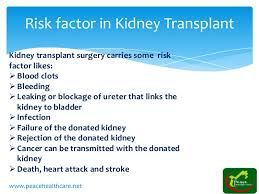
2-**Kidney transplant may be the best choice if you are otherwise healthy. With a new kidney, you will feel much better and will be able to live a more normal life. But you may have to wait for a kidney that is a good match for your blood and tissue type. And you will have to take medicine for the rest of your life to keep your body from rejecting the new kidney.    

Making treatment decisions when you are very ill is hard. It is normal to be worried and afraid. Discuss your concerns with your loved ones and your doctor. It may help to visit a dialysis center or transplant center and talk to others who have made these choices. 

Stayed tune for this weekend on Hemodialysis!

Part One Kidney failure both Acute and Chronic – Learn what they are and know what the difference is!

kidney1 kidney failure part 11b

kidney failurekidney images


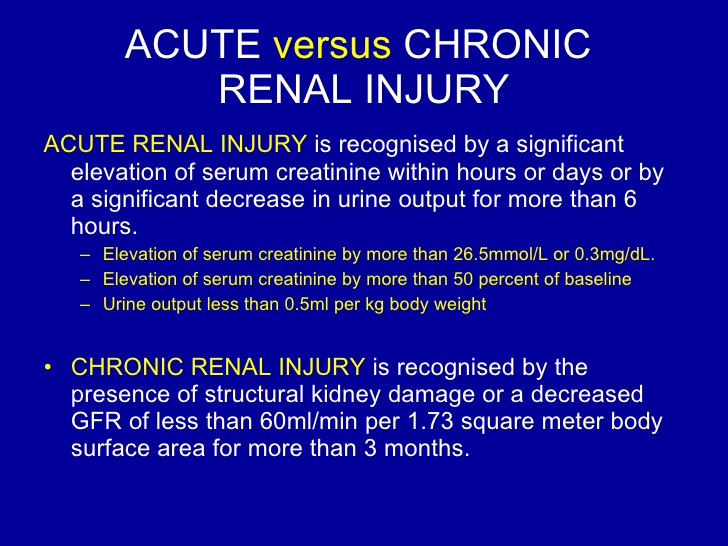
Kidney failure occurs when the kidneys lose their ability to function. To treat kidney failure effectively, it is important to know whether kidney disease has developed suddenly (acute) or over the long term (chronic). Many conditions, diseases, and medicines can create situations that lead to acute and chronic kidney disease. Acute kidney injury, also called acute renal failure, is more commonly reversible than chronic kidney failure since the chronic condition has lasted longer in the body affecting systems for several months to years (some decades). Acute Renal Failure is new to the body as opposed to chronic; making it higher odds this can be treated and cured.

When acute kidney injury (ARF) occurs, the kidneys are unable to remove waste products and excess fluids, which then build up in the body and upset the body’s normal chemical balance.*

The most common causes of acute kidney injury are:

-dehydration

-blood loss from major surgery or injury

-medicines such as nonsteroidal anti-inflammatory drugs (NSAIDs), antibiotics, or the dyes (contrast agents) used in X-ray tests.

Symptoms depend on the cause of acute renal failure and can include:

    • -Little or no urine output.
    • -Dizziness upon standing.
    • -Swelling, especially of the legs and feet.
    • -Loss of appetite, nausea, and vomiting.
    • -Feeling confused, anxious and restless, or sleepy.
    • -Pain in the flank, which is felt just below the rib cage and above the waist on one or both sides of the back.*

If your signs and symptoms suggest that you have acute kidney failure, your doctor may recommend certain tests and procedures to verify your diagnosis. These may include:

  • Urine output measurements. The amount of urine you excrete in a day may help your doctor determine the cause of your kidney failure.
  • Urine tests. Analyzing a sample of your urine, a procedure called urinalysis, may reveal abnormalities that suggest kidney failure.
  • Blood tests. A sample of your blood may reveal rapidly rising levels of urea and creatinine — two substances used to measure kidney function.  Most cases of acute kidney injury occur in people who are already in the hospital for other reasons. In these people, acute kidney injury is usually diagnosed when routine tests show a sudden increase in creatinine and blood urea nitrogen (BUN) levels. A buildup of these waste products in the blood points to a loss of kidney function!**
  • Imaging tests. Imaging tests such as ultrasound and computerized tomography may be used to help your doctor see your kidneys.  Also commonly done is an ultrasound of the kidneys which may help determine whether kidney problems are acute or chronic. Normal-sized kidneys may be present in either condition, but when both kidneys are smaller than normal, chronic kidney disease is usually the problem.  This helps rule out acute from chronic.correcting the cause and supporting the kidneys with dialysis until proper functioning is restored.
  • Removing a sample of kidney tissue for testing. In some situations, your doctor may recommend a kidney biopsy to remove a small sample of kidney tissue for lab testing. Your doctor inserts a needle through your skin and into your kidney to remove the sample.

TREATMENT FOR ARF (reversible in most cases)

Treatment for acute kidney failure typically requires a hospital stay. Most people with acute kidney failure are already hospitalized. How long you’ll stay in the hospital depends on the reason for your acute kidney failure and how quickly your kidneys recover.

In some cases, you may be able to recover at home.

Treating the underlying cause of your kidney failure

Treatment for acute kidney failure involves identifying the illness or injury that originally damaged your kidneys. Your treatment options depend on what’s causing your kidney failure.

CHRONIC KIDNEY DISEASE (CRF):

In giving a short and easily understandable definition Chronic kidney disease happens when your kidneys no longer filter your blood the way they should, so wastes (toxins, usually end products of an acid) build up in your blood. This has probably been going on for years, and it may keep getting worse over time. Just like a car engine damaged but still using the car without getting the engine repaired sooner or later in time the engine no longer functions the same with any organ of the body getting damaged by some long term condition. If your disease gets worse and worse over time, you could have kidney failure or some multi organ failure, depending on the condition causing this.


Regarding Chronic Kidney Failure the causes can be:

** Diabetes (uncontrolled diabetes (Type 1 or 2) for many years.

** High blood pressure for many years.

These are the top 2 causes of most chronic kidney disease. Controlling these diseases can help slow or stop the damage to the individual’s kidneys who has one of these, if not both.

Other common causes of chronic renal failure include:

-recurring pyelonephritis (kidney infection)

-polycystic kidney disease (multiple cysts in the kidneys

-autoimmune disorders such as systemic lupus erythematosus.

-hardening of the arteries, which can damage blood vessels in the kidney.

-A narrowed or blocked renal artery. A renal artery carries blood to the kidneys. Know this for starters, each of your kidneys has about a million tiny filters, called nephrons. The nephron is the tiny filtering structure in your kidneys. Each of your kidneys contain more than a million tiny filtering nephrons that help clean your blood removing toxins dumping them into your urinary bladder so you can evacuate them though urine (urea, urine; get it). Your nephrons play a vital role to our essential daily living. If over a long time you have a renal artery blocked the nephrons stop their function and die.

Remember the nephrons help all humans do the following if there kidneys or one kidney is functioning properly:

-Remove excess water, wastes (like urea, ammonia, etc.) & other substances from your blood.

-Return substances like sodium, potassium or phosphorus to the body whenever any of these substances run llow in your body or do the opposite if they run high to evacuate them through voiding dumping the sodium or phosphorus or potassium in the urinary bladder through the tube from the kidneys to the urinary bladder called ureters.

**If nephrons are damaged by the high sugar content or high blood pressure in the kidneys, they stop working. For a while, healthy nephrons can take on the extra work or overload. But if the damage continues, more and more nephrons shut down. After a certain point, the nephrons that are left cannot filter your blood well enough to keep you’re blood filtered properly to keep you healthy. Just like running from a bear in the street chancing you. We can run only so long but sooner or later we will run out of energy and not be able to run anymore, same concept for the kidney nephrons when they run out of enough energy due to the kidneys not properly working.**

The symptoms can be:

Urinate less than normal.

Have swelling and weight gain from fluid buildup in your tissues. This is called edema.

Feel very tired or sleepy.

Not feel hungry, or you may lose weight without trying.

Often feel sick to your stomach (nauseated) or vomit.

Have trouble sleeping.

Have headaches or trouble thinking clearly.

So what will you do GO TO A DOCTOR OR CALL 911 AND GO TO THE ER:

Your doctor will do blood and urine tests to help find out how well your kidneys are working. These tests can show signs of kidney disease and anemia. (You can get anemia from having damaged kidneys.) You may have other tests to help rule out other problems that could cause your symptoms.

To diagnose chronic renal failure is pretty much the same tests that are listed above on acute renal failure plus:

Chronic kidney disease is also called chronic renal failure or chronic renal insufficiency.There are five stages of kidney disease, from kidney damage with normal GFR to kidney failure.  So GFR will help the MD rule out acute versus chronic to give the MD direction on Rx.Your doctor will ask questions about any past kidney problems. He or she will also ask whether you have a family history of kidney disease and what medicines you take, both prescription and over-the-counter drugs.