Archive | January 2023

QUOTE FOR TUESDAY:

“Alagille syndrome can often be difficult to diagnose because it has signs and symptoms similar to those of other liver diseases, such as biliary atresia. There are several ways to diagnose Alagille syndrome, such as liver function tests, heart evaluations, eye exams, ultrasounds, and genetic testing.  Alagille syndrome can develop by chance with no history of the disease in the family. However, in up to 50% of cases, the disease is passed down from a parent.”

AlagilleSyndrome.com  (https://alagillesyndrome.com/?gclid=EAIaIQobChMIh5vN_q3j_AIVF_rICh0a1A5VEAAYASAAEgID4fD_BwE&gclsrc=aw.ds)

QUOTE FOR MONDAY:

“It’s estimated that 6 out of 10 Americans suffer from a chronic disease, and 4 of those 10 suffer from two or more. These diseases include: type 2 diabetes, Alzheimer’s, stroke, heart disease, cancer, chronic kidney disease and chronic lung disease.”

Centers for Disease Control and Prevention (CDC)

The Top Health Challenges in America!

Chronic Diseases in America

10 people

4 IN 10                                                              6 in 10

Adults in the U.S.                                         Adults in the U.S.

Have two or more                                         have a chronic disease     

The CDC; states Chronic diseases—such as heart disease, cancer, and diabetes—are the leading causes of death and disability in the United States. They are also leading drivers of the nation’s $4.1 trillion in annual health care costs.

Most chronic diseases are caused by key risk behaviors:

  • Tobacco use and exposure to secondhand smoke.
  • Poor nutrition, including diets low in fruits and vegetables and high in sodium and saturated fats.
  • Physical inactivity.
  • Excessive alcohol use.

These behaviors can lead to conditions such as high blood pressure or obesity, which raise the risk of the most common and serious chronic diseases.

The top 10 leading causes of death are still heart disease, cancer, diabetes, stroke and cerebral vascular diseases, chronic lower respiratory diseases, kidney disease, alzheimer’s disease, suicide, unintentional injuries and influenza and pneumonia.

1. Heart Disease

Number of deaths per year: 635,260

Percent of total deaths: 23.1 percent

More common among:

  • men
  • people who smoke
  • people who are overweight or obese
  • people with a family history of heart disease or heart attack
  • people over age 55

Remember the heart is our engine to our body; without the engine we die!  Heart disease runs into many other problems that would not develope without heart disease!

Tips in helping a person live longer and probably more productive with even possibly happier life:

Lifestyle changes can prevent many cases of heart disease and other diseases, such as the following:

  • Quit smoking.
  • Eat a healthier diet.
  • Exercise at least 30 minutes per day, five days a week.
  • Maintain a healthy weight.

QUOTE FOR THE WEEKEND:

“Anger can be a common emotion among people experiencing major depression. You may feel angry at the world, angry about events from your past, or even angry at yourself. This anger can be intense and difficult to control, to the point that it worsens your depression and affects your personal and professional relationships”.

Very Well Mind (https://www.verywellmind.com/connection-between-depression-and-anger)


QUOTE FOR FRIDAY:

“The New York Times reported that mental health providers have experienced an increased demand for services and a resulting “disenfranchised grief,” defined as a sense of loss related to safety, goals, social connections, and activities, accompanied by a sense of not having a right to grieve these losses because others have it worse []. USA Today noted that mental health providers have reported a flood of new clients, an overwhelming need to train others, and increased demand to both help stressed coworkers and deal with tougher cases (i.e, more intimate partner violence, systemic racism, clients placing themselves at risk). Their workloads have resulted in teletherapy fatigue, and they have reported guilt regarding answers they could not give, people they had to turn away, potentially exposing loved ones to COVID-19, or for taking time off to recover from COVID-19. They also noted that they had lost their normal coping strategies, such as decompressing on the drive home, stopping to speak with colleagues between clients, and socializing with friends.”

National Library of Medicine (https://www.ncbi.nlm.nih.gov/pmc/articles/PMC8860255/)

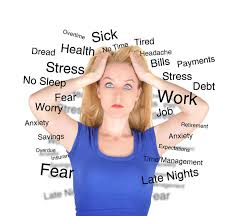
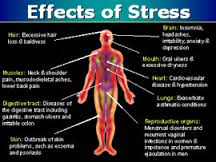
Stress versus Health especially since this disaster of COVID-19!

One way of looking at life is whatever challenges comes your way know you will survive and for any losses you may experience when looking back on them take the positive aspects or memories not the negative that builds a bad effect on you (Ex. Insomnia to depression to high blood pressure to alcoholism to drugs).   A positive effect can be as simple as a smile when reflecting memories, which FYI allows less frowning that will cause less wrinkles on the forehead, as we get older.  Sometimes it’s not that simply and when it gets harder take up a constructive way of dealing with it (Ex. Work out at your level, walking, singing, go to a comedy movie, get together with friends go out, and do anything that gets your mind off of the stress and even out of your body through work out at the gym to just biking or walking.).

For starters stress is a body reaction to CHANGE.  How to you look at change?  Easy, positive!  It may not appear easy at first but try to look at this change as a sense of difficulty yet a challenge with a victory in the end, if approached right.  Let us take the following challenges, for example –  Having a child leave home for college or marriage, losing a home with this economy, a loss of a friend or family member in your life:  How do you look at these experiences positive?

Well for the child I would be so happy for her or him starting college life with my worries but know I raised her or him well and if he makes mistakes on the way he will learn to get up off the ground and fix them knowing he can come to me or dad whenever he has the need or if we sense a problem we would address it (Its part of life=growing up).  Another aspect to look at regarding this stress is there is loss in the parent role so fill up that loss with a new hobby, or get active in whatever organization you are in (Ex. Church, Temple, School, to just taking up ceramics or do more traveling with your spouse and friends).   I had my falls with the stresses that I have come across but got up every time to stand again, some quicker than other times.  If I can do it so can you.

How do you deal with losing a home or a job with this economy now; well appreciate the good memories you had when you had the home and pick up starting a new life elsewhere with making it a journey down the yellow brick road leading you to where the rainbow is at the end; don’t look at it as a loss.  As for the job you once found a job position and will find another in few weeks to few months depending on the Corona Virus and great economy we have since our last election.

Dealing with losing a family member or friend, again, the way I look at it is I appreciate the time I had with her or him and know they haven’t left me in spirit (if deceased).   If the person is still living know there are reasons for everything; whatever the cause was for the reason for the relationship parting and when out of my control I think of how I had a good friendship as opposed to never having one with that individual.  I accept that nothing lasts forever or indefinitely, with appreciating the time I may have had with the person.  Ending note is I look at life this way, whatever positive entity comes in my life may be taken away from me and appreciate every moment you spend with that person or thing in your life that you love so much (including my life span that only upstairs knows how long that time factor will be but I try to live a life at its healthiest optimal level with practicing positive behavior which is knowing whatever stressors come my way there is always someone worse off and with God I can face anything.

If I don’t deal with stress like this than I can expect complications that may arise, just like for anyone else who looks at challenges coming their way in a negative sense.  You commonly see stress become a negative experience when a person faces continuous challenges/stressors without relief or relaxation between the them.  The ending result is the person becomes overworked and stress-related tension builds.  Stress that continues without positive resolution at some level can cause a condition called distress, which is a negative stress reaction.

The physical reactions that happen to your body due to negative stress:

-Elevated high blood pressure –Headaches –Chest Pain –Upset Stomach   –Insomnia –Grinding of the teeth –Jaw Tension –Teeth grinded down –Irritability –Anger –Panic episodes –Vasoconstriction to our vessels   causing increases to the heart rate –Decreases sex drive –Depression (Research even suggests that stress also can bring on or worsen certain symptoms or diseases.)

Stress costs American industry more than $300 billion a year. WOW !                    

The lifetime prevalence of an emotional disorder is more than 50%, often due to chronic, untreated stress reactions.

Remember, Stress is a normal part of life.  Many events that happen to you and around you — and many things that you do yourself (Ex. Work 40 to 60 hrs a week in a highly stressful job, like a staff nurse) – this will put stress on your body. You can experience stress from your environment, your body, and your thoughts.  You can also cause the stress to impact your body with first just signs and symptoms (s/s) developing, that are listed above, but without relief of the stress these s/s can lead you into a disease/illness forming or even make the diagnose (s) you already have even worse.

Many signs and symptoms pick up when exposed to continual stress or stresses that just build up on top of each other causing some people in developing unhealthy habits, poor dieting, and the lack of desire to be as active as they were which in turn develops conditions that would not have occurred if this negative behavior didn’t happen over a long period of time.

This behavior with the stress or stresses you are experiencing increases the probability of health conditions starting to take place in your body or if you’re with certain diagnoses already the stress can possibly impact your body by worsening the condition.    The conditions that can develop from any age of being under continual stress over a period of time are:

-ADD or ADHD –Panic disorders –High blood pressure –Anti-arrhythmias -Cardiac Disease -Diabetes 1 or Diabetes 2  -Stroke –Irritable Bowel Syndrome –Weight Gain/Obesity –Fibromyalgia –Complex Regional Pain Syndrome –ETOH -Depression and so much more.

 How to bypass developing conditions that can be caused from the long constant stress or stresses you experience? One method is fight back (fight or flight), and when it gets really difficult don’t turn to bad heath patterns in your life to deal with the stressors turn to a healthy diet, keeping a healthy weight for your body mass index (BMI) so you can deal better with fighting the stressors in your life (if not sure what your BMI is check online to find out how to calculated it, it is for free), and practice healthy habits.  You may be saying how to I even go about that or maybe it’s easy for me but not true.  Let me shine some light on this topic.  I was there many times before and found a resolution to help deal better with my stresses through a change in eating and I lost 22 lbs. and still I am trying with being physically challenged at this moment to get to my optimal shape.  If you want to check out how to deal effectively with your stress and live a healthier life for prevention of complications.

Do what it best for you and the people in your community or country.  Go outside when you need to shop for foods or things needed at the house for you and the family.  If you have Covid without question stay home. If someone at home has covid positive quarantine that member in a room and have people in the house negative use the home covid tests to check that their still negative as well as feeling well before going out.  When going out wear a mask.

QUOTE FOR THURSDAY:

“In 2011, the Kawasaki Disease Foundation declared January 26 the first National Kawasaki Disease Awareness Day in the United States, and they presented the resolution before the 111th Congress, 2nd Session.  The Kawasaki Disease Foundation chose this date because, on January 26, 1961, Dr. Tomisaku Kawasaki of Japan had his “aha” moment when he saw his second patient with the telltale signs of what would later be named Kawasaki disease (KD). KD is the leading cause of acquired heart disease in U.S. children, but with effective treatment, only a small percentage of KD patients have lasting coronary artery damage.”.

Kawasaki Foundation (https://kdfoundation.org/kd101/)


National Kawasaki Disease Day

Kawasaki disease (KD), also known as Kawasaki syndrome, is a severe illness characterized by inflammation of blood vessels throughout the body that primarily affects young children and infants. Kawasaki disease is the leading cause of acquired heart disease in children. Although about 80 percent of patients are under five years of age, older children and teenagers can also get KD, but this is uncommon. KD is more common in boys than girls, and the majority of cases are diagnosed in the winter and early spring. KD is not contagious.

The disease is named after Tomisaku Kawasaki, a Japanese pediatrician who first described the illness in the medical literature in 1967. Although it is more prevalent among children of Asian and Pacific Island descent, KD affects people of all racial and ethnic groups.

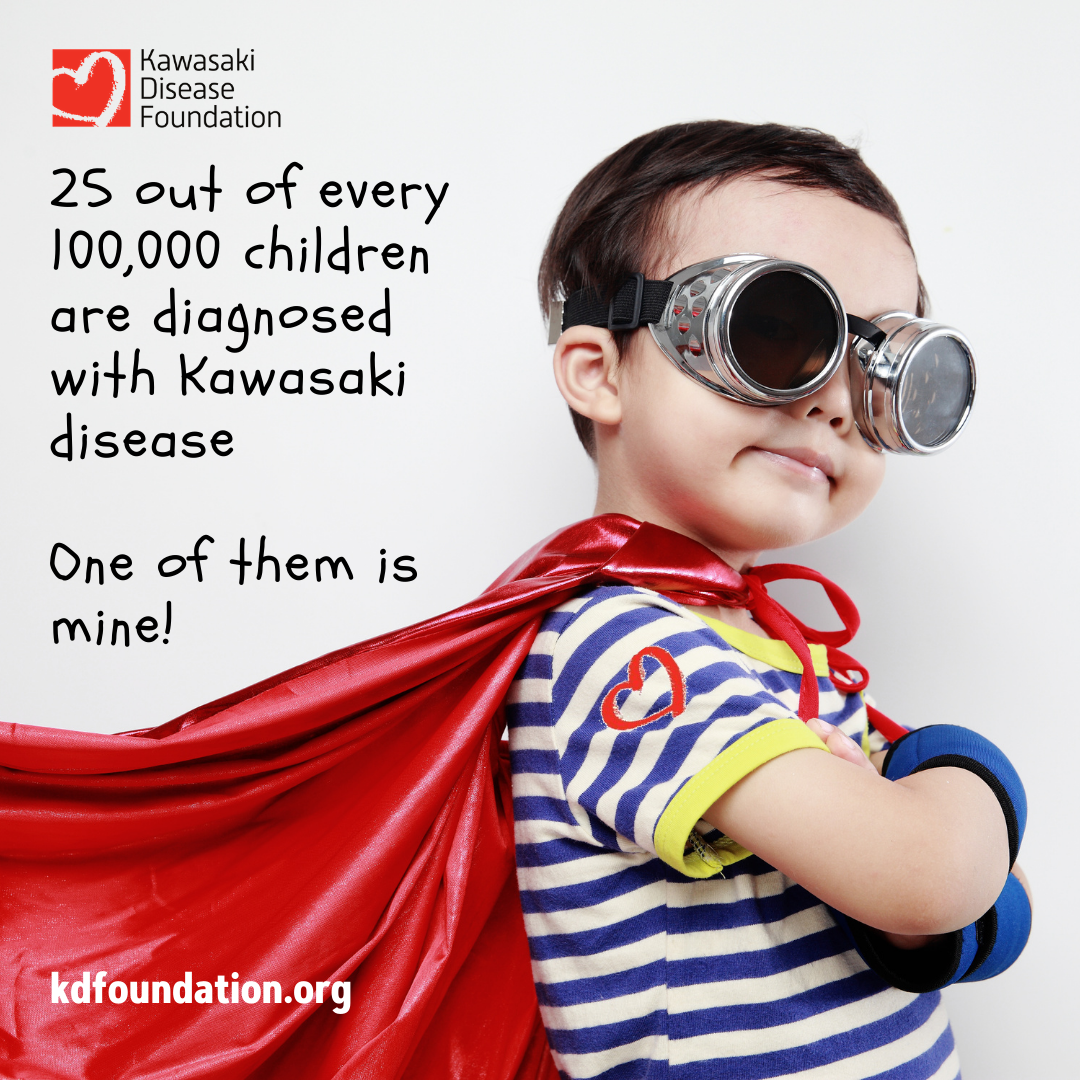
It is estimated that more than 4,200 children are diagnosed with Kawasaki Disease in the U.S. each year. The cause of KD is unknown, although an agent, like a virus, is suspected. There is no currently accepted scientific evidence that KD is caused by carpet cleaning or chemical exposure.

There is no specific test for KD; doctors make a clinical diagnosis based on a collection of symptoms and physical findings.

Symptoms

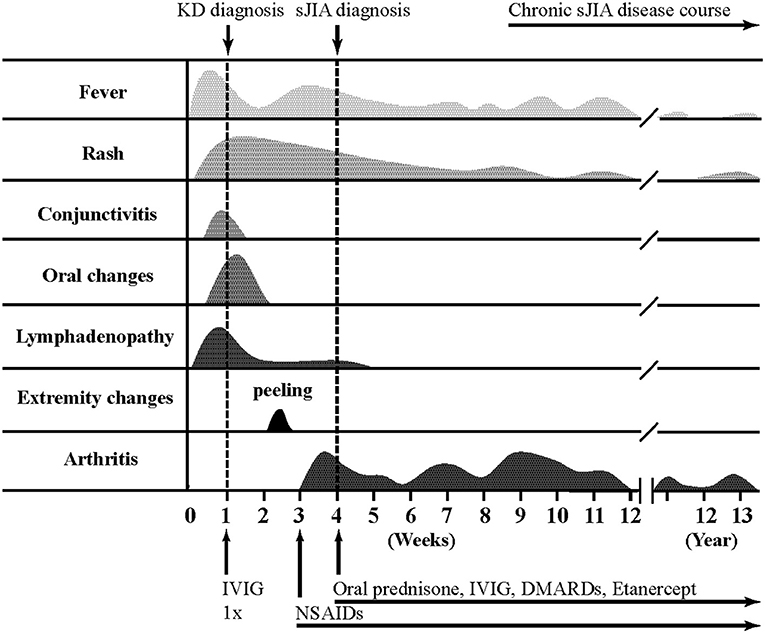
Kawasaki disease symptoms usually appear in three phases. Early symptoms of KD include:

Phase 1

  • A fever that is often higher than 102.2 F (39 C) and lasts at least five days
  • Bloodshot eyes (conjunctivitis) without a thick discharge
  • A rash on the main part of the body (trunk) and/or in the genital area
  • Red, dry, cracked lips and an extremely red, swollen tongue (strawberry tongue)
  • Swollen, red skin on the palms of the hands and the soles of the feet
  • Swollen lymph nodes in the neck

Phase 2

In the second phase of the disease, the symptoms may include:

  • Peeling of the skin on the hands and feet, especially the tips of the fingers and toes
  • Joint pain
  • Diarrhea
  • Vomiting
  • Abdominal pain

Phase 3

In the third phase of the disease, signs and symptoms will slowly fade away unless complications develop. Patients experiencing Kawasaki disease may experience tiredness, irritability and low energy for as long as eight weeks post the initial diagnosis.

Treatment and Complications

To reduce the risk of coronary artery complications, treatment for KD shall be started within ten days of the onset of symptoms. Most KD patients will recover from KD without any lasting heart damage; however, without treatment, about 25% of KD patients will develop abnormalities of the coronary arteries. Treatment for KD may include:

  • Gamma globulin (to lower the risk of coronary artery problems)
  • Aspirin (to treat inflammation, decrease pain and joint inflammation, as well as reduce the fever)

Kawasaki treatment is a rare exception to the rule against aspirin use in children but only when given under the supervision of your child’s doctor. Children who develop coronary artery abnormalities may be required to continue taking aspirin for six weeks or longer to prevent clotting. Taking aspirin has been linked to Reye’s Syndrome, a rare but potentially life-threatening condition that can affect the blood, liver, and brain of children and teenagers after a viral infection. Children who develop chickenpox or the flu during aspirin treatment may be required to stop taking aspirin.

QUOTE FOR WEDNESDAY:

” An estimated 300,000 children in the U.S. — that’s 1 in 250 kids — are affected by some form of JA. This disease takes a unique physical and emotional toll on kids, often resulting in debilitating pain and feelings of loneliness or depression. JA can make it especially challenging for kids to say Yes — Yes to playing, Yes to hanging out with friends, Yes to spending time with family, Yes to being a kid!”

Arthritis Foundation  (http://blog.arthritis.org/juvenile-arthritis/)


Types of Juvenile Arthritis

JIA

JIA

JIA3

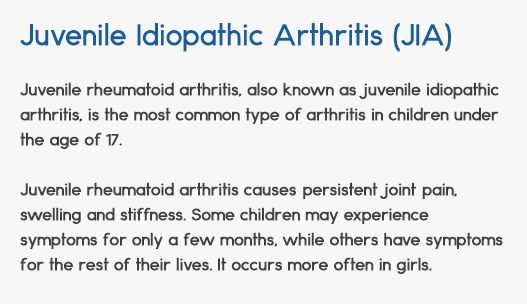
Juvenile arthritis (JA) is not a disease in itself. Also known as pediatric rheumatic disease, JA is an umbrella term used to describe the many autoimmune and inflammatory conditions or pediatric rheumatic diseases that can develop in children under the age of 16. Juvenile arthritis affects nearly 300,000 children in the United States.

Although the various types of juvenile arthritis share many common symptoms, like pain, joint swelling, redness and warmth, each type of JA is distinct and has its own special concerns and symptoms

Types of Juvenile Arthritis

  • Juvenile idiopathic arthritis (JIA). Considered the most common form of arthritis, JIA includes six subtypes: oligoarthritis, polyarthritis, systemic, enthesitis-related, juvenile psoriatic arthritis or undifferentiated.
  • Juvenile dermatomyositis. An inflammatory disease, juvenile dermatomyositis causes muscle weakness and a skin rash on the eyelids and knuckles. 
  • Juvenile lupus. Lupus is an autoimmune disease. The most common form is systemic lupus erythematosus, or SLE. Lupus can affect the joints, skin, kidneys, blood and other areas of the body. 
  • Juvenile scleroderma. Scleroderma, which literally means “hard skin,” describes a group of conditions that causes the skin to tighten and harden.
  • Kawasaki disease. This disease causes blood-vessel inflammation that can lead to heart complications. 
  • Mixed connective tissue disease. This disease may include features of arthritis, lupus dermatomyositis and scleroderma, and is associated with very high levels of a particular antinuclear antibody called anti-RNP. 
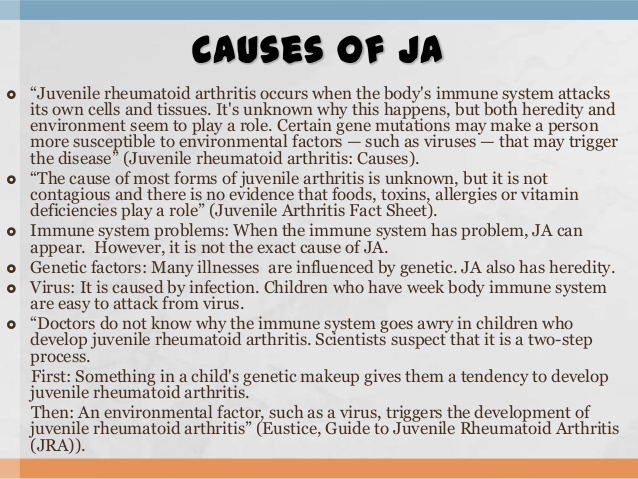
  • Fibromyalgia. This chronic pain syndrome is an arthritis-related condition, which can cause stiffness and aching, along with fatigue, disrupted sleep and other symptoms. More common in girls, fibromyalgia is seldom diagnosed before puberty. No known cause has been pinpointed for most forms of juvenile arthritis, nor is there evidence to suggest that toxins, foods or allergies cause children to develop JA. Some research points toward a genetic predisposition to juvenile arthritis, which means the combination of genes a child receives from his or her parents may cause the onset of JA when triggered by other factors.pain or stiffness when moving joints Swelling in the jointsUnfortunately it is not a simple one or two tests to diagnose. The diagnostic process can be long and detailed. There is no single blood test that confirms any type of JA. In children, the key to diagnosis is a careful physical exam, along with a thorough medical history.

How Juvenile Arthritis is diagnosed:

  • In the morning or after resting Warm or tender joints Limited range of motion (your child’s ability to move his or her joints)
  • Juvenile Arthritis symptoms:
  • Causes of these arthritis illnesses:

What is Juvenile Arthritis Treatment?

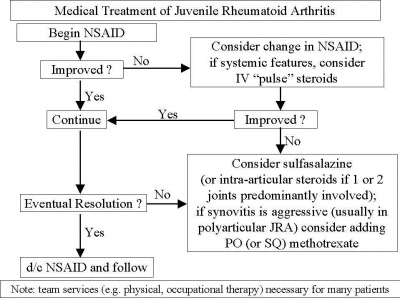
Unfortunately, there is no cure for juvenile arthritis, although with early diagnosis and aggressive treatment, remission is possible. The goal of treatment is to relieve inflammation, control pain and improve the child’s quality of life. Most treatment plans involve a combination of medication, physical activity, eye care and healthy eating.

Juvenile Arthritis Self Care

An important part of JA treatment is teaching the child the importance of how to follow the treatment prescribed by the healthcare team. Self care also involves helping the child address the emotional and social effects of the disease. Self management encompasses the choices made each day to live well and stay healthy and happy.