“You probably already knew that plants were the original medicines that people would use when they were sick. Did you know that we still use them today to come up with new cures for illnesses”
Norfolk Botanical Gardens
“You probably already knew that plants were the original medicines that people would use when they were sick. Did you know that we still use them today to come up with new cures for illnesses”
Norfolk Botanical Gardens


6. Food!
Another way that plants are so beneficial is that they are an abundant diverse, and arguably the most important food source! A wide range of fruits and veggies are provided by incredible plants, providing a significant amount of our fibre intake. Fibre is vital for maintaining a healthy digestive system and feeding our microbiome .
7. Provide Medicines
As well as food, plants provide us with our original medicines. These natural sources of medicine are something that we, as Natural Health Practitioners, still utilise today because of their incredible potential, wide range of applications and proven effectiveness. In 2002, a study stated that ‘Plants are arguably poised for a comeback as sources of human health products’ and we are consistently finding that to be true.
8. Improve Soil and Water Quality
Some plants can act as filters in the water, filtering out toxins, bugs and added pollutants to keep the water clean. Some plants can do the same in the soil; those with a compost bin for ‘recycling’ plants scraps can support this! Putting veggie scraps back into the garden can cause growing plants to thrive by providing essential nutrients and environments for beneficial microorganisms.
9. Act as Protection
Plants are incredible useful for protection, of us and animals. All different parts of plants can provide habitats and homes for many animal species, which is why it’s important to be mindful of how plants are sourced and utilised, we don’t want to be taking away homes!
Plants also provide a large quantity of our building supplies and the shade provided from trees protects humans from harmful UV radiation, as well as from the weather!
10. Moderating Temperature
Plants have a significant impact on moderating temperatures. Indoors, it is thought that plants can reduce heating and cooling costs due to this incredible ability. While outdoors, one study showed that plants like solitary trees, clumps of trees and vines had the ability to reduce surface temperature on buildings in urban environments (7). This is also important to remember as we tackle tough issues like climate change… maybe a few more indoor plants could cool down your home instead of the air conditioner.
Norfolk Botanical Garden (http://norfolkbotanicalgarden.org/education/online-resources/power-plants/plants-people) states the following about how plants enhance our lives:
Plants are one of our most valuable natural resources. Why? Without plants there would be no life on earth! It’s a good thing we have plants and plenty of them. We’d like to show you some of the ways that plants affect your daily life.
Plants Clean the Air: Take a deep breath. Plants recycle the carbon dioxide that we give off and turn it into oxygen that we need in order to breathe. Do you have any plants inside your house? Plants kept indoors can help purify the air and smell better than a fake air freshener. Save some money, buy a plant instead!
 Plants Are Our Food: Plants are not only food for animals but they are our food too! What did you have for breakfast this morning? Unless you decided to skip breakfast there was probably at least one plant somewhere in there. There are grains in cereal, or maybe you drank orange juice, either way you are using plants! What about your other meals? Maybe there are apple slices in your lunch, sweet pineapple on your sundae or french fries from the cafeteria, all of these come from plants.
Do you like tangy barbeque? How about spicy pizza? You can thank plants for that tasty boost. Now that should give you something to chew on for a while!
One of your food colorings comes from a tree. During WWII there was a shortage of butter, so people would have to use margarine. In order to make the plain white margarine look more like real butter the companies would include a small packet of dye that your family could mix into the margarine and make it turn yellow. That dye came from the Annatto tree.
Plants Become Shelter: Did you know that every building that you see around you has been constructed using wood from trees? Whether wood is hiding on the inside of the walls or very obvious on the outside, trees are part of your shelter. What about the furniture that you sit on? Do you have a wooden bed? Tonight when you get into bed look at the tag on your bed sheets. Are they made of cotton? How about the clothes you are wearing? Cotton shirts, cotton blue jeans and cotton socks are just a few of the important things in your life that come from plants.
Plants Are Used For Medicine: You probably already knew that plants were the original medicines that people would use when they were sick. Did you know that we still use them today to come up with new cures for illnesses? Just the smell of some plants can make you feel better. Have you ever used a special cream to help you breathe when you’re feeling stuffy? It was probably mint or eucalyptus that helped you breathe a little easier. Do you know anyone that likes to wear perfume? Wonderful scents come from all kinds of wood, grasses, flowers and even roots.
References For 6-10.
Millward, AA, Torchia, M, Laursen, AE & Rothman, LD 2014, ‘Vegetation placement for summer built surface temperature moderation in an urban microclimate’, Environmental Management, vol. 53, no. 6, pp. 1043-1057.
“As we outlined in a previous blog post, having plants in your office can bring countless health benefits. This is because not only do they reduce dust, mold and bacteria levels (which can trigger allergies and make symptoms worse), but they can also boost concentration and improve your mood and morale.”
Greenleaf.com

Even if we’re not big fans of the “getting in touch with nature” idea, it’s hard to argue against plants brightening up our homes and places of work. What’s interesting is that there’s a growing body of evidence that plants can actually improve our health in significant and specific ways. Here are five reasons to put plants back into our living and work spaces.
1. Plants Can Improve Our Productivity
New research from a team at the University of Exeter in the UK finds that, while stripping our offices of unneeded furnishings might be beneficial, keeping plants in the office to create so-called green spaces can boost worker productivity by as much as 15 percent. The reasons for this aren’t certain but plants appear to improve general well being, something that’s been established by other research, and also might help people to better engage with their environment — obviously, a more engaged worker will probably be more focused and efficient.
2. A Pot Plant in Our Homes Can Improve Our Mood and Lower Anxiety
3. Indoor Plants Improve Our Air Quality
NASA research shows that having plants indoors can help to improve air and water quality in our living spaces. That research was done on sealed units but there is some evidence that this translates to normal houses and buildings, at least to some degree. Obviously, for people with asthma and other breathing conditions this would be important, but for the rest of us cleaner air can also affect us in positive ways, such as improving the quality of our sleep.
Through a process known as photosynthesis, plants create their own food by absorbing carbon dioxide (the bad stuff we breathe out) from the atmosphere and then transforms it into oxygen, whilst simultaneously creating their own food source! How self-sufficient!
This oxygen then becomes the air we breathe, and so the cycle continues. Without an abundance of plants, oxygen concentration in the air around us drops, and we don’t receive our daily requirements!
Plants not only provide us with oxygen but also have the ability to remove pollutants from the air. Research has indicated that certain types of plants have the ability to reduce nasty pollutants like formaldehyde, toluene and benzene. For this reason, ‘green roofs’, which involves growing plants and greenery on rooftops, are being investigated as a possible future tool to help alleviate the negative effects of air pollution.
4. Plants Can Reduce Stress for People Recovering from Illness
Hospital stays can be very stressful, but Dutch researchers have found that one way of helping patients feel more relaxed is to incorporate unobtrusive plants into their hospital rooms. The researchers found that plants are particularly good at improving the perceived attractiveness of a room and that this, it seems, can help improve the patient’s hospital stay experience. Other research has also indicated a similar, wellbeing boosting effect, possibly down to what is known as biophilia, an hypothesis that we have a natural inclination towards greener, plant-filled spaces.
5. Caring for Plants Can Improve Our Quality of Life
Research published in the journal Hort Technology showed that when senior citizens living in low-income assisted-living facilities had plants to care for and cultivate, they were more likely to self-report better health than those who didn’t have plants to look after. The reasons for this marked upturn in positive health perceptions appears to be that the plants give the elderly something to care for and thus a sense of being needed, things that they might not have experienced very much in their later years. Renewing this sense of responsibility and purpose led to improved well being which, while perhaps not improving physical ailments, may give a new perspective and more resilience.
References
“We humans are still learning and re-learning how to harness the self healing ability of plants, in order to enhance or rebalance the health of our own body, mind and spirit. The more we learn about plants the more we find ways to use them to support health.”
NYNATURALNEWS.com
“The major source of lead poisoning among U.S. children is lead-based paint and dust with lead.”
MAYO CLINIC
“Anorexia nervosa and bulimia nervosa are serious psychiatric illnesses related to disordered eating and distorted body images. They both have significant medical complications associated with the weight loss and malnutrition.”
Science Direct
Medical Complications of Anorexia Nervosa:
Low heart rate, low body temperature, low blood pressure, irregular heartbeat
Slowed digestion causing pain, early fullness, nausea, bloating and constipation
Hepatitis of starvation, liver failure
Loss of period in females, low testosterone in males, infertility
Bone marrow suppression, anemia
Bone loss and osteoporosis
Thyroid abnormalities, low blood sugar
Brain atrophy, cognitive difficulty
Dry skin, hair loss, lanugo hair growth
Aspiration pneumonia, respiratory failure
High risk for refeeding syndrome, a potentially deadly complication of injudicious refeeding
Medical Complications of Bulimia Nervosa:
Dental erosion and infections, parotid gland swelling
Esophageal rupture
Gastroesophageal reflux (GERD), constipation
Low potassium, low sodium
Severe edema or fluid overload
Dehydration, fainting
Irregular heartbeat
Seizures
For Treatment:
First know the red flags. Red flags that may indicate an eating disorder include: Skipping meals
Making excuses for not eating
Eating only a few certain “safe” foods, usually those low in fat and calories
Adopting rigid meal or eating rituals, such as cutting food into tiny pieces or spitting food out after chewing
Cooking elaborate meals for others, but refusing to eat them themselves
Collecting recipes
Withdrawing from normal social activities
Persistent worry or complaining about being fat
A distorted body image, such as complaining about being fat despite being underweight
Not wanting to eat in public
Frequent checking in the mirror for perceived flaws
Wearing baggy or layered clothing
Repeatedly eating large amounts of sweet or high-fat foods
Use of syrup of ipecac, laxatives, the over-the-counter weight-loss drug orlistat (Alli), or over-the-counter drugs that can cause fluid loss, such as menstrual symptom relief medications
Use of dietary supplements or herbal products for weight loss
Food hoarding
Leaving during meals to use the toilet
Eating in secret
When to see a doctor
Because of its powerful pull, an eating disorder can be difficult to manage or overcome by yourself. Eating disorders can virtually take over your life. You may think about food all the time, spend hours agonizing over what to eat and exercise to exhaustion. You may feel ashamed, sad, hopeless, drained, irritable and anxious. You may also have a host of physical problems because of your eating disorder, such as irregular heartbeats, fatigue, and bowel or menstrual troubles. If you’re experiencing any of these problems, or if you think you may have an eating disorder, seek medical help.
Urging a loved one to seek treatment
Unfortunately, many people with eating disorders resist treatment. If you have a loved one you’re worried about, urge him or her to talk to a doctor. Even if your loved one isn’t ready to acknowledge having an issue with food, you may be able to open the door by expressing concern and a desire to listen. If you’re concerned your child may have an eating disorder, contact his or her doctor about your concerns. You can get a referral to qualified mental health providers for treatment.
Keep in mind, however, that in children it’s sometimes hard to tell what’s an eating disorder and what’s simply a whim, a new fad, or experimentation with a vegetarian diet or other eating styles. In addition, many girls and sometimes boys go on diets to lose weight, but stop dieting after a short time. If you’re a parent or guardian, be careful not to mistake occasional dieting with an eating disorder. On the other hand, be alert for eating patterns and beliefs that may signal unhealthy behavior, as well as peer pressure that may trigger eating disorders.
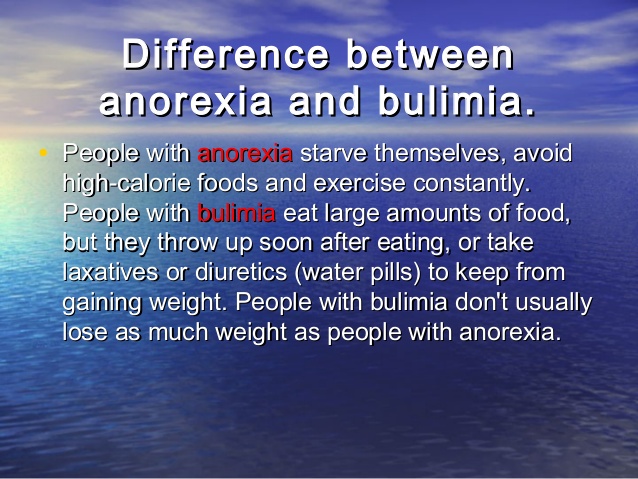
“Anorexia nervosa and bulimia nervosa are the most common clinically recognized eating disorders. Those with anorexia skip meals, adopt highly restrictive and unhealthy diets, obsess over thinness and food, and present abnormal eating habits or rituals.
Bulimia presents itself in the form of binging, or overeating, followed by purging, often either by vomiting or using laxatives.”
Diffen http://www.diffen.com
Anorexia Nervosa
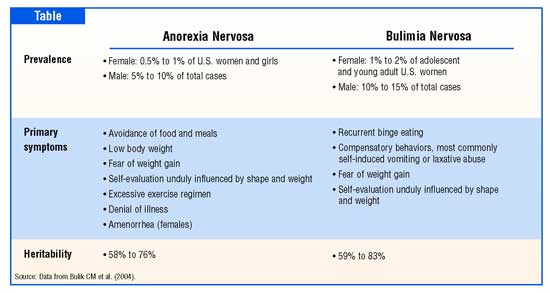
Anorexia Nervosa is characterized by the refusal to eat. It can affect anyone of any gender or age but disproportionately affects young women in their late teens and early twenties.
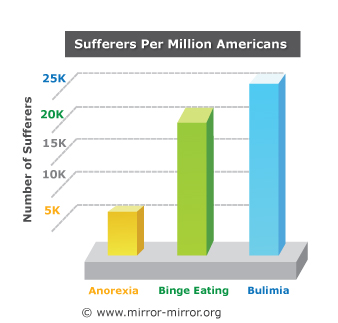
According to the most current edition of the Diagnostic and Statistical Manual of Mental Disorders (DSM-IV) there are four diagnostic criteria that must be present to achieve having Anorexia Nervosa. First a person must refuse to maintain body weight over a minimal normal weight for age and height or have a failure to make expected weight gain during a defined period of growth, resulting in a body weight 15% lower than expected. Second, the person must experience intense fear of gaining weight or becoming fat, even though underweight. Third, the person must have a disturbance in the way his or her body weight, size, or shape is experienced and also experience undue influence of body weight, or shape on self-evaluation, or denial of the seriousness of the current body weight. Finally, amenorrhea must be present. Amenorrhe is the absence of at least three consecutive menstrual cycles when otherwise expected to occur. This eating disorder affects 0.4-percent of adolescents and young women. However it is estimated that more than 4-percent of all women will struggle with anorexia nervosa over the course of their lifetime.
Bulimia Nervosa
Bulimia Nervosa is characterized by cyclical bingeing and purging episodes. Bingeing is defined as the consumption of more food than most other people would eat in a similar circumstance over a discrete period of time accompanied by a sense of lack of control over the food consumption.
Bulimia Nervosa exists when bingeing and compensatory behaviors occur on average 2 times weekly or more for a period of at least 3 months, when the behaviors are not exclusively those of Anorexia Nervosa, and when self-evaluation is unduly influenced by body shape or weight. Those with Bulimia are often very concerned about gaining weight and intensely fear getting fat.
People with Bulimia may engage in a variety of either purging or non-purging behaviors such as vomiting, using laxatives, using diuretics, using enemas, fasting, or exercising excessively. Bulimic bingeing and purging cycles are often conducted in secret because of the shame and disgust associated with the process.
Bulimia nervosa is an eating disorder affects 1.3-percent of adolescents and young women. An additional 0.7-percent of older women will develop this disorder over the course of their life.
Learn tomorrow the other eating disorders. Eating Disorders is this week’s National Awareness Topic!