Thyroid Disease Awareness Month-Part I The A&P of the organ.

thyroid awareness month1  thyroid awareness month2

There is an alarming number of people in America that have issues with their thyroid, in fact it’s a huge number, around 59 million people suffer from a thyroid problem. A thyroid handles your metabolism and is a gland located in the neck area. It can have huge negative affects on your health if it is not treated properly. Many people aren’t even aware that they have any symptoms that are connected with a thyroid; but before going into the problems lets first talk about what the thyroid is.

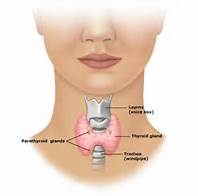
The thyroid gland is a butterfly-shaped organ located in the base of your neck. It releases hormones that control metabolism—the way your body uses energy. The thyroid’s hormones regulate vital body functions, including:

  • Breathing, Heart rate, Central and peripheral nervous systems, Body weight, Muscle strength
  • Menstrual cycles, Body temperature, Cholesterol levels & Much more! Did you know this?

How the Thyroid Gland Works:

  • The thyroid gland is about 2-inches long and lies in front of your throat below the prominence of thyroid cartilage sometimes called the Adam’s apple. The thyroid has two sides called lobes that lie on either side of your windpipe, and is usually connected by a strip of thyroid tissue known as an isthmus. Some people do not have an isthmus, and instead have two separate thyroid lobes.
  • The thyroid is part of the endocrine system, which is made up of glands that produce, store, and release hormones into the bloodstream so the hormones can reach the body’s cells. The thyroid gland uses iodine from the foods you eat to make two main hormones:
  • Triiodothyronine (T3)
  • Thyroxine (T4)The hypothalamus senses low circulating levels of thyroid hormone (Triiodothyronine (T3) and Thyroxine (T4)) and responds by releasing thyrotropin-releasing hormone (TRH). The TRH stimulates the pituitary telling it to produce thyroid-stimulating hormone (TSH); releasing it in the blood.
  • It is important that T3 and T4 levels are neither too high nor too low. Two glands in the brain—the hypothalamus and the pituitary communicate to maintain T3 and T4 balance.
  • When T3 and T4 levels are low in the blood, the pituitary gland releases more TSH to tell the thyroid gland to produce more thyroid hormones.  If T3 and T4 levels are high, the pituitary gland releases less TSH to the thyroid gland to slow production of these hormones.  The thyroid cells take up iodine with and are able to store it up in great quantities.  T3 and T4 travel in your bloodstream to reach almost every cell in the body. The hormones regulate the speed with which the cells/metabolism work. For example, T3 and T4 regulate your heart rate and how fast your intestines process food. So if T3 and T4 levels are low, your heart rate may be slower than normal, and you may have constipation/weight gain. If T3 and T4 levels are high, you may have a rapid heart rate and diarrhea/weight loss.
QUOTE FOR WEEKEND:

“Approximately 150,000 children are born every year in the United States affected by one or more birth defects. Although the cause of over 60% of birth defects are not known, there are things that you can do to help ensure optimal health for your baby.”

Americanpregnancy.org

QUOTE FOR FRIDAY:

“Folic acid is B vitamin that every cell in your body needs for normal growth and development.  Taking folic acid before and during early pregnancy can help prevent neural tube defects in your baby. Before pregnancy, take a multivitamin that has 400 micrograms (also called mcg) of folic acid in it every day.  During pregnancy, take a prenatal vitamin that has 600 mcg of folic acid in it every day.  Take a multivitamin with folic acid every day, even if you’re not trying to get pregnant.”

 MarchofDimes

QUOTE FOR THURSDAY:

“There are effective measures that can be taken to prevent concussions during winter sports activities. Concussions should be taken seriously because they can result to long-term and permanent health issues.   Here are simple tips for preventing head injuries when participating in winter sports: 1-Wear approved, properly fitted and well-maintained safety equipment like helmets.  2-Stipulate safety rules like no direct hits to the head or other dangerous play.  3-Encourage safe playing techniques and encourage individuals to strictly follow rules of play during winter sports activities.”

ConsumerHealthDigest

QUOTE FOR WEDNESDAY:

“Total Brian Injury (TBI) is a quiet crisis. As many as 3.2 million Americans are living with a permanent disability resulting from a brain injury. The Centers for Disease Control and Prevention report that 1.7 million Americans sustain a traumatic brain injury each year. Fifty-two thousand people die from it. Almost a quarter-million people are hospitalized.”

BrainLine.org (All about Brain Injury and PTSD)

QUOTE FOR TUESDAY:

“The only way to determine if a radon exposure exists is to test for it. Having your school tested for radon is something you may want to discuss with your school officials. Because as real as the threat of radon is, the good news is that the problem can be solved.”

EPA United States Environmental Protection Agency

QUOTE FOR MONDAY:

“Macular Degeneration is the leading cause of vision loss, affecting more than 10 million Americans – more than cataracts & glaucoma combined.”

American Macular Degeneration  Foundation AMDF

QUOTE FOR THE WEEKEND:

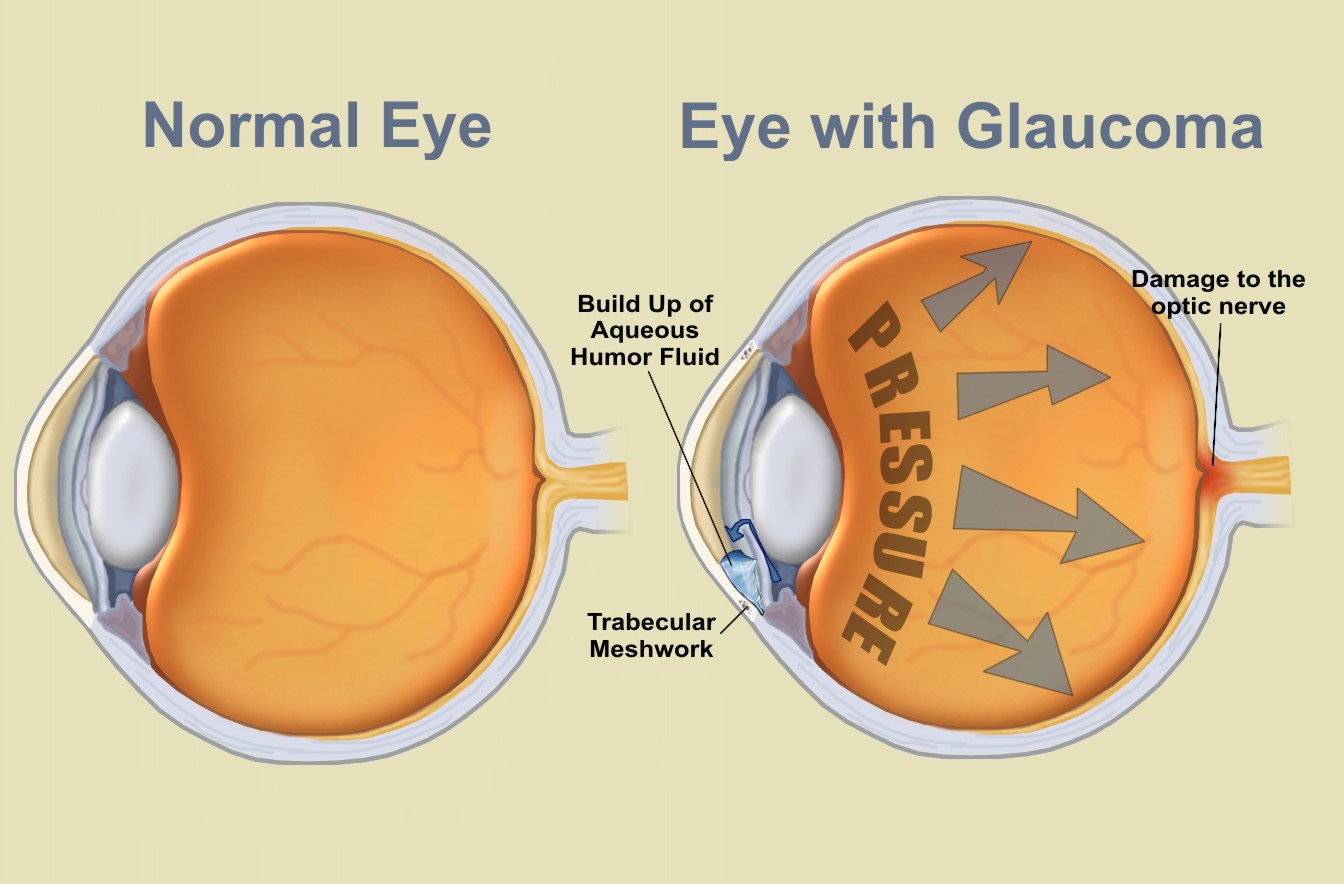
“Glaucoma is a disease that damages your eye’s optic nerve. It usually happens when fluid builds up in the front part of your eye. That extra fluid increases the pressure in your eye, damaging the optic nerve.”
 
American Academy of Opthamology

Part II Top 3 Degenerative Eye Diseases – #2 Glaucoma (National Awareness Glaucoma Month)

glaucoma  glaucoma


A common eye condition in which the fluid pressure inside the eye rises to a level higher than healthy for that eye. If untreated, it may damage the optic nerve, causing the loss of vision or even blindness. The elderly, African-Americans, and people with family histories of the disease are at greatest risk.

Glaucoma is a multi-factorial, complex eye disease with specific characteristics such as optic nerve damage and visual field loss. While increased pressure inside the eye (called intraocular pressure or IOP) is usually present, even patients with normal range IOP can develop glaucoma.

There is no specific level of elevated eye pressure that definitely leads to glaucoma; conversely, there is no lower level of IOP that will absolutely eliminate a person’s risk of developing glaucoma. That is why early diagnosis and treatment of glaucoma is the key to preventing vision loss.

Eye pressure is measured in millimeters of mercury (mm Hg). Normal eye pressure ranges from 12-22 mm Hg, and eye pressure of greater than 22 mm Hg is considered higher than normal. When the IOP is higher than normal but the person does not show signs of glaucoma, this is referred to as ocular hypertension.

High eye pressure alone does not cause glaucoma. However, it is a significant risk factor. Individuals diagnosed with high eye pressure should have regular comprehensive eye examinations by an eyecare professional to check for signs of the onset of glaucoma.

A person with elevated IOP is referred to as a glaucoma suspect, because of the concern that the elevated eye pressure might lead to glaucoma. The term glaucoma suspect is also used to describe those who have other findings that could potentially, now or in the future, indicate glaucoma. For example, a suspicious optic nerve, or even a strong family history of glaucoma, could put someone in the category of a glaucoma suspect.

Vision loss from glaucoma occurs when the eye pressure is too high for the specific individual and damages the optic nerve. Any resultant damage cannot be reversed. The peripheral (side) vision is usually affected first. The changes in vision may be so gradual that they are not noticed until a lot of vision loss has already occurred.

In time, if the glaucoma is not treated, central vision will also be decreased and then lost; this is how visual impairment from glaucoma is most often noticed. The good news is that glaucoma can be managed if detected early, and with medical and/or surgical treatment, most people with glaucoma will not lose their sight.

Most common signs and symptoms of Glaucoma:

There are several forms of glaucoma; the two most common forms are primary open-angle glaucoma (POAG) and angle-closure glaucoma (ACG). Open-angle glaucoma is often called “the sneak thief of sight” because it has no symptoms until significant vision loss has occurred.

Symptoms of Open-Angle Glaucoma

There are typically no early warning signs or symptoms of open-angle glaucoma. It develops slowly and sometimes without noticeable sight loss for many years.

Most people who have open-angle glaucoma feel fine and do not notice a change in their vision at first because the initial loss of vision is of side or peripheral vision, and the visual acuity or sharpness of vision is maintained until late in the disease.

By the time a patient is aware of vision loss, the disease is usually quite advanced. Vision loss from glaucoma is not reversible with treatment, even with surgery.

Because open-angle glaucoma has few warning signs or symptoms before damage has occurred, it is important to see a doctor for regular eye examinations. If glaucoma is detected during an eye exam, your eye doctor can prescribe a preventative treatment to help protect your vision.

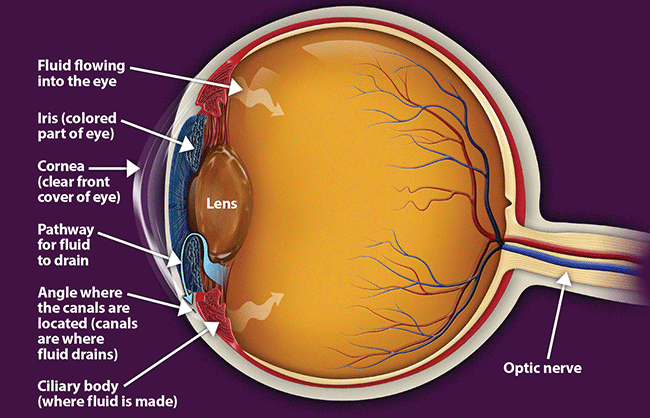
In open-angle glaucoma, the angle in your eye where the iris meets the cornea is as wide and open as it should be, but the eye’s drainage canals become clogged over time, causing an increase in internal eye pressure and subsequent damage to the optic nerve. It is the most common type of glaucoma, affecting about four million Americans, many of whom do not know they have the disease.

You are at increased risk of glaucoma if your parents or siblings have the disease, if you are African-American or Latino, and possibly if you are diabetic or have cardiovascular disease. The risk of glaucoma also increases with age.

Symptoms of Angle-Closure Glaucoma

  • Hazy or blurred vision
  • The appearance of rainbow-colored circles around bright lights
  • Severe eye and head pain
  • Nausea or vomiting (accompanying severe eye pain)
  • Sudden sight loss

Angle-closure glaucoma is caused by blocked drainage canals in the eye, resulting in a sudden rise in intraocular pressure. This is a much more rare form of glaucoma, which develops very quickly and demands immediate medical attention

In contrast with open-angle glaucoma, symptoms of acute angle-closure glaucoma are very noticeable and damage occurs quickly. If you experience any of these symptoms, seek immediate care from an ophthalmologist.

QUOTE FOR FRIDAY:

“A cataract is a medical condition affecting one or both of your eyes. It makes the normally clear lens in your eyes cloudy. This causes you to feel like you are looking through a cloudy lens or fogged-up window. Once your vision becomes cloudy, you have more difficulty doing everyday simple tasks like driving or reading.”