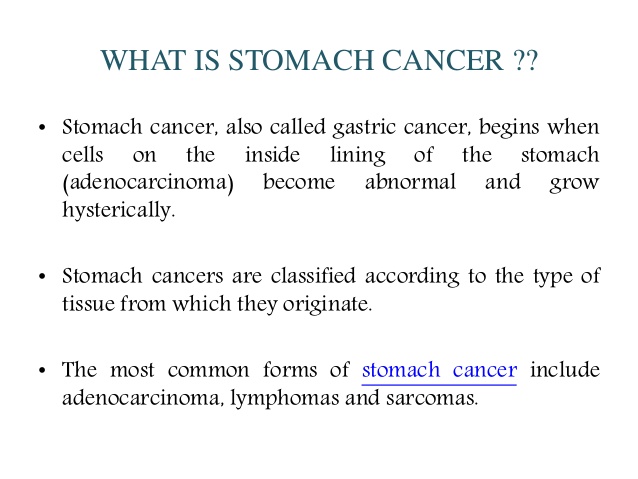
What is Stomach cancer (also called gastric cancer):
This cancer can develop in any part of the stomach, and may spread throughout the stomach and to other organs. It may grow along the stomach wall into the esophagus or small intestine.
The cancer may also extend through the stomach wall and spread to nearby lymph nodes and organs, such as the liver, pancreas and colon. It may spread to distant organs, such as the lungs, the lymph nodes above the collarbone and to a woman’s ovaries.
Different types of stomach cancer include:
- Adenocarcinomas develop within the cells of the innermost lining of the stomach. The majority of stomach cancers are classified as adenocarcinomas.
- Lymphoma is a cancer of the immune system tissue that may start anywhere there are lymph tissues, including the stomach. Lymphomas in the stomach are rather rare and only account for about 4 percent of all stomach cancers.
- Gastrointestinal stromal tumors, or GISTs, are a rare type of stomach cancer that starts in a special cell found in the lining of the stomach called interstitial cells of Cajal (ICCs). Under a microscope, GIST cells look similar to muscle or nerve cells. These tumors may develop throughout the digestive tract, but about 60 to 70 percent occur in the stomach.
- Carcinoid tumors typically start in the hormone producing cells of the stomach. These tumors usually do not spread to different organs and account for only about 3 percent of stomach cancer incidence.
RISK FACTORS FOR STOMACH CANCER:
GENERAL
- Age: Stomach cancer is found most often in people over age 55.
- Gender: The disease affects men twice as often as women.
- Race: Stomach cancer is more common in African Americans than in Caucasians.
- Region: This type of cancer is more common in some parts of the world, such as Japan, Korea, parts of Eastern Europe and Latin America. People in these areas eat many foods that are preserved by drying, smoking, salting or pickling.
BODY
- Obesity: Obesity has been linked to an increased risk of stomach cancer
GENETICS
Certain gene mutations and some inherited conditions are considered stomach cancer risk factors. They include:
- BRCA1 & BRCA2: Inherited mutations on the BRCA1 and BRCA2 genes are often associated with higher risks for breast cancer. Individuals who have inherited these genetic mutations are also at an increased risk for stomach cancer
- E-cadherin/CDH1: Though rare, people who inherit this genetic mutation have a 70 to 80 percent chance of developing stomach cancer in their lifetime. Also, women with this genetic defect have an increased risk of breast cancer.
- Lynch syndrome: This condition may also be referred to as hereditary non-polyposis colorectal cancer (HNPCC), a genetic condition that runs in families. More commonly, this condition is associated with an increased risk for colon cancer. HNPCC also predisposes people to stomach cancers.
- Familial adenomatous polyposis (FAP): This syndrome causes polyps in the colon, stomach and intestines. Often caused by mutations of the gene APC, this syndrome greatly increases a person’s risk of colorectal cancer and may play a small role in increasing a person’s stomach cancer risk.
LIFESTYLE
- Smoking: There is evidence linking cigarette smoking to many types of cancer, including stomach cancer. Smokers have been found to be at greater risk of developing cancer than non-smokers.
- Diet: Scientists believe that eating foods preserved in these ways may play a role in the development of stomach cancer. On the other hand, fresh foods (especially fresh fruits and vegetables and properly frozen or refrigerated fresh foods) may protect against this disease.
- Working in the coal, metal or rubber industries: Chemicals that are released in these environments have been linked to the development of stomach cancer.
OTHER CONDITIONS
- H. pylori infection: Doctors have found that a long-term H. pylori infection may lead to inflammation and pre-cancerous changes to the stomach lining. In fact, stomach cancer patients typically have a higher incidence of H. pylori infections than people who do not have stomach cancer.
- Pernicious anemia: Some people with pernicious anemia may have gastric polyps, which can increase the risk of stomach cancer.
- Epstein-Barr virus infection: According to the American Cancer Society, Epstein-Barr virus is found in the cancer cells of about 5% to 10% of people with stomach cancer.