Where is your cervix located?
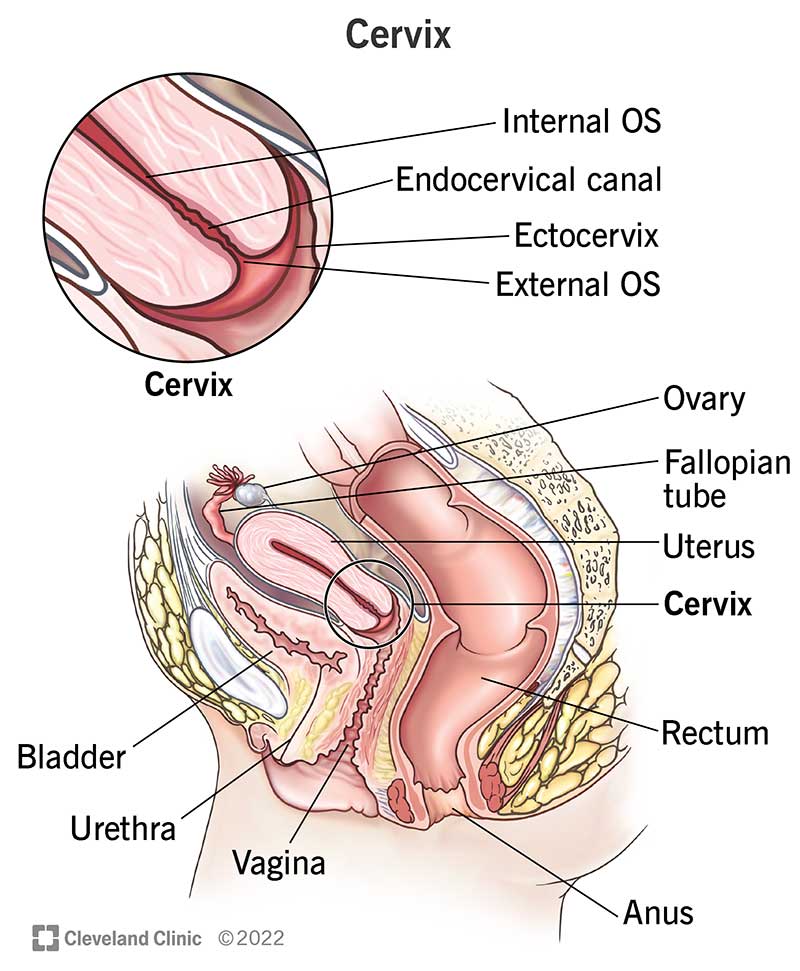
Your cervix is an important part of your reproductive anatomy. Your cervix is located inside your pelvic cavity, anywhere from 3 to 6 inches inside your vaginal canal. It begins at the base of your uterus and extends downward onto the top part of your vagina. This place where your cervix bulges onto the uppermost part of your vagina is called your ectocervix.
Your vagina, cervix and uterus are located behind your bladder and urethra (organs that allow you to pee) and in front of your rectum and anus (organs that allow you to poop).
What does your cervix look like?
The word “cervix” comes from the Latin word meaning “neck.” Like a neck, your cervix is shaped roughly like a cylinder or tube and connects important body parts. While your neck connects your head to the rest of your body, your cervix connects your uterus to your vagina. Your cervix is wider in the middle and narrows at both ends, where it opens into your uterus (top) and vagina (bottom).
Your cervix consists of the following parts:
- Internal OS: The opening that leads to your uterus. Your provider may refer to your internal OS during pregnancy.
- Endocervical canal: A tunnel that extends from your Internal OS to your ectocervix.
- Ectocervix: The part of your cervix that bulges onto the top of your vagina.
- External OS: The opening that leads to your vagina.
Your cervix is a muscular, tunnel-like organ. It’s the lower part of your uterus, and it connects your uterus and vagina. Sometimes called the “neck of the uterus,” your cervix plays an important role in allowing fluids to pass between your uterus and vagina. It enables a baby to leave your uterus so that it can travel through your vagina (birth canal) during childbirth. The cervix is also a common site for cell changes that may indicate cancer.
Getting regular Pap smears allows your provider to screen for irregularities that may be signs of disease.
Who has a cervix?
People who are designated female at birth (DFAB) have a cervix. DFAB people include cisgender women — people who are DFAB and identify as women — and some transgender men and nonbinary individuals. Some intersex individuals have cervixes, too.
What is the functions of your cervix?