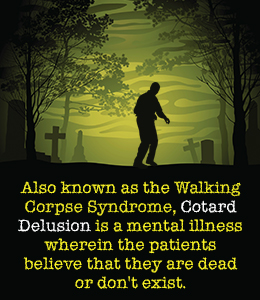
“Cotard’s syndrome is a relatively rare condition that was first described by Dr. Jules Cotard in 1882. Cotard’s syndrome comprises any one of a series of delusions that range from a belief that one has lost organs, blood, or body parts to insisting that one has lost one’s soul or is dead.”
NIH National Library of Medicine (https://www.ncbi.nlm.nih.gov/pmc/articles/PMC2695744/)
Cotard delusion, also known as or nihilistic delusion or walking corpsesyndrome or Cotard’s syndrome , is a rare mental disorder in which the affected person holds the delusional belief that they are already dead, do not exist, are putrefying, or have lost their blood or internal organs.
Signs and Symptoms:
One of the main symptoms of Cotard delusion is nihilism. Nihilism is the belief that nothing has any value or meaning. It can also include the belief that nothing really exists. People with Cotard delusion feel as if they’re dead or rotting away. In some cases, they might feel like they’ve never existed.
While some people feel this way about their entire body, others only feel it in regard to specific organs, limbs, or even their soul.
Depression is also closely related to Cotard delusion. A 2011 review of existing research about Cotard delusion notes that 89% of documented cases include depression as a symptom.
Other symptoms include:
anxiety
hallucinations
hypochondria
guilt
preoccupation with hurting yourself or death
Researchers aren’t sure what causes Cotard delusion, but there are a few possible risk factors. Several studies indicate that the average age of people with Cotard delusion is about 50. It can also occur in children and teenagers. People under the age of 25 with Cotard delusion tend to also have bipolar depression. Women also seem to be more likely to develop Cotard delusion.
In addition, Cotard delusion seems to occur more often in people who think their personal characteristics, rather than their environment, cause their behavior. People who believe that their environment causes their behavior are more likely to have a related condition called Capgras syndrome. This syndrome causes people to think their family and friends have been replaced by imposters. Cotard delusion and Capgras syndrome can also appear together.
Other mental health conditions that might increase someone’s risk of developing Cotard delusion include:
bipolar disorder
postpartum depression
catatonia
depersonalization disorder
dissociative disorder
psychotic depression
schizophrenia
Cotard delusion also seems to be associated with certain neurological conditions, including:
1-“Since 1996, evidence has been increasing for a causal relationship between the outbreak in Europe of a disease in cattle, called bovine spongiform encephalopathy (BSE, or “mad cow disease”), and a disease in humans, called “variant” Creutzfeldt-Jakob disease (vCJD).
Both disorders are invariably fatal brain diseases with unusually long incubation periods measured in years, and are caused by abnormally folded proteins in the brain called “prions” (pree-ons). ”
Cattle affected by BSE experience progressive degeneration of the nervous system. Signs usually don’t appear until about 3–6 years after initial infection.
The highest quality beef comes from animals that are under 36 months of age. Old cows produce highly acceptable beef if properly fattened and processed but know there is testing cows for it before making it food on our table.
Know this BSE belongs to a family of diseases known as transmissible spongiform encephalopathies that includes, among others, scrapie in sheep and goats; chronic wasting disease in deer, elk, and moose; and classic and variant Creutzfeldt-Jakob disease in people.”
1-Centers for Disease Control and Prevention-CDC (https://www.cdc.gov/prions/index.html)
*****
2-CHICAGO (Reuters) states – On May 19,2023 they stated “The U.S. Department of Agriculture (USDA) announced on Friday an atypical case of Bovine Spongiform Encephalopathy (BSE), commonly called mad cow disease, in an older beef cow at a slaughter plant in South Carolina.
USDA stated “the animal never entered slaughter channels and the agency did not expect any trade impacts as a result.
It was the seventh detection of BSE in the United States since 2003 and all but one have been atypical”
Animal and Plant Health Inspection Service said in a statement “This finding of an atypical case will not change the negligible risk status of the United States and should not lead to any trade issues,”.
3-“We know that the earliest point at which current tests can accurately detect BSE is 2-to-3 months before the animal begins to show symptoms. The time between initial infection and the appearance of symptoms is about 5 years. Since most cattle that go to slaughter in the United States are both young and clinically normal, testing all slaughter cattle for BSE might offer misleading assurances of safety to the public.
The carcasses from the tested animals are held and not allowed to enter the human food chain until test results show the samples are negative for Bovine spongiform encephalopathy (BSE or Mad Cow Disease).”
3-U.S.D.A US Dept of Agriculture (https://www.usda.gov/topics/animals/bse-surveillance-information-center)
“Currently, there is no test to detect the disease in a live animal or in muscle meat products. BSE can only be confirmed by microscopic examination of brain tissue from the animal after its death using sophisticated laboratory techniques.”
Their is no standard testing before each cow including other wild life animals listed at the top that go on our plate sold in stores for food? Another thought, In the United States and the European Union, cows are typically slaughtered for beef between the ages of 18 months and 30 months. In the United States, most cows are slaughtered at around 24-30 months of age, although some may be slaughtered as young as 18 months; cows are about 5 yrs old when symptoms start showing. No regular testing on all cows used for meat for BSE no matter how low the incidence in US due to spreading can occur; really? Quite interestingbut know based on statistics you have a 1 in a million chance getting this & it seems by history you have more of a chance in the mid to mid west area of US.
“The word BSE is short but it stands for a disease with a long name, bovine spongiform encephalopathy. “Bovine” means that the disease affects cows, “spongiform” refers to the way the brain from a sick cow looks spongy under a microscope, and “encephalopathy” meaning that it is a disease of the brain. BSE is commonly called “mad cow disease.
Cattle affected by BSE experience progressive degeneration of the nervous system. Signs usually don’t appear until about 3–6 years after initial infection.
Here’s what to look for:
Changes in temperament (nervousness or aggression)
Abnormal posture
Coordination problems and difficulty in rising
Weight loss
Decreased milk production
Loss of condition without noticeable loss of appetite
After signs appear, the animal’s condition deteriorates until it dies. This usually takes anywhere from 2 weeks to 6 months.”
U.S.D.A. US Dept or Agriculture (https://www.aphis.usda.gov/livestock-poultry-disease/cattle/bse)
“Meningitis is an inflammation of the membranes that cover the brain and spinal cord. It can be caused by a number of infectious agents including viruses and bacteria. The type of meningitis and its cause can only be determined by conducting laboratory tests.
Viral meningitis (also called aseptic meningitis) is the most common type of meningitis and is less severe than bacterial meningitis. In Illinois, an average of 600 cases of aseptic meningitis is reported annually, with most occurring in late summer and early autumn. The majority of cases of aseptic meningitis are due to viruses called enteroviruses that can infect the stomach and small intestine. A small number of cases are caused by different viruses, which can be transmitted by infected mosquitoes; these are called arboviruses. Fatal cases of viral meningitis are rare and complete recovery is the rule.
Bacterial meningitis is often more severe than aseptic meningitis, particularly in infants and the elderly. Before antibiotics were widely used, 70 percent or more of bacterial meningitis cases were fatal; with antibiotic treatment, the fatality rate has dropped to 15 percent or less. Bacterial meningitis is most common in the winter and spring. Three bacteria cause the majority of cases: Haemophilus influenzae, Neisseria meningitidis or Streptococcus pneumoniae.”
Illinois Dept. Public Health-IDPH (https://dph.illinois.gov/topics-services/diseases-and-conditions/diseases-a-z-list/meningitis.html)
“With the onset of spring in the Northern Hemisphere, animals that hibernate are waking up from a long-period of deep sleep. They spent the winter hibernating to conserve energy when food was scarce. Animals that hibernate include bats, black bears, Arctic ground squirrels, and common poorwill birds. Many other species such as raccoons and skunks go into a state of torpor during the cold weather, which is a type of light hibernation. Most hibernators wake up during the months of March and April, but some do so as late as May.”
“Prevent Blindness has declared April as Women’s Eye Health and Safety Month in an effort to educate the public on the increased risk for women and vision health issues, as well as steps that can be taken to prevent vision loss.
Two out of every three people living with blindness or vision problems are women according to the National Eye Institute. Women are at greater risk of developing a number of eye conditions, including age-related macular degeneration (AMD), cataracts and glaucoma.
At Texas Retina, we know that women often manage their family’s health and take care of everyone else first. However, it is important that women make their own eye health a priority as early detection and consistent treatment can significantly reduce the risk of vision loss. Here are a few tips:
Women 40 and older should have an annual dilated eye exam.
They should also see their optometrist or ophthalmologist any time they experience a change in vision.
Eat a healthy diet rich in vitamin C, vitamin E, beta carotene, lutein, zeaxanthin, zinc and omega-3 fatty acids. This should include foods such as salmon, broccoli and dark leafy greens.
Stay active as regular exercise is known to reduce the risk of eye disease.
Protect your eyes from the sun by wearing proper sunglasses that block ultraviolet radiation.
“Head and neck cancers usually begin in the squamous cells that line the mucosal surfaces inside the mouth, nose, throat, and salivary glands. They are often referred to as squamous cell carcinomas of the head and neck.
Head and neck cancers account for nearly 4 percent of all cancers in the United States, according to the National Cancer Institute (NCI).
Counting cancers of the oral cavity, pharynx, and larynx, the NCI estimates that about 66,920 cases occurred in the U.S. in 2023. About 15,400 people died from these diseases, according to the NCI’s Surveillance, Epidemiology and End Results (SEER) program.
Head and neck cancer is more common among men than women. These cancers are also diagnosed more often among people over age 50 than among younger people.
Symptoms of head and neck cancers may include a lump or a sore that doesn’t heal. In addition, symptoms can include sore throat that doesn’t go away, difficulty in swallowing, and a hoarse voice.
Alcohol and tobacco use are major risk factors for head and neck cancers. Also, infection with cancer-causing types of human papillomavirus (HPV) increases a person’s risk of certain head and neck cancers.”
American Association for Cancer Research – AACR (https://www.aacr.org/patients-caregivers/awareness-months/head-and-neck-cancer-awareness-month/)
“In 1986, President Reagan recognized March as “National Hemophilia Month” which has since been changed to #BleedingDisordersAwarenessMonth to be inclusive of all #bleedingdisorders. We’ll be posting facts throughout the month to honor our history and raise awareness about all #bleedingdisorders. Hemophilia is usually an inherited bleeding disorder in which the blood does not clot properly. This can lead to spontaneous bleeding as well as bleeding following injuries or surgery.”
World Federation of Hemophilia – WFH (https://www.hemophiliafed.org/resource/bleeding-disorders-awareness-month/)
Sarcoidosis is an inflammatory disease in which the immune system overreacts, causing groups of cells to form clusters of inflamed tissue called “granulomas” in one or more organs of the body.
Sarcoidosis most commonly affects the lungs and lymph nodes, but it can affect any organ including the eyes, skin, heart and nervous system.
Sarcoidosis is a rare disease with 150,000-200,000 cases in the United States per year and approximately 27,000 new cases per year.
Lofgren’s syndrome is an acute, milder form of sarcoidosis that usually goes away within six months to two years after diagnosis.
Black women are three times more likely to be diagnosed with sarcoidosis than White women, tend to have more severe disease, are more likely to be hospitalized and have a higher mortality rate.
In severe cases, sarcoidosis can be life-threatening if it progresses to heart or severe lung disease.
Severe fatigue can impact up to 70% of patients with sarcoidosis even when inflammation is controlled with medication. Fatigue can be disabling, and lead to loss of work.
Sarcoidosis in the lungs is often separated into the “Scadding stages” based on the chest X-ray. There are five Scadding stages, Stage 0 through Stage 4. The stages use the location of the granulomas in the lungs and lymph nodes, to predict the chance of the disease resolving on its own, with lower stages being more likely to resolve or not need treatment. At each stage you can have serious symptoms. You also can move between the stages of sarcoidosis. Patients of any Scadding stage can have involvement of other organs from sarcoidosis.”
American Lung Association (https://www.lung.org/lung-health-diseases/lung-disease-lookup/sarcoidosis/learn-about-sarcoidosis)