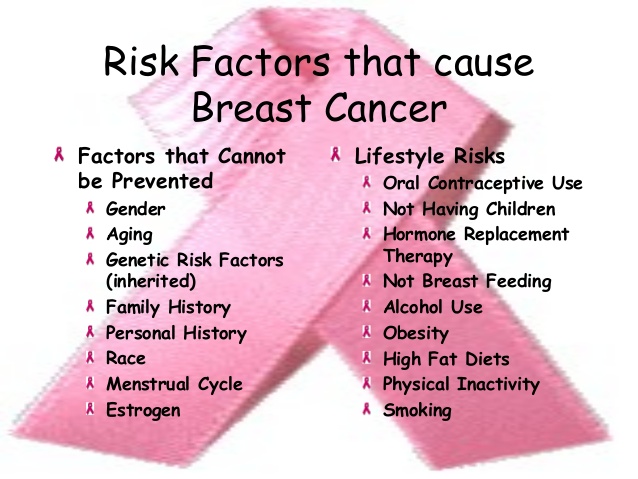
Today’s section regarding Controllable Risk Factors you can change if needed which are:
Obesity
Studies have shown a clear association between obesity and increased risk of post-menopausal breast cancer. Because having more fat tissue can increase a woman’s level of estrogen, it is important for a woman to attempt to control her weight, particularly after menopause. Once a woman has stopped menstruating, her levels of estrogen and progesterone are much lower than they once were. Excess fat tissue may cause significant increases in her hormone levels.
Physical Activity
Physical activity not only helps a woman reduce her risk of breast cancer by maintaining a healthy body weight, it may also have its own benefits to risk reduction. Some studies have shown that physical exercise throughout a woman’s life reduces her risk, independent of her weight.
One theory is that exercise may reduce a woman’s risk by limiting menstrual function, and it has been observed that regular physical exercise can delay menarche — the onset of menstruation — when body fat percentage is low. Since breast cancer risk may be significantly influenced by a woman’s lifetime exposure to hormones, reducing that exposure may also reduce her risk.
Alcohol Consumption
Many epidemiological studies spanning the past 20 years have shown an association between alcohol consumption and increased risk of breast cancer. Studies have consistently found that women who consume at least three alcoholic drinks per day are at higher risk for developing breast cancer than women who do not drink alcohol. Furthermore, study findings have shown that for women who drink two alcoholic drinks or more per day, breast cancer risk is related to the amount of alcohol consumed — higher consumption of alcohol equals higher breast cancer risk.
Among other mechanisms, it has been suggested that alcohol may increase a woman’s hormone levels. A recent study fed women specified amounts of alcohol each day, and demonstrated that a woman’s levels of blood estrogen did increase according to the amount of alcohol she consumed. In particular, the breast cancer risk of post-menopausal women, whose bodies make very little estrogen compared with pre-menopausal women, may be affected by alcohol consumption by this mechanism.
Hormone Replacement Therapy
A study conducted by the Women’s Health Initiative (WHI) showed that women in the study population who took hormone replacement therapy — combined estrogen and progestin — had a 26 percent increased risk (relative to an average woman) of invasive breast cancer after four to five years of therapy. This finding is consistent with the growing evidence that exogenous (outside) hormones increase a woman’s lifetime estrogen exposure as well as increasing her breast cancer risk.
Breastfeeding
An analysis published in July 2002 pulled together data from 47 previous studies to show that breastfeeding does in fact slightly lower a woman’s risk of breast cancer. The longer a woman breastfed, the lower her risk was. For optimal benefit, we recommend breastfeeding a child for 12 months. The hormonal balance is different than a non pregnant women who does not breast feed 12 months.
The decision of whether or not to breastfeed is certainly a very personal one. The knowledge that breastfeeding may offer a slight reduction in risk for developing breast cancer is just one of the many factors that will influence how long a woman decides to breastfeed.