Alzheimer’s Might be “Brain Diabetes”
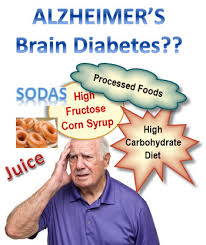
It’s becoming increasingly clear that the same pathological process that leads to insulin resistance and type 2 diabetes may also hold true for your brain. As you over-indulge on sugar and grains, your brain becomes overwhelmed by the consistently high levels of insulin and eventually shuts down its insulin signaling, leading to impairments in your thinking and memory abilities, and eventually causing permanent brain damage.
Regularly consuming more than 25 grams of fructose per day will dramatically increase your risk of dementia and Alzheimer’s disease. Consuming too much fructose will inevitably wreak havoc on your body’s ability to regulate proper insulin levels.
Although fructose is relatively “low glycemic” on the front end, it reduces the affinity for insulin for its receptor leading to chronic insulin resistance and elevated blood sugar on the back end. So, while you may not notice a steep increase in blood sugar immediately following fructose consumption, it is likely changing your entire endocrine system’s ability to function properly behind the scenes.
Additionally, fructose has other modes of neurotoxicity, including causing damage to the circulatory system upon which the health of your nervous system depends, as well as profoundly changing your brain’s craving mechanism, often resulting in excessive hunger and subsequent consumption of additional empty carbohydrate-based calories.
In one study from UCLA, researchers found that rats fed a fructose-rich and omega-3 fat deficient diet (similar to what is consumed by many Americans) developed both insulin resistance and impaired brain function in just six weeks.
Plus, when your liver is busy processing fructose (which your liver turns into fat), it severely hampers its ability to make cholesterol, an essential building block of your brain crucial to its health. This is yet another important facet that explains how and why excessive fructose consumption is so detrimental to your health. Decreasing fructose intake is one of the most important moves you can take in decreasing the risk of Alzheimer’s disease in your lifetime.
Tips for avoiding Alzheimer’s Disease is Part 2 tomorrow. 😉
More Tips for Avoiding Alzheimer’s Disease
The beauty of following a healthy diet is that it helps treat and prevent all chronic degenerative diseases, from the common ones like heart disease, cancer, diabetes, obesity and Alzheimer’s to the ones you have never heard of or can’t even pronounce.
The first step is to eat healthy, maintaining exercise balanced with rest and practice healthy habits in addressing Alzheimer’s disease, which is currently at epidemic proportions, with 5.4 million Americans – including one in eight people aged 65 and over – living with the disease.7 By 2050, this is expected to jump to 16 million, and in the next 20 years it is projected that Alzheimer’s will affect one in four Americans. People we need to live healthier if not to help ourselves our future young ones.
In spite of how common memory loss is among Westerners, it is NOT a “normal” part of aging. While even mild “senior moments” may be caused by the same brain lesions associated with Alzheimer’s disease and other forms of dementia, these cognitive changes are by no means inevitable! People who experience very little decline in their cognitive function up until their deaths have been found (post-mortem) to be free of brain lesions, showing that it’s entirely possible to prevent the damage from occurring in the first place and one of the best ways to do this is by leading a healthy lifestyle.
- Fructose. As mentioned, most everyone will benefit from keeping their total fructose consumed to below 25 grams per day.
- Improve Magnesium Levels. There is some exciting preliminary research strongly suggesting a decrease in Alzheimer symptoms with increased levels of magnesium in the brain. Unfortunately most magnesium supplements do not pass the blood brain levels, but a new one, magnesium threonate, appears to and holds some promise for the future for treating this condition.
- Optimize your vitamin D levels with safe sun exposure. Strong links between low levels of vitamin D in Alzheimer’s patients and poor outcomes on cognitive tests have been revealed Researchers believe that optimal vitamin D levels may enhance the amount of important chemicals in your brain and protect brain cells by increasing the effectiveness of the glial cells in nursing damaged neurons back to health.
- Vitamin D may also exert some of its beneficial effects on Alzheimer’s through its anti-inflammatory and immune-boosting properties. Sufficient vitamin D is imperative for proper functioning of your immune system to combat inflammation that is also associated with Alzheimer’s.
- Vitamin B12: According to a small Finnish study recently published in the journal Neurology,people who consume foods rich in B12 may reduce their risk of Alzheimer’s in their later years. For each unit increase in the marker of vitamin B12 (holotranscobalamin) the risk of developing Alzheimer’s was reduced by 2 percent. Very high doses of B vitamins have also been found to treat Alzheimer’s disease and reduce memory loss.
- Eat a nutritious diet, rich in folate. Vegetables, without question, are your best form of folate, and we should all eat plenty of fresh raw veggies every day.
- High-quality animal-based omega-3 fats, such as krill oil. (I recommend avoiding most fish because, although fish is naturally high in omega-3, most fish are now severely contaminated with mercury.) High intake of the omega-3 fats EPA and DHA help by preventing cell damage caused by Alzheimer’s disease, thereby slowing down its progression, and lowering your risk of developing the disorder.
- Avoid and remove mercury from your body. Dental amalgam fillings, which are 50% mercury by weight, are one of the major sources of heavy metal toxicity, however you should be healthy prior to having them removed.
- Avoid aluminum, such as antiperspirants, non-stick cookware, vaccine adjuvants, etc.
- Exercise regularly. It’s been suggested that exercise can trigger a change in the way the amyloid precursor protein is metabolized,10 thus, slowing down the onset and progression of Alzheimer’s. Exercise also increases levels of the protein PGC-1alpha. Research has also shown that people with Alzheimer’s have less PGC-1alpha in their brain and cells that contain more of the protein produce less of the toxic amyloid protein associated with Alzheimer’s. I would strongly recommend reviewing the Peak Fitness Technique for my specific recommendations.
- Some say, avoid flu vaccinations as most contain both mercury and aluminum, well-known neurotoxic and immunotoxic agents.
- Eat plenty of blueberries. Wild blueberries, which have high anthocyanin and antioxidant content, are known to guard against Alzheimer’s and other neurological diseases.
- Challenge your mind daily. Mental stimulation, especially learning something new, such as learning to play an instrument or a new language, is associated with a decreased risk of Alzheimer’s. Researchers suspect that mental challenge helps to build up your brain, making it less susceptible to the lesions associated with Alzheimer’s disease.
- Avoid anticholinergic and the statin drugs. Drugs that block acetylcholine, a nervous system neurotransmitter, have been shown to increase your risk of dementia. These drugs include certain nighttime pain relievers, antihistamines, sleep aids, certain antidepressants, medications to control incontinence, and certain narcotic pain relievers.
- Statin drugs are particularly problematic because they suppress the synthesis of cholesterol, deplete your brain of coenzyme Q10 and neurotransmitter precursors, and prevent adequate delivery of essential fatty acids and fat-soluble antioxidants to your brain by inhibiting the production of the indispensable carrier biomolecule known as low-density lipoprotein.