QUOTE FOR TUESDAY:

“Cardiovascular disease is the No. 1 cause of death among adults of both sexes in the United States. But this unadorned statistic does not capture the differences in how the disease unfolds in men and in women. “Most of what we know about diagnosis and treatment of heart disease comes from research done on middle-aged men, so we are extrapolating from that data,” says Dr. Nadita Scott, a cardiologist and co-director of the Corrigan Women’s Heart Health Program at Harvard-affiliated Massachusetts General Hospital.”

Harvard Health Publishing

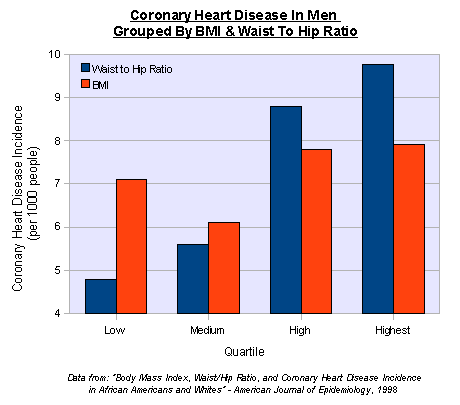
Part I Men with heart disease and how it differs compared to women diagnosed with it.

                         Men and heart diseae                 men and heart disease2

 The perfect gift this Valentine’s Day is the gift of heart health. Along with Valentine’s Day, February marks American Heart Month, a great time to commit to a healthy lifestyle and make small changes that can lead to a lifetime of heart health.

Heart disease is the leading cause of death for men and women. While Americans of all backgrounds can be at risk for heart disease, African American men, especially those who live in the southeast region of the United States, are at the highest risk for heart disease. Additionally, more than 40 percent of African Americans have high blood pressure, a leading cause of heart disease and stroke. That’s why this February during American Heart Month, Million Hearts is encouraging African American men to take charge of their health and start one new, heart-healthy behavior that can help reduce their risk of heart disease and stroke.

Small Changes Can Make a Big Difference

African American men can make a big difference in their heart health by taking these small steps during the month of February and beyond.

  • Schedule a visit with your doctor to talk about heart health. It’s important to schedule regular check-ups even if you think you are not sick. Partner with your doctor and health care team to set goals for improving your heart health, and don’t be afraid to ask questions and trust their advice.
  • Add exercise to your daily routine. Start off the month by walking 15 minutes, 3 times each week. By mid-month, increase your time to 30 minutes, 3 times each week.
  • Increase healthy eating. Cook heart-healthy meals at home at least 3 times each week and make your favorite recipe lower sodium. For example, swap out salt for fresh or dried herbs and spices.
  • Take steps to quit smoking. If you currently smoke, quitting can cut your risk for heart disease and stroke. Learn more a CDC’s Smoking and Tobacco Use website or the AHA.
  • Take medication as prescribed. Talk with your doctor about the importance of high blood pressure and cholesterol medications. If you’re having trouble taking your medicines on time or if you’re having side effects, ask your doctor for help.Heart disease is one of the leading health risks facing men today. According to the American Heart Association (AHA), more than one in three adult men has heart disease. Although it may seem that something so serious should have warning signs, you may be developing heart disease without knowing it as you go about your daily life. Know the early signs of heart disease — as well as risk factors — so you can get treatment early and prevent more serious health problems.The risk factors:Risk factors include:
  • Many men are at high risk for developing heart disease. The AHA reports that only a quarter of men met federal guidelines for physical activity in 2011. In 2015, an estimated 205 million U.S. men were obese. And about 20 percent of men smoke, which can cause the blood vessels to narrow. Narrowed blood vessels are a precursor to certain types of heart disease.
  • Heart disease is an umbrella term that includes heart failure, coronary artery disease, arrhythmias, angina, and other heart-related infections, irregularities, and birth defects.
  • Heart Disease
  • a diet high in saturated fat
  • alcohol abuse or excessive drinking
  • high cholesterol
  • diabetes
  • high blood pressure (hypertension)Early Signs of Heart DiseaseIn the early stages, symptoms that seem like mere annoyances may come and go. For example, you may have heart arrhythmias, which can cause:
  • The first sign of heart disease is often a heart attack or other serious event. But, there are a few important signs that can help you recognize problems before they come to a head.
  • According to the Centers for Disease Control and Prevention (CDC), nearly half of all Americans — both men and women — have three or more risk factors for heart disease.
  • difficulty catching your breath after moderate physical exertion, like walking up a flight of stairs
  • a sense of discomfort or squeezing in your chest that lasts for 30 minutes to a few hours
  • unexplained pain in your upper torso, neck, and jaw
  • a heartbeat that is faster or slower than usual
  • dizziness or fainting
  • Heart disease that involves your blood vessels is often signaled by:
  • chest pain (angina)
  • shortness of breath
  • changes in your extremities, such as pain, swelling, tingling, numbness, coldness, and weakness
  • extreme fatigue
  • irregular heartbeatIn addition to the above symptoms, heart disease caused by an infection of the heart can include dry cough, fever, and skin rashes. *                                                                                                                                                                                                                                                                                                                       *After undergoing triple coronary bypass surgery in 1999, Louisiana native, Clarence Ancar made the decision to make his heart health a priority. Before he had surgery, Clarence knew he had high cholesterol but had dismissed his doctor’s advice on adopting a healthy lifestyle and taking his medication. Clarence’s cardiologist, Dr. Keith C. Ferdinand, taught him that heart disease was not a death sentence and that he could still live a long, healthy life if he committed to making a few changes and respected his heart condition. Working together with his health care team, Clarence developed a plan to start and stay heart healthy. By setting small, achievable goals and tracking those goals, Clarence made a big and lasting difference in his health. He learned the importance of taking his high blood pressure and cholesterol medications. With the help of a dietitian Dr. Ferdinand referred him to, he started eating less of the fatty, salty, and greasy food and added more fruits and vegetables. He also began walking 2-3 miles each day. After his surgery, Clarence lost a significant amount of weight and kept it off. Today, Dr. Ferdinand continues to motivate and support Clarence in his heart health journey. By having a strong and trusting relationship with his doctor, Clarence was able to adopt and maintain a healthy lifestyle. Clarence encourages African American men to be strong and commit to making one heart-healthy lifestyle change during American Heart Month. *

    Strong Men Make Heart Health a Priority

A cluster of risk factors may also signal impending heart disease. For example, your risk of heart disease significantly increases if you have diabetes and high blood pressure.  These can be signs that your blood vessels have narrowed. This narrowing, which can be caused by plaque build-up, makes it more difficult for your heart to pump and circulate oxygenated blood efficiently through your body.

QUOTE FOR MONDAY:

It is happening to younger adults more and more often. This is partly because the conditions that lead to heart disease are happening at younger ages. … High rates of obesity and high blood pressure among younger people (ages 35-64) are putting them at risk for heart disease earlier in life.

Centers for Disease Control and Prevention (cdc.gov)

QUOTE FOR THE WEEKEND:

“There is no cure for Moebius syndrome but some of the symptoms can be treated through treatment therapies for some people with this syndrome.”.

Facial Palsy (facialpalsy.org)


QUOTE FOR FRIDAY:

Moebius syndrome is a rare neurological condition that primarily affects the muscles that control facial expression and eye movement.”

U.S. Library of Medicine (NIH.gov)

QUOTE FOR WEDNESDAY:

“Staying at a healthy weight, being physically active, and limiting how much alcohol you drink can help reduce your risk of breast cancer.”

American Cancer Society


QUOTE FOR MONDAY:

“Winter can be brutal, but research shows you might get some health benefits during the colder months. When it’s cold, your body has to work harder to maintain its core body temperature — and as a result, you might burn more calories. Colder temperatures can help reduce both allergies and inflammation.”

Harvard Health Publishing

Is cold weather good or bad for your health?

the cold2The cold3the cold 4

It depends. Cold weather can be hard on your health in some ways, but it also be good for it, reports the January 2010 issue of the Harvard Health Letter. Most of us spend the winter trying to stay warm, but a little bit of exposure to cold may not be such a bad thing. There are two types of fat in the human body: white fat and brown fat. Brown fat is the heat-producing, calorie-burning fat that babies need to regulate their body temperatures. Most of it disappears with age, but adults retain some brown fat. Dutch researchers reported findings last year that showed that moderately cool temperatures of 61° F activated brown fat in 23 of 24 study volunteers. This is a good thing because brown fat burns calories more efficiently than white fat, and so may help control weight.

It can be tempting to spend the coldest mornings safely tucked under the covers; it’s only natural to want to avoid the most brutal temps. But during periods of such weather-induced isolation, we tend to reach out to contact our closest friends and family on the phone, and end up chatting with them for longer than usual, according to studies of 2012.

For some insects and even animals the freezing cold is not suitable for them and regarding our health well look here; during the summer of 2012 — when West Nile cases were climbing — much was made of the milder 2011-2012 winter and its effect on the disease-spreading mosquito population. The pests thrive in milder climates, meaning they were able to survive — and breed — all winter, just waiting to feast come spring. Freezing or below-freezing temps might kill off some skeeters (and ticks), thereby protecting you from the illnesses they are known to spread.

Through Psychology Today, some research suggests that if the weather never changes, you start taking that sunshine for granted. Shivering through the cold makes those warm spring days seem even better when they finally come along.

There’s a reason putting ice on an injury works. That drop in temperature reduces inflammation in, say, a sprained ankle or stubbed toe. But the theory works on a much grander scale, too — cold temperatures can reduce inflammation and pain all over.  In one recent study, researchers in Finland studied 10 women as they took 20-second plunges into near-freezing water, and also partook in sessions of cold-body cryotherapy (exposing the body to ultra-low temps for brief periods). After being exposed to the cold, participants’ blood showed three times as much norepinephrine, a naturally occurring chemical that may help suppress pain.  In fact, athletes and spa-goers even have a remedy of sorts available for muscle recovery. A 2011 study found that, at extremely low temperatures, such treatments, called cryotherapy, did more for athletes to recover from physical activity than simply resting. Runners who were exposed to temperatures as low as -166 degrees F recovered from exercise faster than those who given other therapies or told to rest, The Atlantic reported. Live in a cold-weather climate? Then you’re well aware that we’ve got a few more weeks of icy temps to endure. But those bitter winds could be doing you more good than you’d think: Preliminary research shows they may lead to a longer life.

In a study published in a recent issue of cell, researchers from the Department of Molecular and Integrative Physiology at the University of Michigan discovered that worms exposed to cold temperatures demonstrate a genetic response that triggers longer life spans.

Studies have shown that exposure to freezing temperatures, even for short periods, can significantly increase your energy expenditure for hours afterward. Swim a few laps in cool water, or take a power walk in winter weather, to enjoy the perk up for your workout.

So enjoy the cold!
QUOTE FOR THE WEEKEND:

Cotard delusion, also known as or nihilistic delusion or walking corpse syndrome or Cotard’s syndrome , is a rare mental disorder in which the affected person holds the delusional belief that they are already dead, do not exist, are putrefying, or have lost their blood or internal organs.

Healthline.com