







QUOTE FOR FRIDAY:

“The aorta carries blood from the heart to the body. Aortic aneurysms can occur anywhere in the aorta. They may be tube shaped or round.

Aortic aneurysms include:

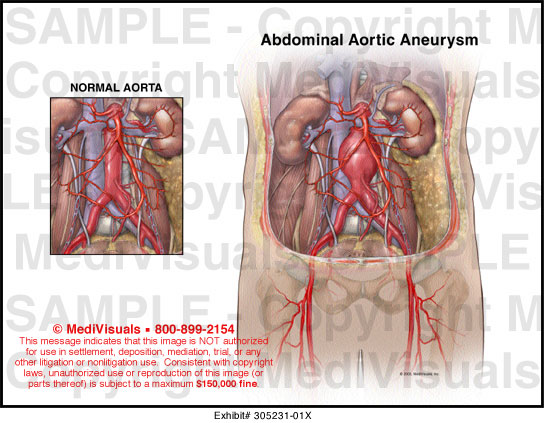
  • Abdominal aortic aneurysm. An abdominal aortic aneurysm occurs along the part of the aorta that passes through the belly area.
  • Thoracic aortic aneurysm. A thoracic aortic aneurysm occurs along the part of the aorta that passes through the chest cavity.”

MAYO CLINIC (https://www.mayoclinic.org/diseases-conditions/aortic-aneurysm/symptoms-causes/syc-20369472)

Some people may have both types of aortic aneurysms.

Having an aortic aneurysm increases the risk of developing a tear in the inner layer of the wall of the aorta. This tear is called an aortic dissection.

Part II Aortic Aneurysms –What’s inside it, What are the risk factors in getting this & the most common causes!

What is inside an aortic aneurysm?

The inside walls of aneurysms are often lined with a blood clot that forms because there is stagnant blood. The wall of an aneurysm is layered, like a piece of plywood.

Who is most likely to have an abdominal aortic aneurysm?

Abdominal aortic aneurysms tend to occur in white males over the age of 60. In the United States, these aneurysms occur in up to 3.0% of the population. Aneurysms start to form at about age 50 and peak at age 80. Women are less likely to have aneurysms than men and African Americans are less likely to have aneurysms than Caucasians.

There is a genetic component that predisposes one to developing an aneurysm; the prevalence in someone who has a first-degree relative with the condition can be as high as 25%.

Collagen vascular diseases that can weaken the tissues of the aortic walls are also associated with aortic aneurysms. These diseases include Marfan and Ehlers-Danlos syndrome.

What are risk factors for aortic aneurysms?

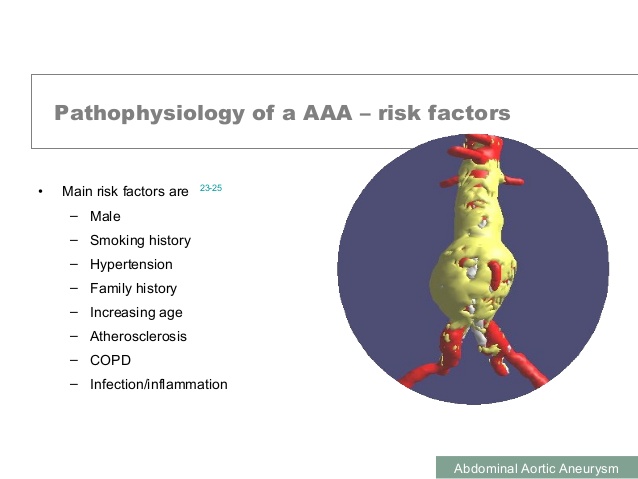
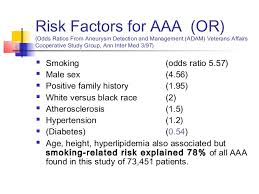
The risk factors for aortic aneurysm are the same as those for atherosclerotic heart disease, stoke, and peripheral artery disease and include:

  • Cigarette smoking: This not only increases the risk of developing an abdominal aortic aneurysm, but also increases the risk of aneurysm rupture. Aortic rupture is a life-threatening event where blood escapes the aorta and the patient can quickly bleed to death.
  • High blood pressure
  • Elevated blood cholesterol levels
  • Diabetes mellitus The most common cause of aortic aneurysms is “hardening of the arteries” called arteriosclerosis. At a majority of aortic aneurysms are from arteriosclerosis. The arteriosclerosis can weaken the aortic wall and the increased pressure of the blood being pumped through the aorta causes weakness of the inner layer of the aortic wall.
  • The aortic wall has three layers, the tunica adventitia, tunica media, and tunica intima. The layers add strength to the aorta as well as elasticity to tolerate changes in blood pressure. Chronically increased blood pressure causes the media layer to break down and leads to the continuous, slow dilation of the aorta.
  • What is the most common cause of aortic aneurysms?

Smoking is a major cause of aortic aneurysm. Studies have shown that the rate of aortic aneurysm has fallen at the same rate as population smoking rates.

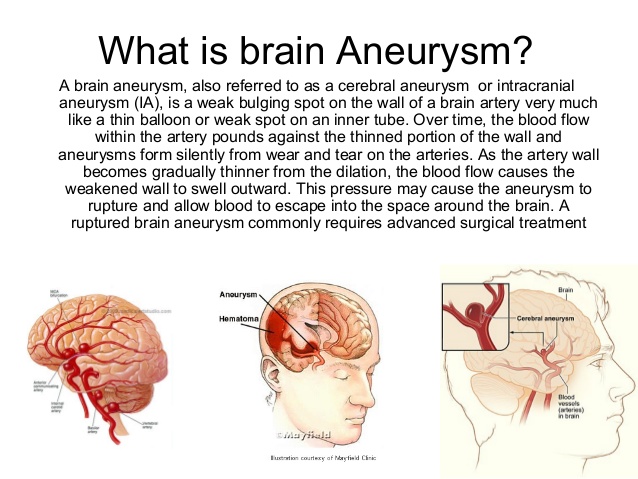
Know a aneurysm can be located in different arteries, like the brain with the same common causes, risk factors and make up inside the aneurysm.

aortic aneurysm 2 

QUOTE FOR THURSDAY:

“An aortic aneurysm is a balloon-like bulge in the aorta, the large artery that carries blood from the heart through the chest and torso.  Facts about aortic aneurysms:

  • Aortic aneurysms or aortic dissections were the cause of 9,904 deaths in 2019.1
  • In 2019, about 59% of deaths due to aortic aneurysm or aortic dissection happen among men.1
  • A history of smoking accounts for about 75% of all abdominal aortic aneurysms.2
  • The U.S. Preventive Services Task Force recommends that men 65 to 75 years old who have ever smoked should get an ultrasound screening for abdominal aortic aneurysms, even if they have no symptoms.3“.

Centers for Disease Control and Prevention – CDC (https://www.cdc.gov/heartdisease/aortic_aneurysm.htm)

Part I What is an aortic aneurysm?

aortic aneurysm 3aortic aneurysm 4aortic aeurysm 5

The aorta is the large artery that exits in the heart and delivers blood to the body. It begins at the aortic valve that separates the left ventricle of the heart from the aorta and prevents blood from leaking back into the left ventricle after a contraction, which is actually when the heart pumps blood. The various sections of the aorta are named based upon “arch-like” initial design and the location of the aorta in the body. Thus, the beginning of the aorta is referred to as the ascending aorta (basically meaning the blood going against resistance due to the vessel being a hill for the blood to go up), followed by the arch of the aorta, then the descending aorta (which is the blood going downward via gravity with the help of the heart pumping the blood of course). The portion of the aorta that is located in the chest (called thorax) is referred to as the thoracic aorta, while the abdominal aorta (the part of the aorta below the thorax region) is located in the abdomen. The abdominal aorta extends from the diaphragm (at the bottom of the lungs like a floor to divide the lungs from the organs in the abdomen) to the mid-abdomen where it splits into the iliac arteries and when it reaches the legs the femoral arteries now start which supplies to the legs oxygenated blood. This is why commonly a cardiac catheterization to visualize the aorta and sometimes the left side of the heart is done starting in the femoral artery since in time it diverts into starting the abdominal aorta.

An aneurysm is an area of a localized widening (dilation) of a blood vessel. The word “aneurysm” is borrowed from the Greek “aneurysma” meaning “a widening”.

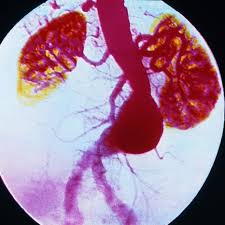
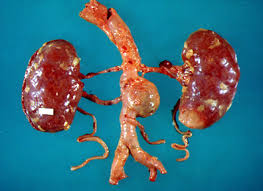
An aortic aneurysm involves the aorta, the major artery that leaves the heart to supply blood to the body. An aortic aneurysm is a dilation or bulging of the aorta..

Most aortic aneurysms are fusiform. They are shaped like a spindle (“fusus” means spindle in Latin) with widening all around the circumference of the aorta. (Saccular aneurysms just involve a portion of the aortic wall with a localized out pocketing).

What is inside an aortic aneurysm?

The inside walls of aneurysms are often lined with a blood clot that forms because there is stagnant blood. The wall of an aneurysm is layered, like a piece of plywood.

Who is most likely to have an abdominal aortic aneurysm?

Abdominal aortic aneurysms tend to occur in white males over the age of 60. In the United States, these aneurysms occur in up to 3.0% of the population. Aneurysms start to form at about age 50 and peak at age 80. Women are less likely to have aneurysms than men and African Americans are less likely to have aneurysms than Caucasians.

There is a genetic component that predisposes one to developing an aneurysm; the prevalence in someone who has a first-degree relative with the condition can be as high as 25%.

Collagen vascular diseases that can weaken the tissues of the aortic walls are also associated with aortic aneurysms. These diseases include Marfan syndrome and Ehlers-Danlos syndrome

Aortic aneurysms can develop anywhere along the length of the aorta but the majority are located in the abdominal aorta. Most of these abdominal aneurysms are located below the level of the renal arteries, the vessels that provide blood to the kidneys. Abdominal aortic aneurysms can extend into the iliac arteries.

What shape are most aortic aneurysms?

Most aortic aneurysms are fusiform. They are shaped like a spindle (“fusus” means spindle in Latin) with widening all around the circumference of the aorta. (Saccular aneurysms just involve a portion of the aortic wall with a localized out pocketing).

Stayed tune for Part II on Aortic Aneurysms tomorrow!


QUOTE FOR WEDNESDAY:

“Gaseous chemical element, symbol: O, atomic number: 8 and atomic weight 15,9994. It’s of great interest because it’s the essential element in the respiratory processes of most of the living cells and in combustion processes. It’s the most abundant element in The Earth’s crust. Nearly one fifth (in volume) of the air is oxygen. Non-combined gaseous oxygen normally exists in form of diatomic molecules, O2, but it also exists in triatomic form, O3, named ozone.  In normal conditions oxygen is a colourless, odourless and insipid gas; it condensates in a light blue liquid. Oxygen is part of a small group of gasses literally paramagnetic, and it’s the most paramagnetic of all. Liquid oxygen is also slightly paramagnetic.

Oxygen is essential for all forms of life since it is a constituent of DNA and almost all other biologically important compounds. Is it even more drammatically essential, in that animals must have minute by minute supply of the gas in order to survive. Oxygen in the lungs is picked up by the iron atom at the center of hemoglobin in the blood and thereby transported to where it is needed.

Every human being needs oxygen to breathe, but as in so many cases too much is not good. If one is exposed to large amounts of oxygen for a long time, lung damage can occur. Breathing 50-100% oxygen at normal pressure over a prolonged period causes lung damage. Those people who work with frequent or potentially high exposures to pure oxygen, should take lung function tests before beginning employment and after that. Oxygen is usually stored under very low temperatures and therefore one should wear special clothes to prevent the freezing of body tissues.”

LennTech  (https://www.lenntech.com/periodic/elements/o.htm#ixzz88ZXf1arK)


QUOTE FOR TUESDAY:

“Nothing compares to the joy of coming home to a loyal companion. The unconditional love of a pet can do more than keep you company. Pets may also decrease stress, improve heart health, and even help children with their emotional and social skills.  An estimated 68% of U.S. households have a pet.  Interacting with animals has been shown to decrease levels of cortisol (a stress-related hormone) and lower blood pressure. Other studies have found that animals can reduce loneliness, increase feelings of social support, and boost your mood.”

National Institute of Health NIH News in Health (https://newsinhealth.nih.gov/2018/02/power-pets)

Animals impact many human lives!

csc_1097  animal-therapy

dogs-and-catshumans-and-pets

dogs-are-amazing-friends1 cutie-dogs-thats-amazing2

cats  dogs


csc_0212  035

Animals play an important role in many people’s lives.  In addition to seeing-eye dogs and dogs that can be trained to detect seizures, animals can also be used in occupational therapy, speech therapy, or physical rehabilitation to help patients recover.  Aside from these designated therapeutic roles, animals are also valued as companions, which can certainly affect the quality of our lives.  Is that companionship beneficial to our health? The better we understand the human-animal bond, the more we can use it to improve people’s lives.

Over 71 million American households (62%) have a pet, and most people think of their pets as members of the family. Some research studies have found that people who have a pet have healthier hearts, stay home sick less often, make fewer visits to the doctor, get more exercise, and are less depressed.  Pets may also have a significant impact on allergies, asthma, social support, and social interactions with other people.

Impact on Physical Health

Companion animals may improve heart health by lowering blood pressure and regulating the heart rate during stressful situations.  In a 2002 study, researchers measured changes in heart rate and blood pressure among people who had a dog or cat, compared to those who did not, when participants were under stress (performing a timed math task).  People with a dog or cat had lower resting heart rates and blood pressure measures at the beginning of the experiment than non-pet owners.  People with a dog or cat were also less likely to have spikes in heart rates and blood pressure while performing the math task, and their heart rates and blood pressure returned to normal more quickly. They also made fewer errors in their math when their pet was present in the room.4  All these findings indicated that having a dog or cat lowered the risk of heart disease, as well as lowering stress so that performance improved.

A similar study found that having your dog in the room lowered blood pressure better than taking a popular type of blood pressure medication (ACE inhibitor) when you are under stress.5

Children’s exposure to companion animals may also ease anxiety.  For example, one study measured blood pressure, heart rate, and behavioral distress in healthy children aged 3 to 6 at two different doctor visits for routine physicals.  At one visit a dog (unrelated to the child) was present in the room and at the other visit the dog was absent.  When the dog was present, children had lower blood pressure measures, lower heart rates, and less behavioral distress.6  Research on the health benefits of child and animal interaction is limited.  Further research is needed on how pets influence child development and specific health outcomes.

These findings suggest that the social support a pet provides can make a person feel more relaxed and decrease stress.7  Social support from friends and family can have similar benefits, but interpersonal relationships often cause stress as well, whereas pets may be less likely to cause stress.  The social support provided by a pet might also encourage more social interactions with people, reducing feelings of isolation or loneliness.  For example, walking with a dog has been found to increase social interaction, especially with strangers, compared to walking without a dog.8

Among elderly people, pet ownership might also be an important source of social support that enhances well-being.  In one study, elderly individuals that had a dog or cat were better able to perform certain physical activities deemed “activities of daily living,” such as the ability to climb stairs; bend, kneel, or stoop; take medication; prepare meals; and bathe and dress oneself.  There were not significant differences between dog and cat owners in their abilities to perform these activities.  Neither the length of time of having a dog or cat nor the level of attachment to the animal influenced performance abilities.    Companion animals did not seem to have an impact on psychological health but researchers suggested that a care-taking role may give older individuals a sense of responsibility and purpose that contributes to their overall well-being.


QUOTE FOR MONDAY:

“In the United States, the most common type of heart disease is coronary artery disease (CAD), which leads many to heart attacks. You can greatly reduce your risk for CAD through lifestyle changes and, in some cases, medication. CAD consists of cholesterol and placque build up, even tar if a smoker, that can be deadly in time with blocking the arteries called atherosclerosis. This in time left untreated can lead to a heart attack or even silent heart attack. CAD also is the brittling of the arteries causing narrowing of the arteries called arteriosclerosis. Here it is the ending result is the blood supply is affected in not getting enough oxygen to the tissue, in particular the heart for CAD.

It is still the number one killer even greater than cancer in both men and women today.”

AHA American Heart Association

QUOTE FOR THE WEEKEND:

“Yersiniosis refers to the illnesses caused by Y. enterocolitica and less often by Y. pseudotuberculosis infections. Infection occurs most often in young children. Common symptoms in children are fever, abdominal pain, and diarrhea, which is often bloody.

Most people become infected by eating contaminated food, especially raw or undercooked pork, or through contact with a person who has prepared a pork product, such as chitlins. For example, babies and infants can be infected if their caretakers handle contaminated food and then do not wash their hands properly before handling the child or the child’s toys, bottles, or pacifiers.  People occasionally become infected after drinking contaminated milk or untreated water, or after contact with infected animals or their feces.  On rare occasions, people become infected through person-to-person contact. For example, caretakers can become infected if they do not wash their hands properly after changing the diaper of a child with yersiniosis.”

CDC – Centers for Disease Control and Prevention  (https://www.cdc.gov/yersinia/faq.html)

QUOTE FOR FRIDAY:

“Agoraphobia is fear of and anxiety about being in situations or places without a way to escape easily or in which help might not be available if intense anxiety develops.  The situations are avoided, or they may be endured but with substantial anxiety. About 30 to 50% of people with agoraphobia also have panic disorder.  Agoraphobia without panic disorder affects about 2% of women and 1% of men during any 12-month period. Peak age at onset is the early 20s; first appearance after age 40 is unusual.”

Merck Manual Professional Version (https://www.merckmanuals.com/professional/psychiatric-disorders/anxiety-and-stressor-related-disorders/agoraphobia)