Archive | September 2024

QUOTE FOR FRIDAY:

“Prostate cancer is cancer that occurs in the prostate. The prostate is a small walnut-shaped gland in males that produces the seminal fluid that nourishes and transports sperm.

Prostate cancer is one of the most common types of cancer. Many prostate cancers grow slowly and are confined to the prostate gland, where they may not cause serious harm. However, while some types of prostate cancer grow slowly and may need minimal or even no treatment, other types are aggressive and can spread quickly.

Prostate cancer that’s detected early — when it’s still confined to the prostate gland — has the best chance for successful treatment.”

MAYO CLINIC (https://www.mayoclinic.org/diseases-conditions/prostate-cancer/symptoms-causes/syc-20353087)

QUOTE FOR THURSDAY:

“Treatment for ovarian cancer usually involves a combination of surgery and chemotherapy.

  • Surgery: An operation in which doctors cut out the cancer.
  • Chemotherapy: Use of special medicines to shrink or kill the cancer. The drugs can be pills you take or medicines given in your veins, or sometimes both.
  • Targeted therapy: Use of drugs to block the growth and spread of cancer cells. The drugs can be pills you take or medicines given in your veins. You will get tests to see if targeted therapy is right for your cancer type before this treatment is used.

Visit the National Cancer Institute for more information about ovarian cancer treatment.”

Center for Disease Control and Prevention – CDC (https://www.cdc.gov/ovarian-cancer/treatment/?cid=google:paid_search_co:ik_24:q1_24_rsa_refresh:ovarian&gad_source=1&gclid=EAIaIQobChMIj63WtM3HiAMVAU9HAR3BciZCEAAYASAAEgKu-_D_BwE)

QUOTE FOR WEDNESDAY:

“Ovarian cancer is a type of cancer that begins in the female reproductive organs that produce and store eggs (ovaries). It occurs when abnormal ovarian cells divide and multiply uncontrollably. “Ovarian cancer” is a generic term for any primary malignant ovarian tumor. However, ovarian cancer is not one disease. There are many types of ovarian cancer, including some that are extremely rare and require specialized treatment. Therefore, establishing the correct diagnosis upfront is very important. The main types of ovarian cancer are named for the cells where the disease first forms. There is epithelial ovarian cancer, germ cell ovarian cancer, stromal ovarian cancer, and primary peritoneal ovarian. ”

MD Anderson Cancer Center

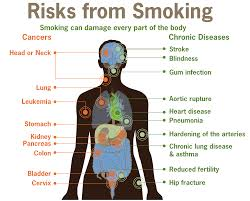
Simple facts with consequences you face if you decide to start or continue smoking.

Through an accurate reference the Centers for Disease Control and Prevention, who wants to save lives and protect people, support the following:

Smoking is estimated to increase the risk—

    • For coronary heart disease by 2 to 4 times1,6
    • For stroke by 2 to 4 times1
    • Of men developing lung cancer by 25 times1
    • Of women developing lung cancer by 25.7 times1

Smoking causes diminished overall heath, such as self-reported poor health, increased absenteeism from work, and increased health care utilization and cost.

Smokers are at greater risk for diseases that affect the engine of the body=The heart and its branches=The circulatory system (putting a smoker at high risk for cardiovascular disease).

  • Smoking causes stroke and coronary heart disease—the leading causes of death in the United States.
  • Even people who smoke fewer than five cigarettes a day can have early signs of cardiovascular disease.
  • Smoking damages blood vessels and can make them thicken and grow narrower. This makes your heart beat faster and your blood pressure go up. Clots can also form.
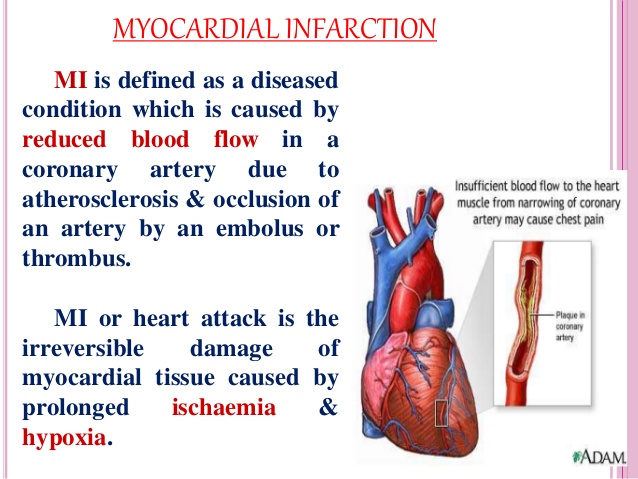
  • A heart attack occurs when a clot blocks the blood flow to your heart. When this happens, your heart cannot get enough oxygen causing starvation of food, being oxygen to the heart tissue. This damages the heart muscle, and part of the heart muscle can die, which is what exactly happens with a heart attack where angina (lack of 02 is reversible).
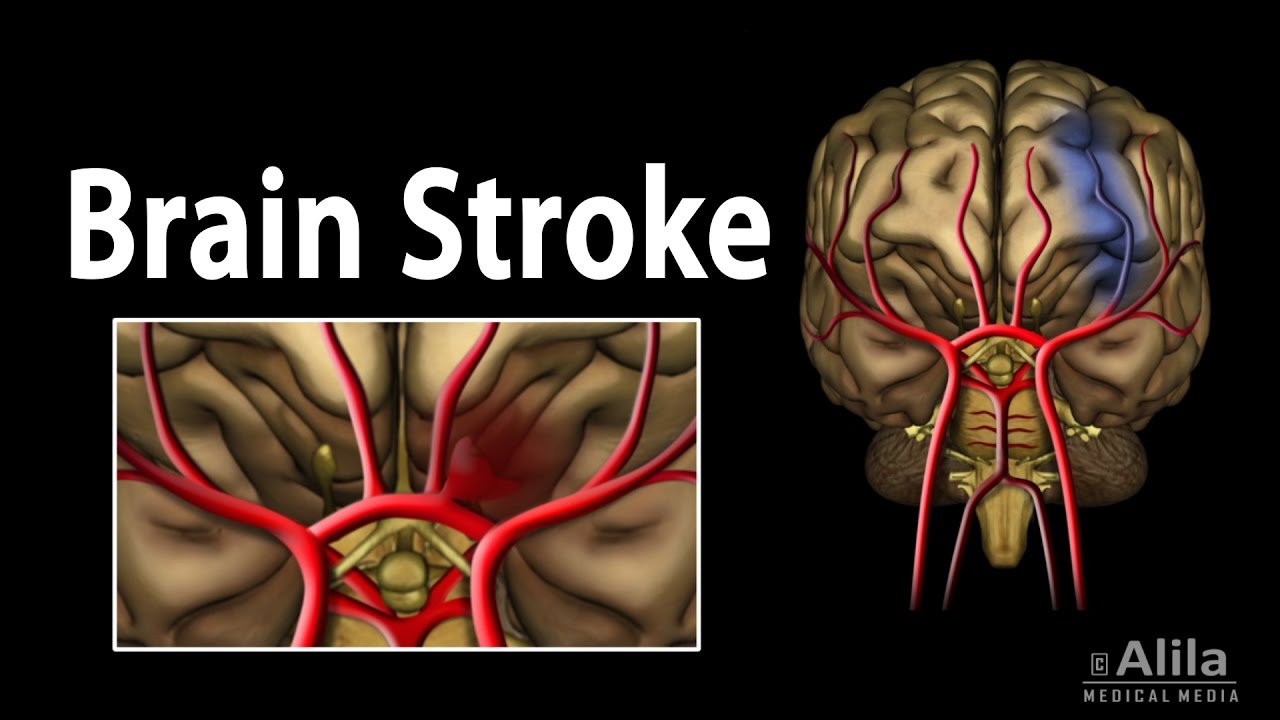
  • A stroke occurs when a clot blocks the blood flow to part of your brain or when a blood vessel in or around your brain bursts causing again starvation of food, being 02, just in a different tissue part. Get it oxygen is the food to all our tissues of the body
  • Blockages caused by smoking can also reduce blood flow to your skin and legs (For example Peripheral Vascular Disease= PVD). Ever see the commercial with a person telling you to stop smoking with fingers surgically removed or limbs, PVD is what occurred to that individual and the person didn’t stop smoking. Due to this behavior what happened the vessels of the individual’s limbs became so narrowed that it cut off oxygenated blood supply to those tissue parts causing ischemia-lack of oxygen, which led to necrosis of the tissue (death) and the part had to be surgi-cally removed. Now that individual can’t walk or grasp things with those limbs that were operated on. Is smoking worth this consequence? I don’t think so, what about you? Just think about it if you still smoke.Smoking can cause lung disease by damaging your airways and the small air sacs (alveoli) found in your lungs. What actually happens to the lung tissue is the pin point openings (alveoli) keeps expanding to a wider opening. The alveoli is responsible of oxygen and carbon dioxide exchange when we inhale and exhale but with the alveoli stretched the exchange of the gases gets poor.
  • Smoking effects the transmission of the body=The Lungs
  • Lung diseases caused by smoking include COPD, which includes emphysema (especially) and chronic bronchitis.
  • Cigarette smoking causes most cases of lung cancer.
  • If you have asthma, tobacco smoke can trigger an attack or make an attack worse.1,2
  • Smokers are 12 to 13 times more likely to die from COPD than nonsmokers.

Smoking can cause cancer in almost every area of the body. If nobody smoked, one of every three cancer deaths in the United States would not happen. Smoking increases risk of dying from cancer and other diseases in cancer patients and survivors.

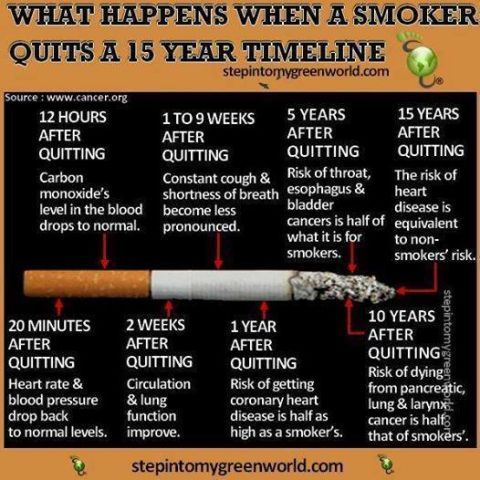
For those who quit smoking what risks you reduce:

  • Quitting smoking cuts cardiovascular risks. Just 1 year after quitting smoking, your risk for a heart attack drops sharply.2
  • Within 2 to 5 years after quitting smoking, your risk for stroke could fall to about the same as a nonsmoker’s.2
  • If you quit smoking, your risks for cancers of the mouth, throat, esophagus, and bladder drop by half within 5 years.2
  • Ten years after you quit smoking, your risk for lung cancer drops by half.

Again, if you smoke you may want to consider stopping; give it a thought.


QUOTE FOR TUESDAY:

“One in 5 children in the United States are obese. Childhood obesity puts kids at risk for health problems that were once seen only in adults, like type 2 diabetes, high blood pressure, and heart disease.  The good news? Childhood obesity can be prevented. Take action during National Childhood Obesity Awareness Month!  You can encourage communities, health professionals, and families to work together to raise awareness about the obesity epidemic and show people how to work towards a solution.  By raising awareness about childhood obesity, we can all work together to keep our kids healthy.”

U.S. Department of Health and Human Services – Health.org (https://health.gov/news/news-and-announcements/2018/09/toolkit-national-childhood-obesity-awareness-month)

QUOTE FOR MONDAY:

“When we are born, our arteries are clear and healthy. They carry blood, oxygen, and nutrients from our hearts to every part of our bodies. They are the channels of life.

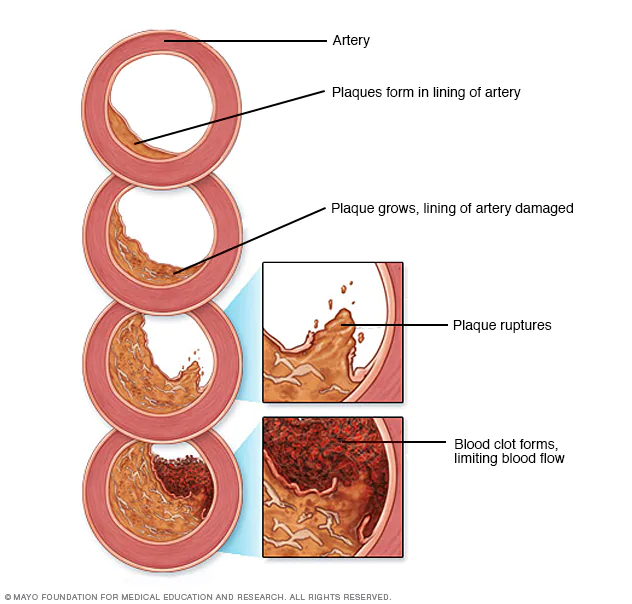
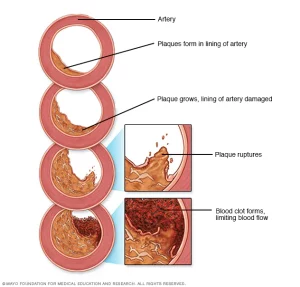
But when our low-density lipoprotein (LDL) cholesterol gets too high, it damages and clogs those arteries which results in cardiovascular disease.

You’ve likely heard of LDL as the “bad cholesterol.” That’s because it’s the single biggest cause of the cardiovascular disease atherosclerosis. When there is too much LDL cholesterol in the bloodstream, it penetrates and irritates the walls of the arteries causing inflammation, plaque and blockages. As long as LDL levels remain high, this process continues and leads to heart attacks, strokes, or peripheral artery disease. 

September is Cholesterol Education Month, so it’s an important time of year to discuss the role of LDL cholesterol in heart disease.

In 2020 alone, approximately 700,000 people died from heart disease in the U.S. It remains the number one killer in America and around much of the world. The easiest way to prevent this is to know your cholesterol numbers and keeping them out of the danger zone.”

Family Heart Foundation (https://familyheart.org/cholesterol-is-key?gad_source=1&gclid=EAIaIQobChMI68_t4sLHiAMVXTIIBR1rghlqEAAYAiAAEgIBovD_BwE)


Part II Cholesterol Month: risk factors, what high cholesterol puts you at risk for and how to prevent this from happening!!

  VS


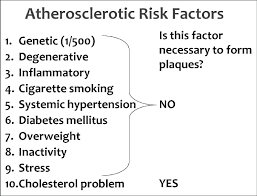
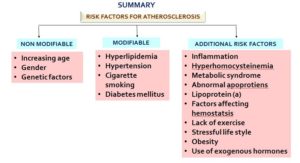
Modifiable Risk Factors putting you at risk for high cholesterol that can put you at risk for heart disease are:

High B/P, Diabetes, Low HDL=good cholesterol, High LDL=bad cholesterol, smoking, eating foods high in SATURATED FAT & CHOLESTEROL, harmful use of alcohol, and lack of any activity in your life (your regular routine doesn’t count like work unless your in a job severely active like construction building homes for example 5 days or week or a personal work out trainer 4 to 5 days week).

MAYO CLINIC states Factors Increasing your BAD Cholesterol:

  • Poor diet. Eating saturated fat, found in animal products, and trans fats, found in some commercially baked cookies and crackers and microwave popcorn, can raise your cholesterol level. Foods that are high in cholesterol, such as red meat and full-fat dairy products, will also increase your cholesterol.
  • Obesity.
  • Lack of exercise. Exercise helps boost your body’s HDL, or “good,” cholesterol while increasing the size of the particles that make up your LDL, or “bad,” cholesterol, which makes it less harmful.
  • Smoking.
  • Age. Because your body’s chemistry changes as you age, your risk of high cholesterol climbs. For instance, as you age, your liver becomes less able to remove LDL cholesterol.
  • Diabetes. High blood sugar contributes to higher levels of a dangerous cholesterol called very-low-density lipoprotein (VLDL) and lower HDL cholesterol. High blood sugar also damages the lining of your arteries.

Non-modifiable Risk Factors=4 types only which are factors we can’t control:

1-Heredity (The higher the risk is when the heredity is closer to you in your family tree=Nuclear family–mom, dad, and siblings).

2-Age (Men aged 45y/o or older & Women aged 55 y/o or older)

3-Gender (It may affect your risk, for years heart disease was considered a man’s disease but we now know that heart disease is the leading cause of death for women as well as men. Although men tend to develop coronary artery disease earlier in life, after age 65 the risk of heart disease for both genders is equal.)

4-Race (Heart disease is higher among African Americans, Mexican Americans, American Indians, native Hawaiians, and some Asian Americans compared to Caucasians).

Your body needs cholesterol to build healthy cells, but high levels of cholesterol can increase your risk of heart disease. With high cholesterol, you can develop fatty deposits in your blood vessels. Eventually, these deposits grow, making it difficult for enough blood to flow through your arteries.
High cholesterol can cause:

Too much cholesterol (LDL cholesterol) puts you at risk for heart disease and stroke, two leading causes of death in the United States. High cholesterol has no signs or symptoms, so the only way to know if you have it is to get your cholesterol checked.

WHAT DOES ALL THIS MEAN?  To make this short & simple, from continuous high cholesterol over time, especially with history in your nuclear family puts you at risk for ATHERO-SCLEROSIS = Blockage In Arteries.  This puts at you at risk for a heart attack, stroke (Based on oxygen blocked by high cholesterol causing lack of oxygenated blood (nutrients) to the heart or brain due to high cholesterol build up in arteries supplying the heart and brain.  This is a high risk for MI & CVA).

Now it makes sense?  The answer to prevention or treatment of cardiac disease is changing or modifying your diet, if it’s unhealthy 100% or just partially. The answer includes exercise (from just walking or if you like working out, even better) and if needed medication but your doctor will decide. All these changes can modify your blood lipid profile=cholesterol control, which helps increasing your heart to a better tolerance with activity, stress and simply functioning. Recommended is going to a cardiologist for people diagnosed with heart conditions or your general practitioner with any illness/disease before making changes to help guide you towards the right choices. Your doctor can help you in determining which prevention or treatment plan is best for you.

Foods high in cholesterol=Fast foods, whole fat dairy products-milk/cheese/butter/mayonnaise/ bacon/processed deli meats/salad dressings and shortenings.

The key is to be living a healthy life. This consists of diet, exercise or activity and healthy habits learned and practiced routinely in your life that will help prevent or assist in treating cardiac disease. The better we treat ourselves regarding health the higher the odds we will live a longer   life. There is not just one food to eat or one type of exercise to do or one healthy habit to keep you healthy, there are choices. Wouldn’t you want less disease/illness for yourself and for others throughout the nation including the future generations?  It is all in change and that would be in your diet, activity getting increased and exercise balanced with rest.  Most importantly sticking to it regularly not doing these changes on occasion and that is all in how well you discipline yourself.

FOR MORE INFORMATION:

National Heart Lung and Blood Institute

P.O. Box 30105

Bethesda, MD 20824-0105
QUOTE FOR THE WEEKEND:

“Your cholesterol levels show how much cholesterol is circulating in your blood. Your HDL (“good” cholesterol) is the one number you want to be high (ideally above 60). Your LDL (“bad” cholesterol) should be below 100. Your total should be below 200. Talk with your provider about what your results mean for you and how to manage your cholesterol.

Your cholesterol levels are important because they help you know your risk for heart disease. Cholesterol is a type of lipid (fat) that helps your body perform many important functions. But too much cholesterol in your blood is harmful. It can enter your artery wall, damage its integrity and lead to atherosclerotic plaque (hardened deposits) forming.

Cholesterol travels through your blood silently. And it turns into plaque silently. Plaque buildup is like someone tiptoeing on a carpet. You might not see or notice its presence for a long time.”

Cleveland Clinic (https://my.clevelandclinic.org/health/articles/11920-cholesterol-numbers-what-do-they-mean)

Part I Cholesterol Month: What is cholesterol, its functions for the body, how its measured, what is good versus bad cholesterol?


What is cholesterol?

Cholesterol forms in the liver but we also get cholesterol through foods we eat too. It is a waxy substance that has many important functions in the body. It is part of various hormones, the makeup of the walls of your body’s cells, a component of bile, and many other purposes. How the body processes it is very complex. It joins with a protein and forms a package called lipoprotein. These lipoproteins carry cholesterol through the blood.

What is the functions of cholesterol in the body?

In our bodies, cholesterol serves three main purposes:
  • It aids in the production of sex hormones.
  • It’s a building block for human tissues.
  • It assists in bile production in the liver.
  • Its main function is to maintain the integrity and fluidity of cell membranes.  Cholesterol helps to regulate membrane fluidity over the range of physiological temperatures. to serve as a precursor for the synthesis of substances that are vital for the organism including steroid hormones, bile acids, and vitamin D.

How is cholesterol measured?

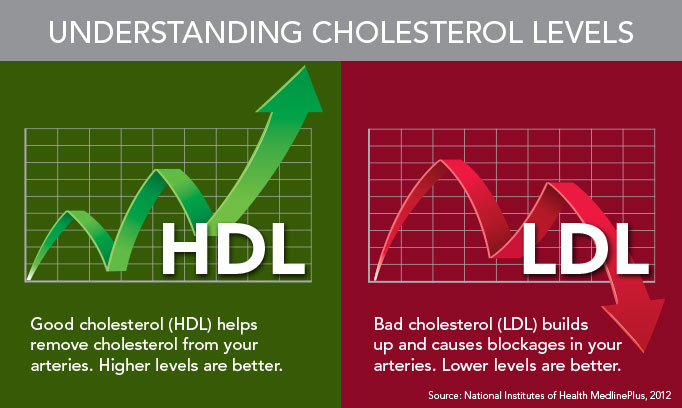
Cholesterol is measured in metric system units. The LDL’s (low density lipoproteins) have the bad cholesterol. LDL’s are the main source of blockage in the arteries. HDL’s (high density lipoproteins) have the good cholesterol. HDL’s help keep cholesterol from building up in the wall of the arteries.  Which most foods show on their labels how much LDL and HDL cholesterol is in a serving of the food your buying.  If it doesnt’t show the cholesterol levels on the label than don’t buy it unless its a treat once in awhile.

Through Cleveland Clinic they state the normal levels of cholesterol for total. HDL and LDL should be:

A HDL level for women 20 yrs old or higher should be 50mg/dl or greater.

A HDL level for men at 20 years old or older should be 40mg/dl or greater.

A LDL level for women or men at 20 years old or older should be less than 100mg/dl.

A total cholesterol level less than 200mg/dl is considered good. It represents the least risk of heart disease. Above that, your level is borderline high. If you are above 200 your level of cholesterol is high.

In our body we have cholesterol which is a type of fat. In certain foods is cholesterol depending on the food you buy. Your total cholesterol includes LDL (low-density lipoprotein) and HDL (high density lipoprotein) cholesterol. Let’s differentiate the two:

1.  LDL (low density lipoprotein) the bad cholesterol can build up in the arterial walls and form plaque in time.  What does this mean?

That build up in the arteries will reduce blood flow and increase your risk to heart disease, especially eating frequently the wrong foods with high and bad cholesterol over years (Example. coronary artery disease, high blood pressure, and eating like this for years can lead to a heart attack or from s/s arising scarring the person to go to the doctor and find out they have blockages & need surgery. The sign and symptoms arising scarring the person can range from chest pain, and can be radiating down the arms, sweating profusely, weakness/fatigue increases in your life, dizziness, you feel like you’re going to fall or actually due to the fatigue/weakness=low blood pressure due to the blockage or the heart just working too hard in doing its function since the cardiac output is decreased from the blockage) Take one of my dear friends who I have known almost 40 years who was a workaholic 10to14hr/7 days a week for at least 35 years and 2 years ago he had to undergo surgery for a coronary artery blockage bypass for 5 vessels blocked 80% to 100%. He should have been dead already due to a heart attach for such blockage but had a successful bypass done followed by long rehab and got better due to high cholesterol eating, smoking (that both play an impact in plaque & tar build up in the vessels) and he stopped but he also was obese by about 50lbs. and lost 30lbs due to better eating and less beer. This could have been prevented if he changed his diet, watched his weight, and quit smoking years ago but that takes discipline, making sacrifices is all within your hands to allow for healthy habits now (prevention) or later when problems occur (treatment), if caught in time. There is a way out of this happening to you.

2-HDL (high density lipoprotein) the good cholesterol it’s known as.  What does this mean?

Because it is thought to help remove bad cholesterol from the body; if you decide the right foods in the right portions that will have more HDL than LDL in them. Differentiating the 2, now another component to keep in mind is risk factors that can put you at risk for heart disease and your doctor will determine what additional risk factors you have putting you at risk for heart disease. These risk factors can be modifiable (controllable by individuals) or non-modifiable (non-controllable by individuals).  Stayed tune for Part II on cholesterol tomorrow covering all this!


QUOTE FOR FRIDAY:

“September is National Suicide Prevention Month – a time to remember the lives lost to suicide, acknowledge the millions more who have experienced suicidal thoughts, and the many individuals, families and communities that have been impacted by suicide. It’s also a time to raise awareness about suicide prevention and share messages of hope.

During September, and throughout the year, we can care about suicide prevention; connect to community, culture, data, and research; and collaborate with others to address this public health problem that has impacted millions of Americans.

EVERYONE can play a role in suicide prevention. Know the warning signs of suicide and #BeThe1To offer support. Seek help for yourself or others by calling or texting 988 or by chat.”

SAMHSA – Substance Abuse and Mental Health Administration

(https://www.samhsa.gov/newsroom/observances/suicide-prevention-month)