Archives

QUOTE FOR THE WEEKEND:

“Regular screening, beginning at age 45, is the key to preventing colorectal cancer (cancer of the colon or rectum). If you’re 45 to 75 years old, get screened for colorectal cancer regularly. If you’re younger than 45 and think you may be at high risk of getting colorectal cancer, or if you’re older than 75, talk to your doctor about screening.

Colorectal polyps and colorectal cancer don’t always cause symptoms, especially at first. That is why getting screened regularly for colorectal cancer is so important.”

Centers for Disease Control and Prevention-CDC (https://www.cdc.gov/cancer/dcpc/resources/features/colorectalawareness/index.htm)

QUOTE FOR FRIDAY:

“The large intestine is the last part of the gastrointestinal (GI) tract, the long, tube-like pathway that food travels through your digestive system. The large intestine is about six feet long — much shorter than the small intestine, which is 22 feet. It’s called the large intestine because it’s wider — about three inches, while the small intestine is only one inch in diameter. It follows from the small intestine and ends at the anal canal, where food waste leaves your body. The large intestine, also called the large bowel, is where food waste is formed into poop, stored, and finally excreted. It includes the colon, rectum and anus. Sometimes “colon” is also used to describe the entire large intestine.”

Cleveland Clinic (https://my.clevelandclinic.org/health/body/22134-colon-large-intestine)

A & P of the large intestines!


the colon to rectum


The GI tract starts at the mouth, to the esophagus, to the stomach, to the small intestines, than to the large intestines, than the rectum to the anus where we remove stool from the GI tract.

Know the cecum is a pouch-like passage that connects the colon to the ileum (the last part of the small intestine). If cancer develops in the cecum, it is treated like colon cancer.

The entire colon is about 5 feet (150 cm) long, and is divided into five major segments. The rectum is the last anatomic segment before the anus, the last part of the GI tract is where the bowel movement comes out.

The ascending and descending colon are supported by peritoneal folds called mesentery.

The proximal colon is the ascending colon and the transverse colon together. The distal colon is the descending colon and the sigmoid colon together.

The right colon consists of the cecum, ascending colon, hepatic flexure and the right half of the transverse colon. The left colon consists of the left half of the transverse colon, splenic flexure, descending colon, and sigmoid.

The intestine is part of the digestive system.  It is made up of the small intestine and the large intestine. The colon and rectum are parts of the large intestine. The colon is a U-shaped tube made of muscle, found below the stomach. The rectum is a shorter tube connected to the colon. Together, the colon and rectum are about 2 metres (6.5 feet) long. They are surrounded by other organs including the spleen, liver, pancreas, bladder and reproductive organs.

The large intestine is made up of the cecum, colon, rectum and anus. The colon and rectum are held in the abdomen by folds of tissue called mesenteries.

The rectum is the lower part of the large intestine that connects to the sigmoid colon. It is about 15 cm (6 in) long. It receives waste from the colon and stores it until it passes out of the body through the anus.

The anus is the opening at the lower end of the rectum through which stool is passed from the body.

Blood Supply and Lymphatics

The superior mesenteric artery (SMA) and the inferior mesenteric artery (IMA) provide blood supply to the colon. Communication between these two vessels happens via the marginal artery, which runs parallel to the length of the entire colon. The branches supplying specific portions of the bowel are as follows:

  • The cecum is supplied by the ileocolic artery, which is a terminal branch of the SMA. The ileocolic artery gives rise to the appendicular artery to supply the appendix.
  • The ascending colon and the right colic flexure are supplied by the ileocolic and right colic arteries, both branches of the SMA.
  • The arterial supply to the transverse colon is mostly from the middle colic artery, which is a branch of  SMA. It may also receive blood supply from the anastomotic arcades between the right and left colic arteries, which collectively form the marginal artery.
  • The descending and sigmoid colon receive their blood supply from the left colic and sigmoid arteries, which are branches of the IMA. The transition of blood supply at the left colic flexure from the SMA to the IMA indicates the embryological transition from the midgut to hindgut that occurs at this point, respectively.
  • The rectum and anal canal are supplied by the superior rectal artery, which is a continuation of the IMA. They also receive supply from branches of the internal iliac arteries, the middle and inferior rectal arteries. Further, the inferior rectal artery is a branch of the internal pudendal artery.

Venous drainage usually accompanies arterial colonic supply. Ultimately, the inferior mesenteric vein (IMV) drains into the splenic vein, while the superior mesenteric vein (SMV) joins the splenic vein to form the hepatic portal vein. Lymphatics of the large intestine drain into the lymph nodes associated with the main vessels that supply them.

Nerves

The midgut-derived ascending colon and proximal two-thirds of the transverse colon receive parasympathetic, sympathetic, and sensory nerve supply from the superior mesenteric plexus.

The hindgut-derived structures, which include the distal one-third of the transverse colon, descending, and sigmoid colon, receive parasympathetic, sympathetic, and sensory nerve innervation from the inferior mesenteric plexus.

The key functions of the colon include the following:

  • Water and nutrient absorption
  • Vitamin absorption
  • Feces compaction
  • Potassium and chloride secretion
  • Moving waste material toward the rectum

Mechanism

Motility

The intestinal wall is made up of multiple layers. The 4 layers of the large intestine from the lumen outward are the mucosa, submucosa, muscular layer, and serosa. The muscular layer is made up of 2 layers of smooth muscle, the inner, circular layer, and the outer, longitudinal layer. These layers contribute to the motility of the large intestine. There are 2 types of motility present in the colon, haustral contraction and mass movement. Haustra are saccules in the colon that give it its segmented appearance. Haustral contraction is activated by the presence of chyme and serves to move food slowly to the next haustra, along with mixing the chyme to help with water absorption. Mass movements are stronger and serve to move the chyme to the rectum quickly.

Absorption of Water and Electrolytes

Absorption of water occurs by osmosis. Water diffuses in response to an osmotic gradient established by the absorption of electrolytes. Sodium is actively absorbed in the colon by sodium channels. Potassium is either absorbed or secreted depending on the concentration in the lumen. The electrochemical gradient created by the active absorption of sodium allows for this. Chloride ions are exchanged for bicarbonate ions across an electrochemical gradient.

Production/Absorption of Vitamins

The colon also plays a role in providing required vitamins through an environment that is conducive for bacterial cultivation. The colon houses trillions of bacteria that protect our gut and produce vitamins. The bacteria in the colon produce substantial amounts of vitamins by fermentation. Vitamin K and B vitamins, including biotin, are produced by the colonic bacteria. These vitamins are then absorbed into the blood. When dietary intake of these vitamins is low in an individual, the colon plays a significant role in minimizing vitamin disparity.

Now that we have reviewed the colon and rectum anatomy and physiology we will tomorrow start on colon cancer awareness for March.

Know cancer in the anal canal or anus is treated differently from colorectal cancer.

Pathophysiology:

Disorders of Large Intestinal Motility

Irritable Bowel Syndrome

Irritable bowel syndrome is thought to be due to psychological factors influencing the motility of the large intestine via the extrinsic autonomic nervous system. During times of stress, segmentation contractions may be increased or decreased, resulting in constipation or diarrhea.

Hirschsprung Disease: Megacolon

Hirschsprung disease is a disorder at birth that occurs when nerve cells are absent (Auerbach’s Plexus) in the muscles of the colon. This affects motility in the colon, making it difficult to pass stool.

Diverticulosis/Diverticulitis

Diverticulosis is a disorder in which pockets develop in the colonic mucosa due to the weakness of the muscle layers in the colon wall. This usually occurs over time from chronic attrition of the aging process. Diverticulitis can develop if these pockets get infected or inflamed, causing abdominal pain and change in bowel movements. Diverticular disease is very common, especially in older adults.

Colitis:

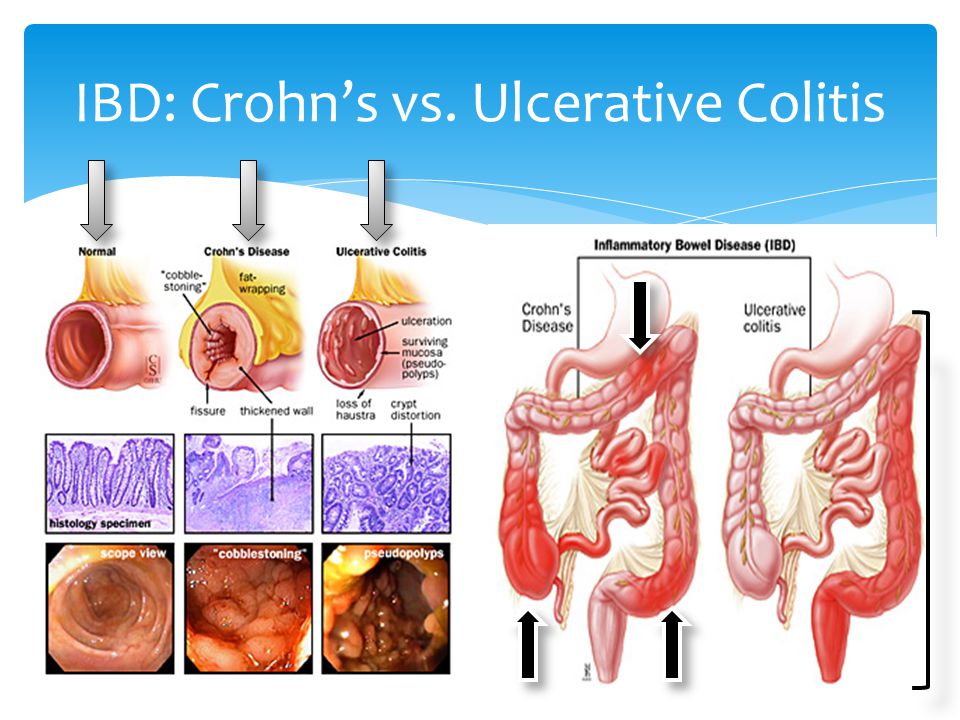
Inflammatory Bowel Disease (Inflammatory) Inflammatory bowel disease includes either Crohn’s disease or ulcerative colitis. Both cause inflammation and scarring within the digestive tract, disrupting the normal function. The cause of inflammatory bowel disease is not known but is likely due to an abnormal response of the immune system. Ulcerative colitis is confined to the large intestine, whereas Crohn’s disease can occur anywhere in the GI tract, from mouth to anus.

Ischemic

Ischemic colitis is more common in the elderly and occurs when there is decreased blood flow to the colon. Decreased blood flow can cause inflammation or injury to the colon. Some causes of ischemic colitis are atherosclerosis of arteries, low blood pressure, blood clots, and bowel obstruction.

Infectious

Infectious colitis can occur from many different viruses, bacteria, or parasites. Infectious colitis most commonly occurs due to ingestion of contaminated food or water, introducing the infectious organism into the colon. The most common causes are Escherichia coli, Campylobacter, Shigella, and Salmonella. These infectious organisms invade the colon, cause inflammation, and affect the normal function, causing abdominal pain and diarrhea. Clostridium difficile is another organism that can cause colitis in association with antibiotic use. C. difficile is part of healthy, normal flora in the colon but can cause problems if it overgrows. Antibiotic use can destroy other susceptible normal flora in the colon, allowing overgrowth and invasion of C. difficile.

Clinical Significance:

Disturbance or dysfunction of the large intestine’s normal physiology can result in poor quality of life and significant medical issues. Pathology of the large intestine is common. One out of every 10 Americans over the age of 40 have diverticular disease, and around 3 million people in the United States have inflammatory bowel disease.  It is important to incorporate a healthy diet and lifestyle to maintain a properly functioning colon. Eating a diet high in fiber and drinking plenty of water allows food to easily move through the colon, keeping the colon relatively clean, which can decrease the risk of diverticular disease. It is also important to maintain healthy colonic flora. Maintaining healthy colonic flora will decrease the risk of abdominal bloating, gas, diarrhea, constipation, and infectious colitis.


QUOTE FOR THURSDAY:

“There are an estimated 1.7 to 3.8 million traumatic brain injuries each year in the United States, according to the CDC, of which 10 percent arise due to sports and recreational activities.  Sustaining an injury while playing sports can range from a mild physical trauma such as a scalp contusion or laceration to severe a traumatic brain injury (TBI) with concurrent bleeding in the brain or coma. It is important to recognize when a head trauma is severe or has resulted in a TBI because it is crucial to seek immediate medical attention.  A traumatic brain injury (TBI) is defined as a form of acquired brain injury from a blow or jolt to the head or a penetrating head injury that disrupts the normal function of the brain. A TBI can result when the head suddenly and violently hits an object, or when an object pierces the skull and enters brain tissue.”

American Association of Neurologiva Surgeons (https://www.aans.org/Patients/Neurosurgical-Conditions-and-Treatments/Sports-related-Head-Injury)

QUOTE FOR WEDNESDAY:

“Anger can be a common emotion among people experiencing major depression. You may feel angry at the world, angry about events from your past, or even angry at yourself. This anger can be intense and difficult to control, to the point that it worsens your depression and affects your personal and professional relationships”.

Very Well Mind (https://www.verywellmind.com/connection-between-depression-and-anger)

QUOTE FOR TUESDAY:

“3 principles in keeping love alive 1. Participate in the act of love · 2. Maintain your individuality and appreciate your partner’s individuality · 3. Ignore your critical inner voice.”.

PsychAlive (https://www.psychalive.org/3-principles-keep-love-alive/)

Learning how to live without love but those with love learn how to keep it alive


The concept of being alone isn’t linked to the feeling of loneliness. In fact, you can make living without love beneficial and positive for you by reading through this article. Soon, you’ll not only be satisfied, but also ecstatic about the way you are and the way your life. One of the major keys in making this happen is endurance and discipline in allowing yourself to get active and not isolate yourself; for if you do and for awhile it’s hard to get out of it. Here are some steps in helping you reach the goal of not feeling alone:

  • Build other relationships. Having a partner shouldn’t be on the relationship pedestal. Without a significant other to get in the way, you now can put in the time and effort to value and develop the numerous other relationships in your life. Include your family and friends nearby, but also those far away. Send cards and write emails to keep in touch with all of your contacts. Don’t forget to include your community. Greet your neighbors and other familiar strangers on the street. As your network grows, you’ll find that what’s most important is the boundless love that you possess and can share with those around you.
  • Keep busy. Getting involved in various activities is a threefold benefit to your life. You’ll be able to fill your schedule, build self-confidence and make tons of new friends. There are countless avenues you can explore from sports to volunteering to religion. Think of the activities you used to be involved in and would like to start up again, but also push yourself to try something new.
  • Be optimistic. Focus on all that you do have instead of concentrating on what you don’t have. If you’re still in the dating game, think positive that the person you’ll deeply connect with is just around the corner. If you want to learn to be happy being alone, act the part and the feelings will come afterwards. Life is all about attitude, so turn the feeling of absence into one of thankfulness. There is already so much to be thankful for.
  • Love yourself. This point is the most important of them all. You may be lacking love from another person, but you definitely should not be lacking love for yourself. You’re the one person that completely and truly understands your needs, so fulfill your own expectations and show appreciation for yourself. Indulge in what makes you insanely happy and joyful. Put yourself in a good mood by treating yourself to your favorite delights. Don’t forget to take care of yourself.

We talk a lot about singles, but we don’t talk about this: what it’s like to live without a partner while longing for one, over years, then decades.

Just 51 percent of the adult population is married, down from 72 percent in 1960. So we talk about swinging, “Sex and the City” singles and extended adolescences. We talk about the delay of marriage or the rise of cohabitation and single motherhood. Depending on our perspective, we cheer the broadening definitions of family or bemoan the breakdown of the nuclear unit.

But the cousin or neighbor or co-worker who always seems to be on his or her own? We don’t give them much thought.

It’s easier not to. Perhaps as much as religion, our society hinges on belief in romantic love. How many songs and novels revolve around the long search and eventual discovery of a beloved? The phrase “happily ever after” implies a singular outcome: two lives made ever better by virtue of their union.

Never mind that close to half of marriages end in divorce that many of those who stay married do so unhappily, and that, rationally, we all know life can be a struggle regardless of relationship status. Ninety percent of us will marry — often repeatedly — on the belief that marriage can add something fundamentally good to our lives.

Certainly, there’s a huge biological imperative to pair up — procreation and protection of the young used to demand it. But reproductive technologies have expanded our baby-making options, and security systems do a good job of deflecting predators. And we still want the ineffable. We want love.

Love is true, but yet, it is fickle. Long lasting love has to evolve and grow over the years, and at times it takes a few unique measures too. Find out how to keep love alivetake in a relationship.

Knowing how to keep love alive in a relationship can seem easy, but it’s actually more difficult that most lovers imagine.

You have to remember you’re not always going to be the same teenager who fell in love with your teenage lover. You will evolve and so will your partner.

Most couples assume they don’t need to have intimate conversations or exchange thoughts about each other’s views on life because they already know everything about their partner.

But what many don’t understand is that we grow and evolve as individuals constantly, and our likes, dislikes and opinions too change all the time.

In the introduction on how to keep love alive, we’ve seen that there are just two basic requirements for a relationship to be successful.

Affection and sexual desire.

As long as we can keep these two emotions on a high, love too can be kept alive and exciting.

Find out how to keep love alive and make the relationship more exciting and fun, even as the years roll by with these simple and at times, unconventional tips.

How to keep love alive

Most lovers start taking their partner for granted over the years, and this eventually leads to boredom in a relationship. Curiosity in a relationship is the driving force in keeping love alive in a long term relationship.

When you assume you know everything about a partner, love starts to stagnate and differences start to crop up, even if the words aren’t voiced out. After all, both of you grow as individuals with each passing day. [Read: How to know if you are in love]

Here are a few tips on how to keep love alive in a relationship and how to bring the excitement back again, especially when it comes to affection and sexual attraction.

Avoid taking each other for granted

One of the disadvantages of long term relationships is the fact that lovers start to take each other for granted. They assume they know their partner’s likes and dislikes and end up making a lot of assumptions, which can be critically wrong at times.

On the other hand, even favors and special gestures are taken for granted as the years go by. If a husband prepares a breakfast-in-bed for his wife every Sunday morning for a few months, it’s a special gesture at the beginning. But as the months go by and the husband decides to sleep in one Sunday morning, the wife ends up getting upset that she wasn’t served her breakfast. Likewise, there may be several other kinds of special gestures that lovers share with each other which can eventually be taken for granted.

By taking these gestures for granted, nothing really becomes a special gesture anymore. Instead it becomes an obligation. Always remember to acknowledge a gesture, however small it may be if you want to understand the secret behind knowing how to keep love alive in a relationship.

By taking each other for granted, be it an evening foot rub or a big birthday bash, you’re taking away the affection behind a gesture, and turning it into an obligation. If you want to keep the love alive in your relationship, acknowledge the gestures and never ever take your partner for granted.

Surprise each other

Remember the first year of your relationship? Both of you went out of your way to buy each other birthday gifts, and every now and then you popped in a surprise just to see your lover smile in surprise. Do you still do that?

In almost all cases, couples stop paying attention to happy surprises after a few years. We want to keep the love alive in a relationship, but almost all of us stop doing anything to keep the relationship exciting and unique. It doesn’t matter if it is concert tickets, a surprise vacation or even a posse of flowers. Go out of your way to make your partner feel special like you used to, and you’ll see that the relationship will only get more exciting and affectionate in no time. [Read: Dating facts]

Celebrate special occasions

Pay attention to relationship landmarks and special occasions in the relationship. Many Valentine’s Days, anniversaries and birthdays may come and go, but that doesn’t mean you should ignore them because you have so many special moments all year round.

Try to make every year exciting and special in its own way. And wherever possible, try to go out of your way to make your partner feel special. You may lose a few hours or a couple of days planning something special, but the fact that you still try to please your partner and make them feel special is a sure sign that you’re taking an initiative to keep the love alive in the relationship.

As long as you give enough importance to affection and sexual desire in a relationship, it’s a great assurance that the flame of love will burn bright in your relationship for years to come.

Sexual desire is by far, one of the most important requirements of a happy romantic relationship. If you want to know how to keep love alive, then your best bet is to focus on a more than satisfying sex life. Can you remember the first time you got intimate with your partner? It may be a while ago, but you can’t really forget the racing heartbeats, the passionate cold sweat and the weak knees, can you?

Now just because it’s been a few years since you’ve been together, there’s really no reason why sex can’t remain exciting and heart pounding. Most people want to know how to keep love alive, but yet they don’t really pay attention to sexual attraction between the partners. Humans are built for procreation, we’re one of the few species on earth that indulge in sex for pleasure. All of us want and need sex, irrespective of whether we get to have it with a partner or someone else. So if you really want to keep your love life on a high, you really have to understand the importance of sex in a relationship, and how vital a role it plays in holding two individuals together in a romantic relationship.

You may have been satisfied doing the missionary position or making love in a quiet bedroom for years until both of you start to get bored with each other bodies. But you can change all that in a few weeks. Start doing something new and exciting, be it indulging in a few fantasies or trying new things in bed or finding new places to make love with each other. It may feel awkward at first, but you’ll be able to have a more satisfying and fulfilling romantic life if you can satisfy your inbuilt sexual urges.

Figuring out how to fix a relationship, if that is the reason for lack of love with romance like when you first fell in love is a lot like stacking a deck of cards. There are so many different cards involved and it’s really difficult to know where exactly the balance went awry.

Just like a stack of cards, in almost all cases, it’s never a single reason that leads to a failure in love.

It’s a series of disappointments and resentments that lead to an unhappy relationship and eventually on both sides doing it.  So it takes 2 to hurt each other and 2 to work things out but let the disappointments and resentments go on and it could get to a point of no turning back.

But nevertheless, it really the relationship doesn’t have to end this way.  Remember most vows include at the alter the day of marriage you will be there in good times and bad.   Even the unhappiest of relationships can be fixed with a bit of understanding and love.  Do you 2 have that in you or was it never there day one or are you two individual strong people who really love each other that are just human making mistakes at times.  Including that you 2 strong people allow your love to overrule the mistake the other one makes with not holding it over the person later in life with the one who made the mistake resolve the problem with never letting it happen again.  Love can be a strong bond or a weak one.

QUOTE FOR MONDAY:

“Kindness is more than behavior. The art of kindness means harboring a spirit of helpfulness, as well as being generous and considerate, and doing so without expecting anything in return. Kindness is a quality of being. The act of giving kindness often is simple, free, positive and healthy. Physiologically, kindness can positively change your brain. Being kind boosts serotonin and dopamine, which are neurotransmitters in the brain that give you feelings of satisfaction and well-being, and cause the pleasure/reward centers in your brain to light up. Endorphins, which are your body’s natural pain killer, also can be released.”.

MAYO CLINIC (https://www.mayoclinichealthsystem.org/hometown-health/speaking-of-health/the-art-of-kindness)

QUOTE FOR THE WEEKEND:

“In psychology, theory of mind is an important social-cognitive skill that involves the ability to think about mental states, both your own and those of others. It encompasses the ability to attribute mental states, including emotions, desires, beliefs, and knowledge, and recognize that other people’s thoughts and beliefs may differ from yours.”.

verywellmind (https://www.verywellmind.com/theory-of-mind-4176826)

QUOTE FOR FRIDAY:

““Heart disease, often used interchangeably with the term “cardiovascular disease” (CVD), describes several conditions affecting the heart, the blood vessels that nourish the heart (the coronary arteries), and the arteries that distribute blood to the brain, legs, and everywhere in-between. Heart disease afflicts or kills as many as one in two adults in the United States and other developed countries. [1]”

Harvard T.H. Chan school of public health (https://www.hsph.harvard.edu/nutritionsource/disease-prevention/cardiovascular-disease/)